Skip to Content Facebook Feature Image

China can be ideal partner for Europe in various fields: French Senator

China

China

China

China can be ideal partner for Europe in various fields: French Senator

2025-12-04 16:57 Last Updated At:22:57

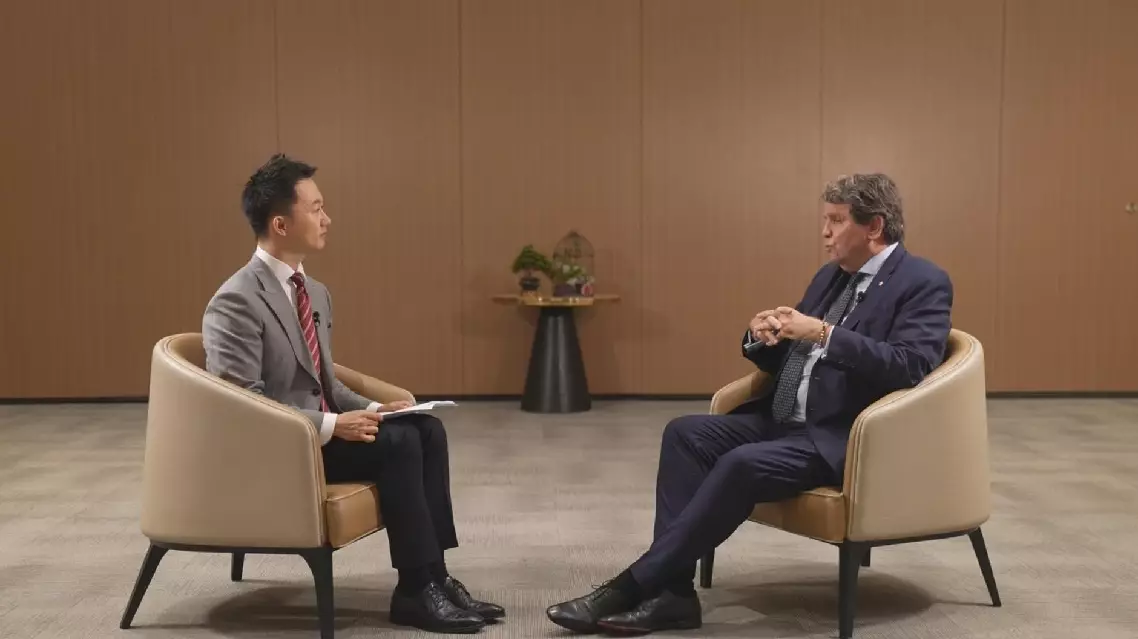
China can be an ideal partner for Europe amid global uncertainty, according to French Senator Thierry Meignen, who also stressed the need for greater cooperation in order to address the pressing issue of climate change.

Meignen was speaking in an exclusive interview with the China Global Television Network (CGTN) in Beijing ahead of the visit of French President Emmanuel Macron.

The French president arrived in the Chinese capital on Wednesday to begin a three-day state visit at the invitation of Chinese President Xi Jinping. It is Macron's fourth state visit to China and a reciprocal visit following President Xi's historic trip to France last year, which came as the two sides marked the 60th anniversary of the establishment of bilateral diplomatic relations.

Meignen stressed that European countries are facing up to a series of shocks and internal divisions, and urgently needs to find reliable new partners.

"Europe is currently facing considerable challenges. It is experiencing an influx of immigrants, leading to some resistance from Eastern European countries towards what is happening in Western Europe. So, what kind of Europe are we talking about today? Europe lacks unity on certain issues, which weakens it. Europe urgently needs partners. We have seen that the U.S. defense umbrella is no longer as effective as it used to be. Europe needs to find new partners and shared ideals so that major countries can reach consensus on a number of issues. In these uncertain times, this is precisely what Europe lacks. Europe needs partners more than ever before," he said, adding that "China can be an ideal partner for Europe."

Meignen also highlighted the importance of climate cooperation and called on governments to take steps to resolutely address climate change, as the 30th UN Climate Change Conference (COP30), which ran from Nov 10 to 21 in Belem, Brazil, demonstrated that transnational climate cooperation is progressing slowly and faces resistance.

"Of course, governments must resolutely address climate change. But we clearly see how complex it is to manage climate change and its key stakeholders. The recent UN Climate Change Conference (COP) in Brazil struggled to offer new ideas. Our progress in this area is slow due to headwinds. There is a discrepancy between what we want to do, what we hope to be able to do, and what we should do. Furthermore, economic constraints underlie all of this, meaning we cannot always make the right decisions—and this often harms the interests of developing countries. Developing countries are more affected by climate change than developed countries, yet they lack the capacity to implement measures that reduce greenhouse gas emissions, take the right steps, and ensure the planet's long-term survival," he said.
China can be ideal partner for Europe in various fields: French Senator

China can be ideal partner for Europe in various fields: French Senator
International figures have strongly criticized recent statements made by Japanese Prime Minister Sanae Takaichi, calling them a blatant violation of international law and an unacceptable interference in China's internal affairs.

At a Diet meeting on Nov 7, Takaichi claimed that the Chinese mainland's "use of force on Taiwan" could constitute a "survival-threatening situation" for Japan and implied the possibility of armed intervention in the Taiwan Strait.

The remarks, which challenge China's sovereignty, have drawn sharp rebuke from observers across the globe, who warn such actions threaten regional stability.

Ruben Guzzetti, director of the Argentine Institute of Geopolitical Studies, said that "a substantial body of prior documentation establishes that Takaichi's statements constitute undue interference in China's internal affairs and a violation of its sovereignty. This is now clear, and it represents a very significant threat to international peace."

Echoing this sentiment, David Monyae, director of the Center for Africa-China Studies at the University of Johannesburg, South Africa, contextualized the issue within historical memory.

"Given the history, the fascism and the damage that Japan caused, not just in China but the whole of Asia and the world during the Second World War, with all those atrocities, what we want is that Japan starts to recognize and starts stating clearly all the atrocities that it caused and to show a sign that it is reversing and it is not going to do what it did in the past. I think for Japan to bring back an imperialistic colonial mentality, it's something that is unacceptable," he said firmly.

The criticism also came from political figures. Tshilidzi Bethuel Munyai, a member of the National Assembly of South Africa, condemned the Japanese leader's statements as "reckless, absurd, and an act of transgression, blatantly undermining the deployed diplomatic achievements between the two countries."

"It erodes the foundation of political trust between China and Japan. It signals very reckless right-wing forces within Japan and the broader international community. By the way, China has firm resolve to safeguard the national sovereignty and as well as territorial integrity," said Munyai.

Amidst this international backlash, experts assert that China's demand for a retraction of Takaichi's remarks is fully justified. The consensus among critics is clear: such provocations undermine the foundations of international law and bilateral relations, and must be withdrawn to prevent further escalation.

Int'l voices condemn Japanese PM's remarks as unacceptable violation of China's sovereignty

Int'l voices condemn Japanese PM's remarks as unacceptable violation of China's sovereignty

Recommended Articles