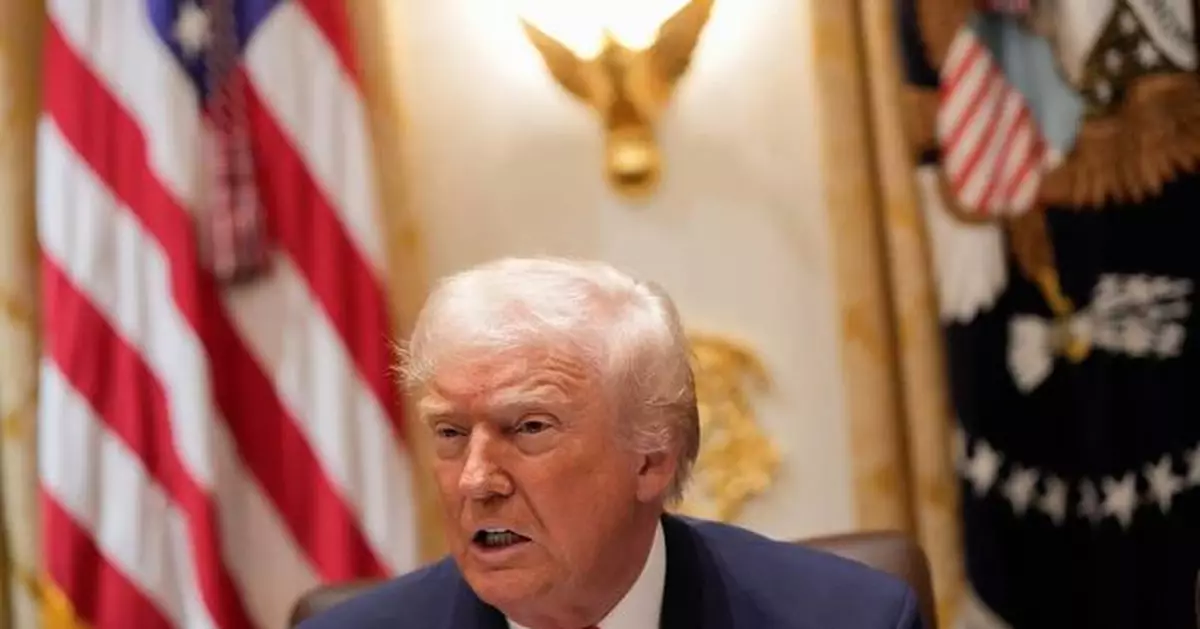
Skip to Content Facebook Feature Image

Trump ventures deeper into anti-immigrant language by calling people from Somalia 'garbage'

News

Trump ventures deeper into anti-immigrant language by calling people from Somalia 'garbage'
News

News

Trump ventures deeper into anti-immigrant language by calling people from Somalia 'garbage'

2025-12-05 16:18 Last Updated At:16:30

He said it four times in seven seconds: Somali immigrants in the United States are “garbage.”

It was no mistake. In fact, President Donald Trump’s rhetorical attacks on immigrants have been building since he said Mexico was sending “rapists” across the border during his presidential campaign announcement a decade ago. He's also echoed rhetoric once used by Adolf Hitler and called the 54 nations of Africa “s—-hole countries.” But with one flourish closing a two-hour Cabinet meeting Tuesday, Trump amped up his anti-immigrant rhetoric even further and ditched any claim that his administration was only seeking to remove people in the U.S. illegally.

More Images
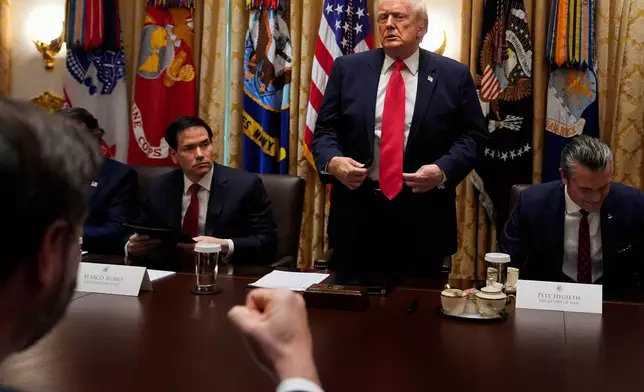
Vice President JD Vance pumps his fist as President Donald Trump stands up following a Cabinet meeting at the White House, Tuesday, Dec. 2, 2025, in Washington. With the President are Secretary of State Marco Rubio, seated left, and Defense Secretary Pete Hegseth, seated right. (AP Photo/Julia Demaree Nikhinson)
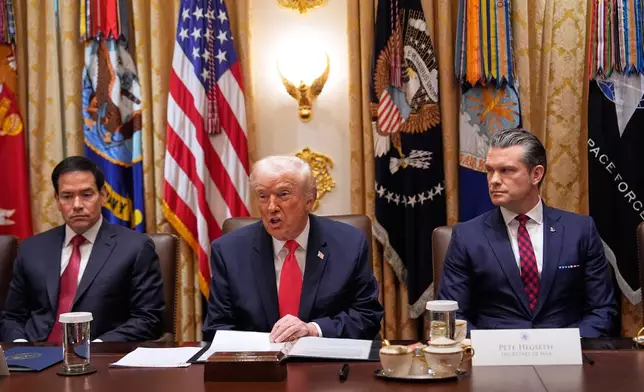
Vice President JD Vance pumps his fist as President Donald Trump stands up following a Cabinet meeting at the White House, Tuesday, Dec. 2, 2025, in Washington. With the President are Secretary of State Marco Rubio, seated left, and Defense Secretary Pete Hegseth, seated right. (AP Photo/Julia Demaree Nikhinson)

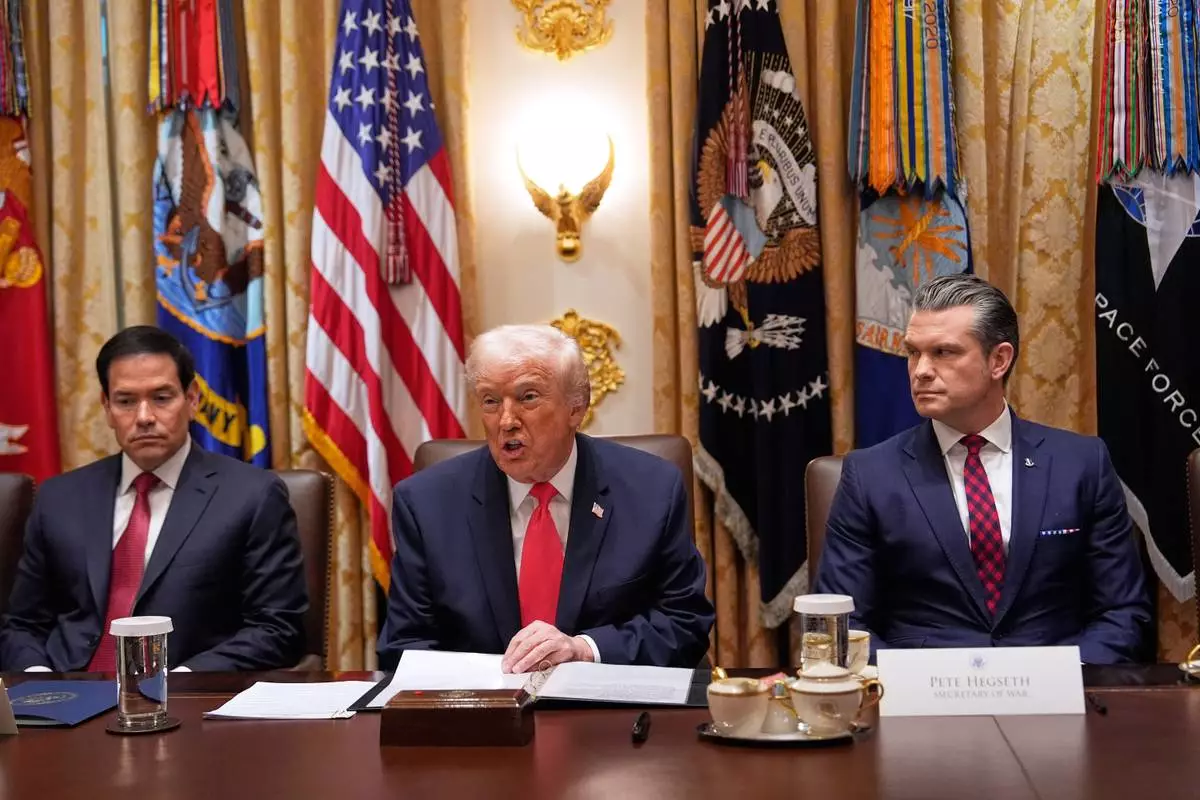
President Donald Trump speaks during a Cabinet meeting at the White House, Tuesday, Dec. 2, 2025, in Washington, as Secretary of State Marco Rubio, left, and Defense Secretary Pete Hegseth, right, look on. (AP Photo/Julia Demaree Nikhinson)
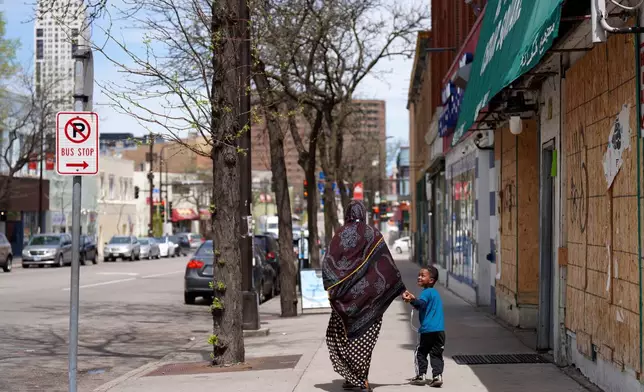
President Donald Trump speaks during a Cabinet meeting at the White House, Tuesday, Dec. 2, 2025, in Washington, as Secretary of State Marco Rubio, left, and Defense Secretary Pete Hegseth, right, look on. (AP Photo/Julia Demaree Nikhinson)

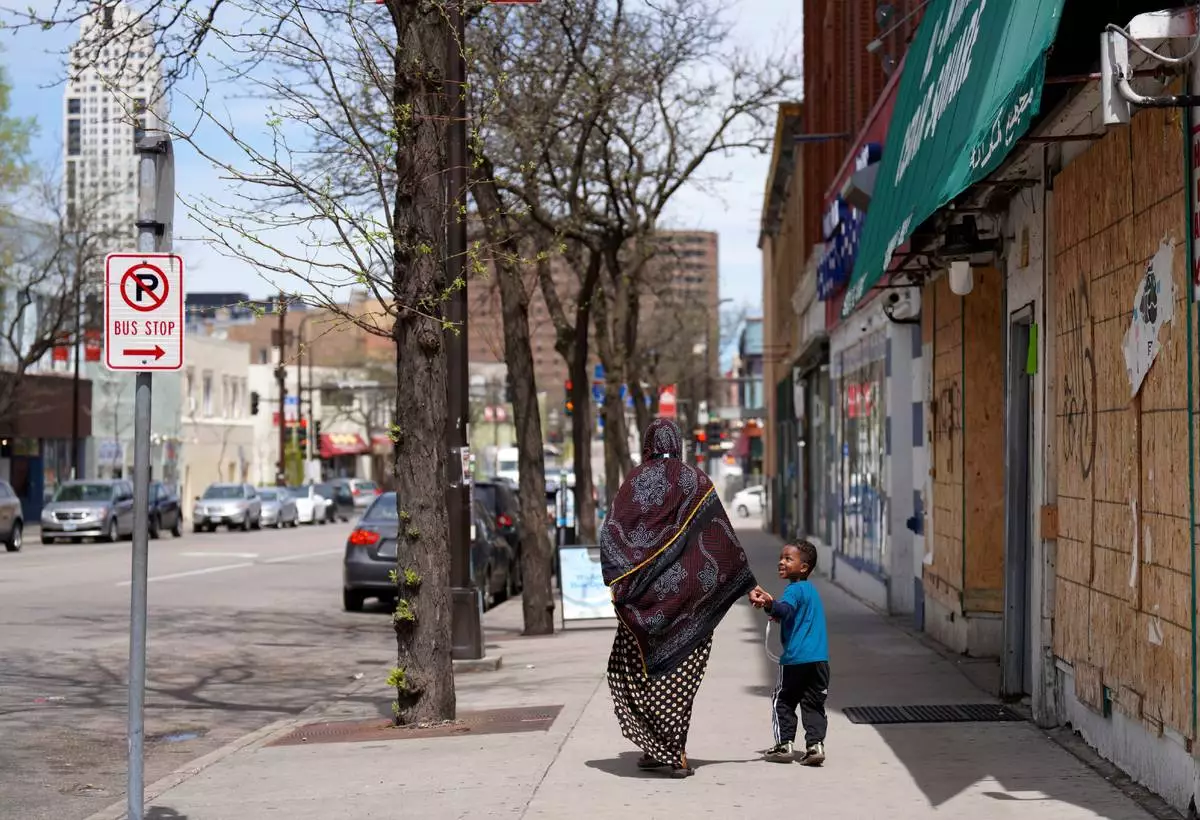
FILE - A woman and a child hold hands as they walk down a street in the predominantly Somali neighborhood of Cedar-Riverside in Minneapolis on Thursday, May 12, 2022. (AP Photo/Jessie Wardarski, File)
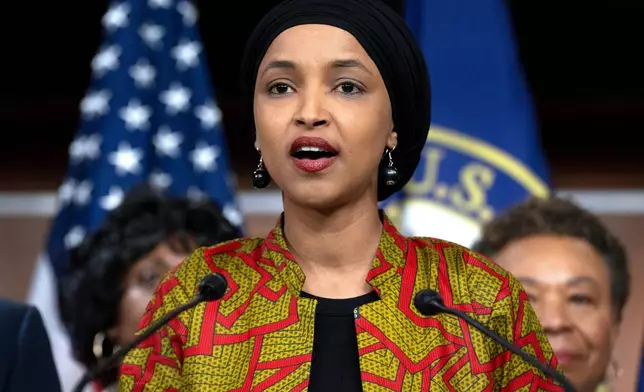
FILE - A woman and a child hold hands as they walk down a street in the predominantly Somali neighborhood of Cedar-Riverside in Minneapolis on Thursday, May 12, 2022. (AP Photo/Jessie Wardarski, File)

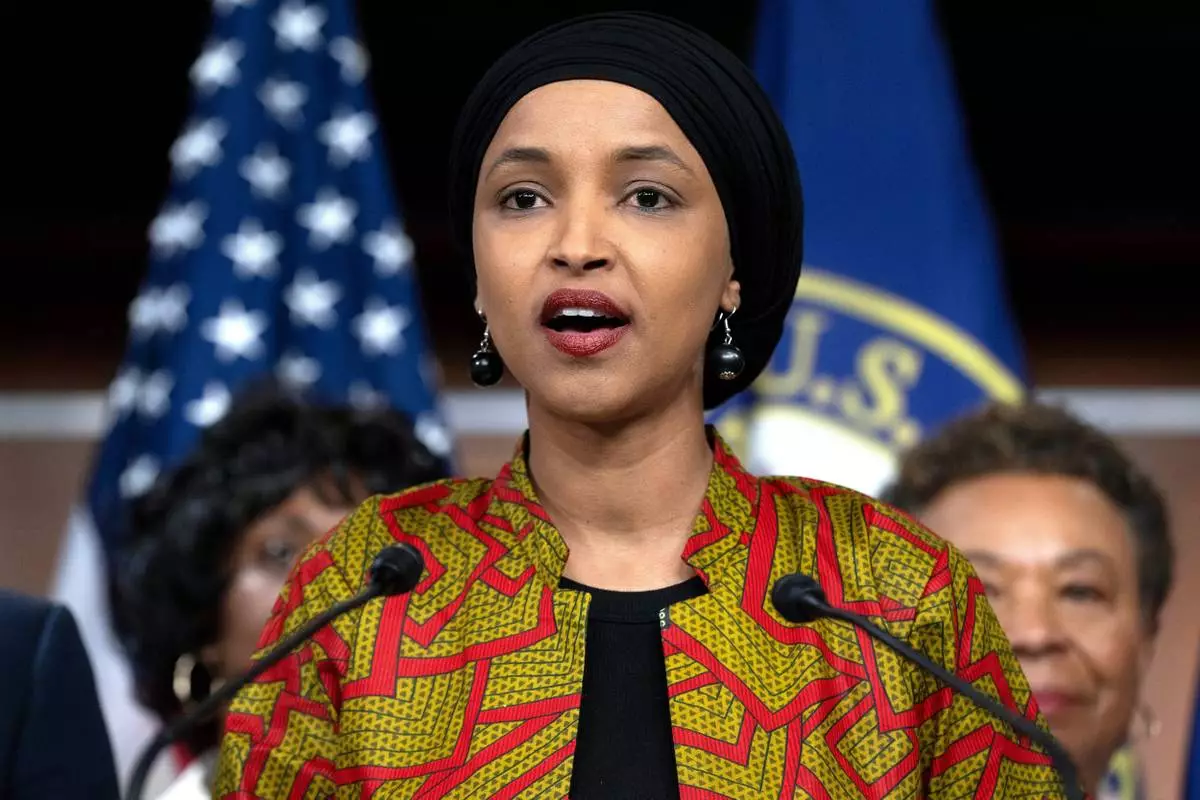
FILE - Rep. Ilhan Omar, D-Minn., speaks during a news conference, May 24, 2023, on Capitol Hill in Washington. (AP Photo/Jacquelyn Martin, File)
FILE - Rep. Ilhan Omar, D-Minn., speaks during a news conference, May 24, 2023, on Capitol Hill in Washington. (AP Photo/Jacquelyn Martin, File)

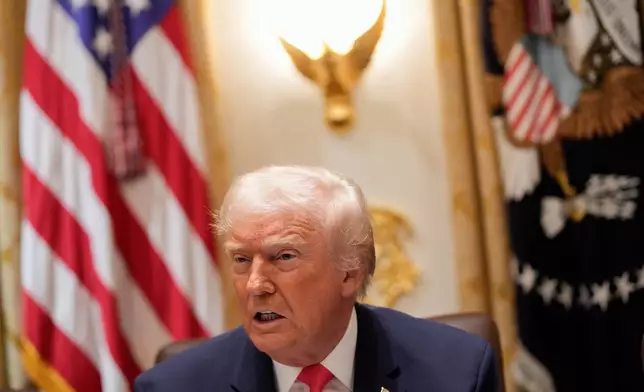
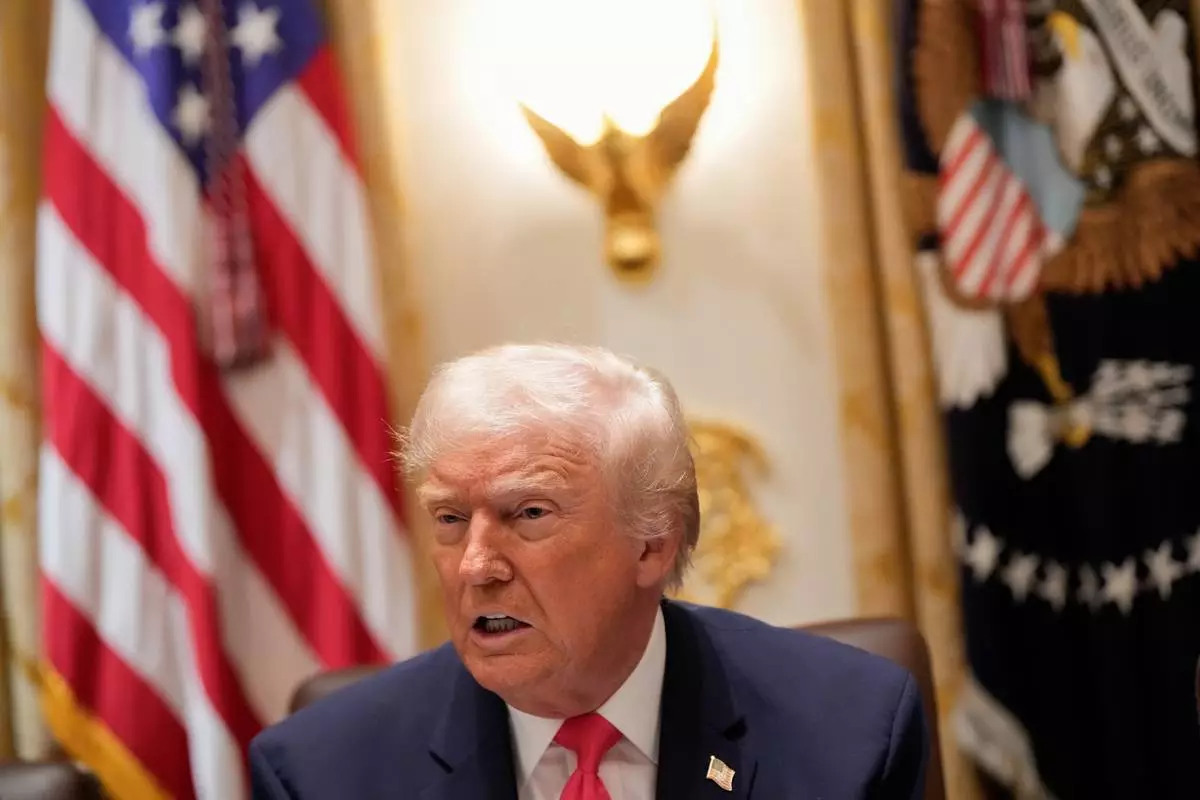
President Donald Trump speaks during a Cabinet meeting at the White House, Tuesday, Dec. 2, 2025, in Washington. (AP Photo/Julia Demaree Nikhinson)

President Donald Trump speaks during a Cabinet meeting at the White House, Tuesday, Dec. 2, 2025, in Washington. (AP Photo/Julia Demaree Nikhinson)

“We don't want ‘em in our country,” Trump said five times of the nation's 260,000 people of Somali descent. “Let ’em go back to where they came from and fix it.” The assembled Cabinet members cheered and applauded. Vice President JD Vance could be seen pumping a fist. Defense Secretary Pete Hegseth, sitting to the president's immediate left, told Trump on-camera, “Well said.”

The two-minute finale offered a riveting display in a nation that prides itself as being founded and enriched by immigrants, alongside an ugly history of enslaving millions of them and limiting who can come in. Trump's U.S. Immigration and Customs Enforcement raids and deportations have reignited an age-old debate — and widened the nation's divisions — over who can be an American, with Trump telling tens of thousands of American citizens, among others, that he doesn’t want them by virtue of their family origin.

“What he has done is brought this type of language more into the everyday conversation, more into the main,” said Carl Bon Tempo, a State University of New York at Albany history professor. “He’s, in a way, legitimated this type of language that, for many Americans for a long time, was seen as outside the bounds.”

Some Americans have long felt that people from certain parts of the world can never really blend in. That outsider-averse sentiment has manifested during difficult periods, such as anti-Chinese fear-mongering in the late 19th century and the imprisonment of some 120,000 Japanese Americans during World War II.

Trump, reelected with more than 77 million votes last year, has launched a whole-of-government drive to limit immigration. His order to end birthright citizenship — declaring that children born to parents who are in the United States illegally or temporarily are not American citizens despite the 14th Amendment — is being considered by the Supreme Court. He has largely frozen the country's asylum system and drastically reduced the number of refugees it is allowed to admit. And his administration this week halted immigration applications for migrants from 19 travel-ban nations.

Immigration remains a signature issue for Trump, and he has slightly higher marks on it than on his overall job approval. According to a November AP-NORC poll, roughly 4 in 10 adults — 42% — approved of how the president is handling the issue, down from about half who approved in March. And Trump has pushed his agenda with near-daily crackdowns. On Wednesday, federal agents launched an immigration sweep in New Orleans,

There are some clues that Trump uses stronger anti-immigration rhetoric than many members of his own party. A study of 200,000 speeches in Congress and 5,000 presidential communications related to immigration between 1880 and 2020 found that the “most influential” words on the subject were terms like “enforce,” “terrorism” and “policy” from 1973 through Trump’s first presidential term.

The authors wrote in the Proceedings of the National Academy of Sciences that Trump is “the first president in modern American history to express sentiment toward immigration that is more negative than the average member of his own party.” And that was before he called thousands of Somalis in the U.S. “garbage.”

The U.S. president, embattled over other developments during the Cabinet meeting and discussions between Russian President Vladimir Putin and U.S. envoys, opted for harsh talk in his jam-packed closing.

Somali Americans, he said, “come from hell” and “contribute nothing.” They do “nothing but bitch” and “their country stinks.” Then Trump turned to a familiar target. Rep. Ilhan Omar, D-Minn., an outspoken and frequent Trump critic, “is garbage," he said. "Her friends are garbage.”

His remarks on Somalia drew shock and condemnation from Minneapolis to Mogadishu.

“My view of the U.S. and living there has changed dramatically. I never thought a president, especially in his second term, would speak so harshly,” Ibrahim Hassan Hajji, a resident of Somalia's capital city, told The Associated Press. “Because of this, I have no plans to travel to the U.S.”

Omar called Trump's “obsession” with her and Somali-Americans “creepy and unhealthy.”

“We are not, and I am not, someone to be intimidated,” she said, “and we are not gonna be scapegoated.”

But from the highest pulpit in the world's biggest economy, Trump has had an undeniable influence on how people regard immigrants.

“Trump specializes in pushing the boundaries of what others have done before,” said César Cuauhtémoc García Hernández, a civil rights law professor at Ohio State University. “He is far from the first politician to embrace race-baiting xenophobia. But as president of the United States, he has more impact than most.” Domestically, Trump has “remarkable loyalty” among Republicans, he added. “Internationally, he embodies an aspiration for like-minded politicians and intellectuals.”

In Britain, attitudes toward migrants have hardened in the decade since Brexit, a vote driven in part by hostility toward immigrants from Eastern Europe. Nigel Farage, leader of the hard-right Reform U.K. party, has called unauthorized migration an “invasion” and warned of looming civil disorder.

France’s Marine Le Pen and her father built their political empire on anti-immigrant language decades before Trump entered politics. But the National Rally party has softened its rhetoric to win broader support. Le Pen often casts the issue as an administrative or policy matter.

In fact, what Trump said about people from Somalia would likely be illegal in France if uttered by anyone other than a head of state, because public insults based on a group's national origin, ethnicity, race or religion are illegal under the country's hate speech laws. But French law grants heads of state immunity.

One lawyer expressed concerns that Trump’s words will encourage other heads of state to use similar hate speech targeting people as groups.

“Comments saying that a population stinks — coming from a foreign head of state, a top world military and economic power — that’s never happened before,” said Paris lawyer Arié Alimi, who has worked on hate speech cases. “So here we are really crossing a very, very, very important threshold in terms of expressing racist … comments.”

But the “America first” president said he isn’t worried about others think of his increasingly polarizing rhetoric on immigration.

“I hear somebody say, ‘Oh, that’s not politically correct,’” Trump said, winding up his summation Tuesday. “I don’t care. I don’t want them.”

Contributing to this report are Associated Press writers Will Weissert and Linley Sanders in Washington, John Leicester in Paris, Jill Lawless in London, Evelyne Musambi in Nairobi, Kenya, and Omar Faruk in Mogadishu.
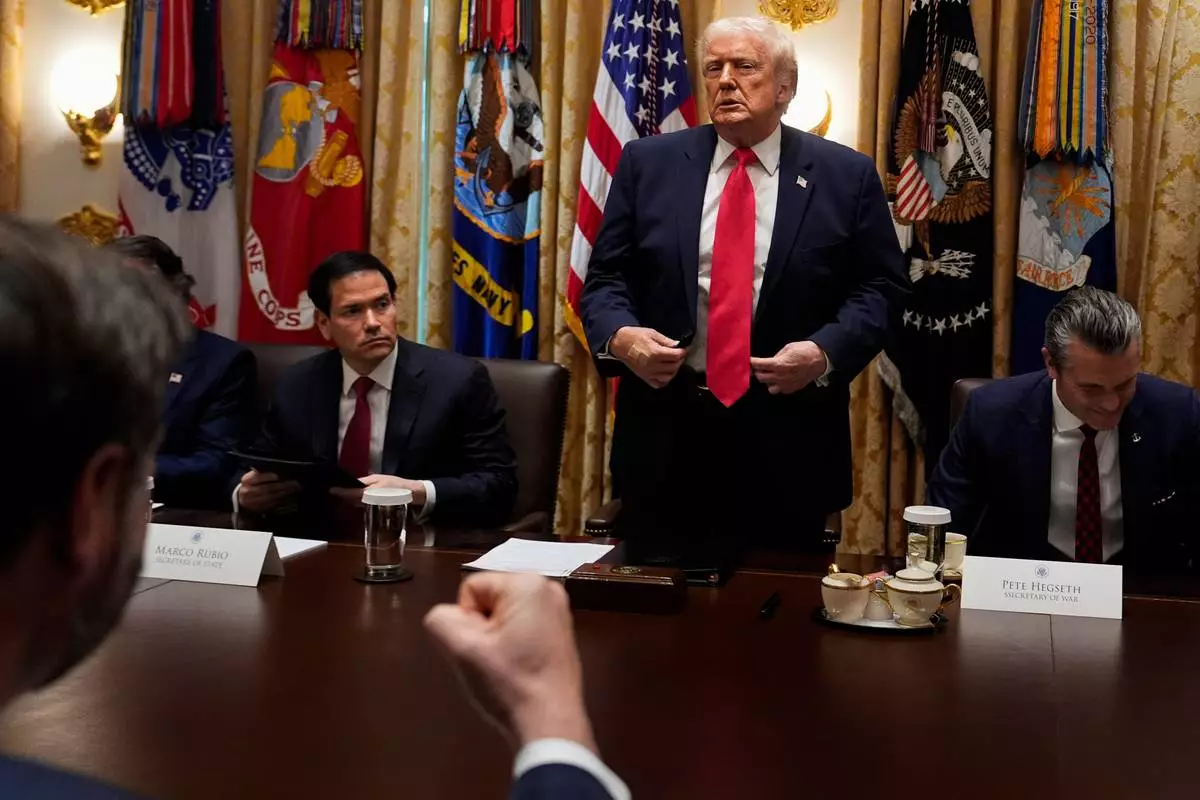
Vice President JD Vance pumps his fist as President Donald Trump stands up following a Cabinet meeting at the White House, Tuesday, Dec. 2, 2025, in Washington. With the President are Secretary of State Marco Rubio, seated left, and Defense Secretary Pete Hegseth, seated right. (AP Photo/Julia Demaree Nikhinson)
Vice President JD Vance pumps his fist as President Donald Trump stands up following a Cabinet meeting at the White House, Tuesday, Dec. 2, 2025, in Washington. With the President are Secretary of State Marco Rubio, seated left, and Defense Secretary Pete Hegseth, seated right. (AP Photo/Julia Demaree Nikhinson)

President Donald Trump speaks during a Cabinet meeting at the White House, Tuesday, Dec. 2, 2025, in Washington, as Secretary of State Marco Rubio, left, and Defense Secretary Pete Hegseth, right, look on. (AP Photo/Julia Demaree Nikhinson)
President Donald Trump speaks during a Cabinet meeting at the White House, Tuesday, Dec. 2, 2025, in Washington, as Secretary of State Marco Rubio, left, and Defense Secretary Pete Hegseth, right, look on. (AP Photo/Julia Demaree Nikhinson)

FILE - A woman and a child hold hands as they walk down a street in the predominantly Somali neighborhood of Cedar-Riverside in Minneapolis on Thursday, May 12, 2022. (AP Photo/Jessie Wardarski, File)
FILE - A woman and a child hold hands as they walk down a street in the predominantly Somali neighborhood of Cedar-Riverside in Minneapolis on Thursday, May 12, 2022. (AP Photo/Jessie Wardarski, File)

FILE - Rep. Ilhan Omar, D-Minn., speaks during a news conference, May 24, 2023, on Capitol Hill in Washington. (AP Photo/Jacquelyn Martin, File)
FILE - Rep. Ilhan Omar, D-Minn., speaks during a news conference, May 24, 2023, on Capitol Hill in Washington. (AP Photo/Jacquelyn Martin, File)

President Donald Trump speaks during a Cabinet meeting at the White House, Tuesday, Dec. 2, 2025, in Washington. (AP Photo/Julia Demaree Nikhinson)

President Donald Trump speaks during a Cabinet meeting at the White House, Tuesday, Dec. 2, 2025, in Washington. (AP Photo/Julia Demaree Nikhinson)
NEW DELHI (AP) — Russian President Vladimir Putin is set to hold talks with Indian Prime Minister Narendra Modi on Friday at an annual summit aimed at expanding defense and trade ties, as the United States presses New Delhi to revise its decades-old partnership with Moscow.

The 23rd Russia-India Summit comes at a pivotal moment as the United States pushes for a Ukraine peace deal while seeking global cooperation. It will test New Delhi’s efforts to balance relations with Moscow and Washington as the nearly four-year war in Ukraine grinds on.

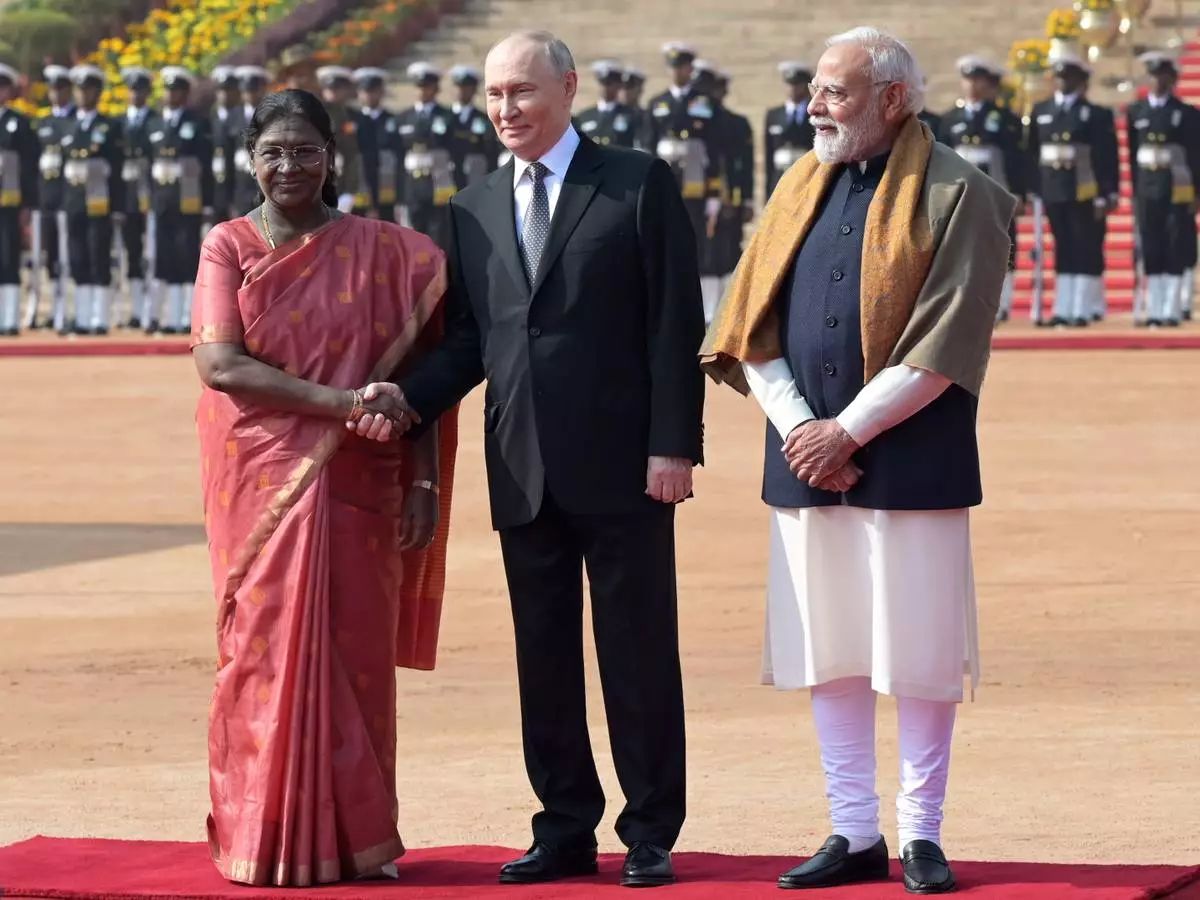
Putin was received by Modi at an airport in New Delhi on Thursday, who gave the visiting leader a bear hug and a tight handshake with the gusto of an old friend.

According to Indian officials involved in the preparation for the summit, the agenda includes talks on defense, energy and labor mobility.

In his opening remarks before the summit talks, Putin said he informed Modi about the war in Ukraine and U.S.-led peace effort. He thanked Modi for his attention to the war and “efforts directed at resolving the situation” while hailing Russia’s ties with India as historic and profound.

The Russian leader said the two countries have made significant progress in recent years with growth in their economies leading to expansion of cooperation in technology, aviation, space, and artificial intelligence.

“We have a very trusting relationship when it comes to military-technical cooperation. We intend to move forward in all these areas,” Putin added.

Modi, for his part, called for an expansion of India-Russia financial relations. “I hope we will take our meeting forward with such positive outcomes,” he said.

Modi emphasized the need for a “roadmap for peace” and said he hoped the world will soon be free from ongoing tensions.

“India is not neutral. India takes the side of peace. We support all efforts for peace. We stand shoulder to shoulder with respect to peace,” he added.

While India has historically maintained deep ties with Russia, critics say Putin’s visit could strain relations with the European Union and the United States and might jeopardize negotiations for major trade agreements with both that are seen as critical for India’s exports.

U.S. President Donald Trump raised tariffs on Indian goods to 50% in August, citing New Delhi's discounted Russian oil. India has been the second biggest importer of Russian crude after China.

The U.S. says purchases of Russian oil help finance Moscow’s war machine. In October, the U.S. sanctioned two of Moscow’s biggest oil producers to force countries like India to cut down on imports. Indian officials have said New Delhi has always abided by international sanctions and would do so in the case of Russia oil purchases as well.

India and the U.S. set a target for the first tranche of a trade deal by the fall, but the deal hasn’t come through yet amid strains in relations.

India is also in the final stages of talks on a trade agreement with the EU, which sees Russia's war in Ukraine as a major threat.

Putin’s India visit, “given the timing and geopolitical context, underscores New Delhi’s strategic tightrope walk between the West and the rest, chiefly Russia,” said Praveen Donthi, a senior analyst with the International Crisis Group.

Donthi said India’s tilt toward Russia dates back to the Cold War and persists despite its official nonaligned position. “The significant change now is its desire to be a strategic partner with the U.S. at the same time, which will be a diplomatic challenge,” he added.

In his meeting with Putin, Modi is likely to push for faster delivery of two further Russian S-400 surface-to-air missile systems. It has already received three under a 2018 deal worth about $5.4 billion. The delay has been tied to supply chain disruptions linked to the war in Ukraine.

The two sides signed a pact in February to improve military cooperation, exercises, port calls, disaster relief assistance and logistics support. Moscow’s State Duma ratified the same ahead of Putin’s India visit.

Talks are also expected on upgrading India’s Russian-made Su-30MKI fighter jets and accelerating deliveries of critical military hardware.

Trade is also expected to be a major point in talks.

Bilateral trade between the two countries stood at $68.7 billion in the last fiscal year ended March, and the aim is to boost it to $100 billion by 2030. The trade is heavily skewed in favor of Russia with deep deficits for India, which it is looking to bridge by pushing exports.

India is keen to increase exports of pharmaceuticals, agriculture and textiles to Russia and is seeking the removal of non-tariff barriers. New Delhi is also seeking long-term supplies of fertilizers from Moscow.

Another key area where the two countries are expected to finalize an agreement is the safety and regulation of migration of Indian skilled workers to Russia.

Putin last visited India in 2021. Modi was in Moscow last year, and the two leaders briefly met in September in China during a Shanghai Cooperation Organization summit.

Hussain reported from Srinagar, India.

Russian President Vladimir Putin receives a guard of honor during a ceremonial reception at the Rashtrapati Bhavan in New Delhi, India, Friday, Dec. 5, 2025. (AP Photo)

Russian President Vladimir Putin receives a guard of honor during a ceremonial reception at the Rashtrapati Bhavan in New Delhi, India, Friday, Dec. 5, 2025. (AP Photo)

Russian President Vladimir Putin, left, and Indian Prime Minister Narendra Modi pose for a photo prior to their talks in New Delhi, India, Friday, Dec. 5, 2025. (Mikhail Tereshchenko, Sputnik, Kremlin Pool Photo via AP)

Russian President Vladimir Putin, left, and Indian Prime Minister Narendra Modi pose for a photo prior to their talks in New Delhi, India, Friday, Dec. 5, 2025. (Mikhail Tereshchenko, Sputnik, Kremlin Pool Photo via AP)

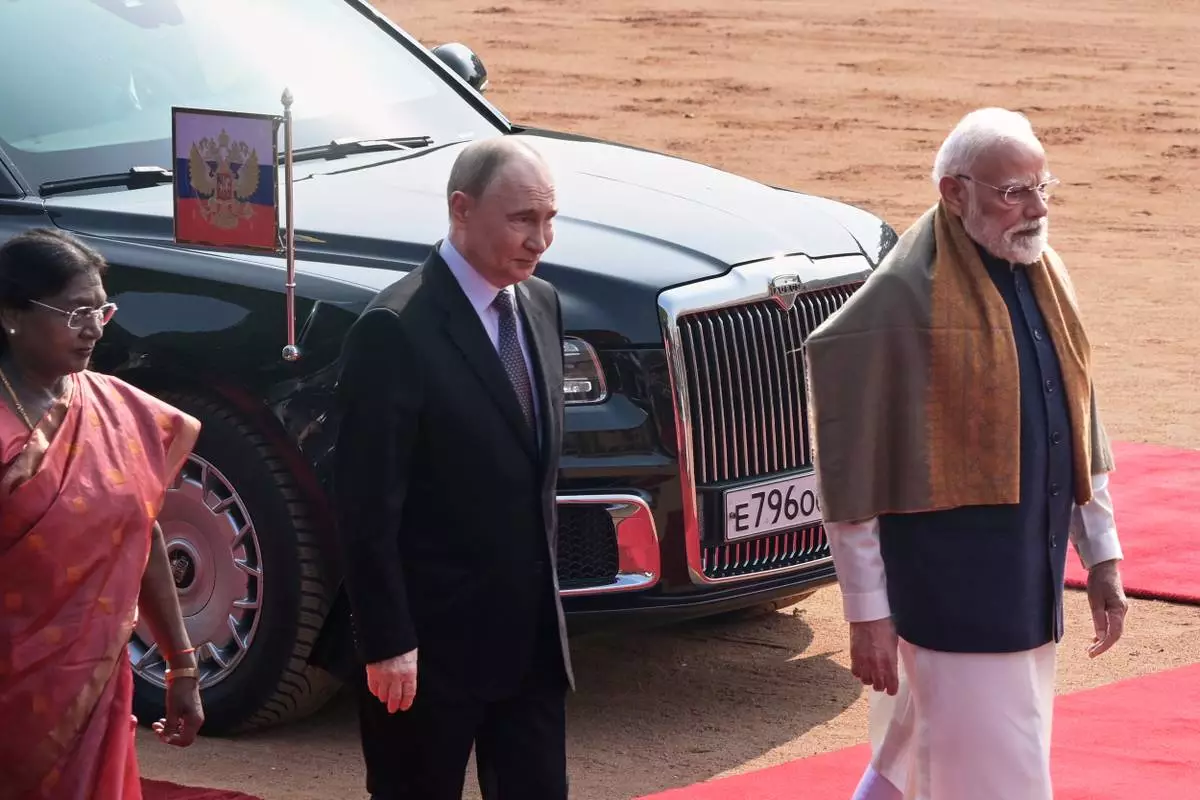
Russian President Vladimir Putin, center, walks along with Indian President Droupadi Murmu, left, and Indian Prime Minister Narendra Modi during a ceremonial reception at the Rashtrapati Bhavan in New Delhi, India, Friday, Dec. 5, 2025. (AP Photo)

Russian President Vladimir Putin, center, walks along with Indian President Droupadi Murmu, left, and Indian Prime Minister Narendra Modi during a ceremonial reception at the Rashtrapati Bhavan in New Delhi, India, Friday, Dec. 5, 2025. (AP Photo)

Russian President Vladimir Putin, left, and Indian Prime Minister Narendra Modi pose for a photo prior to their talks in New Delhi, India, Friday, Dec. 5, 2025. (Mikhail Tereshchenko, Sputnik, Kremlin Pool Photo via AP)

Russian President Vladimir Putin, left, and Indian Prime Minister Narendra Modi pose for a photo prior to their talks in New Delhi, India, Friday, Dec. 5, 2025. (Mikhail Tereshchenko, Sputnik, Kremlin Pool Photo via AP)

Russian President Vladimir Putin, center, shakes hands with Indian President Droupadi Murmu as Indian Prime Minister Narendra Modi, right, looks on during a ceremonial reception at the Rashtrapati Bhavan in New Delhi, India, Friday, Dec. 5, 2025. (AP Photo)

Russian President Vladimir Putin, center, shakes hands with Indian President Droupadi Murmu as Indian Prime Minister Narendra Modi, right, looks on during a ceremonial reception at the Rashtrapati Bhavan in New Delhi, India, Friday, Dec. 5, 2025. (AP Photo)

Russian President Vladimir Putin, center, poses for a photograph with Indian Prime Minister Narendra Modi, right, and Indian President Droupadi Murmu during a ceremonial reception at the Rashtrapati Bhavan in New Delhi, India, Friday, Dec. 5, 2025. (AP Photo)

Russian President Vladimir Putin, center, poses for a photograph with Indian Prime Minister Narendra Modi, right, and Indian President Droupadi Murmu during a ceremonial reception at the Rashtrapati Bhavan in New Delhi, India, Friday, Dec. 5, 2025. (AP Photo)

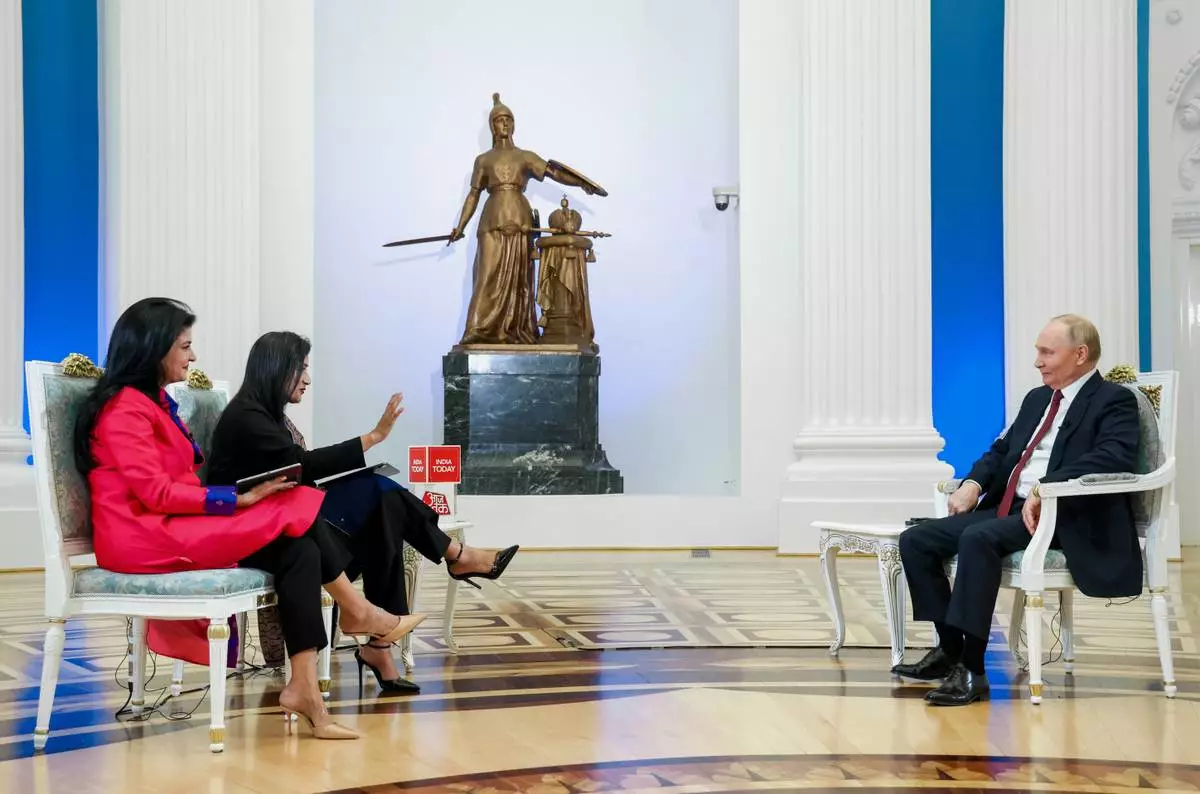
Russian President Vladimir Putin gestures during an interview with journalists and executives of Aaj Tak and India Today TV channels at the Kremlin in Moscow, Russia, Wednesday, Dec. 3, 2025. (Vyacheslav Prokofyev/Sputnik, Kremlin Pool Photo via AP)

Russian President Vladimir Putin gestures during an interview with journalists and executives of Aaj Tak and India Today TV channels at the Kremlin in Moscow, Russia, Wednesday, Dec. 3, 2025. (Vyacheslav Prokofyev/Sputnik, Kremlin Pool Photo via AP)

Russian President Vladimir Putin, right, speaks during an interview with journalists and executives of Aaj Tak and India Today TV channels at the Kremlin in Moscow, Russia, Wednesday, Dec. 3, 2025. (Vyacheslav Prokofyev/Sputnik, Kremlin Pool Photo via AP)

Russian President Vladimir Putin, right, speaks during an interview with journalists and executives of Aaj Tak and India Today TV channels at the Kremlin in Moscow, Russia, Wednesday, Dec. 3, 2025. (Vyacheslav Prokofyev/Sputnik, Kremlin Pool Photo via AP)

Russian President Vladimir Putin, left, and Indian Prime Minister Narendra Modi sit inside a limousine as they arrive at the Indian Prime Minister office in New Delhi, India, on Thursday, Dec. 4, 2025. (Alexander Kazakov, Sputnik, Kremlin Pool Photo via AP)

Russian President Vladimir Putin, left, and Indian Prime Minister Narendra Modi sit inside a limousine as they arrive at the Indian Prime Minister office in New Delhi, India, on Thursday, Dec. 4, 2025. (Alexander Kazakov, Sputnik, Kremlin Pool Photo via AP)

Recommended Articles