The United States could hardly have asked for a better draw at the 2026 World Cup.
The co-host should expect to stick around at its own party until at least the round of 32 after being grouped with Paraguay, Australia and the winner of a European playoff between Turkey, Slovakia, Kosovo and Romania in Friday's draw, attended by President Donald Trump in Washington.
Click to Gallery
U.S. team coach Mauricio Pochettino arrives to attend the draw for the 2026 soccer World Cup at the Kennedy Center in Washington, Friday, Dec. 5, 2025. (AP Photo/Julia Demaree Nikhinson)
(left to right) FIFA President Gianni Infantino,President Donald Trump, Mexican President Claudia Sheinbaum and Canadian Prime Minister Mark Carney smile during the draw for the 2026 soccer World Cup at the Kennedy Center in Washington, Friday, Dec. 5, 2025. (Dan Mullan/Pool Photo via AP)
FIFA President Gianni Infantino speaks during the draw for the 2026 soccer World Cup at the Kennedy Center in Washington, Friday, Dec. 5, 2025. (AP Photo/Stephanie Scarbrough, Pool)
U.S. team coach Mauricio Pochettino attends the draw for the 2026 soccer World Cup at the Kennedy Center in Washington, Friday, Dec. 5, 2025. (Dan Mullan/Pool Photo via AP)
President Donald Trump is greeted by FIFA President Gianni Infantino during the draw for the 2026 soccer World Cup at the Kennedy Center in Washington, Friday, Dec. 5, 2025. (Jia Haocheng/Pool Photo via AP)
U.S. coach Mauricio Pochettino will take nothing for granted but with none of those nations ranked in the top 20 by FIFA it would be a major disappointment if his team failed to advance as one of the top two in Group D or via the safety net as a best-performing third-place qualifier.
Another co-host, Mexico, will also expect to progress from a group with South Africa, South Korea and one of Denmark, North Macedonia, Czech Republic or Ireland.
Third co-host Canada's group could look significantly more difficult if four-time world champion Italy qualifies via the playoffs. Canada, which has never won a point at the World Cup, also drew Qatar and Switzerland.
The relatively kind draws for the co-hosts looks like a consequence of a supersized 48-team World Cup, up from 32 teams.
With so many teams and a seeded draw, it was natural the biggest nations would be kept apart in the opening phase.
There was no obvious “group of death.”
France was drawn with Senegal, Norway and one of Bolivia, Suriname or Iraq.
England, ranked No. 4, has No. 10-ranked Croatia, Ghana and Panama.
The group phase may deliver shocks but it is hard to see the real jeopardy for the top seeded teams.
Defending champion Argentina has to navigate only Algeria, Austria and Jordan, while European champion Spain has Cape Verde, Saudi Arabia and Uruguay.
Spain coach Luis de la Fuente, however, insisted danger was all around.
“People think there are easy groups but it is a very similar level,” de la Fuente said. “This will be a historic World Cup because there’s an exceptional level all round. These games force you to play at your best.”
Morocco was one of the stories of the last World Cup by becoming the first African team to reach the semifinals. And it has the chance to make a statement in its first game next year against mighty Brazil.
Morocco coach Walid Regragui said it will be “one of the greatest matches” of the tournament.
“We want to try to win the group or at least get through to the next phase,” he told TV Globo. “Since the 2022 World Cup everyone wants to beat us.”
England vs. Croatia is a repeat of a 2018 semifinal. Croatia won on that occasion and was a semifinalist again in 2022. England is one of the title favorites next year after back-to-back European Championship finals.
There's a repeat of one of the biggest ever World Cup upsets when France takes on Senegal. Senegal stunned the then-defending champion France 1-0 in 2002.
“We know this is a very tough group, we cannot rest,” France coach Didier Deschamps said.
Tiny Curaçao and Cape Verde will share the stage with titans of international soccer.
Curaçao is the smallest nation by population ever to qualify for the World Cup and will play four-time champion Germany. Cape Verde is the third smallest to qualify and is grouped with Spain.
Scotland, at its first World Cup since 1998, faces familiar opposition in Brazil. The nations have met on four previous occasions at sport's biggest event — 1974, ‘82, ’90 and ‘98 — and Scotland didn’t win any of them.
The Scots were also grouped with Morocco in 1998 and will meet again.
Haiti completes Group C.
Lionel Messi and Cristiano Ronaldo are on course to set a new record of appearing at six World Cups.
Should Argentina and Portugal win their respective groups, the earliest the two greats could meet would be in the quarterfinals in Kansas City.
Messi ended his long wait to win the World Cup when he led Argentina to glory in 2022.
Ronaldo is still waiting to win the one major trophy that has eluded him and this is surely his last chance, given he will be 41 when the tournament kicks off.
AP soccer: https://apnews.com/hub/soccer

U.S. team coach Mauricio Pochettino arrives to attend the draw for the 2026 soccer World Cup at the Kennedy Center in Washington, Friday, Dec. 5, 2025. (AP Photo/Julia Demaree Nikhinson)

(left to right) FIFA President Gianni Infantino,President Donald Trump, Mexican President Claudia Sheinbaum and Canadian Prime Minister Mark Carney smile during the draw for the 2026 soccer World Cup at the Kennedy Center in Washington, Friday, Dec. 5, 2025. (Dan Mullan/Pool Photo via AP)

FIFA President Gianni Infantino speaks during the draw for the 2026 soccer World Cup at the Kennedy Center in Washington, Friday, Dec. 5, 2025. (AP Photo/Stephanie Scarbrough, Pool)

U.S. team coach Mauricio Pochettino attends the draw for the 2026 soccer World Cup at the Kennedy Center in Washington, Friday, Dec. 5, 2025. (Dan Mullan/Pool Photo via AP)

President Donald Trump is greeted by FIFA President Gianni Infantino during the draw for the 2026 soccer World Cup at the Kennedy Center in Washington, Friday, Dec. 5, 2025. (Jia Haocheng/Pool Photo via AP)
WASHINGTON (AP) — Outdated intelligence likely led to the United States carrying out a deadly missile strike on an elementary school in Iran that killed over 165 people, many of them children, in the opening hours of the conflict, according to a U.S. official and a second person briefed on findings of a preliminary U.S military investigation into the incident.
The bombing of the school and its casualties involving children has become a focal point of the war, and if ultimately confirmed to be at the hands of the U.S., would also stand among the highest civilian casualty events caused by the American military operations in the last two decades.
President Donald Trump initially blamed Iran for the attack, later said he wasn’t certain who was to blame, and then said he would accept the results of the Pentagon’s investigation. The issue took on added urgency on Wednesday after the New York Times first reported that a preliminary investigation found that the U.S. was responsible.
U.S. Central Command relied on target coordinates for the strike using outdated data provided by the Defense Intelligence Agency, according to the person familiar with the preliminary finding.
The agency did not respond to a request for comment.
The preliminary finding prompted immediate calls for more information from the Pentagon. White House press secretary Karoline Leavitt said that “the investigation is still ongoing.”
Both the U.S. official and the person familiar with the matter spoke to The Associated Press on the condition of anonymity to discuss the sensitive matter.
Dozens of Democratic senators demanded answers from the Trump administration on Wednesday as a growing body of evidence suggested that the U.S. was likely responsible for a strike at an elementary school in Iran that killed over 165 people, many of them children.
The letter from more than 45 senators pressed Defense Secretary Pete Hegseth on whether the U.S. was culpable for the strike and what previous analysis of the building had been done. The senators also raised concerns about the Pentagon hollowing-out a congressionally mandated office set up specifically to reduce civilian casualties.
“Under this administration, budgetary and personnel cuts at the Department have robbed military commands of crucial resources to prevent and respond to civilian casualties,” the senators wrote. Those include cuts at U.S. Central Command, whose forces are leading the military campaign against Iran, and the Civilian Protection Center of Excellence, which was signed into law in 2022 as part of a Pentagon ambition to reduce death tolls from strikes.
The revelation could threaten to erode public support in the U.S. effort against Iran at a time when Trump, who as a candidate railed against American involvement in “stupid” overseas wars, faces persistent questions about the purpose and of the conflict and what would bring it to an end.
One former Pentagon official said the Feb. 28 strike that hit Shajareh Tayyebeh Elementary School, which is located near a neighboring base for the Iranian Revolutionary Guard, came as a natural result of changes made by the Trump administration to reduce staff to mitigate civilian harm and Hegseth’s emphasis on lethality over legality.
There are several indications that the strike on the school may have been avoidable.
It happened Saturday morning, the start of the Iranian school week, when the building was full of young children. Satellite analysis by the AP shows that the school, as well as other targets struck the same day, had characteristics visible from the air that could have identified them as civilian sites before they were struck.
The AP reported last week that satellite images, expert analysis, a U.S. official and public information released by the U.S. military all suggested it was likely a U.S. strike. That evidence grew stronger on Monday, as new footage emerged showing what experts identified as a U.S.-made Tomahawk cruise missile slamming into the military compound as smoke was already rising from the area where the school was located.
Publicly available satellite imagery shows the school building was part of the military compound until about 2017, when a new wall was added to separate the two. A watchtower on the property was also removed. Around the same time, the imagery shows the walls surrounding the building were painted with murals in vibrant colors, primarily blue and pink, so bright they're visible from space
The school was clearly labeled as such in online maps and has an easily-accessible website full of information about students, teachers and administrators.
International law governing warfare bars strikes on structures, vehicles and people that are not military objectives and combatants. Civilian homes, schools, medical facilities and cultural sites are generally off limits for military strikes. The proximity of a school to a valid military target does not change its status as a civilian site, said Elise Baker, a senior staff lawyer at the Atlantic Council, a Washington-based nonprofit think tank.
If the U.S. is found responsible, said Sen. Tim Kaine during a briefing with journalists on Wednesday: “It’s either we’ve changed our traditional targeting rules or we made a mistake.”
“If we’ve changed our traditional targeting rules and we no longer provide the same level of protection for civilians, that would be tragic,” Kaine said.
Some Republicans, too, are sounding alarms.
Sen. Kevin Cramer of North Dakota told reporters that an investigation needs to “get to the bottom of it,” and then “admit if you know whose fault it is.”
If the U.S. was behind it, Cramer said, the military must “do everything you can to eliminate those mistakes going forward.”
He added: “But you also can’t undo it.”
Congress directed the Pentagon to create the Civilian Protection Center of Excellence in late 2022 as part of the wide-ranging annual defense authorization bill, which passed both chambers with broad bipartisan support. The bill said the center was to “institutionalize and advance knowledge, practices, and tools for preventing, mitigating, and responding to civilian harm.”
The measure put into law an initiative that had already been started by Defense Secretary Lloyd Austin earlier that year. The 36-step action plan was “ambitious and necessary,” Austin said at the time.
In April 2023, that office had a full-time director hired by the Army and an initial core staff of 30 civilians, according to a 2024 Pentagon report that said that the workforce was expected to grow.
Wes Bryant began working there in 2024 as the Branch Chief of Civil Harm Assessments. One of the things the office was discussing was updating the “no strike list,” he said, a series of civilian targets in other countries that the Pentagon keeps. When he was working at the Pentagon, it was well known that the list was out-of-date, he said. But under Hegseth, the office's size was slashed and the work on updating the no-strike lists stopped, he said.
“They have no budget. They're just sitting there trying to maintain any semblance of the mission,” he said.
Capt. Tim Hawkins, the spokesman for U.S. Central Command, denied reports that the military command only had a single person assigned to the mission but would not offer any further details, citing the ongoing investigation.
Frankel reported from Jerusalem. Associated Press writers Mary Clare Jalonick, Konstantin Toropin and Joey Cappelletti in Washington contributed to this report.

The arm of a deceased person is seen protruding from the rubble as rescue workers and residents search in the aftermath a strike on a girls' elementary school in Minab, Iran, Saturday, Feb. 28, 2026. (Abbas Zakeri/Mehr News Agency via AP)
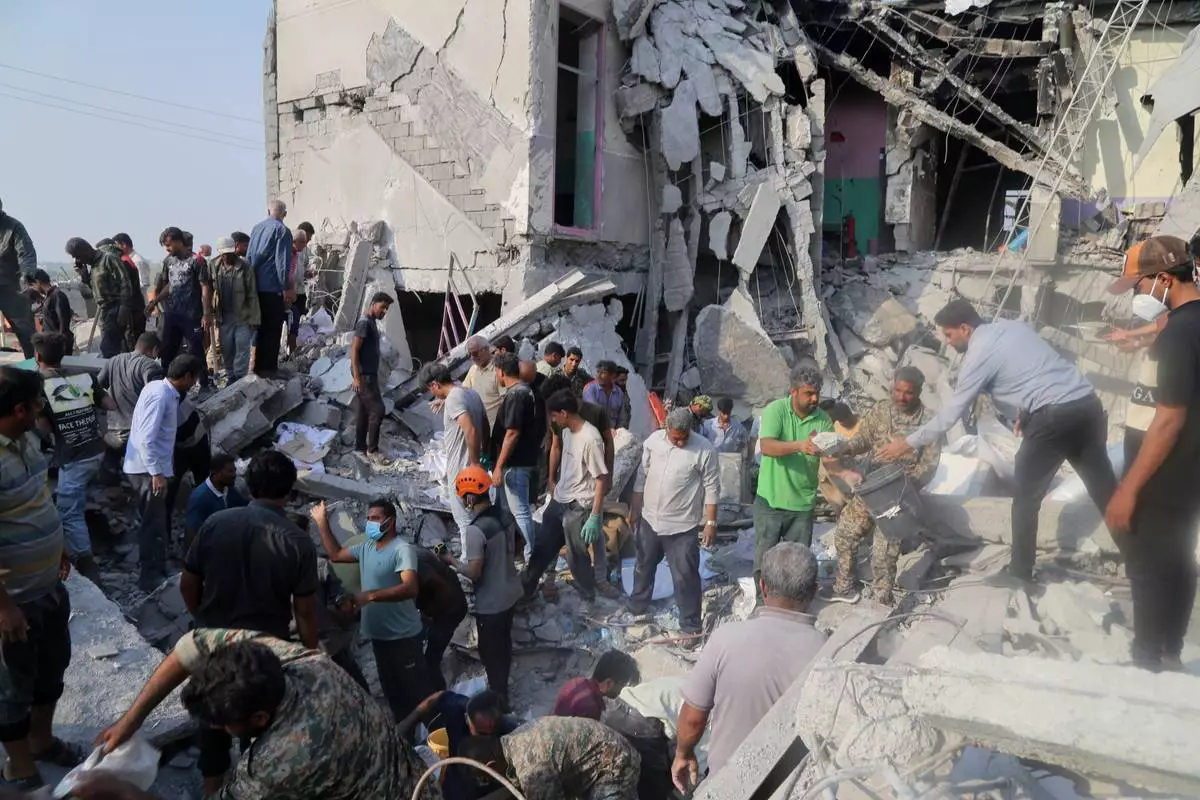
Rescue workers and residents search through the rubble in the aftermath of a strike on a girls' elementary school in Minab, Iran, Saturday, Feb. 28, 2026. (Abbas Zakeri/Mehr News Agency via AP)
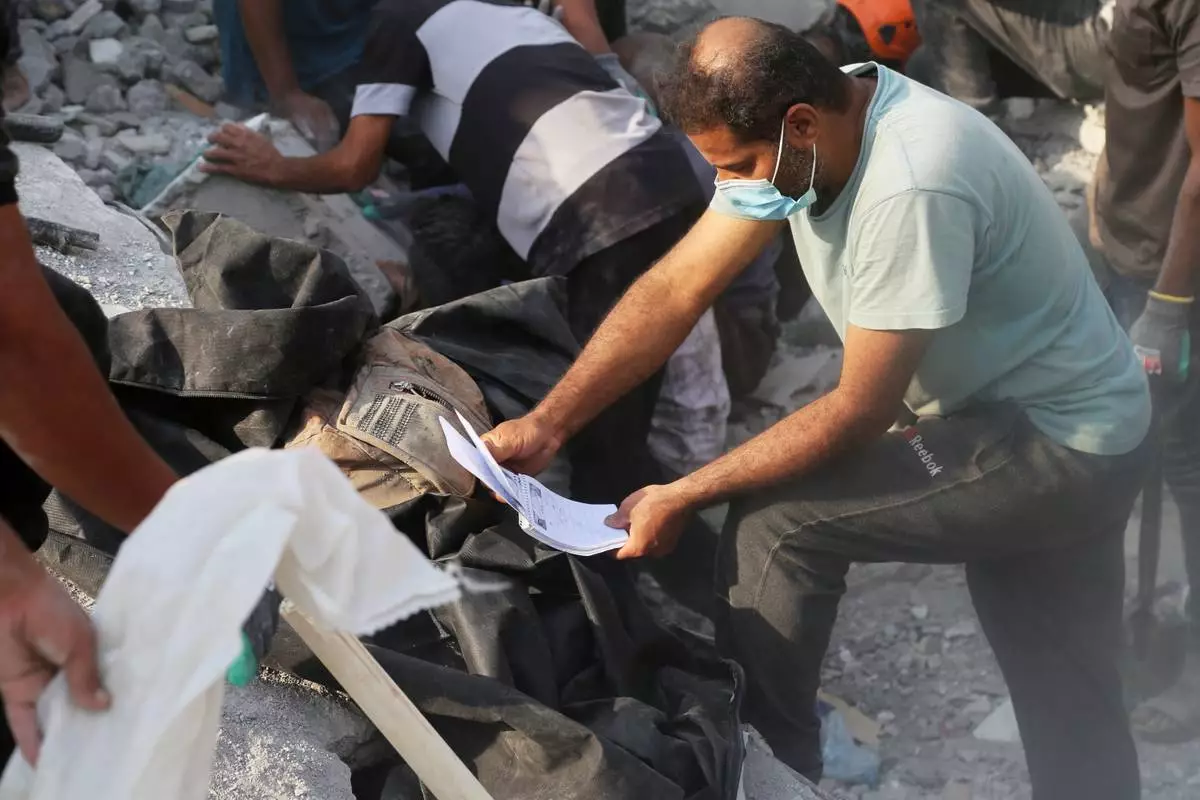
Rescue workers and residents search through the rubble in the aftermath of a strike on a girls' elementary school in Minab, Iran, Saturday, Feb. 28, 2026. (Abbas Zakeri/Mehr News Agency via AP)
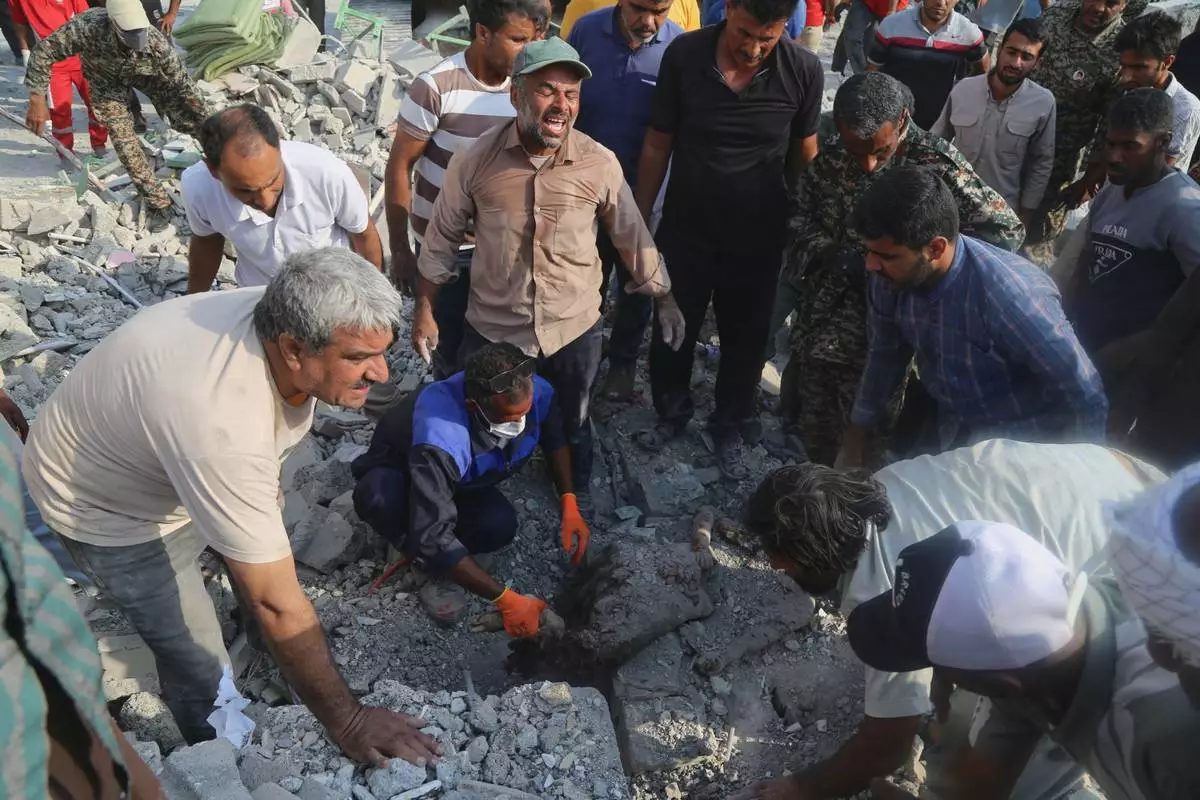
Rescue workers and residents search through the rubble in the aftermath of a strike on a girls' elementary school in Minab, Iran, Saturday, Feb. 28, 2026. (Abbas Zakeri/Mehr News Agency via AP)
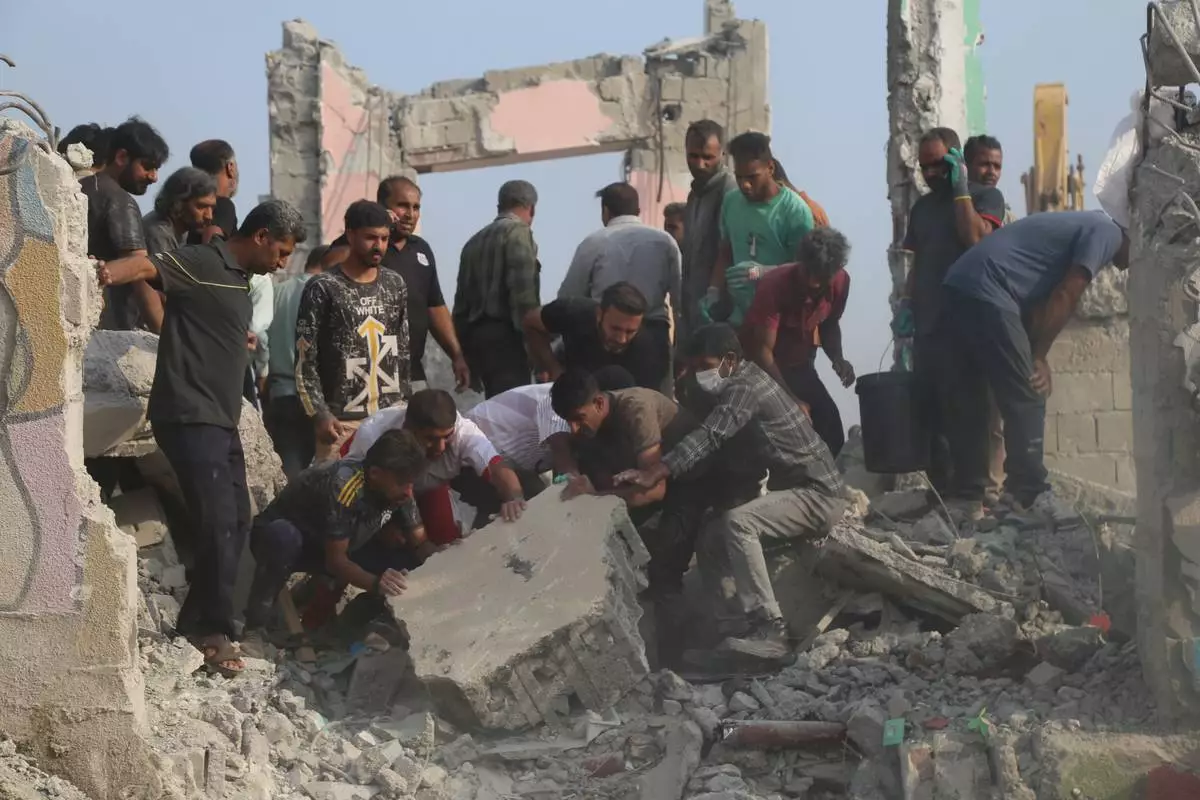
Rescue workers and residents search through the rubble in the aftermath of a strike on a girls' elementary school in Minab, Iran, Saturday, Feb. 28, 2026. (Abbas Zakeri/Mehr News Agency via AP)