Skip to Content Facebook Feature Image

Argentina's President Milei to issue a dollar bond, eyeing a return to global markets

News

Argentina's President Milei to issue a dollar bond, eyeing a return to global markets
News

News

Argentina's President Milei to issue a dollar bond, eyeing a return to global markets

2025-12-06 06:18 Last Updated At:06:31

BUENOS AIRES, Argentina (AP) — The libertarian government of Argentina's President Javier Milei announced Friday it would issue a dollar bond for the first time in nearly eight years, as the cash-strapped country seeks a return to international markets and faces an enormous sum of debt due in the coming months.

The dollar-denominated sovereign bond, issued under Argentine law and targeted at foreign and local investors, has an interest rate, or coupon, of 6.5% and matures in November 2029, the Economy Ministry said, without offering details on the size of the offering.

Analysts say the bond auction signals growing confidence in President Milei's reforms after his party's landslide midterm election victory reassured bondholders that his government would be able to pay them back.

“It shows they are taking steps — slowly — toward normalizing the market and reducing dependence on international reserves, which is a big concern,” said Fernando Marull, an Argentine economist.

“Ideally, debt should be paid with refinancing, not with scarce reserves. It’s like going to a bank and refinancing your loan instead of paying the whole thing in cash from your pocket. That's why this is so important."

Economy Minister Luis Caputo said the money would be crucial for settling part of the $4.2 billion in debt that’s coming due on Jan. 9 without tapping reserves. Because the bond won’t be issued under foreign law, he said, it won’t need congressional approval.

“The reopening of foreign currency debt markets will expand the Treasury’s options regarding the instruments available for debt management," Caputo wrote on social media, attributing the move to Milei's success in reining in the budget deficit and lifting most capital controls that fenced off its debt markets.

Regaining access to international borrowing markets has been one of Milei's goals since the radical libertarian economist took office in late 2023 on a bid to lower severe inflation, stabilize Argentina’s troubled economy and reverse years of hefty public spending under left-wing populist governments.

Chronic economic crises have led Argentina to default on its debt nine times, most recently in a 2020 restructuring. As a result, high borrowing costs and legal tussles with restive foreign investors have left the country unable to take on debt abroad for most of the past two decades.

Without tapping global capital markets — which is how many governments around the world borrow or roll over debts — Argentina will struggle to expand its economy, and to repay the more than $40 billion it owes the International Monetary Fund.

Earlier this year, Caputo secured a fresh $20 billion loan from the IMF to help Milei press ahead with fiscal reforms. To unlock successive tranches of funds, Milei's government committed to building up its net hard-currency reserves to around $5 billion by the year's end.

IMF spokesperson Julie Kozack told reporters on Thursday that “meeting the end-of-year reserve target will be challenging" for Argentina. Warning that Milei’s current exchange rate policy of propping up the peso slowed reserve accumulation, she added:

“We continue to advocate that the authorities should use the window of opportunity to implement a consistent and robust monetary and foreign exchange framework to help support the accumulation of reserves.”

Milei has diverted billions of dollars from central bank coffers to strengthen the depreciating Argentine peso in recent months.

That strategy was pushed to the extreme in the run-up to the midterm elections as doubts about the trajectory of Milei's harsh austerity plan triggered a run on the peso. With the official rate of the peso crashing against the dollar, U.S. President Donald Trump stepped in to save his ideological ally with a $20 billion credit line and outright purchases of pesos.

While the electoral win thrilled markets and vindicated Trump, unease remains that nothing can stop Milei from burning through foreign reserves again if he depends on a strong peso to fight inflation — not even this bond auction, which experts say is less attractive to foreign investors for being issued under local law.

“I don’t think this represents a return to international markets,” said Juan Battaglia, chief economist at Cucchiara, a stock brokerage in Buenos Aires.

“The government has made significant progress in normalizing the financial account, but there is still a long way to go.”
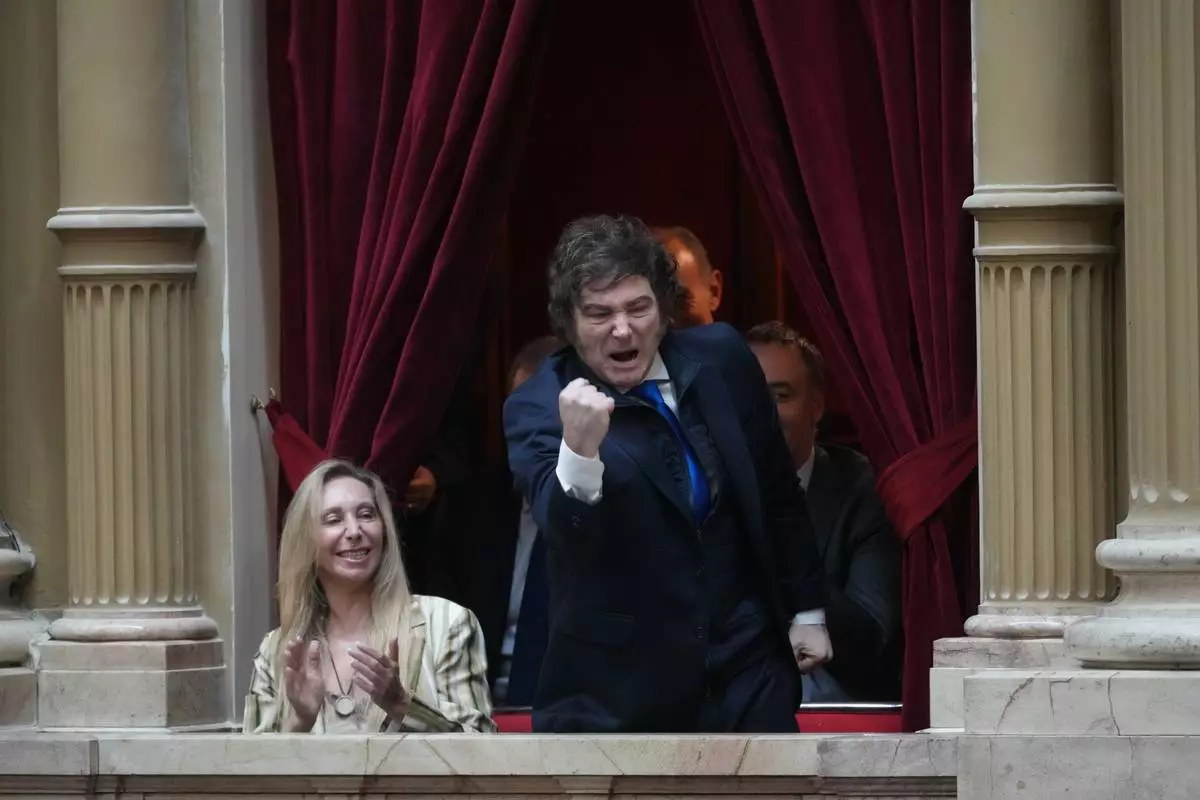
Argentine President Javier Milei, right, and General Secretary of the Presidency Karina Milei, his sister, cheer for their party's lawmakers during the swearing-in ceremony for newly elected legislators at Congress in Buenos Aires, Argentina, Wednesday, Dec. 3, 2025. (AP Photo/Rodrigo Abd)


Argentine President Javier Milei, right, and General Secretary of the Presidency Karina Milei, his sister, cheer for their party's lawmakers during the swearing-in ceremony for newly elected legislators at Congress in Buenos Aires, Argentina, Wednesday, Dec. 3, 2025. (AP Photo/Rodrigo Abd)
NEW YORK (AP) — A former high-level agent with the U.S. Drug Enforcement Administration and an associate have been charged with conspiring to launder millions of dollars and obtain military-grade firearms and explosives for a Mexican drug cartel, according to an indictment unsealed Friday in New York City.

Paul Campo, 61, of Oakton, Virginia, who retired from the DEA in 2016 after a 25-year career, and Robert Sensi, 75, of Boca Raton, Florida, were allegedly caught in a sting operation that involved their dealings with a confidential source who posed as a member of the Jalisco New Generation Cartel, but really was being directed by law enforcement officials.

The cartel, also know as CJNG, was designated as a foreign terrorist organization by Secretary of State Marco Rubio in February.

Jay Clayton, the U.S. attorney for the Southern District of New York, said Campo betrayed his DEA career.

“As alleged, Paul Campo and Robert Sensi conspired to assist CJNG, one of the most notorious Mexican cartels that is responsible for countless deaths through violence and drug trafficking in the United States and Mexico,” Clayton said in a statement.

Lawyers for Campo and Sensi entered not guilty pleas on their behalf during appearances in federal court in Manhattan on Friday afternoon.

“Certainly the charges here are quite alarming,” Magistrate Judge Robert W. Lehrburger said during Sensi's appearance.

Over the past year, Campo and Sensi allegedly agreed to launder about $12 million in drug proceeds for the cartel and converted about $750,000 in cash to cryptocurrency, thinking it was going to the group when it really went to the federal government, the indictment says. They also provided a payment for about 220 kilograms of cocaine that they were told would be distributed and sold in the U.S. for about $5 million, and they would get a cut of the proceeds, according to the allegations.

They also said they would look into procuring commercial drones, AR-15 semiautomatic rifles, M4 carbines, grenade launchers and rocket-propelled grenades for the cartel, the indictment alleges. Campo's lawyer disputed the allegation in the indictment that the two men “agreed to explore” obtaining weapons for the cartel, saying it's a cop-out for a lack of evidence.

Campo also boasted about his prior law enforcement experience during conversations with the confidential source and offered to be a “strategist” for the cartel, authorities said. He began his career as a DEA agent in New York and rose to become deputy chief of financial operations for the agency, the indictment said.

Assistant U.S. Attorney Varun Gumaste said in court Friday that Campo and Sensi’s alleged conduct was “quite egregious and concerning.” He said the evidence includes hours of recordings of the two men talking with the source, as well as cellphone location data, emails and surveillance images.

Gumaste said both men had international ties and were flight risks.

Campo's lawyer, Mark Gombiner, called the indictment a “somewhat sensationalized and somewhat incoherent document.” Some of the allegations in it are contradictory, he argued.

Both men were ordered detained with out bail, and their next court hearings were set for Dec. 19.

Sensi's attorney, Amanda Kramer, argued that Sensi is not a flight risk and has multiple health problems, including injuries from a fall two months ago, early-stage dementia and type II diabetes.

Campo and Sensi are both charged with four conspiracy counts related to alleged narcoterrorism, terrorism, narcotics distribution and money laundering.

Gumaste said evidence shows that Sensi also was engaged in a scheme to procure military-grade helicopters for a Middle East country. He said Sensi has three convictions from the late 1980s and early 1990s involving charges of mail fraud, defrauding the government and stealing $2.5 million.

Campo has no criminal record, Gombiner said.

DEA Administrator Terrance Cole said in a statement that while Campo is no longer employed by the DEA, the allegations undermine trust in law enforcement.

The DEA has been roiled in recent years by several embarrassing instances of misconduct in its ranks. The Associated Press has tallied at least 16 agents over the past decade brought up on federal charges ranging from child pornography and drug trafficking to leaking intelligence to defense attorneys and selling firearms to cartel associates, revealing gaping holes in the agency’s supervision.

Starting in 2021, the agency placed new controls on how DEA funds can be used in money laundering stings, and warned agents they can now be fired for a first offense of misconduct if serious enough, a departure from prior administrations.

Collins reported from Hartford, Connecticut. Associated Press writer Joshua Goodman in Miami contributed to this report.

FILE - Acting U.S. Attorney for the Southern District of New York Jay Clayton talks on a phone as he exits court in New York, May 19, 2025. (AP Photo/Ted Shaffrey, File)

FILE - Acting U.S. Attorney for the Southern District of New York Jay Clayton talks on a phone as he exits court in New York, May 19, 2025. (AP Photo/Ted Shaffrey, File)

Recommended Articles