College football’s coaching carousel is slowing down after a dizzying frenzy. Eleven Power Four coaches were fired this fall and another in March. Kentucky's Mark Stoops was the last one shown the door and the fifth from the Southeastern Conference.
Unprecedented parity, revenue-sharing and access to the expanded College Football Playoff have created a win-now approach for administrators.
Florida State’s Mike Norvell, Maryland’s Mike Locksley, Wisconsin’s Luke Fickell and Baylor's Dave Aranda got hot-seat reprieves and will return in 2026.
Ole Miss coach Lane Kiffin's decision to leave for LSU sped up the hiring cycle, with Memphis coach Ryan Silverfield, North Texas coach Eric Morris, South Florida coach Alex Golesh and Tulane coach Jon Sumrall getting called up from the Group of Five to lead Power Four programs.
Here are the programs in the spotlight (in alphabetical order):
Fired: Sam Pittman, 63, on Sept. 28, 2025.
Record: 32-34 over six seasons, including 14-29 in the SEC.
Buyout: Nearly $9 million.
Interim: Offensive coordinator Bobby Petrino.
Noteworthy: Petrino guided the Razorbacks between 2008 and 2011, showing improvement every year. His tenure ended after a motorcycle crash led to the admission of an affair with a former Arkansas volleyball player.
Replacement: The Razorbacks hired Silverfield on Nov. 30.
Fired: Hugh Freeze, 56, on Nov. 2, 2025
Record: 15-19 over three seasons, including 6-16 in the SEC.
Buyout: $15.8 million.
Interim: Defensive coordinator DJ Durkin.
Noteworthy: The 56-year-old Freeze failed to fix Auburn’s offensive issues in his three years on the Plains. The Tigers scored 24 or fewer points in 17 of his 22 league games.
Replacement: The Tigers hired Golesh on Nov. 30 and kept Durkin as DC.
Fired: Justin Wilcox, 49, on Nov. 23, 2025.
Record: 48-55 over nine seasons, including 26-47 in conference play (21-37 in the Pac-12, 5-10 in the ACC).
Buyout: Roughly $10.9 million.
Interim: Former Hawaii and Washington State coach Nick Rolovich.
Noteworthy: Longtime NFL coach and first-year Cal general manager Ron Rivera made the move following a lopsided loss to Stanford that assured Wilcox of never having a winning record in conference play with the Bears.
Replacement: The Golden Bears hired Tosh Lupoi on Dec. 4, bringing back a former player and assistant who has been Oregon’s defensive coordinator for the past four seasons.
Fired: Billy Napier, 46, on Oct. 19, 2025.
Record: 22-23 over four seasons, including 12-16 in the SEC.
Buyout: About $21 million.
Interim: Receivers coach Billy Gonzales.
Noteworthy: Napier was almost always in the crosshairs, in part because he declined to give up play-calling duties as the Gators’ offense failed to make progress.
Replacement: The Gators hired Sumrall on Nov. 30.
Fired: Mark Stoops, 58, on Dec. 1, 2025.
Record: 82-80 over 13 seasons (with 10 wins vacated), including 25-68 in the SEC.
Buyout: Approximately $37.7 million, with all it due within 60 days. But the sides were working to spread that out over time.
Interim: None.
Noteworthy: Stoops was the longest-tenured coach in the SEC.
Replacement: The Wildcats hired Oregon offensive coordinator Will Stein hours after Stoops' dismissal.
Fired: Brian Kelly, 64, on Oct. 26, 2025.
Record: 34-14 over four seasons, including 19-10 in the SEC.
Buyout: About $54 million, which the school agreed to pay after Kelly sued for the full amount.
Interim: Associate head coach/running backs coach Frank Wilson.
Noteworthy: Kelly’s buyout is the second largest in the history of college athletics. It was the first time Kelly had been fired in his coaching career.
Replacement: The Tigers hired Kiffin on Nov. 30.
Fired: Jonathan Smith, 46, on Nov. 30, 2025.
Record: 9-15 over two seasons, including 4-14 in the Big Ten.
Buyout: More than $30 million.
Interim: Defensive Coordinator Joe Rossi.
Noteworthy: Smith was under fire from the moment Michigan State hired him late in 2023. He previously went 34-35 in six years at Oregon State.
Replacement: The Spartans hired former Northwestern coach Pat Fitzgerald on Dec. 1.
Fired: Mike Gundy, 58, on Sept. 23, 2025.
Record: 170-90 over 21 seasons, including 102-72 in the Big 12.
Buyout: $15 million.
Interim: Offensive coordinator Doug Meacham.
Noteworthy: Gundy went viral in 2007 for shouting “Come after me! I’m a man! I’m 40!” while defending one of his players.
Replacement: The Cowboys hired Morris on Nov. 25.
Fired: James Franklin, 53, on Oct. 12, 2025.
Record: 104-45 over 12 seasons, including 64-36 in the Big Ten.
Buyout: More than $49 million, although it was negotiated down to $9 million before he got another job (Virginia Tech).
Interim: Associate head coach Terry Smith.
Noteworthy: Franklin became the first coach since 1978 to lose consecutive games (UCLA, Northwestern) while being favored by 20 or more points.
Replacement: Penn State on Dec. 5 hired Matt Campbell, who went 72-55 in 10 seasons at Iowa State. The Nittany Lions initially targeted BYU's Kalani Sitake, but he signed a long-term extension with the Cougars.
Fired: Troy Taylor, 56, on March 25, 2025.
Record: 6-18 over two seasons, including 4-13 in conference play (2-7 in the Pac-12, 2-6 in the ACC).
Buyout: Unknown.
Interim: Longtime NFL coach Frank Reich.
Noteworthy: General manager Andrew Luck fired Taylor in March following reports that the coach allegedly mistreated staffers and then asked Reich to fill in for a season.
Replacement: The Cardinal hired Tavita Pritchard on Nov. 28.
Fired: DeShaun Foster, 45, on Sept. 14, 2025.
Record: 5-10 over two seasons, including 3-6 in the Big Ten.
Buyout: $6.43 million.
Interim: Special assistant Tim Skipper.
Noteworthy: Foster was fired three games into his second season, with athletic director Martin Jarmond acknowledging he made a mistake by giving the inexperienced Foster the job.
Replacement: The Bruins have targeted James Madison’s Bob Chesney as their next football coach.
Fired: Brent Pry, 55, on Sept. 14, 2025.
Record: 16-24 over four seasons, including 10-13 in the ACC.
Buyout: About $6 million.
Interim: Offensive coordinator Philip Montgomery.
Noteworthy: Since Pry’s dismissal, the university voted to increase the athletics department budget by $229.2 million over the next four years. The bump for 2026 ups Tech’s athletic budget to $190.1 million, placing it among the top third in the ACC.
Replacement: The Hokies hired Franklin on Nov. 17.
Get poll alerts and updates on the AP Top 25 throughout the season. Sign up here and here (AP News mobile app). AP college football: https://apnews.com/hub/ap-top-25-college-football-poll and https://apnews.com/hub/college-football
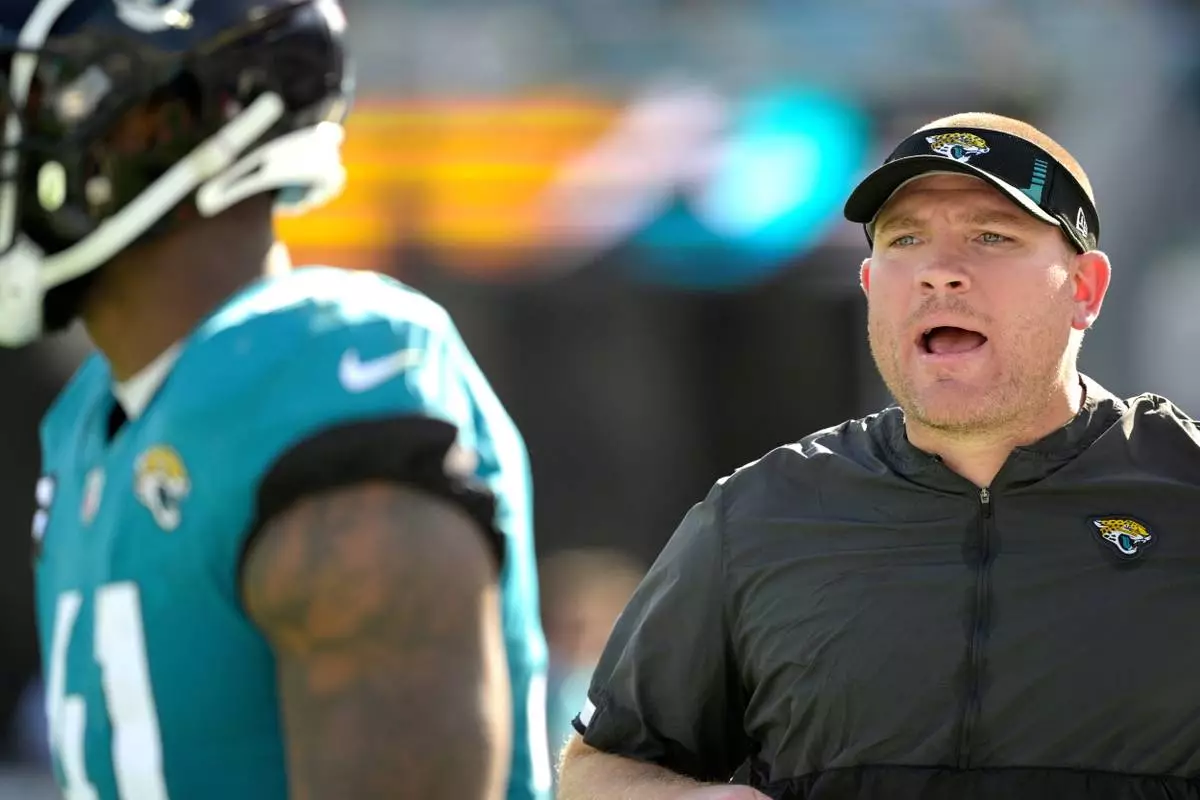
FILE -Jacksonville Jaguars defensive line coach Tosh Lupoi, right, calls out instructions on the sideline during the second half of an NFL football game against the Indianapolis Colts, Jan. 9, 2022, in Jacksonville, Fla. (AP Photo/Phelan M. Ebenhack, File)
KHARKIV, Ukraine (AP) — When Russia’s full-scale invasion began nearly four years ago, a 26-year-old soldier known as Monka didn’t see a combat role she could do. But that changed as technology reshaped the battlefield and opened new paths.
Last year, she joined the military as a pilot of short-range, first-person view, or FPV, drones after giving up a job managing a restaurant abroad and returning home to Ukraine to serve.
Her shift is part of a larger trend of more women joining Ukraine's military in combat roles, a change made possible by the technological transformation of modern warfare, military officials say.
“The fact that technology lets us deliver ammunition without carrying it in our hands or running it to the front line — that’s incredible,” said Monka, who serves in the Unmanned Systems Battalion of the Third Army Corps. She and other women followed Ukraine’s military protocol by identifying themselves using only their call signs.
More than 70,000 women served in Ukraine's military in 2025, a 20% increase compared with 2022, including over 5,500 deployed directly on the front line, according to Ukraine’s Defense Ministry.
Some units have tailored recruitment efforts toward women, expanding rosters in a sign that Ukraine is looking to strengthen and expand its army even as peace negotiations weigh a possible cap on the future size of the military.
Leaders in the capital Kyiv, as well as many soldiers like Monka, see the army as one of the few security guarantees that Ukraine has against Russia.
“We need everyone — engineers, pilots, IT specialists, programmers, we simply need brains. It’s not about men or women. We need people who are ready to work hard,” she said.
A drone pilot is one of the Ukrainian military's most popular combat professions chosen by women, military officials said.
When Imla from the Kraken 1654 unit left her career as a professional hockey player to join the military, the 27-year-old initially planned to become a combat paramedic.
She spent her first six months as a platoon medic, but the job required learning to fly drones. She started with small ones before moving to larger models carrying bombs and eventually switching to full-time drone work.
Imla clearly remembers her first drone flight, a reconnaissance mission. When they handed her the controller, she was so nervous her hands wouldn’t stop shaking.
“To be honest, I even wanted to cry in some moments,” she recalled. “But then, over time, you build up experience on the job and start feeling confident.”
The Khartiia Corps has taken more women into its ranks, reporting a 20% increase since 2024. About six months ago, the brigade launched a recruitment campaign aimed at women for combat and technological roles in cooperation with the Dignitas Foundation, a charity organization supporting Ukraine by funding technological innovation and civic development projects.
“In recent months, dozens of women have joined us in combat roles and are working successfully,” said Volodymyr Dehtyarov, the Khartiia Corps public affairs officer. “The more technology we have, like drones, the more historically male professions open up."
Khartiia has started training officers and future commanders on how to work with mixed units including people of different ages, genders and backgrounds, which Dehtyarov said helps commanders become more effective leaders.
The Ukrainian army remains conservative at its core and some units don’t make it easy for women.
A 25-year-old soldier with the call sign Yaha joined the military in 2023 and initially did paperwork as an army clerk. Three months later, she began asking to attend drone courses. Commanders at the time did not respond with enthusiasm and instead suggested she replace the cook.
“It was unpleasant for me, because I didn’t expect such uncomfortable conditions, such strict limitations,” Yaha said.
In the kitchen, she spent her free time studying drone manuals, practicing on a simulator and training in computer clubs with a controller she bought herself.
“I liked that you could strike the enemy remotely,” she said. “So I thought this was our future.”
Eventually, she became a bomber-drone pilot in the 9th Brigade.
“War is not cool or glamorous. It’s pain, suffering and loss. You just do it because you want to change the situation," she said. "But you’re not invincible. You’re just a person like everyone else."
Chibi, a 20-year-old FPV technician from the Khartiia Brigade, prepares drones for the battlefield from a dark damp basement near the front line in eastern Ukraine.
She initially faced prejudice from soldiers who claimed she had inferior technical skills because she was a woman. But she also had a supportive male colleague who helped her take the first steps toward becoming an FPV technician, which she finds more interesting than being a pilot.
“There needs to be more women in the army," Chibi said, her hair dyed pink and dark blue. "The more women there are, the better the attitude toward them will be.”
Olha Meloshyna, the spokesperson for Ukraine’s Unmanned Systems Forces, says the belief that drone roles are safer is wrong, as Russians actively hunt drone operators.
Their unit is seeing more women move into technological roles, including drone operation, drone repair and electronic warfare, as drones have become one of the main tools of striking and reconnaissance on the battlefield.
According to Meloshyna, 4.2% of the Unmanned Systems Forces are women, a number she considers significant because women enlist voluntarily.
“We are part of the new Ukrainian army that formed during the invasion. So in terms of gender-based acceptance into the Armed Forces, we have never had any division — what matters to us is desire and motivation,” she said.
She said that they are now conducting a more media-focused recruitment campaign, inviting and planning to recruit 15,000 people to join, including women. Recruiters say that women are applying for both combat and noncombat positions.
“The Unmanned Systems Forces are a system, and it is made up of people — men and women,” Meloshyna said. “No drone is autonomous. It needs human involvement. And the more personnel we have, the more drones will fly toward Russia.”

Chibi, a Ukrainian soldier from the Khartia brigade, tests a drone, Friday, Nov. 7, 2025, in Kharkiv Oblast, Ukraine. (AP Photo/Julia Demaree Nikhinson)
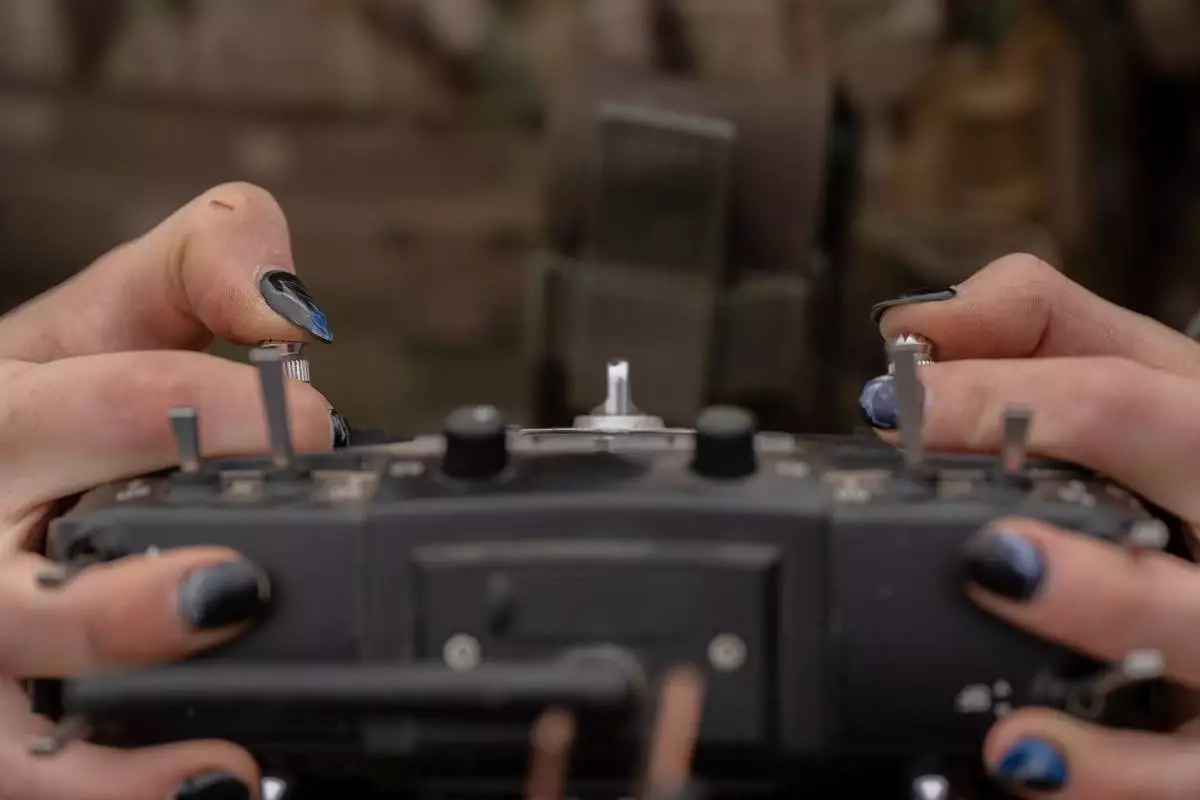
Monka, a Ukrainian FPV drone operator from the third assault brigade, pilots an FPV drone during a demonstration for The Associated Press, Wednesday, Nov. 5, 2025, in Kharkiv Oblast, Ukraine. (AP Photo/Julia Demaree Nikhinson)
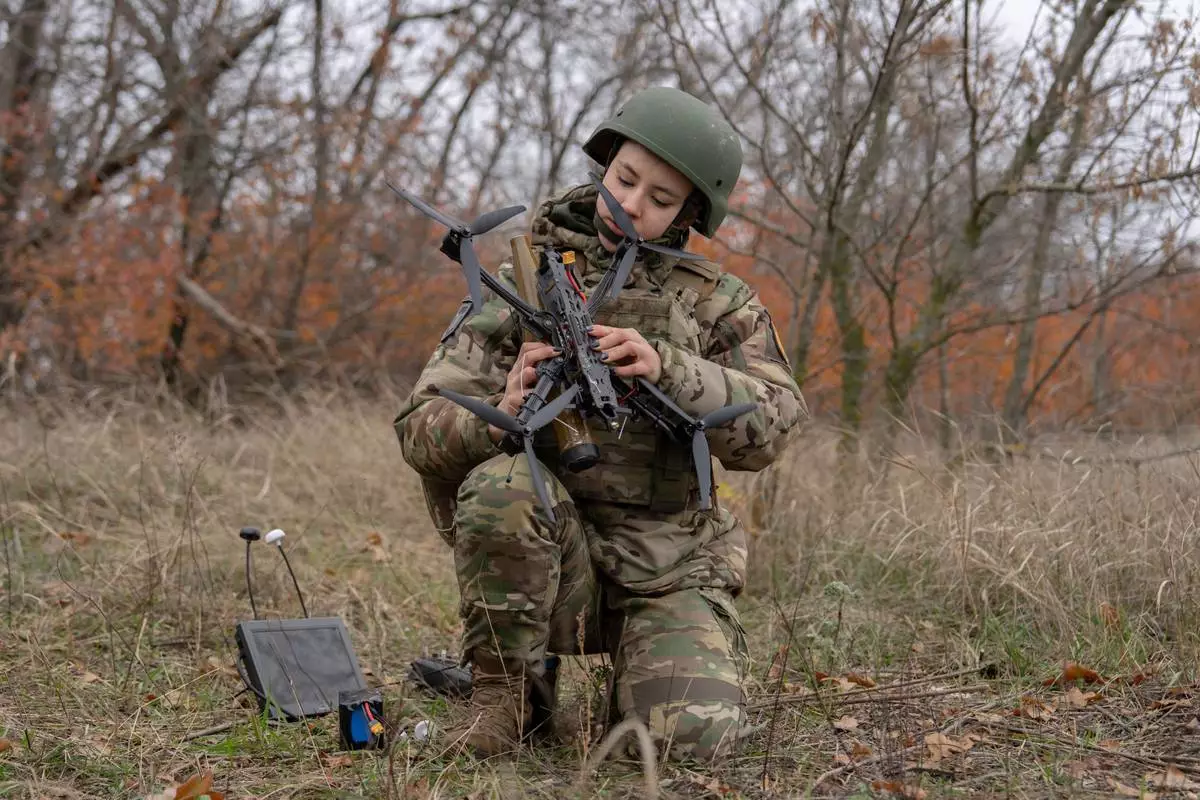
Monka, an FPV drone operator from the third assault brigade, assembles an FPV drone during a demonstration for The Associated Press, Wednesday, Nov. 5, 2025, in Kharkiv Oblast, Ukraine. (AP Photo/Julia Demaree Nikhinson)
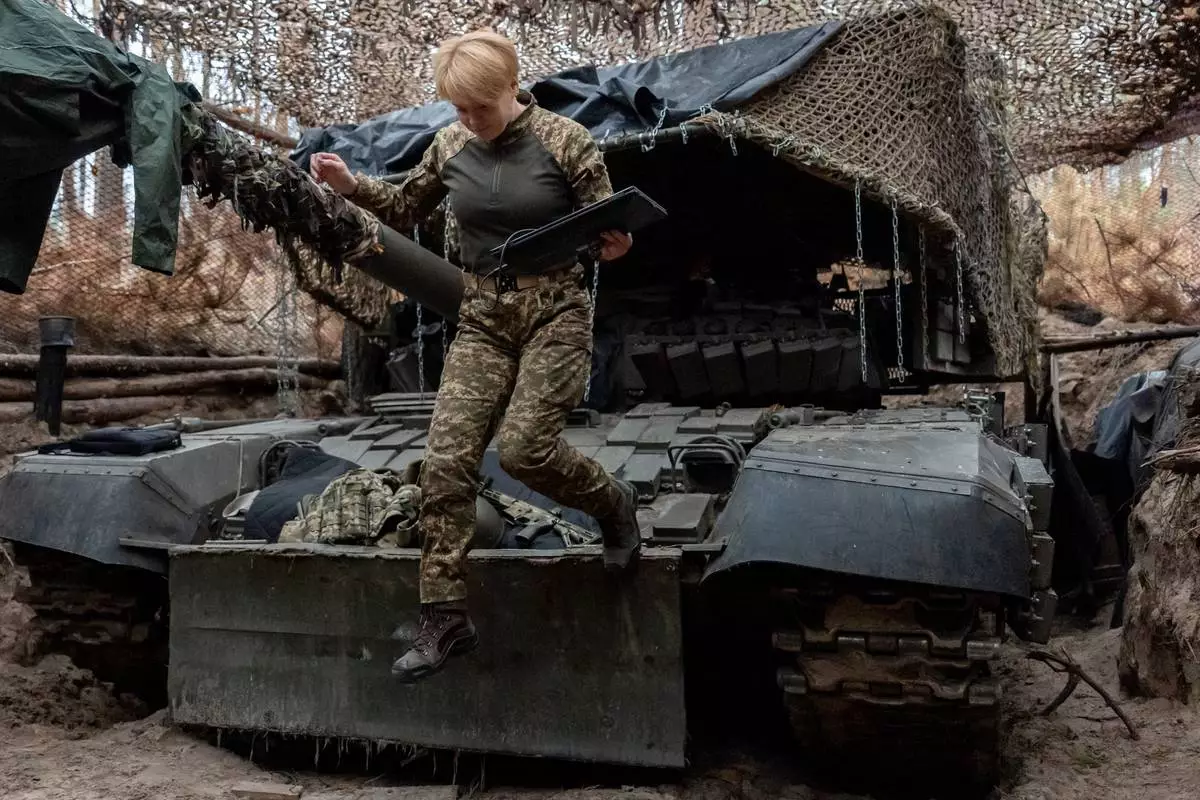
A Ukrainian soldier from the Khartia brigade, callsign Muza, jumps down from a tank following a demonstration for The Associated Press, Thursday, Nov. 6, 2025, in Kharkiv Oblast, Ukraine. (AP Photo/Julia Demaree Nikhinson)

A Ukrainian drone operator from the Kraken 1654 unit, callsign Imla, flies a Vampire drone during a demonstration for The Associated Press, Wednesday, Nov. 5, 2025, in Kharkiv Oblast, Ukraine. (AP Photo/Julia Demaree Nikhinson)