Skip to Content Facebook Feature Image

The Supreme Court weighs another step in favor of broad presidential power sought by Trump

News

The Supreme Court weighs another step in favor of broad presidential power sought by Trump
News

News

The Supreme Court weighs another step in favor of broad presidential power sought by Trump

2025-12-06 21:11 Last Updated At:21:20

WASHINGTON (AP) — Chief Justice John Roberts has led the Supreme Court 's conservative majority on a steady march of increasing the power of the presidency, starting well before Donald Trump's time in the White House.

The justices could take the next step in a case being argued Monday that calls for a unanimous 90-year-old decision limiting executive authority to be overturned.

The court's conservatives, liberal Justice Elena Kagan noted in September, seem to be “raring to take that action.”

They already have allowed Trump, in the opening months of the Republican's second term, to fire almost everyone he has wanted, despite the court's 1935 decision in Humphrey's Executor that prohibits the president from removing the heads of independent agencies without cause.

The officials include Rebecca Slaughter, whose firing from the Federal Trade Commission is at issue in the current case, as well as officials from the National Labor Relations Board, the Merit Systems Protection Board and the Consumer Product Safety Commission.

The only officials who have so far survived efforts to remove them are Lisa Cook, a Federal Reserve governor, and Shira Perlmutter, a copyright official with the Library of Congress. The court already has suggested that it will view the Fed differently from other independent agencies, and Trump has said he wants her out because of allegations of mortgage fraud. Cook says she did nothing wrong.

Humphrey's Executor has long been a target of the conservative legal movement that has embraced an expansive view of presidential power known as the unitary executive.

The case before the high court involves the same agency, the FTC, that was at issue in 1935. The justices established that presidents — Democrat Franklin D. Roosevelt at the time — could not fire the appointed leaders of the alphabet soup of federal agencies without cause.

The decision ushered in an era of powerful independent federal agencies charged with regulating labor relations, employment discrimination, the air waves and much else.

Proponents of the unitary executive theory have said the modern administrative state gets the Constitution all wrong: Federal agencies that are part of the executive branch answer to the president, and that includes the ability to fire their leaders at will.

As Justice Antonin Scalia wrote in a 1988 dissent that has taken on mythical status among conservatives, “this does not mean some of the executive power, but all of the executive power.”

Since 2010 and under Roberts' leadership, the Supreme Court has steadily whittled away at laws restricting the president's ability to fire people.

In 2020, Roberts wrote for the court that “the President’s removal power is the rule, not the exception” in a decision upholding Trump’s firing of the head of the Consumer Financial Protection Bureau despite job protections similar to those upheld in Humphrey’s case.

In the 2024 immunity decision that spared Trump from being prosecuted for his efforts to overturn the 2020 election results, Roberts included the power to fire among the president's “conclusive and preclusive” powers that Congress lacks the authority to restrict.

But according to legal historians and even a prominent proponent of the originalism approach to interpreting the Constitution that is favored by conservatives, Roberts may be wrong about the history underpinning the unitary executive.

“Both the text and the history of Article II are far more equivocal than the current Court has been suggesting,” wrote Caleb Nelson, a University of Virginia law professor who once served as a law clerk to Justice Clarence Thomas.

Jane Manners, a Fordham University law professor, said she and other historians filed briefs with the court to provide history and context about the removal power in the country's early years that also could lead the court to revise its views. “I'm not holding my breath,” she said.

Slaughter's lawyers embrace the historians' arguments, telling the court that limits on Trump's power are consistent with the Constitution and U.S. history.

The Justice Department argues Trump can fire board members for any reason as he works to carry out his agenda and that the precedent should be tossed aside.

“Humphrey’s Executor was always egregiously wrong,” Solicitor General D. John Sauer wrote.

A second question in the case could affect Cook, the Fed governor. Even if a firing turns out to be illegal, the court wants to decide whether judges have the power to reinstate someone.

Justice Neil Gorsuch wrote earlier this year that fired employees who win in court can likely get back pay, but not reinstatement.

That might affect Cook's ability to remain in her job. The justices have seemed wary about the economic uncertainty that might result if Trump can fire the leaders of the central bank. The court will hear separate arguments in January about whether Cook can remain in her job as her court case challenging her firing proceeds.
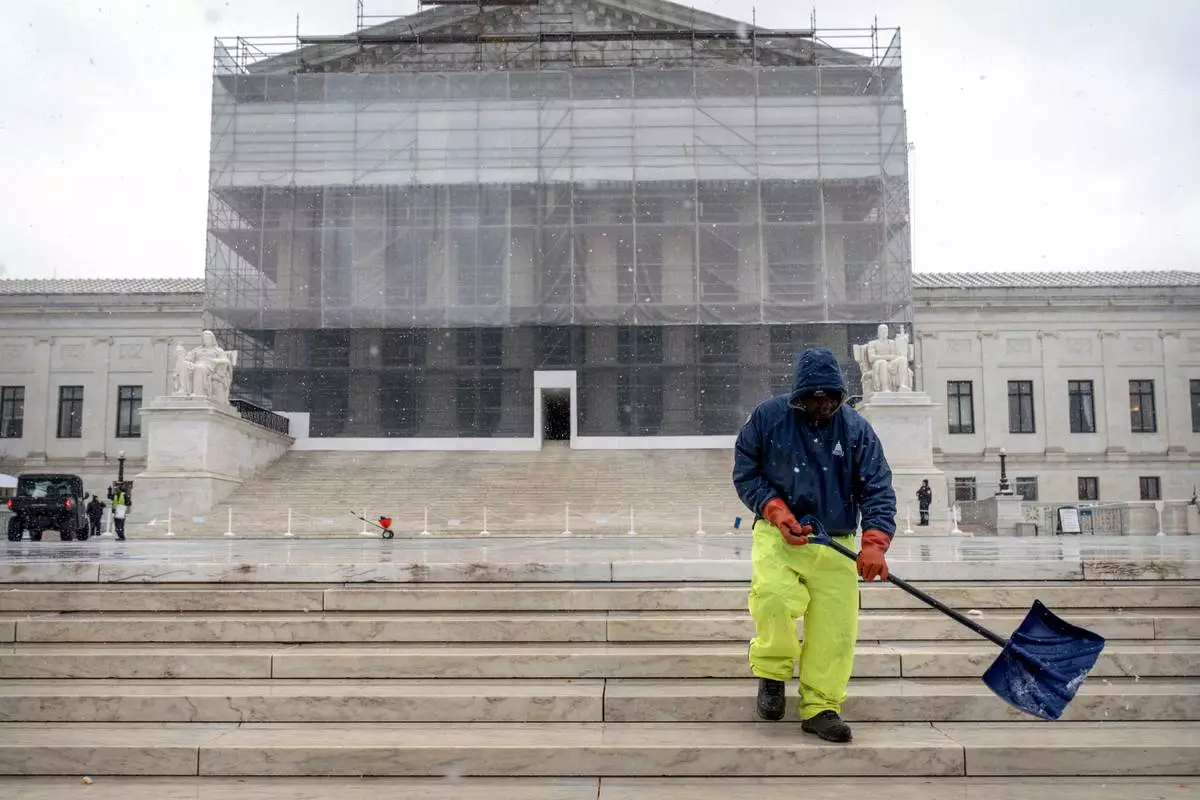
A worker shovels snow and ice in front of the Supreme Court building during the first snowfall of the winter season on Friday, Dec. 5, 2025, in Washington. (AP Photo/Mark Schiefelbein)
A worker shovels snow and ice in front of the Supreme Court building during the first snowfall of the winter season on Friday, Dec. 5, 2025, in Washington. (AP Photo/Mark Schiefelbein)

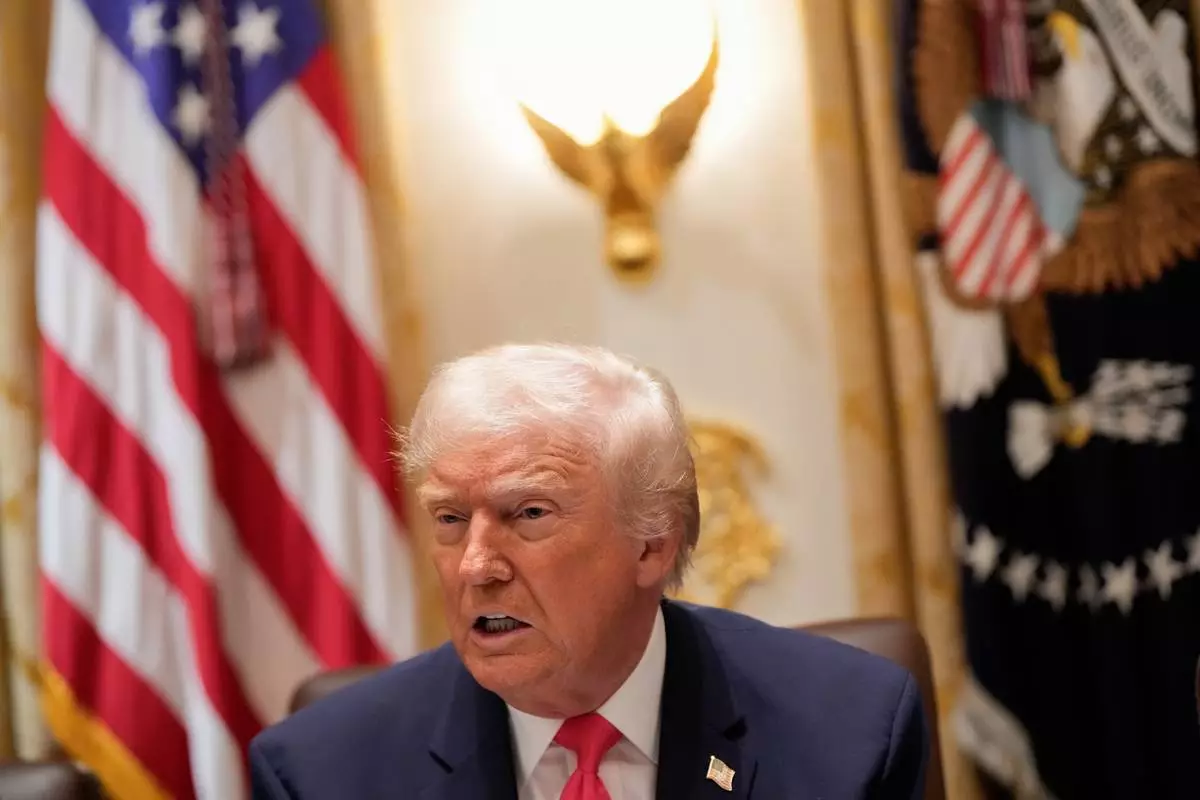
President Donald Trump speaks during a Cabinet meeting at the White House, Tuesday, Dec. 2, 2025, in Washington. (AP Photo/Julia Demaree Nikhinson)


President Donald Trump speaks during a Cabinet meeting at the White House, Tuesday, Dec. 2, 2025, in Washington. (AP Photo/Julia Demaree Nikhinson)

KYIV, Ukraine (AP) — Russia unleashed a major missile and drone barrage on Ukraine overnight into Saturday, after U.S. and Ukrainian officials said they’ll meet on Saturday for a third day of talks aimed at ending the nearly 4-year-old war,

Following talks that made progress on a security framework for postwar Ukraine, the two sides also offered the sober assessment that any “real progress toward any agreement” ultimately will depend “on Russia’s readiness to show serious commitment to long-term peace.”

The statement from U.S. special envoy Steve Witkoff, Trump’s son-in-law Jared Kushner as well as Ukrainian negotiators Rustem Umerov and Andriy Hnatov came after they met for a second day in Florida on Friday. They offered only broad brushstrokes about the progress they say has been made as Trump pushes Kyiv and Moscow to agree to a U.S.-mediated proposal to end the war.

Russia used 653 drones and 51 missiles in the wide-reaching overnight attack on Ukraine, which triggered air raid alerts across the country and came as Ukraine marked Armed Forces Day, the country’s air force said Saturday morning.

Ukrainian forces shot down and neutralized 585 drones and 30 missiles, the air force said, adding that 29 locations were struck.

At least eight people were wounded in the attacks, Ukrainian Minister of Internal Affairs Ihor Klymenko said.

Among these, at least three people were wounded in the Kyiv region, according to local officials. Drone sightings were reported as far west as Ukraine’s Lviv region.

Russia carried out a “massive missile-drone attack” on power stations and other energy infrastructure in several Ukrainian regions, Ukraine’s national energy operator, Ukrenergo, wrote on Telegram.

Ukraine’s Zaporizhzhia nuclear power plant temporarily lost all off-site power overnight, the International Atomic Energy Agency said Saturday, citing its Director General Rafael Mariano Grossi.

The plant is in an area that has been under Russian control since early in Moscow’s invasion of Ukraine and is not in service, but it needs reliable power to cool its six shut-down reactors and spent fuel, to avoid any catastrophic nuclear incidents.

Ukrainian President Volodymyr Zelenskyy said that energy facilities were the main targets of the attacks, also noting that a drone strike had “burned down” the train station in the city of Fastiv, located in the Kyiv region.

Russia’s Ministry of Defense said its air defenses had shot down 116 Ukrainian drones over Russian territory overnight into Saturday.

Russian Telegram news channel Astra said Ukraine struck Russia’s Ryazan Oil Refinery, sharing footage appearing to show a fire breaking out and plumes of smoke rising above the refinery. The Associated Press could not independently verify the video.

The General Staff of the Ukrainian Armed Forces later said Ukrainian forces had struck the refinery. Ryazan regional Gov. Pavel Malkov said a residential building had been damaged in a drone attack and that drone debris had fallen on the grounds of an “industrial facility,” but did not mention the refinery.

Months of Ukrainian long-range drone strikes on Russian refineries have aimed to deprive Moscow of the oil export revenue it needs to pursue the war. Meanwhile, Kyiv and its western allies say Russia is trying to cripple the Ukrainian power grid and deny civilians access to heat, light and running water for a fourth consecutive winter, in what Ukrainian officials call “weaponizing” the cold.

The latest round of attacks came as U.S. President Donald Trump’s advisers and Ukrainian officials said they’ll meet for a third day of talks on Saturday, after making progress on finding agreement on a security framework for postwar Ukraine.

Following Friday’s talks, the two sides also offered the sober assessment that any “real progress toward any agreement” ultimately will depend “on Russia’s readiness to show serious commitment to long-term peace.”

The statement from U.S. special envoy Steve Witkoff, Trump’s son-in-law Jared Kushner as well as Ukrainian negotiators Rustem Umerov and Andriy Hnatov came after they met for a second day in Florida on Friday. They offered only broad brushstrokes about the progress they say has been made as Trump pushes Kyiv and Moscow to agree to a U.S.-mediated proposal to end nearly four years of war.

Follow AP’s coverage of the war in Ukraine at https://apnews.com/hub/russia-ukraine

Workers and military inspect Ukrainian Fire Point's Flamingo missiles during handover to the military in an undisclosed location in Ukraine Thursday, Dec. 4, 2025. (AP Photo/Efrem Lukatsky)

Workers and military inspect Ukrainian Fire Point's Flamingo missiles during handover to the military in an undisclosed location in Ukraine Thursday, Dec. 4, 2025. (AP Photo/Efrem Lukatsky)

Recommended Articles