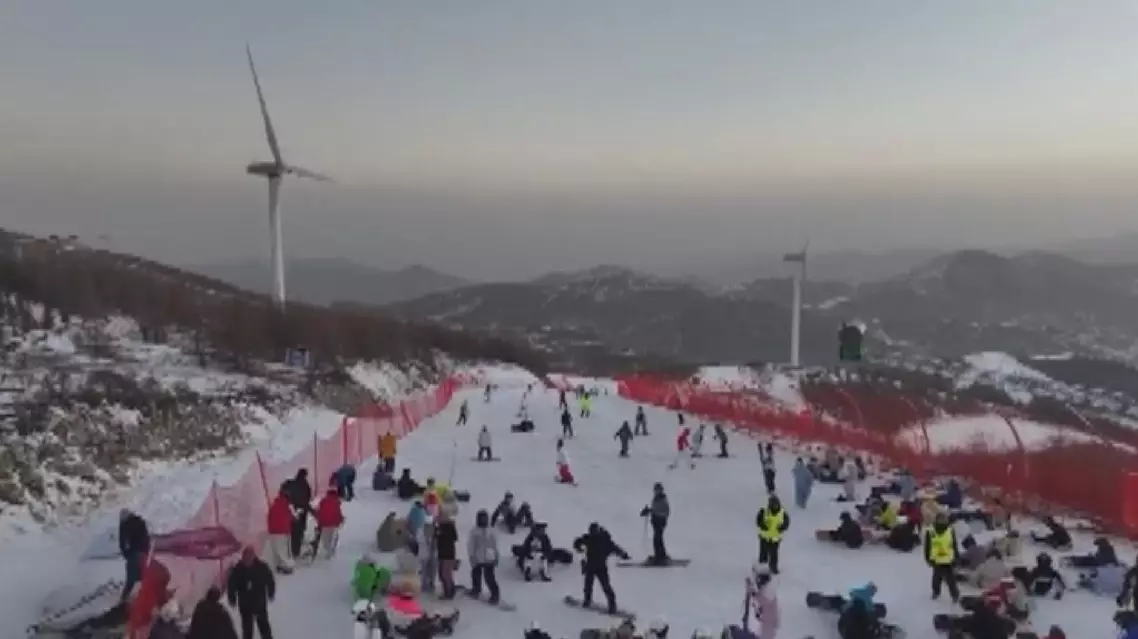
As winter tourism peaks, many skiing fields across China have rolled out a variety of ice-and-snow-themed activities to boost travel and encourage public participation in winter sports. At the Snow Ruyi Ski Resort in the Chongli Olympic Park in Zhangjiakou City of north China's Hebei Province, a 3,000-square-meter youth ski training and competition center is set to open soon. Equipped with six dedicated ski trails and a professional coaching team, the center's "ski-and-study" program has emerged as a new highlight.
"Last week marked the first week since the ski season opened. We have received an average of 3,000 visitors per day. This year, we have a variety of activities planned for every weekend," said Sun Jianhua, a person in charge of the Snow Ruyi Ski Resort.
Since the 2022 Beijing Winter Olympics, Beijing, together with nearby Hebei's Zhangjiakou City, have been developing the Beijing-Zhangjiakou Sports, Culture and Tourism Belt, integrating ice and snow tourism resources along the route and bringing new vitality into regional economic development.
Northeast China's Jilin Province, which is abundant in ice and snow resources, has launched a unique "ice and snow holiday" particularly tailored for all primary and middle school students from Dec 3 to 7, offering free winter sports experiences and cultural tourism discounts to encourage youth participation in ice-snow activities.
The five-day break, alongside regular winter and summer breaks, has allowed students to have more time for winter sports and activities. In Jilin, major ski resorts have become the primary venues for students to experience winter sports.
"I'm really happy to have the time to go out and have fun," said a student.
"I feel very relaxed," said another student.
"I think the snow holiday is truly wonderful. It allows children to connect with nature, and outdoor activities are especially beneficial for their physical health," said Hao Dongmei, a local resident.
Beyond traditional winter tourism offerings, innovative activities have also been introduced to meet diverse visitor preferences. In northwest China’s Xinjiang Uygur Autonomous Region, ice floating has made its debut, with participants donning protective suits to drift on partially frozen rivers. This unique experience has been first introduced this year at the Aweitan reservoir in Altay Prefecture.
"My first snow experience ever in my life. I've never seen so much snow and ice before, and the sensation is truly amazing," said a tourist.
Many places in China embrace winter tourism boom