The Tengchong Scientists Forum 2025 opened in southwest China's Yunnan Province on Saturday, bringing together hundreds of scientists, university leaders, and entrepreneurs from around the world to discuss frontier research and the integration of science with industry.
More than 120 academicians and over 70 presidents of well-known universities from home and abroad attended the forum, themed "Science and AI Changing the World," discussing the significant value of artificial intelligence (AI) in empowering industries across the board.
On the opening day of the three-day event, the "Tengchong Science Award" was presented to Chinese scientist Pan Jianwei from the University of Science and Technology of China in recognition of his pioneering achievements in quantum communication and quantum computing.
And for the first time, the forum also honored nine outstanding young scientists under the age of 40.
Xu Zhanbo, professor from Xi'an Jiaotong University in northwest China's Shaanxi Province is one of them. His team has developed the world's first hydrogen-powered smart zero-carbon energy system. His breakthrough supports China's goals of advancing green technological innovation.
"I believe that as information technology continues to integrate with the traditional energy sector, helping overcome some of the technological bottlenecks of sensing, calculation, and control in the traditional energy sector, building more zero-carbon parks is entirely feasible," said Xu.
A technology outlook report was released at the event, forecasting 10 major megatrends expected to transform the world by 2049. The report predicts that artificial intelligence will reach human-like capabilities across multiple domains, which was a hot topic at the forum.
"AI will be used quite a lot in the area of advanced materials, in chemistry, in physics. However, we need new technologies. Now, we're back at the drawing desk, trying to create new approaches of the use of AI for materials science," said Konstantin Novoselov, Nobel Laureate in Physics.
Yunnan Province is China's gateway to South and Southeast Asia. The forum also aims to foster international collaboration, particularly with neighboring countries.
"Talent developments, technology transfer, joint research and development, I think these are so founded on the grounds of what we are going to do with whatever effort we have in the country, but also collaboration with ASEAN, Lancang-Mekong countries, particularly in China," said Hul Seingheng, under-secretary of state at the Cambodian Ministry of Industry, Science, Technology and Innovation.
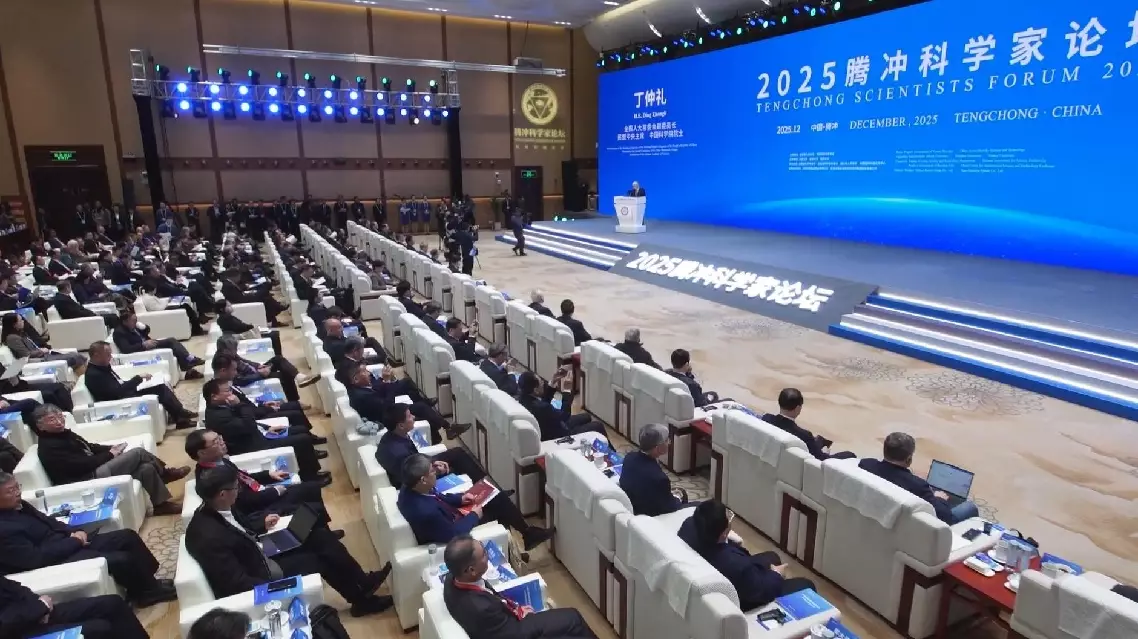
Global scientists gather in Tengchong to advance innovation-driven development