MIAMI--(BUSINESS WIRE)--Dec 6, 2025--
TheOther, a premium matcha brand sourcing ceremonial-grade, first harvest matcha from Uji, Japan, made its official debut during Art Basel with an intimate multi-sensory dinner last night at Forte Dei Marmi followed by a private after party at SOPRA Club in Miami Beach.
This press release features multimedia. View the full release here: https://www.businesswire.com/news/home/20251206676337/en/
Co-hosted by British Rapper Central Cee, the evening celebrated TheOther Master’s Blend, a first-harvest matcha crafted in collaboration with one of Japan’s most respected tea-growing lineages, spanning over five generations. Along with TheOther’s Co-Founders Michael Lillelund and Harish Koneru, guests experienced a modern expression of the traditional tea ceremony and curated tastings, all designed to showcase the brand’s signature combination of authentic tradition and accessible luxury. The evening offered elevated signature cocktails featuring the Master's Blend in a refined Matcha Martini, Matcharita (featuring 818 Tequila ), Matcha Mojito and Highball.
Notable attendees included leading figures from fashion, art, and culture. Ghali, Christina “Tinx” Najjar, Sofia Resing,Casey Boonstra, Elizabeth Lake, Adelina Novak, Jesse Solomon, Victoria Vesce, and Mike Majlak, among others.
“We chose Forte dei Marmi and SOPRA because they embody the refined, modern spirit that sits at the heart of TheOther,” said Michael Lillelund, Co-founder and President of TheOther. “Miami’s creative pulse meets timeless Japanese elegance here, making it the perfect place to introduce TheOther to the world.”
“The balance of heritage and modernity lives in every detail of tonight’s experience,” said Harish Koneru, Co-Founder and CEO of TheOther. “From the beginning, our goal was to honor centuries of matcha tradition while bringing its ritual into a contemporary, culturally dynamic space.”
TheOther is now available online at TheOther.com, with a Miami café opening early next year.
Every TheOther product packaging includes a Renoon-powered QR code that reveals the origin and story of the tea leaves you’re about to enjoy, helping customers engage with what they buy.
ABOUT THEOTHER
TheOther is a premium matcha brand offering ceremonial-grade first harvest matcha, sourced directly from Uji, Japan. With a mission to bring a new, no-nonsense approach to matcha, TheOther blends deep Japanese tea tradition with modern sensibilities, delivering matcha “like no other” through e-commerce and soon at its Miami flagship cafe. TheOther is now available online at TheOther.com, with a Miami café opening in early 2026.
Download event images - HERE
Photo credit: Zach Hilty/ BFA.com
Download event images - HERE
Photo Credit: Emrgent Media Group

Central Cee Performs for Full-Capacity Crowd at TheOther Launch Party at SOPRA Club in Miami Beach. Photo Courtesy of: Emrgent Media Group
NEW YORK (AP) — Tomatoes, ubiquitous in everything from fast-food burgers to haute cuisine, are taking on a new role beyond the plate: A nagging reminder of rising costs.
Prices for those red orbs have soared more than any other food product over the past year to cement a spot as one of the consumer headaches du jour.
“The tomato has become a symbol of something much deeper,” says Isaac Bernal Carbajo, a New York City chef who lamented life's “simplest pleasures” falling victim to price increases. “Something as basic as buying fresh vegetables is starting to become a serious financial decision for many families.”
Tomato prices are up about 40% over a year ago, according to the latest Consumer Price Index, dwarfing increases for other groceries, including coffee (up 18.5%), beef roasts (up 17.8%) and frozen fish and seafood (up 12%), among other products that have become symbols of America’s affordability squeeze.
A separate inflation gauge released Thursday showed that overall prices increased 3.8% in April from a year earlier, the highest reading in nearly three years.
Alongside crop yields, experts blame price increases for tomatoes, in part, on two pillars of President Donald Trump’s second-term policies: the Iran war and tariffs. The war spiked gas prices and increased shipping costs. Meantime, the U.S. withdrew from a deal allowing duty-free imports of tomatoes from Mexico, which grows most of America's supply.
Usha Haley, a Wichita State University economist, says it's “a perfect storm of trade policy, extreme weather and Mideast policy.”
American tomato farmers cheered the withdrawal from the tomato deal last July, saying it would help rebuild their shrinking industry. But for consumers, it's been painful. Though the U.S. withdrew from the Mexico tomato deal in July, it took time to see the impact in the produce aisle, with more imports in late winter and early spring.
When the tomatoes arrived, they were slapped with a 17% tariff.
“Tariffs are undeniably a big driver of the price inflation,” says Brett Massimino, a Virginia Commonwealth University business professor. “Because the U.S. relies on Mexico for the majority of its tomato supply, any changes in trade policy can have a large impact.”
U.S. tariffs collected on tomatoes ballooned from just $16,424 in 2024 to nearly $4.6 million, according to federal data, a staggering 27,879% increase.
As the cost trickles down, outraged shoppers have pulled out their phones in the produce aisle, shooting videos lamenting costs they said quadrupled, with some vowing to plant a garden to avoid prices of up to $8 a pound. But the impact has been most pronounced for businesses that rely on tomatoes as a key ingredient in their kitchens.
MarginEdge, which tracks prices for restaurants, says grape tomatoes have increased most — 65% in just a month — but prices have gone up across all types of tomatoes.
Phillip Coles, a professor of supply chain management at Lehigh University, says prices should drop later in the year when domestically grown tomatoes are harvested. Higher prices, he says, will also “induce farmers to increase planting to meet the demand, but this takes longer because of the lead time.”
Meantime, it's translating to a big hit for businesses like Snarf’s Sandwiches, which puts a tomato in nearly every sandwich it makes.
Wayne Humphrey, chief operating officer of Snarf’s, which operates dozens of stores in Colorado, Missouri and Texas, said cases of tomatoes went from costing him $27 to $93 in the space of a year, piled on top of rising expenses for other ingredients including bread and beef, as well as increased labor costs.
“That single ingredient now costs us more than $1.7 million in additional spend annually,” says Humphrey. “The math is getting harder to ignore.”
Associated Press writer Dee-Ann Durbin contributed to this report. Matt Sedensky can be reached at msedensky@ap.org and https://x.com/sedensky
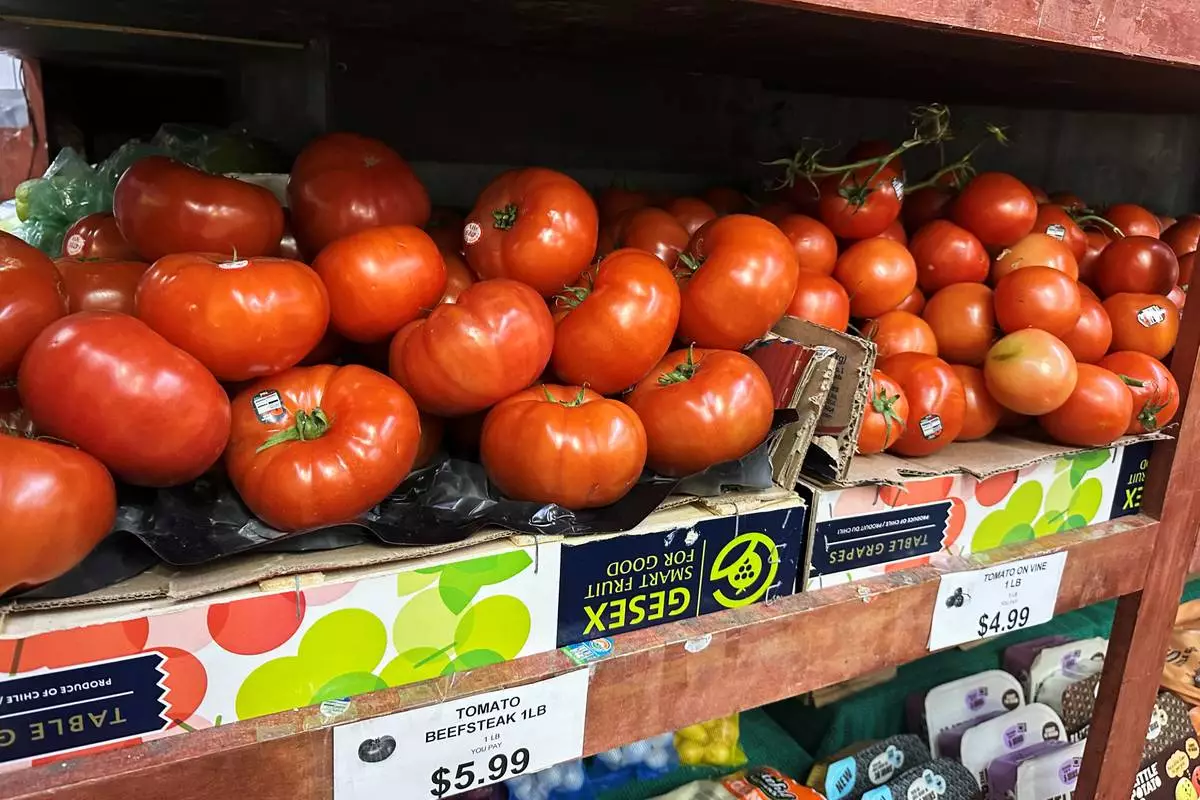
Tomatoes await customers on the shelves of a supermarket in New York on Tuesday, May 26, 2026. (AP Photo/Matt Sedensky)
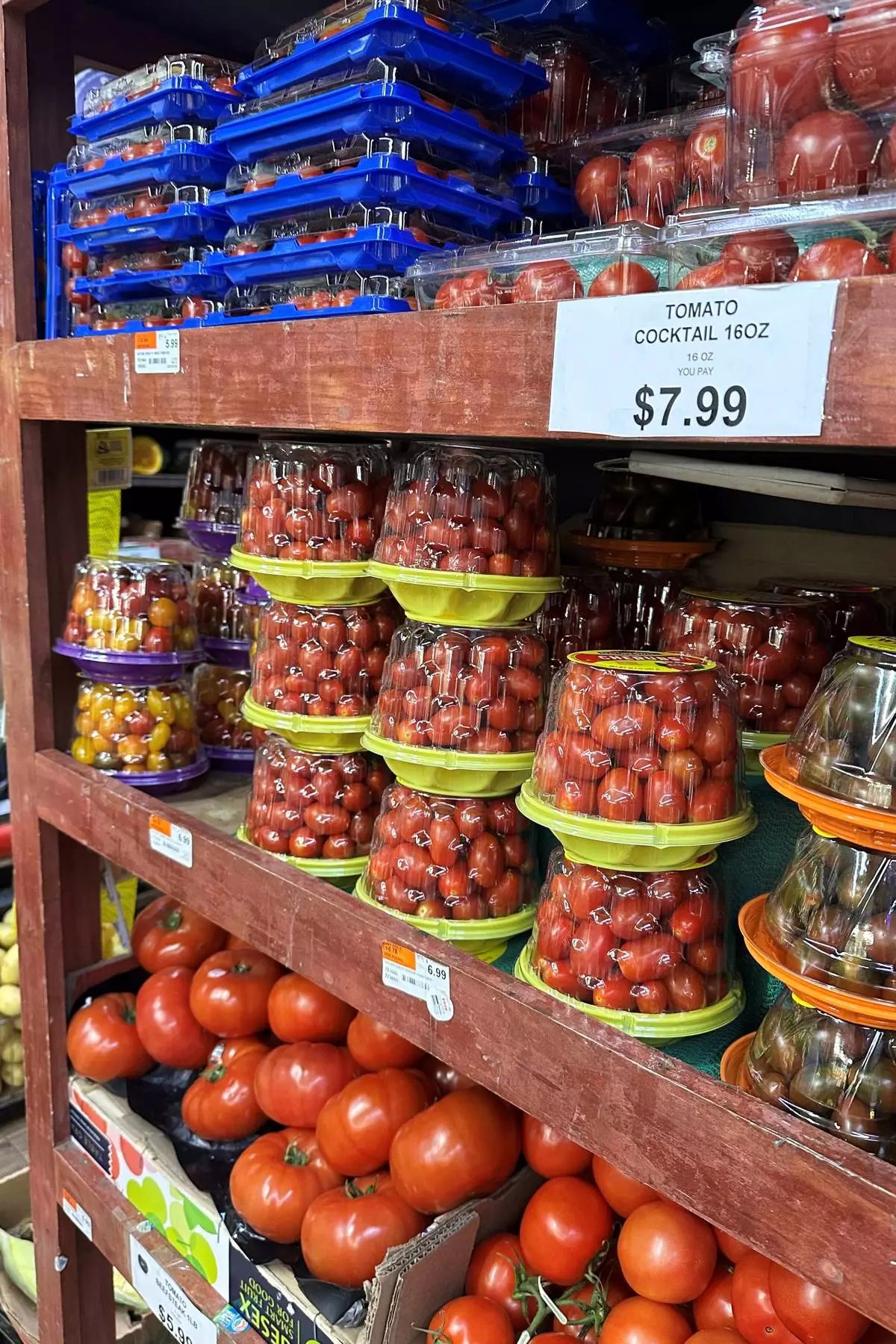
Tomatoes await customers on the shelves of a supermarket in New York on Tuesday, May 26, 2026. (AP Photo/Matt Sedensky)