The securities industry should provide investors with a wider range of products more conducive to long-term investments, said Wu Qing, chairman of the China Securities Regulatory Commission (CSRC) at the 8th Member Congress of the China Securities Association on Saturday.
Noting that stocks and funds account for only about 15 percent of Chinese residents' assets, the chairman emphasized that the country can harness the huge potential demand for asset management and wealth management.
"We must proactively cater to the diverse wealth management needs of investors with different risk appetites, investment scales, and investment horizons, providing more abundant and targeted products and services which are more conducive to long-term and value investments. We must work together with investors for mutual benefit and win-win outcomes, jointly participating in and sharing the fruits of economic and capital market development," said Wu.
As investor confidence and market resilience have significantly strengthened, the total market capitalization of A-shares -- stocks traded on Chinese mainland markets -- exceeded 100 trillion yuan (about 14 trillion U.S. dollars) for the first time in August.
Amid the growth, Wu stressed that stability remains the bottom line for the industry, calling on institutions to strengthen compliance and risk control while focusing on risks in areas such as margin trading, securities lending, and over-the-counter business to prevent illegal interference by shareholders and safeguard the rights and interests of small and medium-sized investors.
According to CSRC policy guidelines, the commission will appropriately optimize supervision of high-quality institutions to support their improvement in capital efficiency, while for a few problematic securities firms, it will strictly supervise and punish them according to law, resolutely clear out non-compliant shareholders, and maintain market order and stability.

China's top securities regulator urges abundant long-term investment products
The 32nd Asia-Pacific Economic Cooperation (APEC) Ministers Responsible for Trade Meeting concluded in east China's Suzhou on Saturday, yielding fruitful results and laying significant groundwork for the APEC Economic Leaders' Meeting in November.
The trade ministers' meeting focused on "building an open and predictable regional and multilateral economic and trade order" and "fostering new engines of innovative and dynamic trade and investment cooperation."
Chinese Commerce Minister Wang Wentao briefed the media on the meeting's outcomes at a press conference.
Wang said the meeting issued a joint statement titled the Suzhou Statement, and approved the latest edition of the APEC Roadmap for Innovative, Competitive and Resilient Services.
All parties agreed to advance policy innovation and reform in services trade, build an open and predictable investment environment, improve regional trade facilitation and supply chain resilience, strengthen standards coordination, and enhance intellectual property protection, Wang told the media.
He also said that substantial progress was made on a framework document for regional digital trade cooperation and the ministers emphasized promoting inclusive AI development, strengthening AI-related trade, and bridging the digital divide to ensure shared benefits from digital transformation.
The minister noted that the outcomes of the meeting demonstrated strong cooperation willingness, highlighted an innovation-oriented approach, and reflected inclusiveness and shared benefits. "The fact that Asia-Pacific economies can come together, uphold the original aspiration of promoting trade and investment liberalization and facilitation while supporting economic growth and prosperity, and engage in in-depth discussions on the important issue of 'where multilateral and regional economic and trade cooperation is headed,' fully demonstrates that open regionalism and true multilateralism enjoy broad support, and that mutual success and shared development serve the fundamental interests of all economies," Wang said.
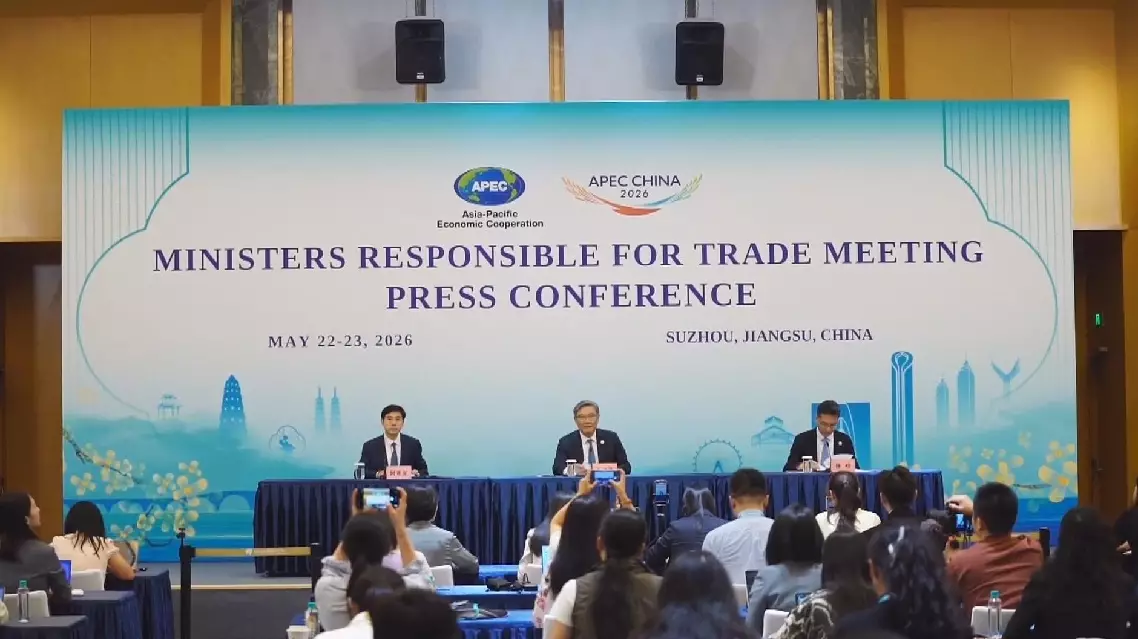
2026 APEC trade ministers' meeting concludes with fruitful results