Two brilliant rainbows arched over the majestic Hukou Waterfall on the Yellow River on Thursday, creating a spectacular winter tableau alongside the glistening icicles fringing the riverbank in northwest China.
This rare phenomenon occurred as turbulent waters, funneled through the narrow Hukou gorge, plunged downward and churned up vast clouds of mist. Carried aloft by the wind, the fine spray refracted sunlight to produce two distinct, vividly colored rainbows.
Staff at the scenic area said that rainbows are actually more common in winter than in summer, owing to abundant water vapor and pronounced day-night temperature differentials; nevertheless,the appearance of a double rainbow remains a rare occurrence.
As temperatures fall and water flow diminishes, sections of the Hukou Waterfall have begun to freeze, adorning the railings and rocks along the banks with spectacular icicles of diverse shapes.
The Hukou Waterfall is the largest waterfall on the Yellow River -- China's second-longest river -- and the world's largest yellow waterfall. Located between Shanxi and Shaanxi Provinces in northern and northwest China, the waterfall lies within a narrow, precipitous gorge and is renowned for its rapid flow and thunderous roar.
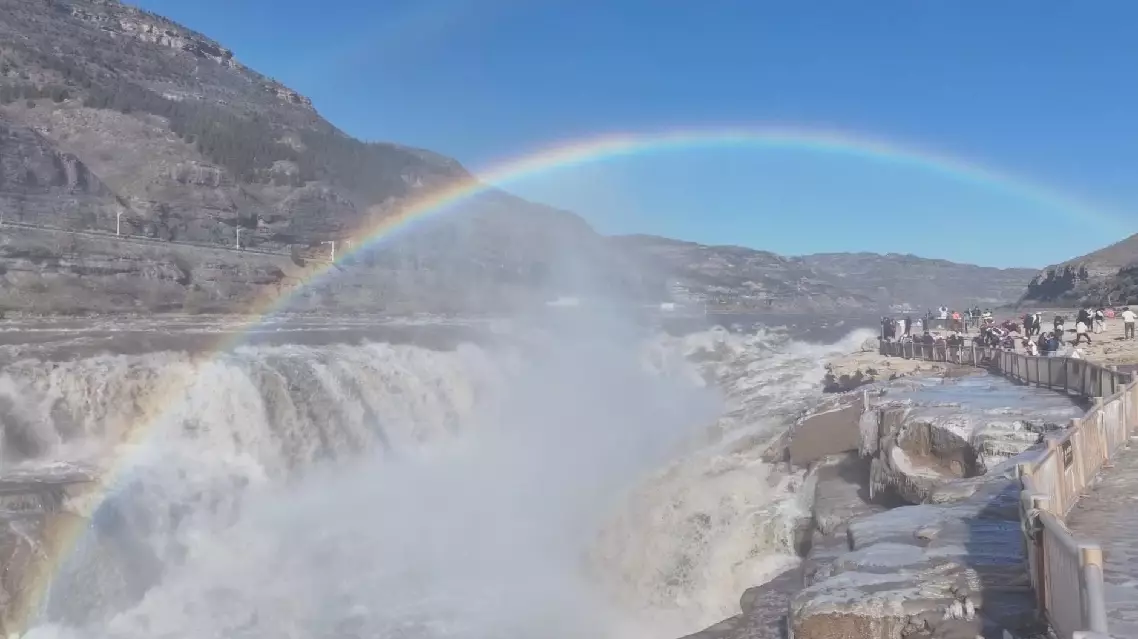
Double rainbows, icicles form spectacular winter scenery of Yellow River's Hukou Waterfall
China's 42nd Antarctic Expedition team has started unloading supplies for scientific exploration after arriving at waters near the Zhongshan Station, a Chinese research base in Antarctica.
The ongoing seven-month scientific exploration mission is supported by Chinese icebreakers the Xuelong and the Xuelong 2, which set sail from Shanghai on Nov 1.
The two icebreakers will deliver about 2,000 tons of supplies to the Zhongshan Station for scientific exploration.
The Xuelong 2 arrived first at a designated unloading spot about 12 kilometers from the Zhongshan Station. Later, the ship's Ka-32 helicopter transported in batches more than 300 tons of polar fuel to the research base when weather conditions were favorable.
"Nearly 90 members of the expedition team carried by the two ship are already at the Zhongshan Station, preparing for receiving supplies and assignments for scientific exploration," said Wang Tao, person in charge of unloading operations at the Zhongshan Station.
Thanks to more than 30 hours of efforts by the Xuelong 2 to widen the channel and lead the way, the Xuelong, which was carrying about 1,500 tons of supplies, has also arrived at the unloading spot.
The unloading operations, involving a combination of sea-ice transport and helicopter lifts, are expected to be finished within two weeks.
And then, the Xuelong and the Xuelong 2 will proceed to China's Qingling Station and Changcheng Station in Antarctica, respectively.
The expedition team includes more than 500 members from over 80 institutions on the Chinese mainland, along with researchers from more than 10 other countries and regions, such as Thailand, Chile and Portugal, as well as China's Hong Kong and Macao Special Administrative Regions, in support of broader international scientific collaboration.
They will conduct multi-disciplinary scientific surveys, advance several major national research projects, and test domestically developed equipment under polar conditions.
Particularly, scientific drilling experiments in lakes deep in the Antarctic inland ice sheet will be carried out for the first time.
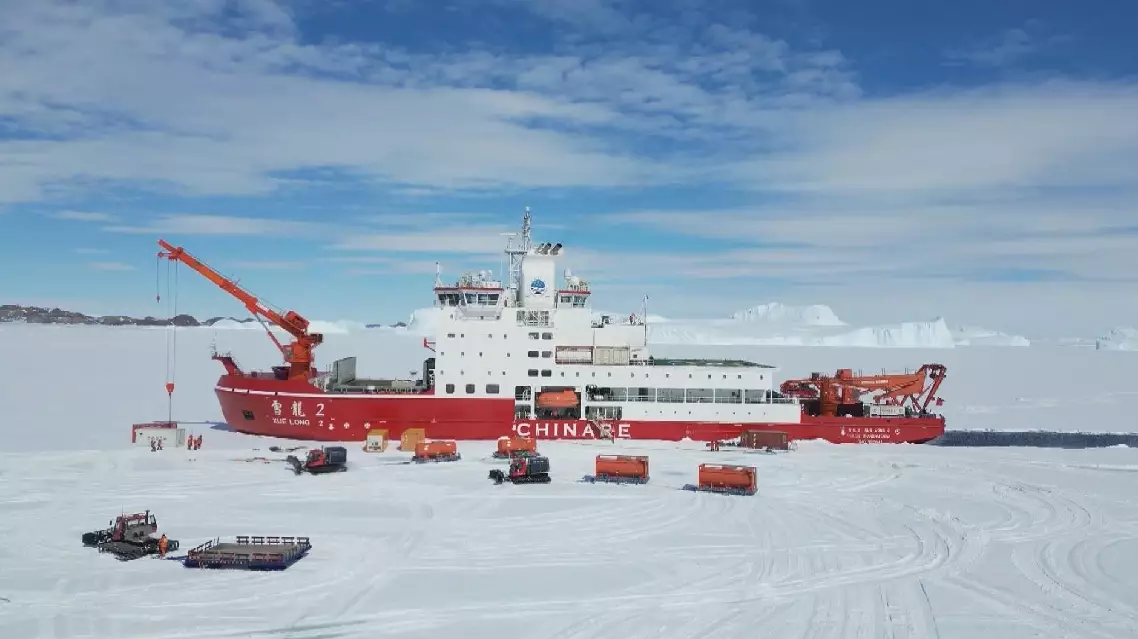
China's 42nd Antarctic Expedition team unloads supplies at Zhongshan Station