NEW YORK (AP) — Orlando star forward Franz Wagner left the Magic’s loss to the New York Knicks with a lower leg injury during the first quarter Sunday.
Wagner was going up for a dunk on a lob pass from teammate Anthony Black when he was fouled hard by Knicks center Ariel Hukporti with 4:43 remaining in the period. Wagner appeared to land awkwardly on his left leg and immediately grabbed at the area below his knee before needing help going to the Magic locker room.
Hukporti’s foul was reviewed for a flagrant foul, but the call of common foul was confirmed.
The Magic ruled Wagner out for the remainder of the game and said in a statement he would be re-evaluated upon the team’s return to Orlando. The Magic are slated to host the Miami Heat in the NBA Cup quarterfinals Tuesday at Kia Center.
“You never want to see anybody go down, but that hurt my heart, watching him hit the floor,” Magic coach Jamahl Mosley said. “Now I’m just praying that everything is going to be OK with him, but we just don’t like to see that happen to him, especially (Wagner), who does everything the right way at all times he’s on the floor.”
Wagner is the Magic’s leading scorer and is tied for 20th in the NBA with 23.4 points per game. He had scored seven points on 3-for-4 shooting in seven minutes before leaving the game.
“You never like seeing nobody go down, whether it’s your team or the opposing,” Magic guard Jalen Suggs said. “We’re praying for (Wagner’s) recovery, and we’ll see what it’s like when we get back home, but our thoughts and our love are with him. We’re a family, so whenever you see one of your own go down, it’s tough.”
The Knicks outscored the Magic 17-9 over the remainder of the quarter and led 35-31 after one. Orlando rebounded by outscoring New York 24-19 in the second and had a 55-54 halftime lead.
“I think it took us a minute to respond, which is natural. One of your brothers goes down, it takes a moment,” Mosley said. “My heart hurt as soon as he went down, so it’s hard to get yourself back in that space. But our guys, I think as time went on, they got themselves back into it.”
The Magic just got Paolo Banchero back in their last game, a 106-105 win over the Heat on Friday, after he missed 10 in a row with a left groin injury. Yet, Orlando’s dynamic combination of Banchero and Wagner lasted less than five quarters before Wagner went down.
“We’ve been here before, and you always lean on the things that have happened in the past a little bit, to take that experience, but we’ve got to learn from it,” Mosley said. “We talked about our depth and our defense being our strong suit, so our guys are going to have to step up to the plate depending on how long guys are out for.”
AP NBA: https://apnews.com/hub/NBA
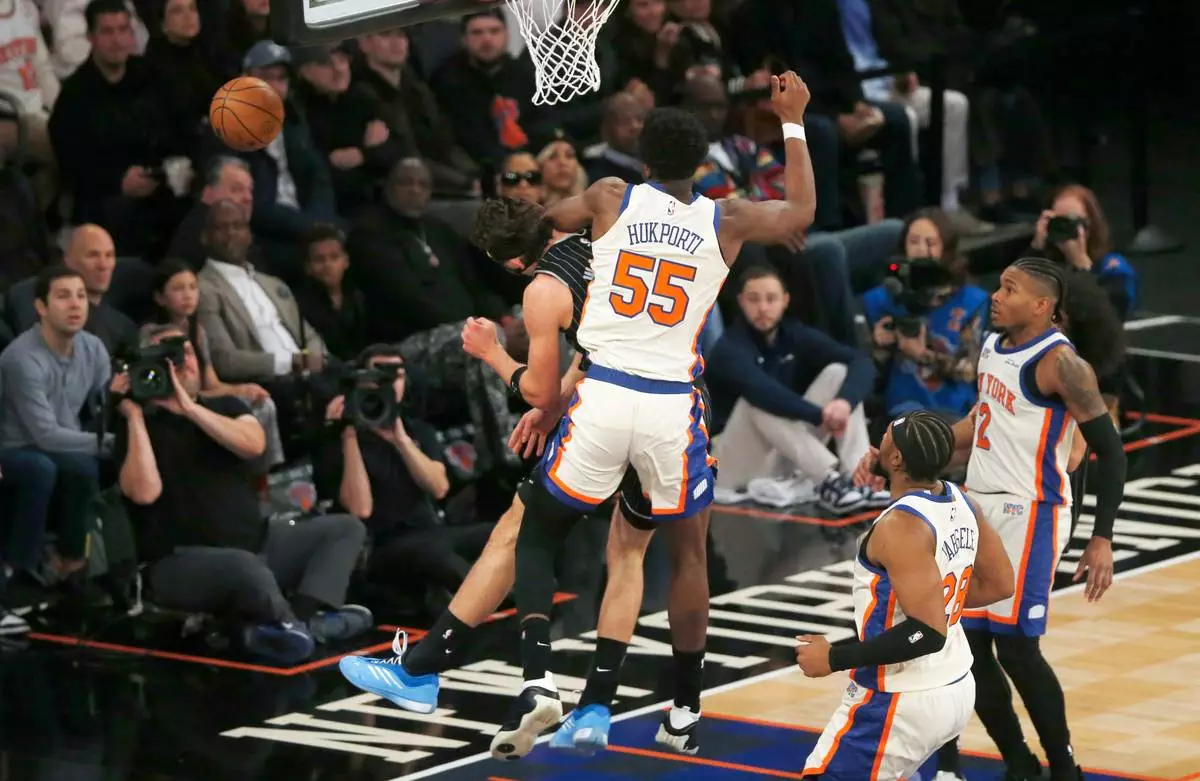
New York Knicks center Ariel Hukporti (55) fouls Orlando Magic forward Franz Wagner, left, during the first half of an NBA basketball game Sunday, Dec. 7, 2025, in New York. Wagner did not return to action after the play. (AP Photo/John Munson)

New York Knicks center Ariel Hukporti (55) fouls Orlando Magic forward Franz Wagner, left, during the first half of an NBA basketball game Sunday, Dec. 7, 2025, in New York. Wagner did not return to action after the play. (AP Photo/John Munson)
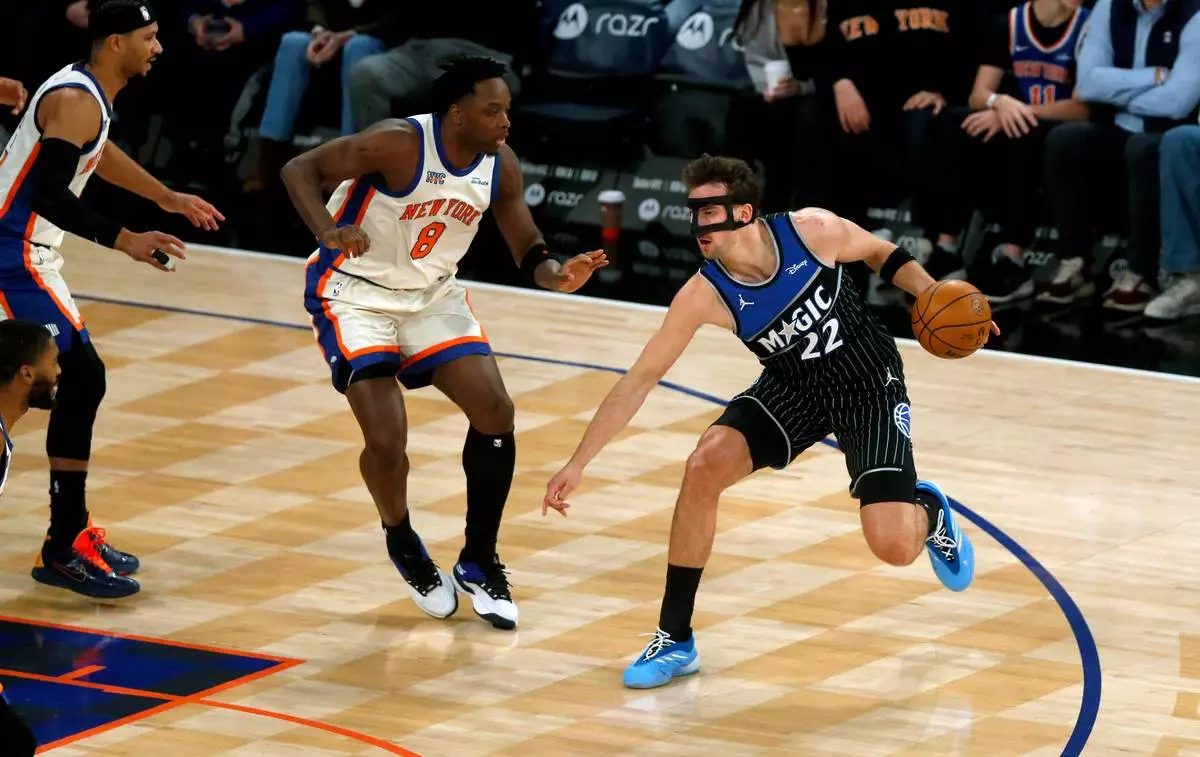
New York Knicks forward OG Anunoby, left, defends Orlando Magic forward Franz Wagner during the first half of an NBA basketball game Sunday, Dec. 7, 2025, in New York. (AP Photo/John Munson)
STANFORD, Calif. (AP) — Kyle Smith’s sales pitch to Ebuka Okorie on everything Stanford had to offer him kept on coming: For about 10 minutes the coach shared all the great things he believed could happen if Okorie decided to come West and play basketball for the Cardinal.
Turns out Smith could have saved his words and energy during their sit-down that day. The under-the-radar point guard from New Hampshire had already made up his mind to move across the country instead of attending Harvard as he’d originally planned — and as his parents had hoped.
Okorie made the choice during his recruiting visit to The Farm.
“He actually gave me a little speech,” Okorie recalled. “He was talking to me for like 10 minutes and then at the end of his speech I told him I was committing and we still laugh and joke about it today because he was basically saying I should have just said it at first so he didn’t have to give me a whole speech.”
They enjoy reflecting on all of it now, nearly a year and a half later and with Okorie leading the way for Stanford (20-12). He scored 14 points in a 64-63 loss to Pittsburgh in the Atlantic Coast Conference Tournament on Tuesday but still has a chance to finish as the ACC’s top scorer — beginning the week ahead of Duke's conference player of the year and rookie of the year Cameron Boozer — and already is the league's regular-season scoring champion. Okorie began the week ranked fifth in the nation averaging 23.1 points per game and second among freshmen.
The last Stanford player who led the conference in scoring was Landry Fields in 2009-10, at 22 points per game.
“I was just selling Stanford, why you should do it and he let me go on the whole deal and I was just talking about, ‘Hey, you’re a great fit, we want guys that are committed, guys with great attitudes, great work ethic and your profile,’ how academics is important,” Smith shared. “I went on and on and on and on. And then he’s like, ‘I’m coming.’ That’s when I said, ‘You let me rattle on, you were coming the whole time?’”
Initially, Okorie had decided on Harvard over Brown based on his Nigerian parents’ guidance that it would be a better choice academically. Then Okorie’s high school coach from Brewster Academy in New Hampshire, Jason Smith, reached out to Stanford and some other programs inquiring about whether there might be an opportunity for him at a more prominent school in a bigger conference.
On Monday, the 6-foot-2 Okorie was named to the All-ACC first team and ACC All-Rookie team. He also averages 3.7 rebounds, 3.6 assists and 1.6 steals.
Okorie doesn’t even turn 19 until April — and the next pressing question will be whether he stays put at Stanford or declares for the NBA Draft. Okorie insists he isn’t thinking about all of that just yet.
Stanford has been a nice fit so far.
“It’s been great. From the beginning the coaches and all my teammates have welcomed me,” he said. “I’ve been working and I feel like I’ve earned my spot. Coming here I feel like I had the opportunity to do that. It’s been really fun.”
Smith has challenged Okorie to be more vocal, recently presenting him with a five-page “Cardinal Rules” tutorial — Smith wrote the “manifesto” as he calls it — about playing point guard at Stanford, using the names of past Cardinal stars at the position like Chris Hernandez and Brevin Knight as part of the lesson.
He didn’t give that to Okorie right way, rather waiting until the freshman found a rhythm with college basketball and life as a student-athlete.
That comfort level shows, whether in front of a big crowd or behind the scenes.
During a practice last week at Maples Pavilion, Okorie flipped an overhead pass to Donavin Young, who knocked down the 3-pointer as Okorie pumped his fist in delight on the opposite side of the arc.
Okorie then yelled “He can’t guard you!” after AJ Rohosy drove to his left for a layup and converted the three-point play.
“Good take!” Okorie let out when Jaylen Thompson made a three-point play of his own a couple of minutes later.
His spirit is infectious, and Okorie insists all the support from the players around him like senior guard Benny Gealer has been the reason he has adapted so quickly and had the kind of season he has had.
“That’s really high praise from a great player who has been great for our team, as important as any one of us,” Gealer said. “He’s just so talented as a young person. I feel like he’s probably giving me too much credit. I’m just there to support him and encourage him and keep him locked in because you don’t really see too many talents like him come by. I know coach wants him to maximize his potential and every one of us wants him to maximize his potential, too.”
Okorie is doing just that.
Smith loves watching the growth and maturity Okorie exhibits each day, initially figuring Okorie would play 20 to 25 minutes per game “and now he’s a two-way player and I can’t take him out of the game."
Everybody involved has celebrated Okorie, taking to heart Smith’s recent message of having joy for others.
“It’s pretty amazing,” Smith said. “He’s just so coachable, and where I’m at in my life and my coaching career it’s ‘enjoy the ride.’ … He’s just a good dude, so he’s easy to root for.”
Get poll alerts and updates on the AP Top 25 throughout the season. Sign up here and here (AP News mobile app). AP college basketball: https://apnews.com/hub/ap-top-25-college-basketball-poll and https://apnews.com/hub/college-basketball
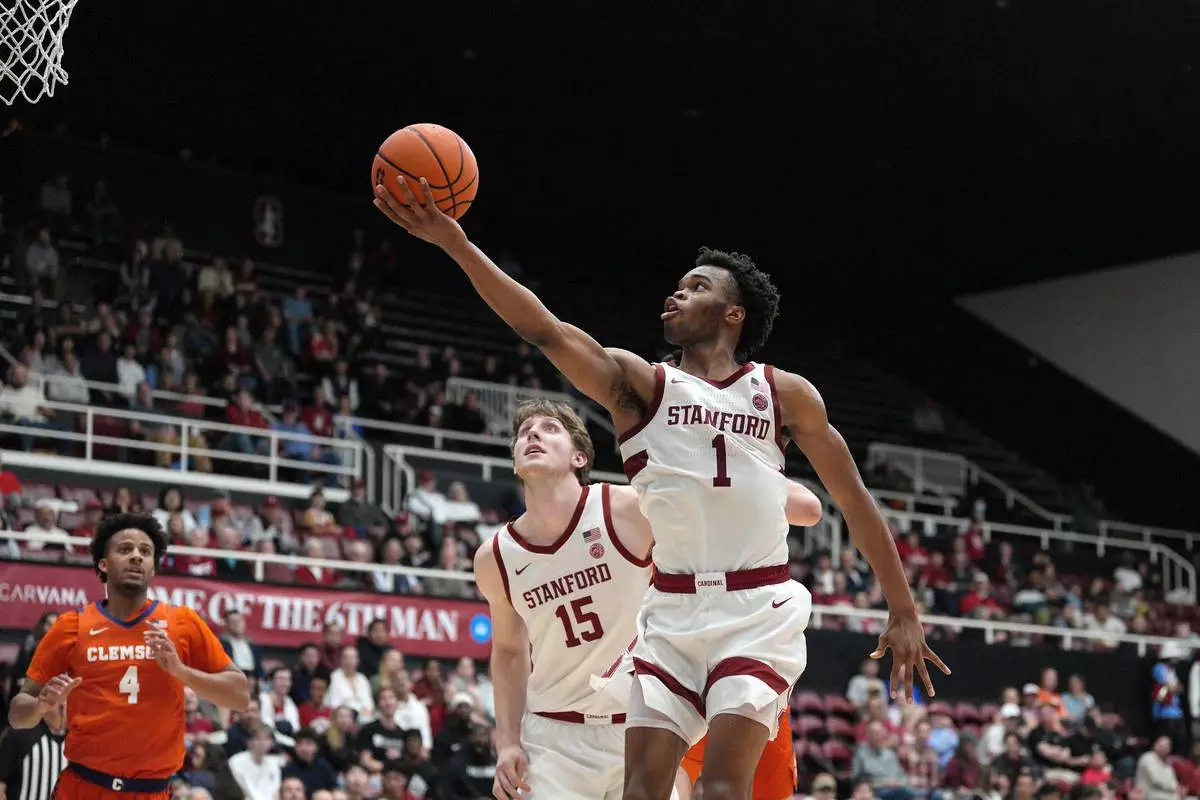
FILE - Stanford guard Ebuka Okorie (1) drives to the basket against Clemson during the second half of an NCAA college basketball game in Stanford, Calif., Wednesday, Feb. 4, 2026. (AP Photo/Tony Avelar, File)
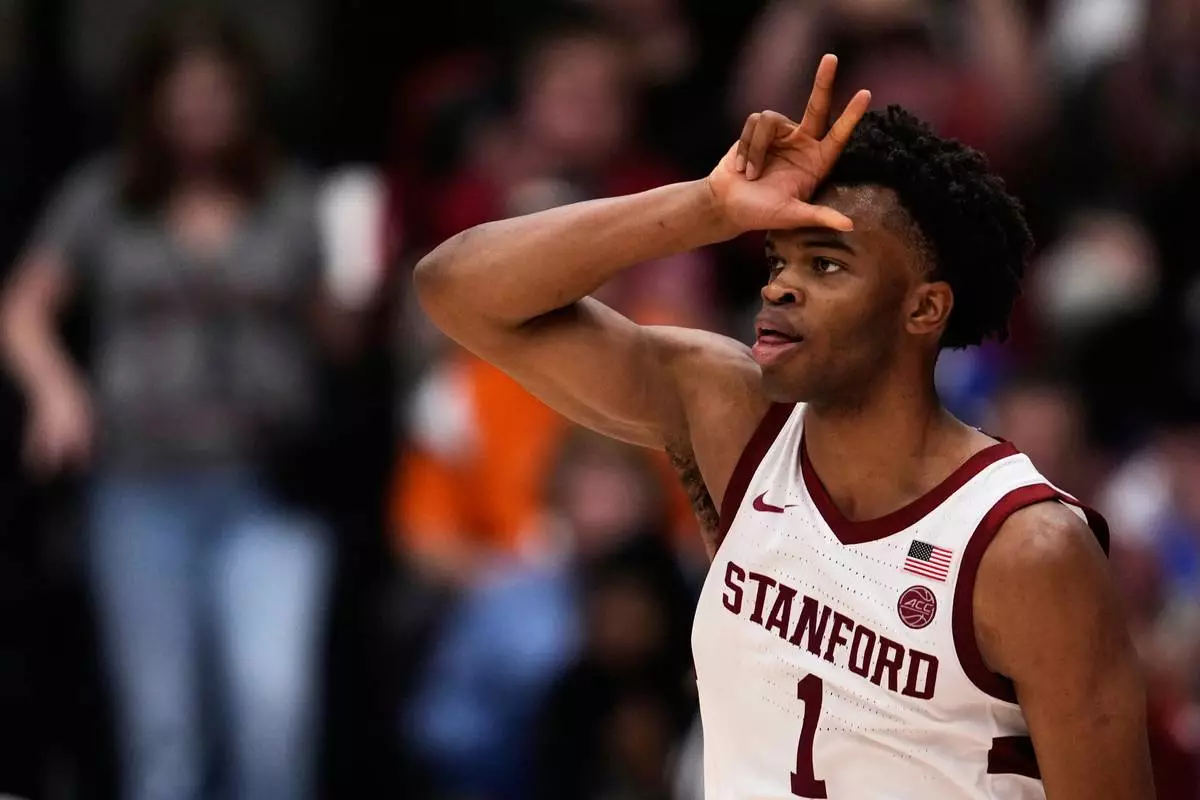
FILE - Stanford guard Ebuka Okorie (1) reacts after making a 3-point basket during the first half of an NCAA college basketball game against Duke, Saturday, Jan. 17, 2026, in Stanford, Calif. (AP Photo/Godofredo A. Vásquez, File)