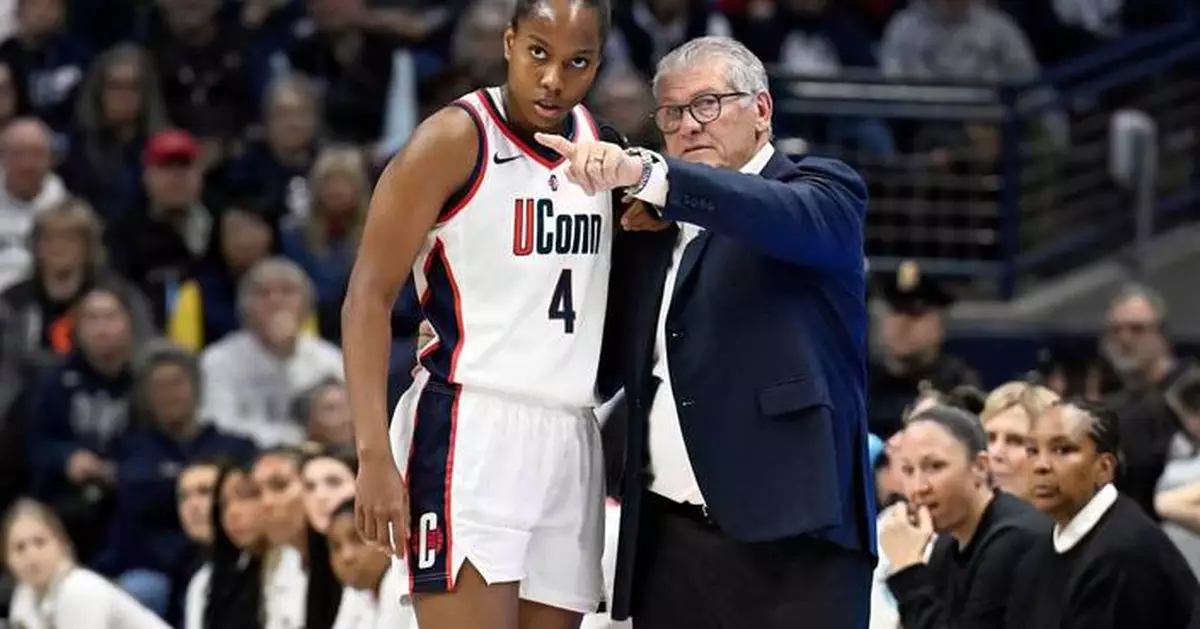
STORRS, Conn. (AP) — Sarah Strong had 20 points, five rebounds, five steals and four assists, Azzi Fudd scored all of her 16 points in the first half and had four steals, and top-ranked UConn beat DePaul 102-35 on Sunday to extend its Big East regular-season winning streak to 40.
UConn (9-0, 2-0) finished with 23 steals, its third game this season with at least 20. Fifteen of those came in the first half as the Huskies led 58-18 at halftime on a day when UConn retired Hall of Fame guard Sue Bird’s No. 10 in a ceremony before the game.
Kayleigh Heckel had 16 points, six rebounds and five assists, and Jana El Alfy had a season-high 11 points. KK Arnold added seven points and seven assists.
Fudd and Strong combined for 10 points as UConn scored the first 14 points. UConn shot 75% from the field in the first quarter to race out to a 28-9 lead. Strong had four baskets in the first four minutes of the second quarter to put the Huskies up by 30 as the Huskies won their 27th game in a row against DePaul.
This was UConn's largest margin of victory in 28 meetings against the Blue Demons, topping a 47-point win in 2013.
Gina Davorija and Devin Hagemann with eight points apiece for DePaul (2-8, 0-2). Ally Timm had back-to-back 3-pointers in the second quarter.
DePaul is home against UMass Lowell on Thursday.
UConn plays at No. 16 USC on Saturday.
Get poll alerts and updates on the AP Top 25 throughout the season. Sign up here. AP women’s college basketball: https://apnews.com/hub/ap-top-25-womens-college-basketball-poll and https://apnews.com/hub/womens-college-basketball
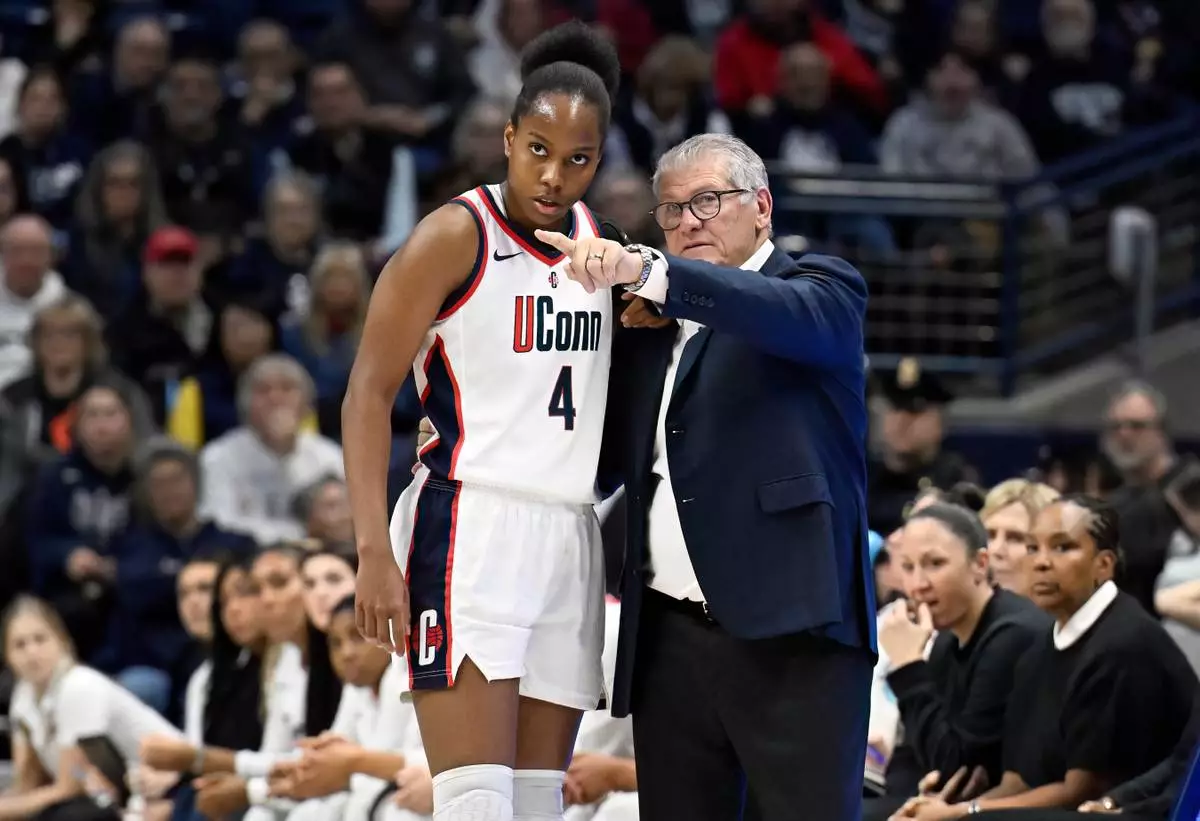
UConn head coach Geno Auriemma, right, talks with UConn guard Blanca Quinonez (4) in the first half of an NCAA college basketball game against DePaul, Sunday, Dec. 7, 2025, in Storrs, Conn. (AP Photo/Jessica Hill)
LONDON (AP) — Keir Starmer has never had a bad word to say in public about Donald Trump.
That is not being reciprocated now as the American president lambasts the British prime minister over his reluctance to join the U.S.-Israeli strikes on Iran.
The dispute is roiling a relationship that Starmer worked hard to forge, and further straining trans-Atlantic ties frayed by Trump’s “America first” foreign policy and transactional approach to international relations.
“This was the most solid relationship of all. And now we have very strong relationships with other countries in Europe,” Trump told British tabloid The Sun in an interview published Tuesday.
“I mean, France has been great. They’ve all been great," Trump said. “The U.K. has been much different from others.”
“It’s very sad to see that the relationship is obviously not what it was,” he said.
Starmer initially blocked American planes from using British bases for the attacks on Iran that started on Saturday. He later agreed to let the United States use bases in England and on Diego Garcia in the Indian Ocean to strike Iran’s ballistic missiles and their storage sites, but not to hit other targets.
Even after the British base at Akrotiri in Cyprus was hit by an Iran-made drone over the weekend, Starmer said that the United Kingdom “will not join offensive action.”
The British leader also offered a rare, though implicit, rebuke of the U.S. president, saying the U.K. government doesn't believe in “regime change from the skies.”
“Any U.K. actions must always have a lawful basis and a viable, thought-through plan,” Starmer told lawmakers in the House of Commons on Monday.
“President Trump has expressed his disagreement with our decision not to get involved in the initial strikes, but it is my duty to judge what is in Britain’s national interest,” Starmer added.
The Financial Times called it Starmer’s “Love Actually moment” — a reference to the 2003 movie scene in which a British prime minister played by Hugh Grant stands up to a bullying U.S. president played by Billy Bob Thornton.
Friction between the two leaders has been building for months. Trump’s threat to take over Greenland was denounced by Starmer and other European leaders earlier this year. Recently, Trump has condemned Britain’s agreement to hand over the Chagos Islands, home to the Diego Garcia base, to Mauritius, despite his administration earlier backing the deal.
Peter Ricketts, a former head of the U.K. Foreign Office, told The Observer newspaper that under Trump, “the Americans have effectively given up on any effort to be consistent with international law.”
That is a red line for the law-abiding Starmer, a barrister and former chief prosecutor for England and Wales.
The spat is a setback for Starmer’s efforts to woo Trump since the president's return to office in 2025. The British government rolled out the red carpet to the president for a state visit as the guest of King Charles III, and Starmer consistently has praised Trump's efforts — so far unsuccessful — to broker an end to the Russia-Ukraine war.
The Iran war has also divided European leaders, who fall along a spectrum from condemnation to support.
NATO Secretary-General Mark Rutte said that he unreservedly approves of Trump’s decision to attack Iran and kill its supreme leader, and called the war crucial for Europe’s security.
The U.K., France and Germany jointly said that they weren't involved in the strikes, but were prepared to enable “necessary and proportionate defensive action to destroy Iran’s capability to fire missiles and drones at their source.”
Spanish Prime Minister Pedro Sánchez condemned the strikes as “unjustifiable” and “dangerous.”
Polling suggests many Britons are skeptical of the U.S. justification for war. But politicians to the right of Starmer’s Labour Party slammed the prime minister for not joining the offensive. Conservative leader Kemi Badenoch said that her party “stands behind America taking this necessary action against state-sponsored terror.”
Foreign Office Minister Stephen Doughty denied the U.S.-U.K. “special relationship” was on the ropes.
“Our relationship with the United States is strong,” he said Tuesday in the House of Commons. “It has endured, it continues to endure, and it will endure into the future on both the economic and the security fronts.”
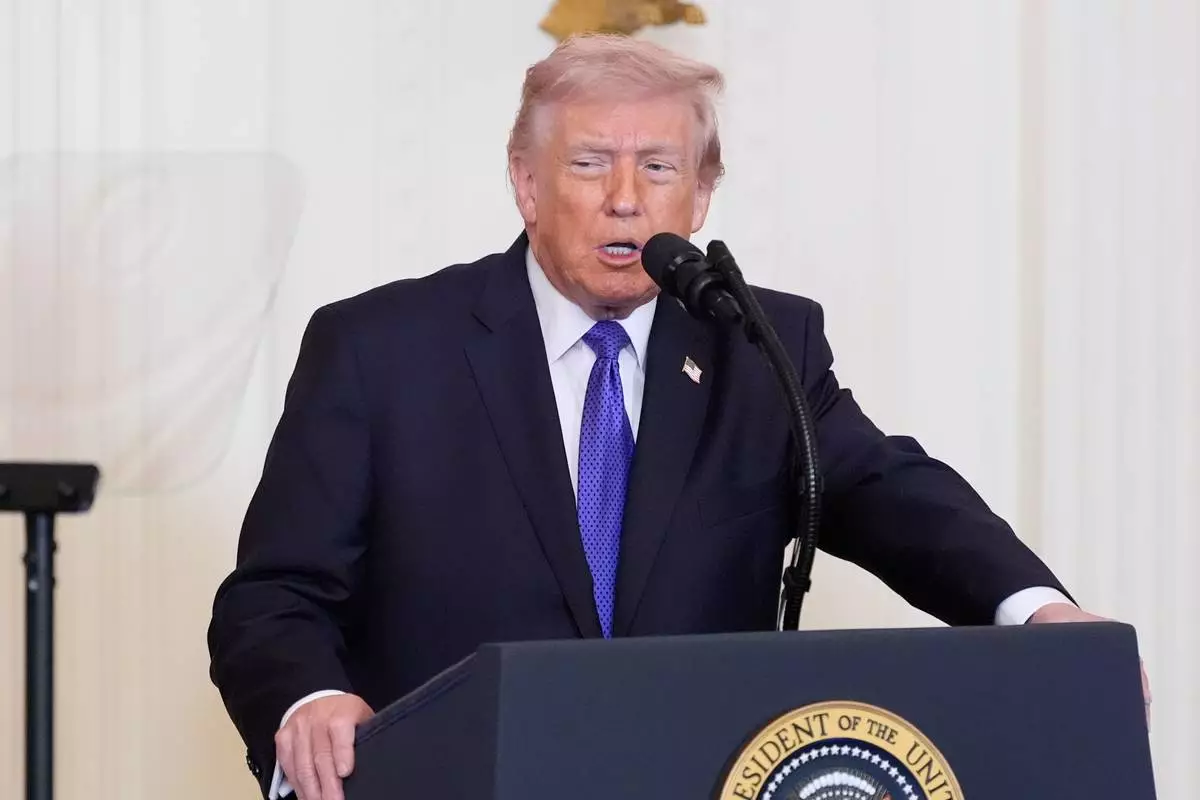
President Donald Trump speaks about Iran before a Medal of Honor ceremony in the East Room of the White House, Monday, March 2, 2026, in Washington. (AP Photo/Alex Brandon)
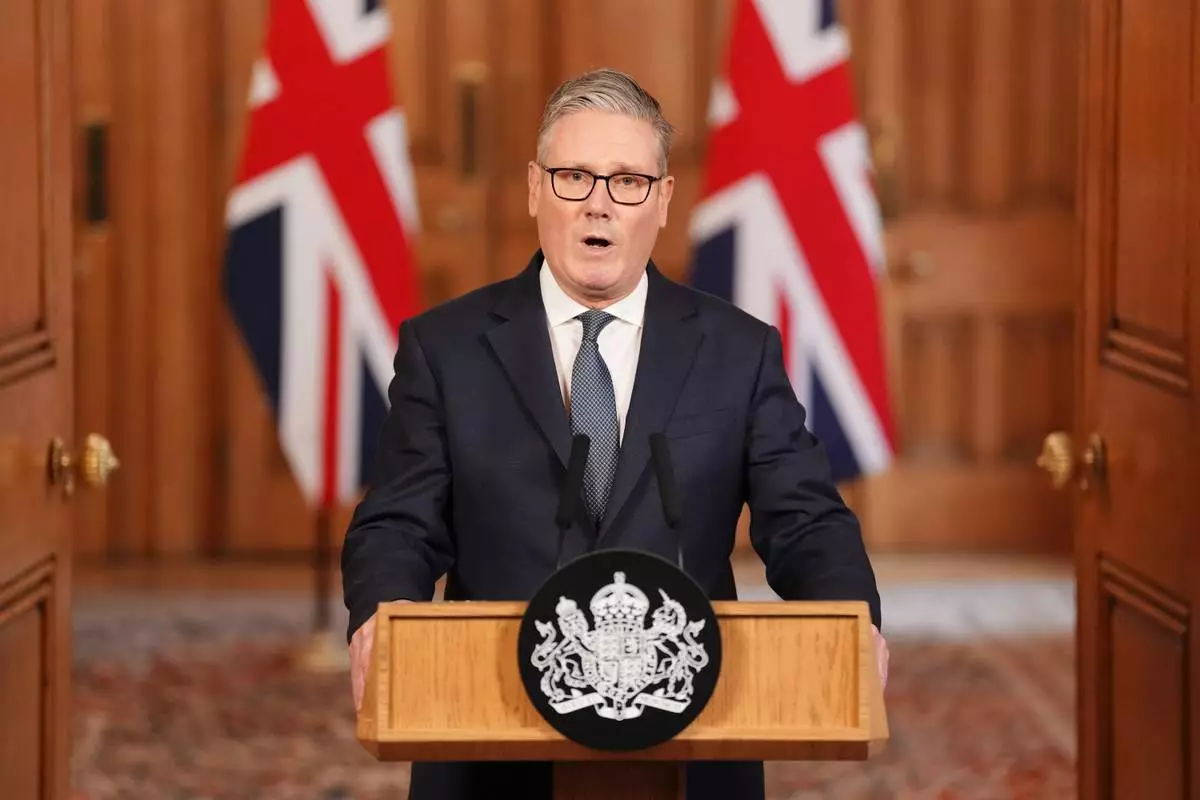
Britain's Prime Minister Keir Starmer issues a statement at 10 Downing Street, London, on the latest developments in the Middle East, Saturday Feb. 28, 2026. (Jonathan Brady/Pool via AP)
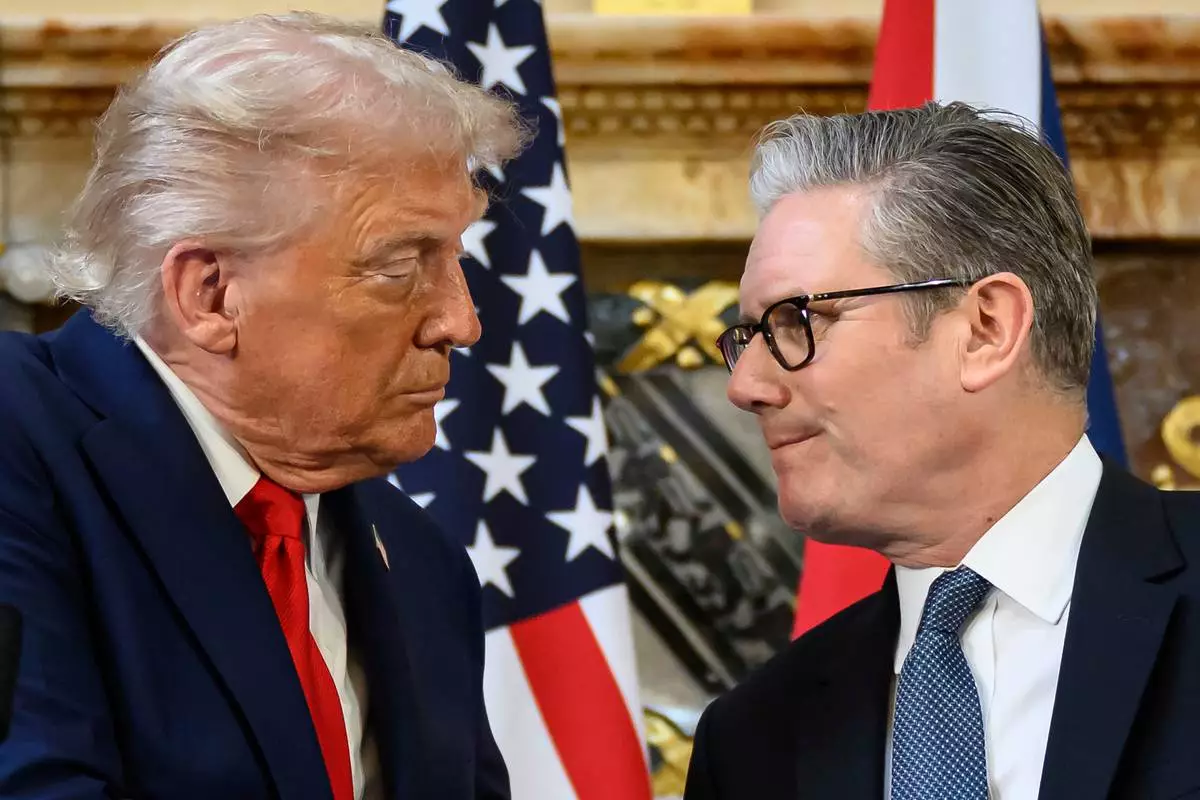
U.S. President Donald Trump, left, and British Prime Minister Keir Starmer look at each other as they shake hands during a press conference at Chequers near Aylesbury, England, Thursday Sept. 18, 2025. Leon Neal/Pool Photo via AP, File)