|
YANTAI, China, Dec. 8, 2025 /PRNewswire/ -- On December 4, the 2025 Shandong Green Low-carbon High-quality Development Conference was held in Yantai, Shandong province. Against the backdrop of the fifth anniversary of China's 'dual carbon' goals, Yantai's achievements—as one of the country's first pilot cities for carbon peaking and for realizing the value of ecological products—are more than local practice; they represent a notable example in the global conversation about sustainable development pathways for bay areas.
From the precision manufacturing of Tokyo Bay to the financial innovation of New York Bay and the deep integration of the Guangdong–Hong Kong–Macao Greater Bay Area, bay areas have become pivotal geographic units driving global economic and technological changes. On the shores of the Yellow Sea and the Bohai Sea, Yantai—a representative bay–area economy—is addressing contemporary challenges through its green development practices.
As a cradle of China's modern industry, Yantai's industrial system spans 37 of the country's 41 major industrial categories. It is the first ordinary prefecture–level city in the northern part of China to join the 'one–trillion–yuan GDP club,' and is hailed as the region's strongest prefecture–level city. Yantai is currently home to more than 50 listed companies with a combined market value exceeding 1.2 trillion yuan.
In recent years, Yantai has prioritized clean energy as one of its 16 key industrial chains, building a new energy system that coordinates nuclear, wind, solar, and hydrogen power alongside energy storage and liquefied natural gas (LNG). It has advanced major projects in nuclear power, offshore wind power, and offshore photovoltaics, forging a distinct clean-energy identity.
The development of clean energy in Yantai boasts eight notable 'firsts': producing Shandong's first kilowatt-hour of nuclear power and first kilowatt-hour of offshore wind power; delivering China's first kilowatt-hour from a pile–based fixed offshore photovoltaic project and the world's first from a deep–sea floating offshore photovoltaic project; completing the country's first integrated demonstration of offshore wind power and marine ranching; constructing the country's largest coastal photovoltaic-plus-energy-storage station; bringing the country's first commercial nuclear energy heating demonstration project into operation; and achieving the highest installed clean-energy capacity in Shandong. These accomplishments represent a systemic revolution in energy use, not merely a collection of projects.
Data show that, over the past three years, Yantai has cut its energy consumption intensity by a cumulative 20.9%, meeting its energy saving and carbon reduction targets for 19 consecutive years. Its installed clean-energy capacity has now surpassed 17 million kilowatts.
Looking ahead, Yantai is charting a new growth path with six future-oriented industries—life sciences, deep-sea and aerospace technologies, next–generation nuclear power, artificial intelligence, new electronic materials, and humanoid robotics—which are expected to drive green, low–carbon, high–quality development. The city projects that total output value of industrial enterprises above the designated size will exceed 1.7 trillion yuan by 2027, a target supported by sustained investment in innovation.
YANTAI, China, Dec. 8, 2025 /PRNewswire/ -- On December 4, the 2025 Shandong Green Low-carbon High-quality Development Conference was held in Yantai, Shandong province. Against the backdrop of the fifth anniversary of China's 'dual carbon' goals, Yantai's achievements—as one of the country's first pilot cities for carbon peaking and for realizing the value of ecological products—are more than local practice; they represent a notable example in the global conversation about sustainable development pathways for bay areas.
From the precision manufacturing of Tokyo Bay to the financial innovation of New York Bay and the deep integration of the Guangdong–Hong Kong–Macao Greater Bay Area, bay areas have become pivotal geographic units driving global economic and technological changes. On the shores of the Yellow Sea and the Bohai Sea, Yantai—a representative bay–area economy—is addressing contemporary challenges through its green development practices.
As a cradle of China's modern industry, Yantai's industrial system spans 37 of the country's 41 major industrial categories. It is the first ordinary prefecture–level city in the northern part of China to join the 'one–trillion–yuan GDP club,' and is hailed as the region's strongest prefecture–level city. Yantai is currently home to more than 50 listed companies with a combined market value exceeding 1.2 trillion yuan.
In recent years, Yantai has prioritized clean energy as one of its 16 key industrial chains, building a new energy system that coordinates nuclear, wind, solar, and hydrogen power alongside energy storage and liquefied natural gas (LNG). It has advanced major projects in nuclear power, offshore wind power, and offshore photovoltaics, forging a distinct clean-energy identity.
The development of clean energy in Yantai boasts eight notable 'firsts': producing Shandong's first kilowatt-hour of nuclear power and first kilowatt-hour of offshore wind power; delivering China's first kilowatt-hour from a pile–based fixed offshore photovoltaic project and the world's first from a deep–sea floating offshore photovoltaic project; completing the country's first integrated demonstration of offshore wind power and marine ranching; constructing the country's largest coastal photovoltaic-plus-energy-storage station; bringing the country's first commercial nuclear energy heating demonstration project into operation; and achieving the highest installed clean-energy capacity in Shandong. These accomplishments represent a systemic revolution in energy use, not merely a collection of projects.
Data show that, over the past three years, Yantai has cut its energy consumption intensity by a cumulative 20.9%, meeting its energy saving and carbon reduction targets for 19 consecutive years. Its installed clean-energy capacity has now surpassed 17 million kilowatts.
Looking ahead, Yantai is charting a new growth path with six future-oriented industries—life sciences, deep-sea and aerospace technologies, next–generation nuclear power, artificial intelligence, new electronic materials, and humanoid robotics—which are expected to drive green, low–carbon, high–quality development. The city projects that total output value of industrial enterprises above the designated size will exceed 1.7 trillion yuan by 2027, a target supported by sustained investment in innovation.
** The press release content is from PR Newswire. Bastille Post is not involved in its creation. **

Yantai offers global bay areas a paradigm of low-carbon transformation

Yantai offers global bay areas a paradigm of low-carbon transformation
|
The new imaging flagship series fuses advanced hardware with visionary TECNO AI to empower artistic creation, streamline daily life, and safeguard the digital experience.
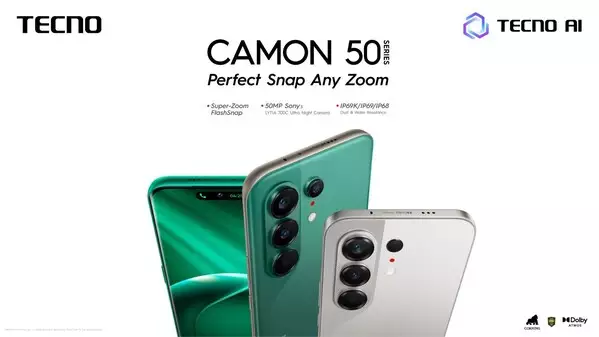
BARCELONA, Spain, March 4, 2026 /PRNewswire/ -- AI-driven innovative technology brand TECNO today took the stage at MWC 2026 to unveil the CAMON 50 Series. Featuring the CAMON 50 Ultra 5G, CAMON 50 Pro, and CAMON 50, the lineup represents a bold evolution in mobile technology—seamlessly merging professional-grade hardware with intuitive, integrated AI.
A Professional Imaging System, Re-imagined with AI
The CAMON 50 Ultra 5G is a powerhouse built for visionaries. At its core lies a segment-leading 50MP Sony LYTIA 700C Ultra Night Camera, engineered to achieve exceptional clarity even in the most challenging low-light environments. Complementing this is a dedicated 50MP 3X Telephoto Camera (available on Ultra 5G and Pro models) that brings the iconic 70mm portrait focal length to your fingertips. Whether capturing intimate, flattering close-ups or seizing crisp action from across a stadium with its AI 60X SuperZoom, this flagship system ensures every perspective is rendered with professional-grade precision.
Beyond the lens, the AI RAW 2.0 imaging engine acts as the brain of the CAMON 50 Ultra 5G system, mastering complex light and detail to deliver surgical accuracy and crystalline clarity. The experience is further elevated by Super-Zoom FlashSnap, a breakthrough that seamlessly merges high-speed action capture with powerful telephoto capabilities, allowing users to freeze split-second emotions with perfect precision even from a distance. To perfect the creative process, the industry-first AI Auto Zoom serves as an on-the-go editor, intelligently detecting subjects and cropping for optimal composition into a gallery-ready masterpiece.
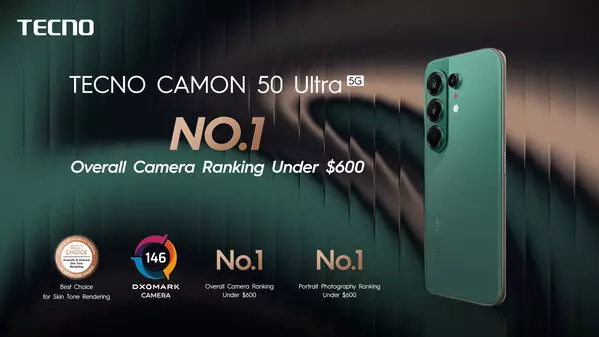
Underscoring its exceptional imaging capabilities, the CAMON 50 Ultra 5G achieved an impressive DXOMARK overall camera score of 146—the highest for smartphones under $600—along with a stellar portrait score of 142, ranking among the top in its price segment. "With the upcoming CAMON 50 Ultra 5G, TECNO's proprietary Universal Tone technology confirms a bright and engaging image style that closely matches how users naturally see the scene. Combined, these strengths will make the CAMON 50 Ultra 5G stand out as a compelling choice for accurate and inclusive skin tone rendering under $600," commented Frédérique Guichard, CEO of DXOMARK.
Everyday AI: A Creative and Efficient Partner
TECNO believes AI should empower your vision, not complicate it. The CAMON 50 Series debuts the industry-first AI Art Gallery, a creative sanctuary where ordinary photos transcend into extraordinary art. Driven by the Dream Scape Model, it offers a global palette of artistic styles, allowing you to reimagine your world through the lens of world-renowned masterpieces or vibrant local heritage. This creative freedom extends beyond the static: the AI Image-to-Video Generator breathes life into still images, while Live Photo captures the heart of every moment and AI 3D PhotoSpace adds immersive spatial depth to ordinary photos.
Even in challenging environments, AI LightMaster 2.0 acts as your invisible lighting crew, vanishing glare, reflections, and distracting shadows with a single tap. Beyond the lens, this intelligence is woven into the fabric of daily life. A dedicated AI Key puts a professional researcher and editor in your pocket; whether you are distilling complex articles with One-Tap FlashMemo, refining social media captions via AI Writing 2.0, or managing wellness via the AI Health Assistant. The upgraded AI assistant, Ella, has evolved into a versatile mentor, serving as your personal Oral Practice Partner and a 24/7 problem-solving tutor.
The CAMON 50 Series also leverages the OneLeap platform to deliver a "silky smooth" experience with TECNO Laptops and MEGAPADs. This interconnected hub facilitates Phone Mirroring, Keyboard and Mouse Sharing, as well as Cross-device Copy and Paste for Text and Image, transforming the series into a high-efficiency workspace.
Engineered for Confidence: Security and Durability Built to Last
The CAMON 50 Series is engineered as a steadfast guardian of your digital life. It marks the debut of TGuard, TECNO's comprehensive security ecosystem. A defining pillar of TGuard is its industry-first off-grid search technology, enabling you to pinpoint your device's location even without a SIM card or when the battery is completely depleted.
The flagship CAMON 50 Ultra 5G delivers reliable performance powered by the MediaTek Dimensity 7400 Ultimate processor. All models in the series feature a 1.5K 144Hz Ultra-bright AMOLED display for ultra-smooth visuals. Durability is paramount, with the series featuring the highest IP68/IP69/IP69K dust and water resistance. This is coupled with a 5-year durability battery of up to 6500mAh (varies by market) and 45W Super Charge. For explorers, the innovative FreeLink technology allows for network-free calling and messaging over Bluetooth Long Range.
"The CAMON 50 Series is designed to be a thoughtful partner in your day," said Jack Guo, General Manager of TECNO. "The AI isn't just for show; it's there to help, whether that's by remembering important information for you, giving your photos a creative twist, or simply making your phone smarter and easier to use. We've focused on making cutting-edge AI feel warm and intuitive, a natural extension of your creativity and your daily life."
For any related media queries, please contact pr.tecno@tecno-mobile.com.
## END ##
About TECNO
As a global innovative technology brand with operations in over 70 markets, TECNO has been committed to revolutionizing the digital experience in global emerging markets, relentlessly pushing for the perfect integration of contemporary, aesthetic design with the latest technologies and AI. TECNO offers a wide range of smartphones, smart wearables, laptops and tablets, smart gaming, HiOS operating systems and smart home products. Guided by its brand essence of "Stop At Nothing", TECNO is committed to unlocking the newest technologies and AI-powered new experiences for forward-looking individuals, inspiring them to never stop pursuing their best selves and their best futures. For more information, please visit TECNO's official site: www.tecno-mobile.com.
The new imaging flagship series fuses advanced hardware with visionary TECNO AI to empower artistic creation, streamline daily life, and safeguard the digital experience.
BARCELONA, Spain, March 4, 2026 /PRNewswire/ -- AI-driven innovative technology brand TECNO today took the stage at MWC 2026 to unveil the CAMON 50 Series. Featuring the CAMON 50 Ultra 5G, CAMON 50 Pro, and CAMON 50, the lineup represents a bold evolution in mobile technology—seamlessly merging professional-grade hardware with intuitive, integrated AI.
A Professional Imaging System, Re-imagined with AI
The CAMON 50 Ultra 5G is a powerhouse built for visionaries. At its core lies a segment-leading 50MP Sony LYTIA 700C Ultra Night Camera, engineered to achieve exceptional clarity even in the most challenging low-light environments. Complementing this is a dedicated 50MP 3X Telephoto Camera (available on Ultra 5G and Pro models) that brings the iconic 70mm portrait focal length to your fingertips. Whether capturing intimate, flattering close-ups or seizing crisp action from across a stadium with its AI 60X SuperZoom, this flagship system ensures every perspective is rendered with professional-grade precision.
Beyond the lens, the AI RAW 2.0 imaging engine acts as the brain of the CAMON 50 Ultra 5G system, mastering complex light and detail to deliver surgical accuracy and crystalline clarity. The experience is further elevated by Super-Zoom FlashSnap, a breakthrough that seamlessly merges high-speed action capture with powerful telephoto capabilities, allowing users to freeze split-second emotions with perfect precision even from a distance. To perfect the creative process, the industry-first AI Auto Zoom serves as an on-the-go editor, intelligently detecting subjects and cropping for optimal composition into a gallery-ready masterpiece.
Underscoring its exceptional imaging capabilities, the CAMON 50 Ultra 5G achieved an impressive DXOMARK overall camera score of 146—the highest for smartphones under $600—along with a stellar portrait score of 142, ranking among the top in its price segment. "With the upcoming CAMON 50 Ultra 5G, TECNO's proprietary Universal Tone technology confirms a bright and engaging image style that closely matches how users naturally see the scene. Combined, these strengths will make the CAMON 50 Ultra 5G stand out as a compelling choice for accurate and inclusive skin tone rendering under $600," commented Frédérique Guichard, CEO of DXOMARK.
Everyday AI: A Creative and Efficient Partner
TECNO believes AI should empower your vision, not complicate it. The CAMON 50 Series debuts the industry-first AI Art Gallery, a creative sanctuary where ordinary photos transcend into extraordinary art. Driven by the Dream Scape Model, it offers a global palette of artistic styles, allowing you to reimagine your world through the lens of world-renowned masterpieces or vibrant local heritage. This creative freedom extends beyond the static: the AI Image-to-Video Generator breathes life into still images, while Live Photo captures the heart of every moment and AI 3D PhotoSpace adds immersive spatial depth to ordinary photos.
Even in challenging environments, AI LightMaster 2.0 acts as your invisible lighting crew, vanishing glare, reflections, and distracting shadows with a single tap. Beyond the lens, this intelligence is woven into the fabric of daily life. A dedicated AI Key puts a professional researcher and editor in your pocket; whether you are distilling complex articles with One-Tap FlashMemo, refining social media captions via AI Writing 2.0, or managing wellness via the AI Health Assistant. The upgraded AI assistant, Ella, has evolved into a versatile mentor, serving as your personal Oral Practice Partner and a 24/7 problem-solving tutor.
The CAMON 50 Series also leverages the OneLeap platform to deliver a "silky smooth" experience with TECNO Laptops and MEGAPADs. This interconnected hub facilitates Phone Mirroring, Keyboard and Mouse Sharing, as well as Cross-device Copy and Paste for Text and Image, transforming the series into a high-efficiency workspace.
Engineered for Confidence: Security and Durability Built to Last
The CAMON 50 Series is engineered as a steadfast guardian of your digital life. It marks the debut of TGuard, TECNO's comprehensive security ecosystem. A defining pillar of TGuard is its industry-first off-grid search technology, enabling you to pinpoint your device's location even without a SIM card or when the battery is completely depleted.
The flagship CAMON 50 Ultra 5G delivers reliable performance powered by the MediaTek Dimensity 7400 Ultimate processor. All models in the series feature a 1.5K 144Hz Ultra-bright AMOLED display for ultra-smooth visuals. Durability is paramount, with the series featuring the highest IP68/IP69/IP69K dust and water resistance. This is coupled with a 5-year durability battery of up to 6500mAh (varies by market) and 45W Super Charge. For explorers, the innovative FreeLink technology allows for network-free calling and messaging over Bluetooth Long Range.
"The CAMON 50 Series is designed to be a thoughtful partner in your day," said Jack Guo, General Manager of TECNO. "The AI isn't just for show; it's there to help, whether that's by remembering important information for you, giving your photos a creative twist, or simply making your phone smarter and easier to use. We've focused on making cutting-edge AI feel warm and intuitive, a natural extension of your creativity and your daily life."
For any related media queries, please contact pr.tecno@tecno-mobile.com.
## END ##
About TECNO
As a global innovative technology brand with operations in over 70 markets, TECNO has been committed to revolutionizing the digital experience in global emerging markets, relentlessly pushing for the perfect integration of contemporary, aesthetic design with the latest technologies and AI. TECNO offers a wide range of smartphones, smart wearables, laptops and tablets, smart gaming, HiOS operating systems and smart home products. Guided by its brand essence of "Stop At Nothing", TECNO is committed to unlocking the newest technologies and AI-powered new experiences for forward-looking individuals, inspiring them to never stop pursuing their best selves and their best futures. For more information, please visit TECNO's official site: www.tecno-mobile.com.
** This press release is distributed by PR Newswire through automated distribution system, for which the client assumes full responsibility. **

TECNO CAMON 50 Series: Redefining Professional Imaging Through the Power of Practical AI
TECNO CAMON 50 Series: Redefining Professional Imaging Through the Power of Practical AI

TECNO CAMON 50 Series: Redefining Professional Imaging Through the Power of Practical AI
TECNO CAMON 50 Series: Redefining Professional Imaging Through the Power of Practical AI