Guangzhou, the capital city of south China's Guangdong Province, is developing a comprehensive network of rehabilitation services and barrier-free facilities to improve the daily life and social integration of people with disabilities.
From citywide rehabilitation centers to a system delivering rehabilitation services to the tune of over 640,000 times annually, and from accessible public transportation to the country's first batch of top-level barrier-free venues, the city, which is jointly hosting China's 12th National Games for Persons with Disabilities and the 9th National Special Olympic Games with the Hong Kong and Macao Special Administrative Regions (SARs) from Dec 8 to 15, is creating a comprehensive support system to enable people with disabilities to engage more fully in society.
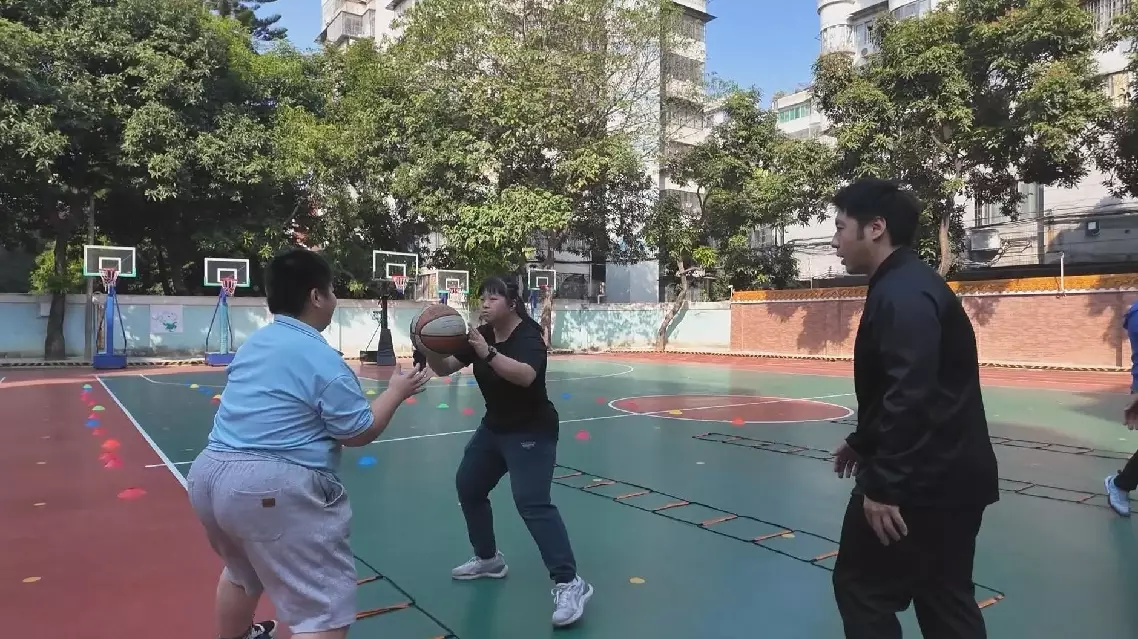
On a basketball court in Guangzhou, a group of young people with disabilities are learning to play basketball. Among them are children with autism and intellectual disabilities. One of the players, the 22-year-old Yongxin, has an intellectual disability, and this court has become a gateway for her to connect with society.
"Yongxin was very afraid of interacting with others when she first came here, and she was also overweight. To address her situation, we provided regular exercise-based rehabilitation. Now her overall condition has improved, and she is able to better integrate into society," said Liang Zihao, a basketball coach with the Guangzhou Xinyou Service Association for Persons with Mental and Intellectual Disabilities.
Yongxin now works at a supermarket. After several years of inclusive sports and social adaptation training, she can efficiently complete tasks such as restocking shelves and arranging shopping baskets.
For children with disabilities, the period from birth to the age of six is considered critical for rehabilitation that lays the foundation for lifelong development. The Guangdong Rehabilitation Center for Persons with Disabilities provides tailored education and rehabilitation programs for children with different conditions. In 2024 alone, similar institutions throughout the city delivered rehabilitation services to people with disabilities to the tune of more than 649,000 times.
"We mainly use approaches that combine rehabilitation and education to help the kids improve their capabilities to adapt to daily life, including developing their language and motor abilities, with the ultimate goal of enhancing their capacity to adapt to life and social environments," said Wu Xianzhong, director of the Guangdong Rehabilitation Center for Persons with Disabilities.
In addition, recent years have witnessed Guangzhou's continuous efforts in constructing accessible public environments across the city, enabling residents with disabilities to move around the city freely and explore the wider world.
"It's very convenient. I often take the subway. Once we call for help, staff members will come up quickly, send us down with an inclined wheelchair lift, and assist us all the way onto the subway. When we get to another station, someone will be there to help us get off as well," said local resident Ye Wuzhang who suffers a kind of disability.
South China city boosts support for social inclusion of people with disabilities