
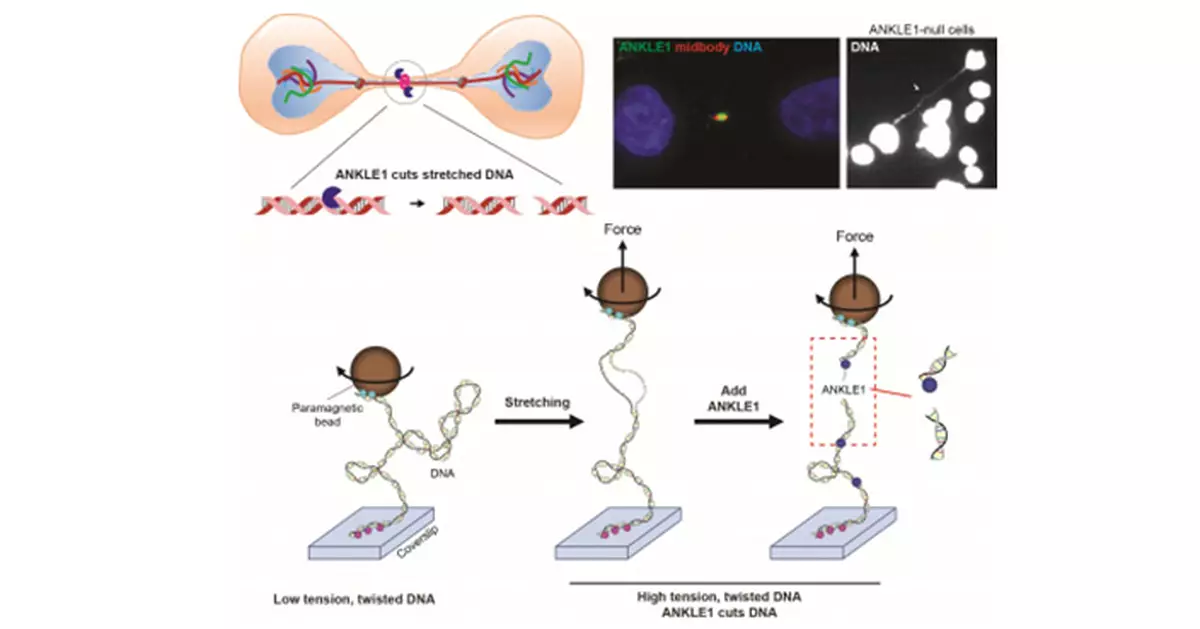
An international research team has identified a human protein, ANKLE1, as the first DNA-cutting enzyme (nuclease) in mammals capable of detecting and responding to physical tension in DNA. This ‘tension-sensing’ mechanism plays a vital role in maintaining genetic integrity during cell division—a process that, when disrupted, can lead to cancer and other serious diseases.
The study, published in Nature Communications, represents a major advance in the understanding of cellular DNA protection. The research was conducted through a cross-disciplinary collaboration between Professor Gary Ying Wai CHAN’s laboratory at the School of Biological Sciences, The University of Hong Kong (HKU) and Dr Artem EFREMOV’s biophysics team at Shenzhen Bay Laboratory (SZBL), with additional contributions from researchers at the Hong Kong University of Science and Technology (HKUST) and the Francis Crick Institute in London.
DNA under stress: the hidden danger during cell division
Every time a cell divides, it must accurately replicate and segregate its DNA. However, this process can sometimes go wrong, leaving DNA entangled and forming ‘chromatin bridges’—threads of genetic material that stretch between the two new cells as they try to separate. These bridges break under the mechanical tension generated as cells pull apart, potentially causing severe genetic errors linked to cancer and immune disorders.
‘Think of these chromatin bridges as tightropes under tension during cell division,’ explains Professor Gary Chan, senior author of the study. ‘If they snap suddenly, it can wreak havoc on the genome, causing mutations and instability.’ Until now, scientists have not fully understood how cells safely resolve these tense DNA bridges without triggering catastrophic damage.
HKU and SZBL Scientists Discover First Human DNA-Cutting Enzyme That Senses Physical Tension – A Breakthrough in Understanding How Cells Prevent Genetic Disorders
ANKLE1: the genome’s first ‘tension-sensing’ DNA cutter
The research reveals that ANKLE1, a protein previously associated with DNA repair, functions as a specialised ‘tension sensor’ nuclease during cell division. Using advanced single-molecule experiments—where individual DNA molecules are manipulated with tiny magnetic tweezers—the team discovered that ANKLE1 can ‘feel’ when DNA is stretched or twisted. Remarkably, ANKLE1 only cuts DNA under tension or when DNA is supercoiled (twisted), as occurs in overstretched chromatin bridges. This precision prevents the DNA from breaking randomly, which could otherwise cause genetic chaos.
‘Our discovery shows that ANKLE1 acts like a smart pair of scissors,’ says Dr Artem Efremov, co-senior author and biophysics expert. ‘It only cuts DNA when it is really needed—when the DNA is stretched and at risk of breaking in a harmful way. This is a completely new way for cells to sense and respond to mechanical stress on their genetic material.’
The team combined traditional biological techniques with cutting-edge biophysical tools, applying controlled forces to DNA molecules while observing ANKLE1’s activity in real time. ‘This project could only have succeeded by bringing together expertise from both disciplines,’ notes Professor Chan. ‘By using physics-based approaches, we could see how ANKLE1 responds to the physical state of DNA, something that is invisible with standard biological methods.’
Implications for genome stability and cancer therapy
This discovery marks a significant step forward in understanding how cells safeguard genetic material under physical stress. By revealing how ANKLE1’s role as a tension-sensitive DNA cutter, the research provides crucial insights into how cells prevent dangerous DNA breaks that can lead to cancer and other diseases.
Intriguingly, the study suggests that inhibiting ANKLE1 could push cancer cells—already prone to genome instability—beyond a critical threshold, potentially making them more susceptible to existing treatments. As a result, ANKLE1 may emerge as a novel therapeutic target, offering new strategies to exploit tumour vulnerabilities while deepening the knowledge of genome maintenance.
InvestHK and HKCEA co-host Mainland Spring Reception and Mainland enterprises GoGlobal Forum
Invest Hong Kong (InvestHK) and the Hong Kong Chinese Enterprises Association (HKCEA) jointly organised a Mainland Spring Reception today (March 10), gathering representatives of Mainland enterprises and business leaders to celebrate the Chinese New Year. The two parties also held the GoGlobal Forum before the reception to explore development opportunities and discuss how enterprises can leverage Hong Kong as their home port to realise international expansion plans. Both events were attended by nearly 800representatives from Mainland enterprises.
The reception was officiated by the Financial Secretary, Mr Paul Chan; Deputy Director of the Liaison Office of the Central People's Government in the Hong Kong Special Administrative Region (HKSAR) Mr Zhang Yong; the Secretary for Commerce and Economic Development, Mr Algernon Yau; the Director-General of Investment Promotion at InvestHK, Ms Alpha Lau; and the Chairman of the HKCEA, Mr Wang Haimin.
In his speech, Mr Chan pointed out that this year marks the beginning of the country's 15th Five-Year Plan, and the next five years will be a crucial period for the country's development. Under the "one country, two systems" framework, Hong Kong possesses unique institutional strengths and serves as an international hub for finance, trade, shipping, and innovation and technology. It is essential for Hong Kong to leverage these strengths to accelerate its integration into the national development strategy. The Hong Kong Special Administrative Region Government looks forward to continuing to work closely with Mainland enterprises to promote Hong Kong's prosperity and stability, and to contribute to the nation's development.
Mr Chan also noted that Mainland enterprises have long been based in Hong Kong, actively supporting the Government in driving the city's economic development and playing a pivotal role across various industries. In recent years, Mainland enterprises have accelerated their global expansion, with many of them have been using Hong Kong as a platform for fund raising, showcasing their products and services, conducting R&D activities, and managing international operations. The Government will take a multipronged approach to welcome more Mainland enterprises to Hong Kong, enabling them to fully utilise the city's one-stop financial support and international advantages to strengthen their own development.
At the GoGlobal Forum, Mr Yau said that in the face of significant opportunities arising from the Global South markets and the Belt and Road Initiative, Hong Kong, as the preferred platform for Mainland enterprises going global, is fully prepared to provide one-stop support services in navigating them to go global. He said he looks forward to seeing more Mainland enterprises expanding globally via Hong Kong, working hand in hand to achieve mutual benefits and write a new chapter for Mainland enterprises going global.
Mr Wang said that the HKCEA has united a broad spectrum of Mainland enterprises setting up in Hong Kong. It has become a cornerstone in supporting Hong Kong's economic development and maintaining the city's long-term prosperity and stability, further inspiring Mainland enterprises to regard Hong Kong as their home and leveraging the city for growth with confidence and momentum. Looking ahead, the HKCEA is eager to strengthen co-operation with all sectors and move forward together, contributing to Hong Kong's transition from stability to prosperity and facilitating the steady and sustained implementation of "one country, two systems".
The Commerce and Economic Development Bureau established the Task Force on Supporting Mainland Enterprises in Going Global (GoGlobal Task Force) last October, integrating Hong Kong's overseas offices, including those under InvestHK, the Hong Kong Trade Development Council, as well as Hong Kong offices on the Mainland, to set up a one-stop platform. The GoGlobal Task Force also brings together Hong Kong's professional services ecosystem to provide one-stop support to Mainland enterprises expanding overseas via the city. It will continue to organise various activities to promote Hong Kong's unique advantages as a platform for Mainland enterprises to go global.
The annual spring reception is a flagship event jointly organised by InvestHK and the HKCEA to express gratitude to Mainland enterprises for their contributions to Hong Kong's socio-economic development. The GoGlobal Forum gathered representatives from Hong Kong's professional services sectors and Mainland enterprises to share insights on Hong Kong's unique advantages as a globally connected business hub, alongside successful case studies of going global via the city. InvestHK will continue to support the work of the GoGlobal Task Force.
InvestHK and HKCEA co-host Mainland Spring Reception and Mainland enterprises GoGlobal Forum Source: HKSAR Government Press Releases