China’s Shenzhou-21 crew onboard the country's orbiting space station completed their mission's first series of extravehicular activities (EVAs) on Tuesday, according to the China Manned Space Agency (CMSA).
The trio crew, consisting of mission commander Zhang Lu and astronauts Wu Fei and Zhang Hongzhang, completed all assigned tasks by 18:42 (Beijing Time) after more than eight hours, with assistance from the space station's robotic arm and ground-based research fellows.
The EVAs began around 10:28, when Zhang Lu opened the airlock hatch door on the lab module, Wentian, and moved outside.
Wu Fei provided support by handing out equipment and tools at the hatch and assisting with inspection work from inside.
The pair wore new spacesuits featuring red and blue trims, marking their debut during an extravehicular mission, according to the CMSA.
At around 13:19, Zhang Lu rode the robotic arm to approach the viewport window of the Shenzhou-20 return capsule, where he photographed and assessed a damaged area.
Tiny cracks were found in the viewport window, most probably caused by external impacts from space debris. As a result, the Shenzhou-20 spacecraft did not meet the safety requirements for the astronauts' return and has remained in orbit.
At around 15:30, Wu Fei joined Zhang Lu outside the cabin to carry out coordinated tasks, while Zhang Hongzhang provided support from inside the Tianhe core module.
Overall, the Shenzhou-21 crew's first series of EVAs included inspecting and imaging the Shenzhou-20 return capsule's viewport window, installing debris-shielding components on the space station, and replacing multilayer covers on a thermal control adapter.
Since entering the orbiting space station combination on Nov 1, the Shenzhou-21 astronauts have completed various tasks, including a rotation with the Shenzhou-20 crew, maintenance of the space station platform, inspection and organization of emergency supplies, and life and health support activities.
The three astronauts for the Shenzhou-20 mission returned to the Earth aboard the Shenzhou-21 spacecraft on November 14.
And the Shenzhou-22 spaceship was launched on November 25 as a return vessel for the Shenzhou-21 astronauts in orbit.
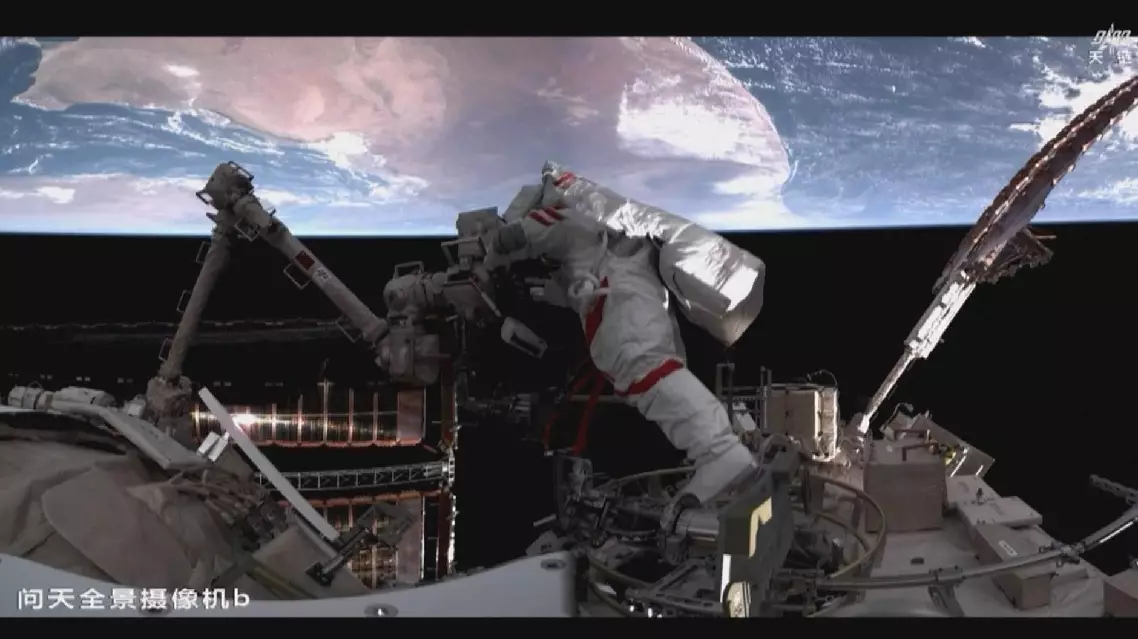
China's Shenzhou-21 astronauts complete first series of extravehicular activities
China's Shenzhou-21 astronauts complete first series of extravehicular activities
China's Shenzhou-21 astronauts complete first series of extravehicular activities