The China Council for the Promotion of International Trade (CCPIT), leading a Chinese business delegation, wrapped up a visit to the United States at the invitation of its US counterparts, the CCPIT said on Sunday.
The delegation visited Washington, San Francisco, Oakland, and other places in the U.S. from Dec. 2 to 6, aiming to deepen economic and trade exchanges and cooperation among the business communities of the two nations.
During the visit, CCPIT chairman Ren Hongbin held working talks with the U.S. Department of Commerce, led a delegation to visit and meet with San Francisco Mayor Daniel Lurie and Oakland Mayor Barbara Lee, and visited and conducted research at companies such as Apple and HP.
The CCPIT has collaborated with U.S. authorities and business organizations and hosted multiple China-U.S. business matchmaking events, engaging in discussions and exchanges with over 170 U.S. companies and institutions.
Ren introduced China's new measures to adhere to high-quality development and high-level opening up, and promoted the fourth China International Supply Chain Expo (CISCE), which is scheduled for June 22 to 26 in 2026.
He also emphasized that the CCPIT will support and promote the Chinese and American business communities in taking more proactive actions to deepen exchanges and cooperation and make greater contributions to the stable, healthy, and sustainable development of China-U.S. relations.
American business leaders generally believe that the visit has effectively promoted China-U.S. business exchanges and cooperation, and said that the recommendations for formulating China's 15th Five-Year Plan (2026-2030) have enhanced American companies' confidence in China's economic development, attracting them to continue to invest in China while deepening cooperation between Chinese and American companies in the industrial and supply chains.

Chinese business delegation wraps up U.S. visit with fruitful results
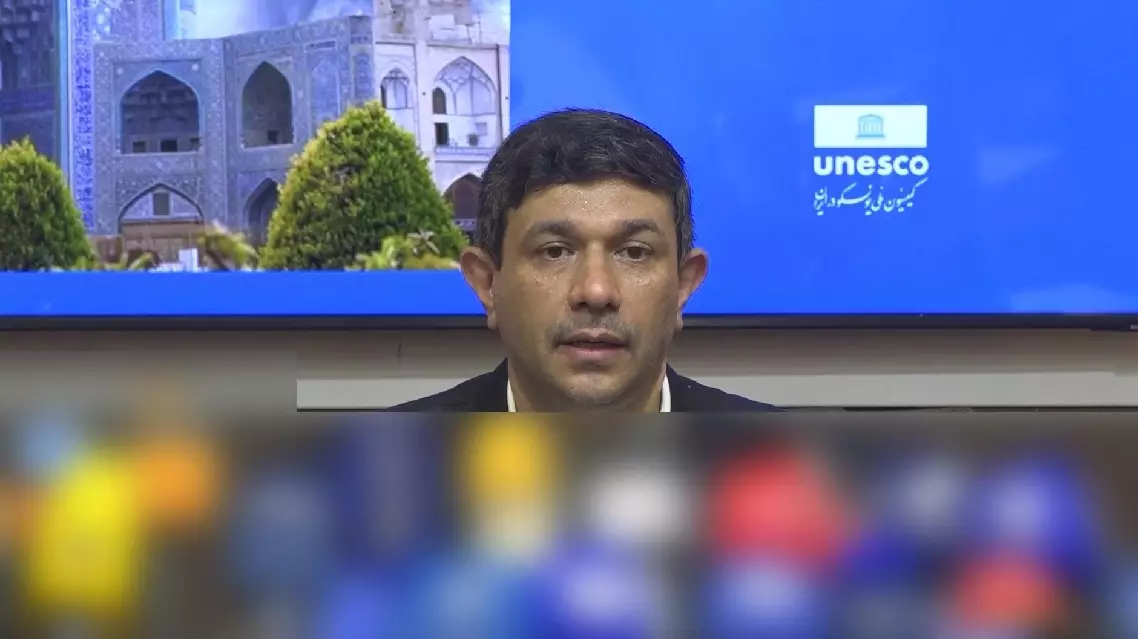
The U.S.-Israeli airstrikes against Iran since February 28 have inflicted irreparable damage on the country's priceless cultural heritage sites, according to Hassan Fartousi, secretary-general of the Iranian National Commission for UNESCO.
Speaking to the press on Tuesday, Fartousi said that 132 cultural heritage items have been attacked in recent strikes, emphasizing that the losses extend far beyond monetary valuation.
"Last night, I was told that 132 pieces [items] of our cultural heritage have been attacked, and it is really impossible to say how much the costs are, and it can be said that these (damaged cultural heritage items) are priceless and irreparable. How can these be defined?" Fartousi said.
Among the most severely affected sites is the Golestan Palace, a UNESCO World Heritage Site inscribed in 2013.
Fartousi said that about 40 percent of the palace's historic mirror works, dating back nearly 220 years to the Qajar period, have been damaged.
"Unfortunately, in Golestan Palace, there are almost 40 percent of the mirror works [that] have been damaged which belong to almost 220 years ago, the Qajar period. The same situation [occurred] in the Saad Abad complex [in] which the Green Palace [was] attacked in a way which the specialists were telling me very sadly that it may not be possible to repair some of the damages," he said.
The Golestan Palace complex, selected as the royal residence and seat of power by the Qajar ruling family in the 19th century, has been described by UNESCO as "a masterpiece of the Qajar era, embodying the successful integration of earlier Persian crafts and architecture with Western influences."
The Saad Abad complex, a sprawling former royal compound in northern Tehran, encompasses an extensive park with multiple buildings now serving as museums dedicated to Iran's cultural history. The official residence of Iran's president is located adjacent to the site.
U.S.-Israeli airstrikes cause irreparable damage to Iran's cultural heritage sites: UNESCO official