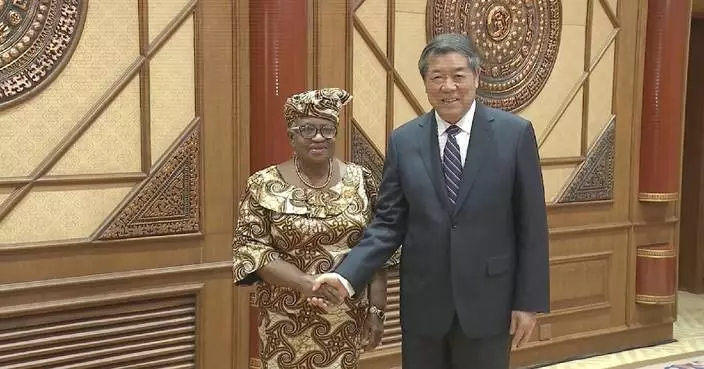
China's 15th Five-Year Plan, charting the course for its development in 2026-2030, will serve as a source of certainty and confidence in a world that undergoes unprecedented changes at a pivotal crossroads, UN Conference on Trade and Development (UNCTAD) Secretary-General Rebeca Grynspan said Tuesday.
The 20th Communist Party of China Central Committee adopted the recommendations for formulating the five-year plan at its fourth plenary session in October. A communique released after the plenum signaled how the world's second-largest economy will advance its economic and social progress.
When unilateralism, protectionism and geopolitical tensions are constantly escalating in the world, policy certainty has become particularly scarce yet encouraging.
Starting in the 1950s, five-year plans have concretely mapped out China's development path and guided market expectations. Different from Western countries that often flip-flop on policies with election cycles, China maintains its policy consistency, refraining from hasty and reckless decision-making.
"China puts the five-year plan out and so we can know what are China's plans. It is very important for the world to plan what China will do, because China is the second most important economy of the world. And so in that sense, first of all, it's welcome, and the second thing for me that is welcome is that you have a long-term view in a world of which short-termism is very refreshing," Grynspan said.
According to the communique, in the next five years, China aims to make significant advancements in high-quality development. It seeks to achieve greater self-reliance and strength in science and technology, steer the development of new quality productive forces, and build a modernized industrial system.
China will also shift further toward services, consumption and innovation. Greater importance will be placed on domestic demand and a unified national market, leveraging the vast potential of a population exceeding 1.4 billion.
Job creation and refined income distribution are also high on the agenda among a range of efforts to improve public wellbeing and promote common prosperity for all, the communique showed.
Contributing an estimated 30 percent to global economic expansion, China with rapid economic growth and long-term social stability is undoubtedly a boon for all.
"I saw several things. First of all, the continued emphasis on quality productive forces, the bed for innovation, for technology and for productivity growth, very important for China. Then I see also the emphasis on quality consumption to improve the well-being of the households and the communities, and I think that this is very important because obviously consumption in China will impact the whole world," Grynspan said.
According to official data, China's goods trade has remained the world's largest for eight years straight, increasing by 32.4 percent from 2020 to 2024, and its service trade surpassed one trillion U.S. dollars for the first time last year, ranking second globally.

China's new five-year plan provides world with certainty amid short-termism: UNCTAD head
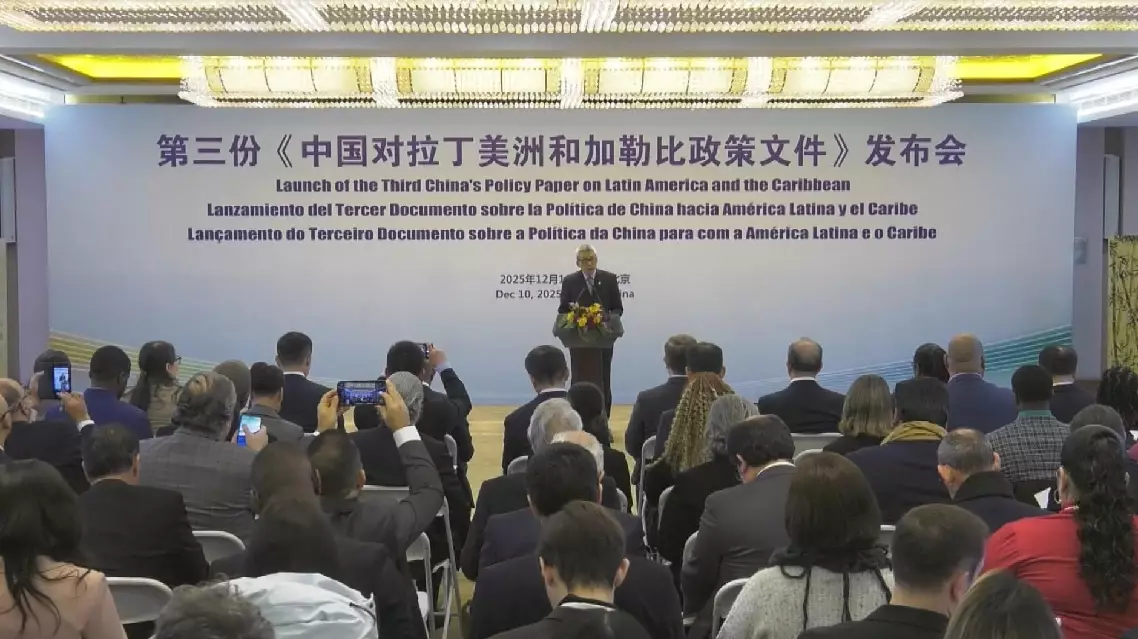
China's Policy Paper on Latin America and the Caribbean (LAC), the third of its kind in less than two decades, was published on Wednesday.
The Chinese government released the first such document in Nov 2008 and the second in Nov 2016.
The latest policy paper said China stands ready to join hands with Latin America and the Caribbean to promote solidarity, development, civilization, peace and people-to-people connectivity to advance shared development and revitalization, and write a new chapter in building a China-LAC community with a shared future.
The policy paper consists of three parts; "Latin America and the Caribbean: A Land Full of Vibrancy and Hope," "The Flourishing Relations Between China and Latin America and the Caribbean" and "Joining Hands to Promote the Five Programs for Building a China-LAC Community with a Shared Future."
Cai Wei, China's assistant minister of foreign affairs, said at the launch ceremony that the latest policy paper reviews the strong growth of China-LAC relations and lays out China's policy proposals going forward for exchanges and cooperation in over 40 areas. It also responds actively to LAC countries' needs and concerns in terms of trade, investment, finance, sci-tech, innovation, climate change and more.
"China will continue to support Latin American countries firmly in upholding their independence, self-reliance and unity, as they explore a path to modernization suited to their national conditions. We will strengthen exchanges at all levels and continuously deepen exchanges and mutual learning on governance and modernization experiences. China is willing to share the opportunities of its own modernization journey with Latin American countries and help countries in the region enhance their capacity for independent and sustainable development," said Cai.
Cai also highlighted the mutually beneficial nature of bilateral relations, noting that these ties should not be interfered with by any third party.
"Facts have proven that the idea of a community with a shared future is a vivid reflection of the great growth of China-Latin America relations in recent years. It should be pointed out that China-Latin America relations are founded solely on mutual benefit and win-win cooperation, devoid of geopolitical calculations, not targeting any third party, and should not be interfered with by any third party," said Cai.
Representatives from the LAC noted that China is a sincere friend and reliable partner to the LAC countries.
The mutually beneficial cooperation between China and Latin America spans various fields, and China's development has provided valuable lessons for countries in the region, said Francisco Gutierrez, director of the Regional Coordination and Integration Mechanisms at the Colombian Ministry of Foreign Affairs.
"The relationship between China and CELAC (the Community of Latin American and Caribbean States) holds significant potential to continue contributing to shared objectives, always through a cooperative, respectful and constructive approach. The pro tempore presidency of CELAC reiterates that regional political dialogue must continue to be guided by multilateralism, cooperation for development, and the strengthening of an international order based on rules. In this spirit, CELAC values China's readiness to maintain a constructive relationship oriented toward mutual benefit, and fully respectful of the sovereign equality of states," Guttierez said.
"We emphasize that China's presence in Latin America and the Caribbean does not constitute a threat, but an opportunity to diversify partners, broaden horizons and cooperation, and strengthen the region's autonomy in making strategic decisions. Peace and stability are indispensable conditions for development and that spirit is present in China's actions. This great country does not seek to impose models or condition political decisions. On the contrary, it accompanies the countries of our region on their own paths of development, always respecting historical, cultural and social peculiarities, and with each action supports Latin America and the Caribbean in being a zone of peace. For this reason, Latin America and the Caribbean, together, in one voice, we say that we reject actions that attempt to disrespect the one-China principle or their general threats to international security," said Martin Charles, dean of diplomatic corps of LAC countries in China and ambassador of Dominica to China.
Charles also said the implementation of the policy paper will be critical in advancing a China-LAC community with a shared future, and will have direct impacts on cooperation in infrastructure construction, education, culture, agriculture and other areas.
China-LAC cooperation has emerged in recent years as an important model of South-South cooperation, with 24 countries in the region joining the Belt and Road Initiative.
China has become the region's second-largest trading partner, with the value of bilateral trade exceeding 500 billion U.S. dollars for the first time last year.
China releases policy paper on Latin America, Caribbean