The NFL is seeking to create a practice squad of officials and wants postseason assignments to be based on performance rather than seniority.
Those are among the key points league executive Troy Vincent emphasized to owners in a virtual meeting on Wednesday.
The league and the NFL Referees Association have been negotiating a new collective bargaining agreement since the summer of 2024. The current CBA expires on May 31, 2026.
So far, discussions with the game officials’ union have been unsuccessful, according to a memo that was sent to teams and obtained by The Associated Press.
“We strive for excellence in all aspects of the game, including officiating,” Vincent said. “Throughout the course of collective bargaining, the NFL has remained focused on implementing changes to the agreement (and otherwise exercising our rights) in ways that will improve the performance of game officials, increase accountability, and ensure that the highest-performing officials are officiating our highest-profile games. Our priority is to have the best officials on the field, a performance-based model.”
The league wants compensation tied to performance so that only high-performing game officials during the regular season share in the year-end bonus pool.
The league is also seeking greater flexibility to ensure the best officials are on the field during the postseason. The current CBA includes seniority as a factor in making postseason assignments. Vincent said the union wants to keep seniority as a factor.
The union could not immediately be reached for comment on the league's proposals.
Training and development is another area highlighted by the NFL.
“Mandatory training and development programs are essential for low-performing and probationary officials. The union is resisting our efforts to give these officials access to more practice repetitions,” Vincent said.
Currently, the league has no communication with game officials during the roughly three-month stretch between the Super Bowl and May 15.
“We believe shortening that dead period and increasing access to all game officials for rules discussions, video review, mechanics, and appropriate football operations and committee meetings will improve the game and game officials’ performance,” Vincent said.
The league is also seeking to extend the probationary period during which new game officials are assessed in order to gain flexibility to remove those who are underperforming. The union’s last proposal called for the elimination of the probationary period entirely, according to the memo.
“We will continue to advocate for changes to our collective bargaining agreement that will improve training, reward performance and increase accountability,” the memo said. “These measures and the continued incorporation of technology, including the expanded use of replay assist, will further improve officiating.”
The league is exploring the possibility of adding several more plays to replay assist in 2026, including crackback blocks, low blocks/clipping, blindside blocks, intentional grounding to determine a receiver's position on the field and illegal formation on kickoffs to determine feet on the ground when the ball is touched.
AP NFL: https://apnews.com/hub/nfl

FILE - The NFL shield is displayed at midfield during the Super Bowl 59 NFL football game, Feb. 9, 2025, in New Orleans. (AP Photo/Adam Hunger, File)
WASHINGTON (AP) — The House voted to pass a sweeping defense policy bill Wednesday that authorizes $900 billion in military programs, including a pay raise for troops and an overhaul of how the Department of Defense buys weapons.
The bill's passage on a 312-112 vote comes at a time of increasing friction between the Republican-controlled Congress and President Donald Trump’s administration over the management of the military.
The annual National Defense Authorization Act typically gains bipartisan backing, and the White House has signaled “strong support” for the must-pass legislation, saying it is in line with Trump's national security agenda. Yet tucked into the over-3,000-page bill are several measures that push back against the Department of Defense, including a demand for more information on boat strikes in the Caribbean and support for allies in Europe, such as Ukraine.
Overall, the sweeping bill calls for a 3.8% pay raise for many military members as well as housing and facility improvements on military bases. It also strikes a compromise between the political parties — cutting climate and diversity efforts in line with Trump's agenda, while also boosting congressional oversight of the Pentagon and repealing several old war authorizations. Still, hard-line conservatives said they were frustrated that the bill does not do more to cut U.S. commitments overseas.
“We need a ready, capable and lethal fighting force because the threats to our nation, especially those from China, are more complex and challenging than at any point in the last 40 years,” said Rep. Mike Rogers, the GOP chair of the House Armed Services Committee.
Lawmakers overseeing the military said the bill would change how the Pentagon buys weapons, with an emphasis on speed after years of delay by the defense industry. It's also a key priority for Defense Secretary Pete Hegseth. Rep. Adam Smith, the top Democrat on the armed services panel, called the bill “the most ambitious swing at acquisition reform that we’ve taken.”
Still, Smith lamented that the bill does not do as much as Democrats would like to rein in the Trump administration but called it “a step in the right direction towards reasserting the authority of Congress.”
“The biggest concern I have is that the Pentagon, being run by Secretary Hegseth and by President Trump, is simply not accountable to Congress or accountable to the law,” he said.
The legislation next heads to the Senate, where leaders are working to pass the bill before lawmakers depart Washington for a holiday break.
Several senators on both sides of the aisle have criticized the bill for not doing enough to restrict military flights over Washington. They had pushed for reforms after a midair collision this year between an Army helicopter and a jetliner killed all 67 people aboard the two aircraft near Washington's Ronald Reagan National Airport. The National Transportation Safety Board and families of the victims have also voiced opposition to that section of the bill, raising concerns that it would make the airspace more dangerous.
Here's what the defense bill does as it makes its way through Congress.
Lawmakers included a provision that would cut Hegseth's travel budget by a quarter until the Pentagon provides Congress with unedited video of the strikes against alleged drug boats near Venezuela. Lawmakers are asserting their oversight role after a Sept. 2 strike where the U.S. military fired on two survivors who were holding on to a boat that had partially been destroyed.
The bill also demands that Hegseth allow Congress to review the orders for the strikes.
Trump's ongoing support for Ukraine and other allies in Eastern Europe has been under doubt over the last year, but lawmakers included several positions meant to keep up U.S. support for countering Russian aggression in the region.
The defense bill requires the Pentagon to keep at least 76,000 troops and major equipment stationed in Europe unless NATO allies are consulted and there is a determination that such a withdrawal is in U.S. interests. Around 80,000 to 100,000 U.S. troops are usually present on European soil. It also authorizes $400 million for each of the next two years to manufacture weapons to be sent to Ukraine.
Additionally, there is a provision to keep U.S. troops stationed in South Korea, setting the minimum requirement at 28,500.
The bill makes $1.6 billion in cuts to climate change-related spending, the House Armed Services Committee said. U.S. military assessments have long found that climate change is a threat to national security, with bases being pummeled by hurricanes or routinely flooded.
The bill also would save $40 million by repealing diversity, equity and inclusion offices, programs and trainings, the committee said. The position of chief diversity officer would be cut, for example.
Congress is putting an official end to the war in Iraq by repealing the authorization for the 2003 invasion. Supporters in both the House and Senate say the repeal is crucial to prevent future abuses and to reinforce that Iraq is now a strategic partner of the U.S.
The 2002 resolution has been rarely used in recent years. But the first Trump administration cited it as part of its legal justification for a 2020 U.S. drone strike that killed Iranian Gen. Qassim Suleimani.
Congress would permanently remove U.S. sanctions put on Syria after the Trump administration temporarily lifted many penalties.
Lawmakers imposed economically crippling sanctions on the country in 2019 to punish former leader Bashar Assad for human rights abuses during the nearly 14-year civil war. After Syrian President Ahmed al-Sharaa led a successful insurgency to depose Assad, he is seeking to rebuild his nation’s economy.
Advocates of a permanent repeal have said international companies are unlikely to invest in projects needed for the country’s reconstruction as long as there is a threat of sanctions returning.
Democrats criticized House Speaker Mike Johnson for stripping a provision from the bill to expand coverage of in vitro fertilization for active duty personnel. An earlier version covered the medical procedure, known as IVF, which helps people facing infertility have children.

Secretary of Defense Pete Hegseth listens during remarks on the sidelines of the AUKUS Defense Ministers' Ministerial meeting at the Pentagon, Wednesday, Dec. 10, 2025, in Washington. (AP Photo/Mark Schiefelbein)
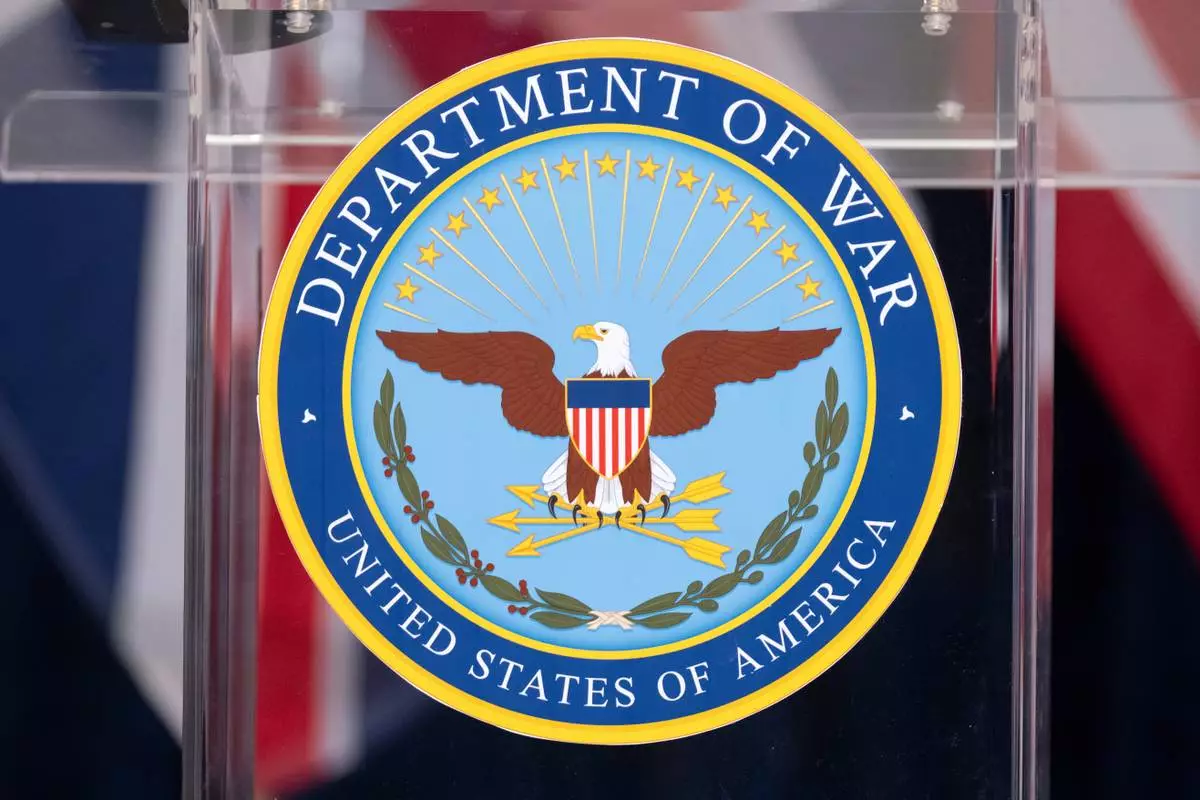
The seal is seen on a podium at the Pentagon, Wednesday, Dec. 10, 2025, in Washington, before Defense Secretary Pete Hegseth speaks. (AP Photo/Mark Schiefelbein)