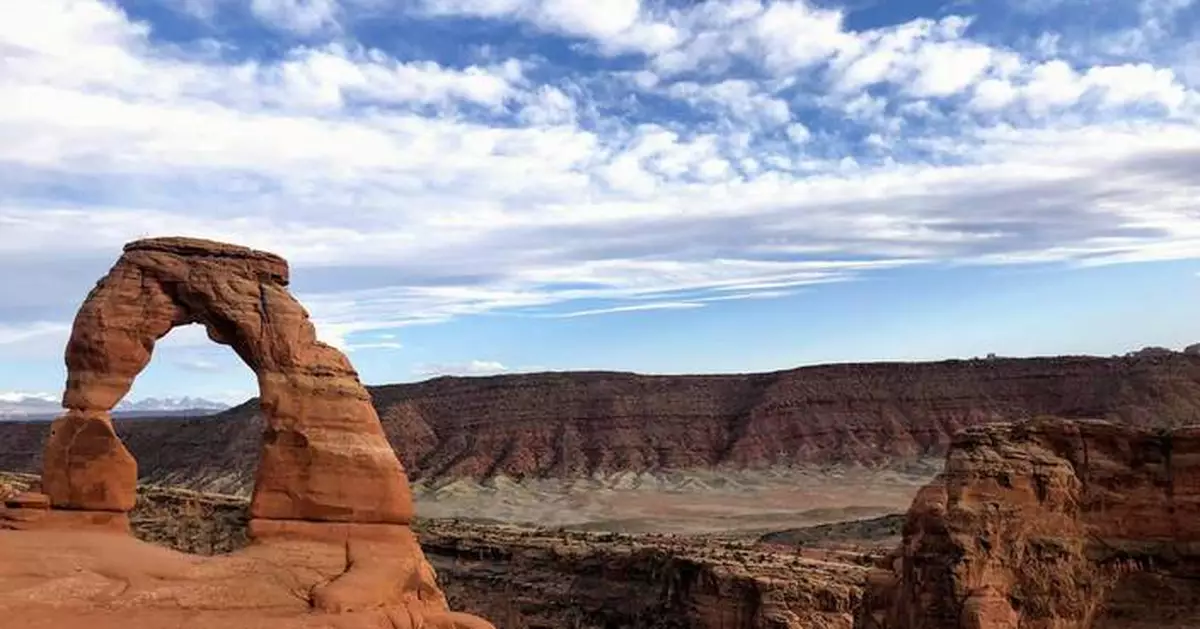
Getting trapped in quicksand is a corny peril of old movies and TV shows, but it really did happen to one unfortunate hiker in Utah's Arches National Park.
The park famous for dozens of natural, sandstone arches gets over 1 million visitors a year, and accidents ranging from falls to heat stroke are common.
Quicksand? Not really — but it has happened at least a couple of times now.
“The wet sand just kind of flows back in. It’s kind of a never-ending battle,” said John Marshall, who helped a woman stuck in quicksand over a decade ago and coordinated the latest rescue.
On Sunday, an experienced hiker, whose identity wasn't released, was traversing a small canyon on the second day of a 20-mile (32-kilometer) backpacking trip when he sank up to his thigh, according to Marshall.
Unable to free himself, the hiker activated an emergency satellite beacon. His message got forwarded to Grand County emergency responders and Marshall got the call at 7:15 a.m..
“I was just rolling out of bed,” Marshall said. “I'm scratching my head, going, ‘Did I hear that right? Did they say quicksand?’"
He put his boots on and rendezvoused with a team that set out with all-terrain vehicles, a ladder, traction boards, backboards and a drone. Soon, Marshall had a bird's-eye view of the situation.
Through the drone camera he saw a park ranger who'd tossed the man a shovel. But the quicksand flowed back as soon as the backpacker shoveled it away, Marshall said.
The Grand County Search and Rescue team positioned the ladder and boards near the backpacker and slowly worked his leg loose. By then he'd been standing in near-freezing muck, in temperatures in the 20s (negative 6 to negative 1 Celsius), for a couple of hours.
Rescuers warmed him up until he could stand, then walk. He then hiked out on his own, even carrying his backpack, Marshall said.
Quicksand is dangerous but it's a myth total submersion is the main risk, said Marshall.
“In quicksand you’re extremely buoyant,” he said. “Most people won’t sink past their waist in quicksand.”
Marshall is more or less a quicksand expert.
In 2014, he was a medic who helped a 78-year-old woman after she was stuck for over 13 hours in the same canyon just 2 miles (3 kilometers) from where Sunday's rescue took place.
The woman's book club got worried when she missed their meeting. They went looking for her and found her car at a trailhead. It was June — warmer than Sunday but not sweltering in the canyon's shade — and the woman made a full recovery after regaining use of her legs.
“Both had very happy endings,” Marshall said.

FILE - Delicate Arch is seen at Arches National Park on April 25, 2021, near Moab, Utah. (AP Photo/Lindsay Whitehurst, File)
MOUNT VERNON, Wash. (AP) — Residents began packing up and fleeing rising rivers in western Washington state Wednesday as a new wave of heavy rain swept into a region still reeling from a storm that triggered rescues and road closures a day earlier.
In the Pacific Northwest, an atmospheric river was swelling rivers toward record levels, with major flooding expected in some areas including the Skagit River, a major agricultural valley north of Seattle. In the town of Mount Vernon, officials ordered residents within the river’s floodplain to evacuate.
Earlier in the day, dozens of vehicles were backed up at a sandbag-filling station in the town as residents prepared for what Mayor Peter Donovan described as “what increasingly appears to be a worst-case scenario here.”
Washington Gov. Bob Ferguson declared a statewide emergency Wednesday, saying, “Lives will be at stake in the coming days.” He estimated that as many as 100,000 Washington residents may soon face evacuation orders.
Gent Welsh, adjutant general of the Washington National Guard, said hundreds of Guard members will be sent to help communities.
In the Mount Rainier foothills southeast of Seattle, Pierce County sheriff’s deputies rescued people at an RV park in Orting, including helping one man in a Santa hat wade through waist-deep water. Part of the town was ordered to evacuate over concerns about the Puyallup River’s extremely high levels and upstream levees.
A landslide blocked part of Interstate 90 east of Seattle, with photos from Eastside Fire & Rescue showing vehicles trapped by tree trunks, branches, mud and standing water, including a car rammed into the metal barrier on the side of the road.
Officials also closed a mountainous section of U.S. 2 due to rocks, trees and mud. The state transportation department said there were no detours available and no estimated time for reopening.
The Skagit River is expected to crest at roughly 47 feet (14.3 meters) in the mountain town of Concrete early Thursday, and roughly 41 feet (12 meters) in Mount Vernon early Friday.
Those are both “record-setting forecasts by several feet,” Skagit County officials said.
Flooding from the river long plagued Mount Vernon, the largest city in the county with some 35,000 residents. In decades past, residents would form sandbagging brigades when floods threatened, but businesses were often inundated. Flooding in 2003 displaced hundreds of people.
The city completed a floodwall in 2018 that helps protect the downtown. It passed a major test in 2021, when the river crested near record levels.
But the city is on high alert. The historic river levels expected Friday could top the wall, and some are worried that older levees could fail.
“The concern about that kind of pressure on the levy and dike system is real," said Ellen Gamson, executive director of the Mount Vernon Downtown Association. "It could potentially be catastrophic.”
Gamson said many business owners were renting tables to place their inventory higher off the floor. Sheena Wilson, who owns a floral shop downtown, said she stacked sandbags by the doors and cleared items off the floor.
“If the water comes in above table height I’ve got bigger problems than my merchandise,” she said.
Jake Lambly, 45, added sandbags, tested water pumps and moved valuables to the top floor of the home he shares with his 19-year-old son. Lambly said he was concerned about damage in his neighborhood, where people “are just on the cusp of whether or not we can be homeowners."
“This is my only asset,” he said from his front porch. “I got nothing else.”
Harrison Rademacher, a meteorologist with the weather service in Seattle, described the atmospheric river soaking the region as “a jet stream of moisture” stretching across the Pacific Ocean “with the nozzle pushing right along the coast of Oregon and Washington.”
Authorities in Washington have knocked on doors to warn residents of imminent flooding in certain neighborhoods, and evacuated a mobile home park along the Snohomish River. The city of Snohomish issued an emergency proclamation, while workers in Auburn, south of Seattle, installed temporary flood control barriers along the White River.
In Sumas, a small city along the U.S.-Canada border, a flood siren rang out at city hall and residents were told to leave. The border crossing was also closed to southbound commercial vehicles to leave more room for evacuations, according to the Abbotsford Police Department.
Climate change has been linked to some intense rainfall. Scientists say that without specific study they cannot directly link a single weather event to climate change, but in general it’s responsible for more intense and more frequent extreme storms, droughts, floods and wildfires.
Another storm system is expected to bring more rain starting Sunday, Rademacher said. “The pattern looks pretty unsettled going up to the holidays.”
Rush reported from Portland, Oregon. Associated Press writers Gene Johnson in Seattle; Martha Bellisle in Issaquah, Washington; Sarah Brumfield in Cockeysville, Maryland; Kathy McCormack in Concord, New Hampshire, and Hallie Golden in Seattle contributed to this report.

A flag ripples in the wind as snow falls in Lowville, New York, on Tuesday night, Dec. 9, 2025. The area faces a winter storm warning through Thursday. (AP Photo/Cara Anna)

Rescue workers with Chehalis Fire venture into a flooded neighborhood to pick up evacuees after heavy rains, Tuesday, Dec. 9, 2025, in Chehalis, Wash. (AP Photo/Lindsey Wasson)

A flag ripples in the wind as snow falls in Lowville, New York, on Tuesday night, Dec. 9, 2025. The area faces a winter storm warning through Thursday. (AP Photo/Cara Anna)
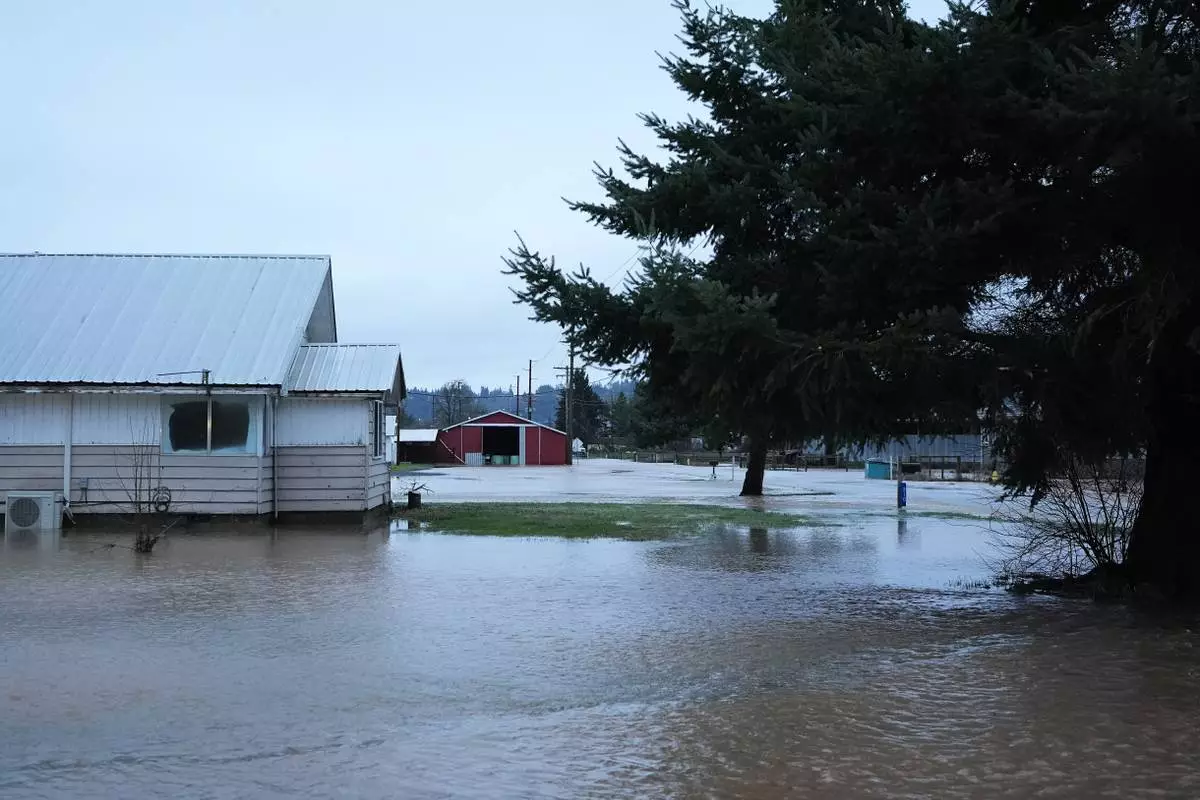
Floodwaters surround homes and buildings after heavy rains, Tuesday, Dec. 9, 2025, in Chehalis, Wash. (AP Photo/Lindsey Wasson)
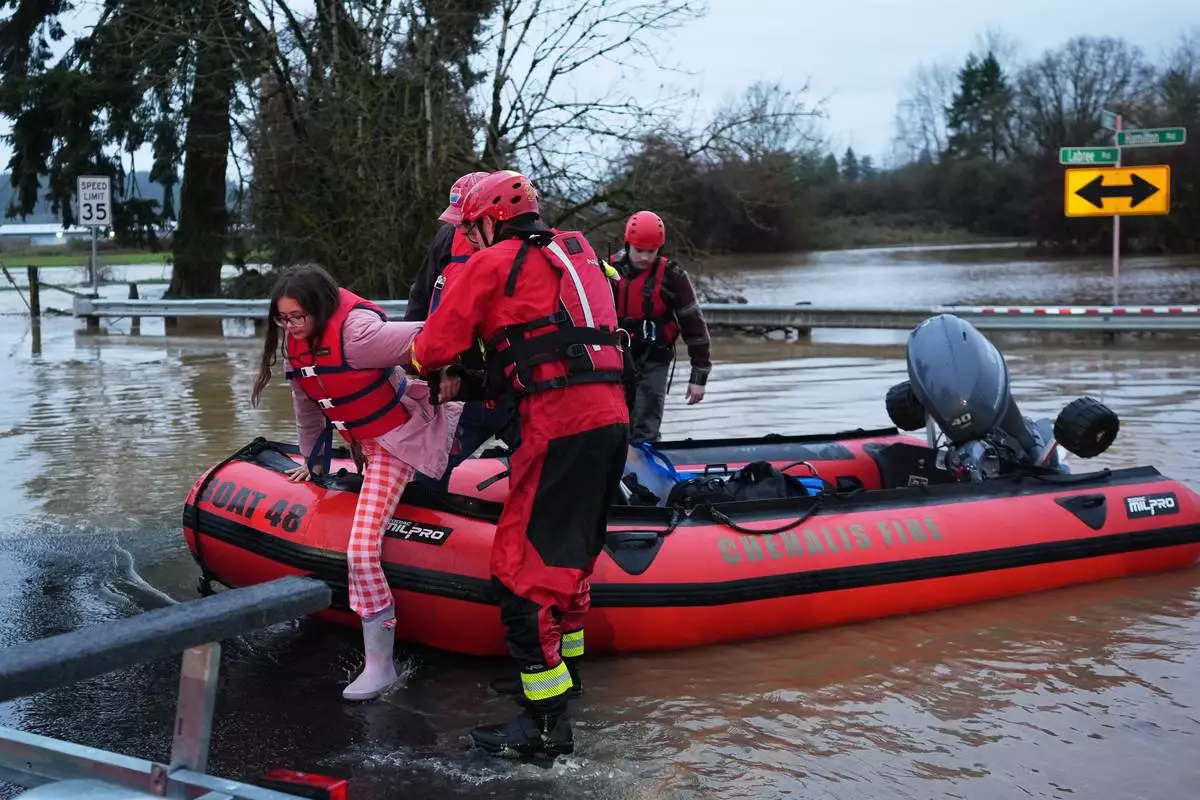
Maery Schine, 11, is helped out of a rescue boat by rescue workers with Chehalis Fire after evacuating with her father Patric, second from left, following flooding after heavy rains in the region Tuesday, Dec. 9, 2025, in Chehalis, Wash. (AP Photo/Lindsey Wasson)
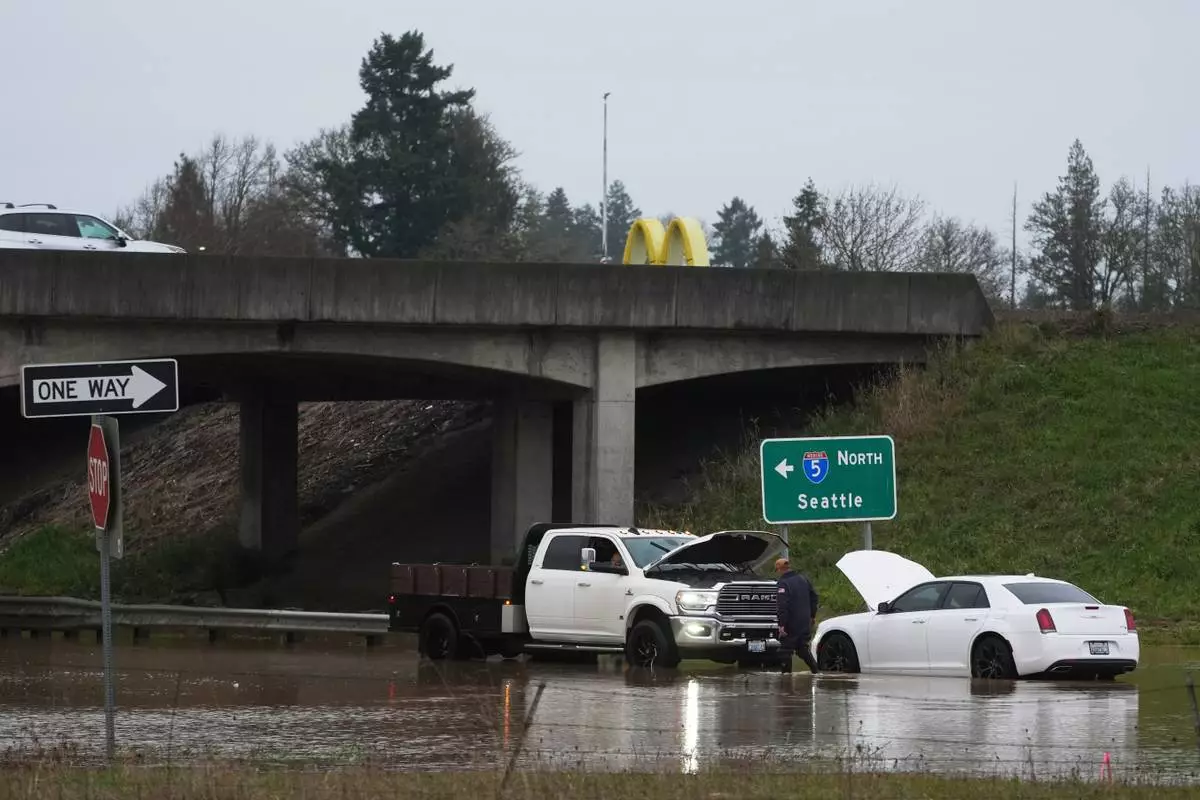
A man checks on a car caught in flooding after heavy rains Tuesday, Dec. 9, 2025, in Napavine, Wash. (AP Photo/Lindsey Wasson)
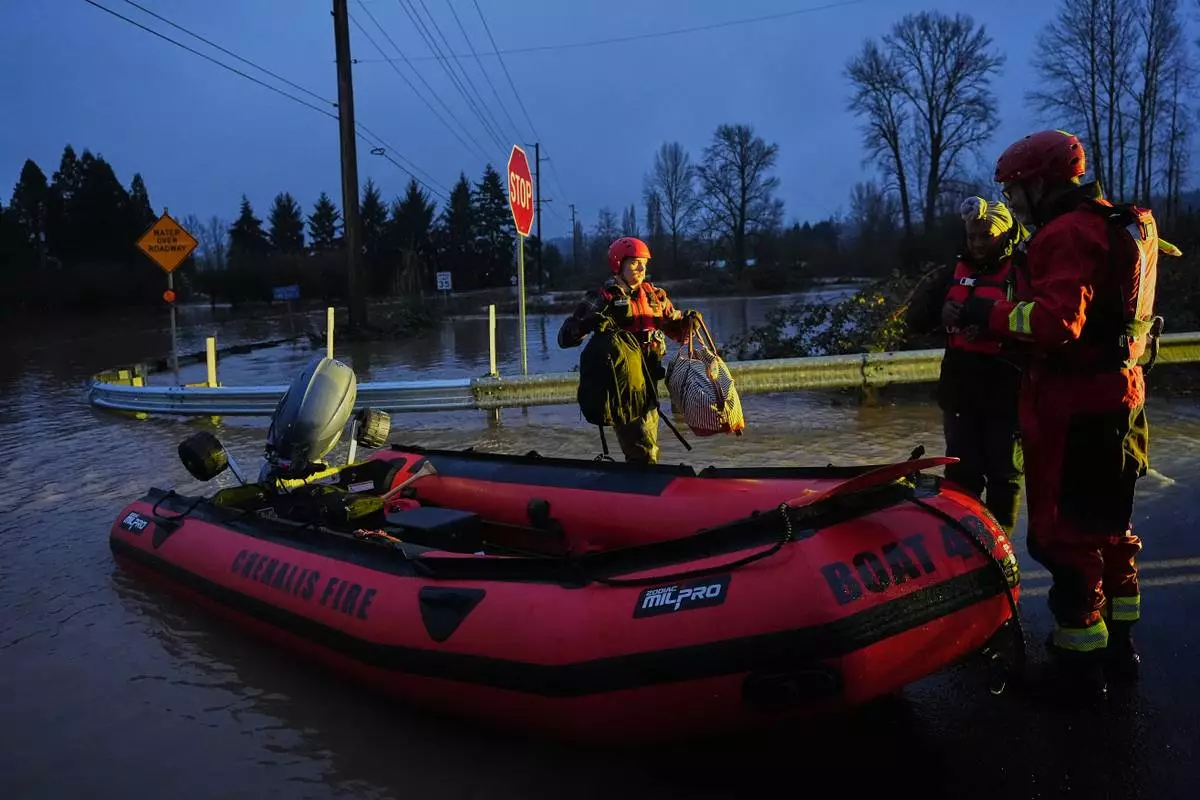
Chehalis Fire rescue workers help residents evacuate their flooded neighborhood after heavy rains in the region Tuesday, Dec. 9, 2025, in Chehalis, Wash. (AP Photo/Lindsey Wasson)