LONDON--(BUSINESS WIRE)--Dec 11, 2025--
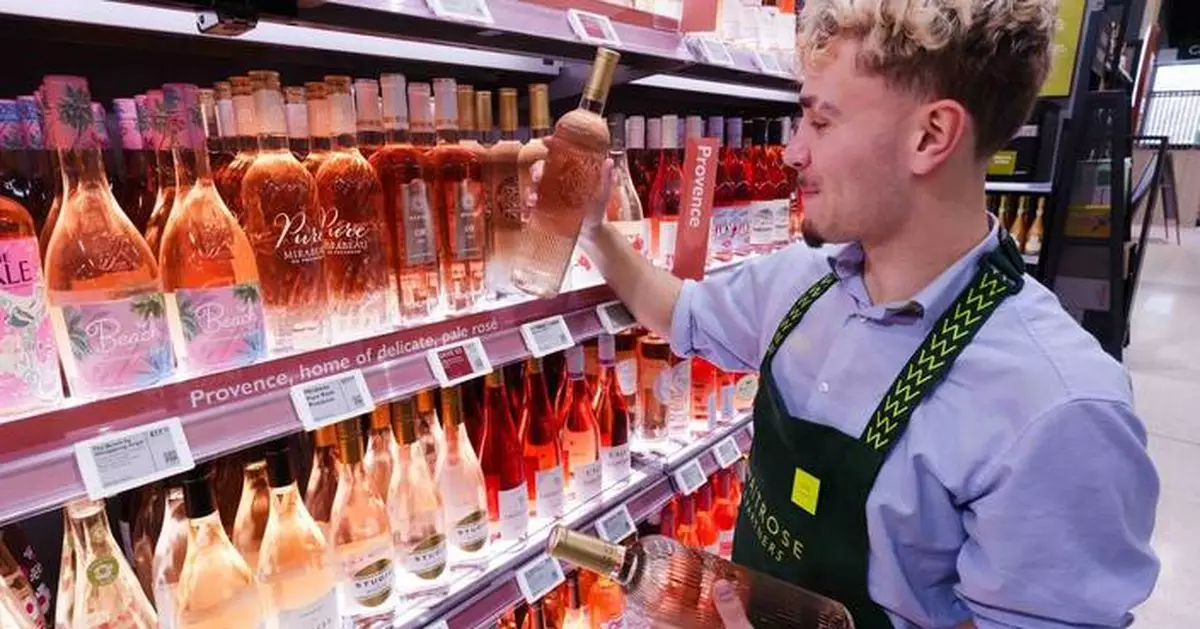
Waitrose and SOLUM have announced a partnership to deploy Electronic Shelf Labels (ESL) across all Waitrose stores.
This press release features multimedia. View the full release here: https://www.businesswire.com/news/home/20251211692071/en/
The rollout, planned for completion in 2026, will reduce the time spent on manual ticket updates, freeing up Partners to spend more time providing customers with the service Waitrose is renowned for.
SOLUM’s Newton Pro ESL was selected for its premium design, outstanding durability and quality, reliable performance, and suitability for the fast-paced demands of food retail.
Its refined aesthetic aligns with the look and feel of Waitrose stores, while its rapid update speeds and long-lasting operation support the high level of accuracy required across fresh, ambient and specialist categories. Newton Pro also includes a built-in button feature that can help streamline everyday operational tasks such as indicating stock status, offering Waitrose additional flexibility as its digital capabilities continue to grow.
Mark Duckworth, Country Manager UK & Ireland at SOLUM, commented:
“This milestone reflects the strength of SOLUM — not only in product quality and design, but in how closely we have aligned our goals with Waitrose throughout the process. From the initial PoC, our teams worked side by side to support their ambitions and ensure the solution delivered meaningful value in store. We’re proud to contribute to the high standards Waitrose sets and see this as an important step in enabling further innovation across the sector.”
About SOLUM
Founded in 2015 as a spin-off from Samsung Electro-Mechanics, SOLUM is a publicly traded company listed on the KOSPI stock exchange. The company has established itself as a leader in power solutions, display technologies, and electronic shelf labels (ESL), driving innovation across the global retail sector. With a strong commitment to customer-centric innovation and sustainable retail transformation, SOLUM continues to develop high-quality solutions that empower retailers to operate more efficiently in an increasingly digital world.
Learn more at https://www.solumesl.com/en.
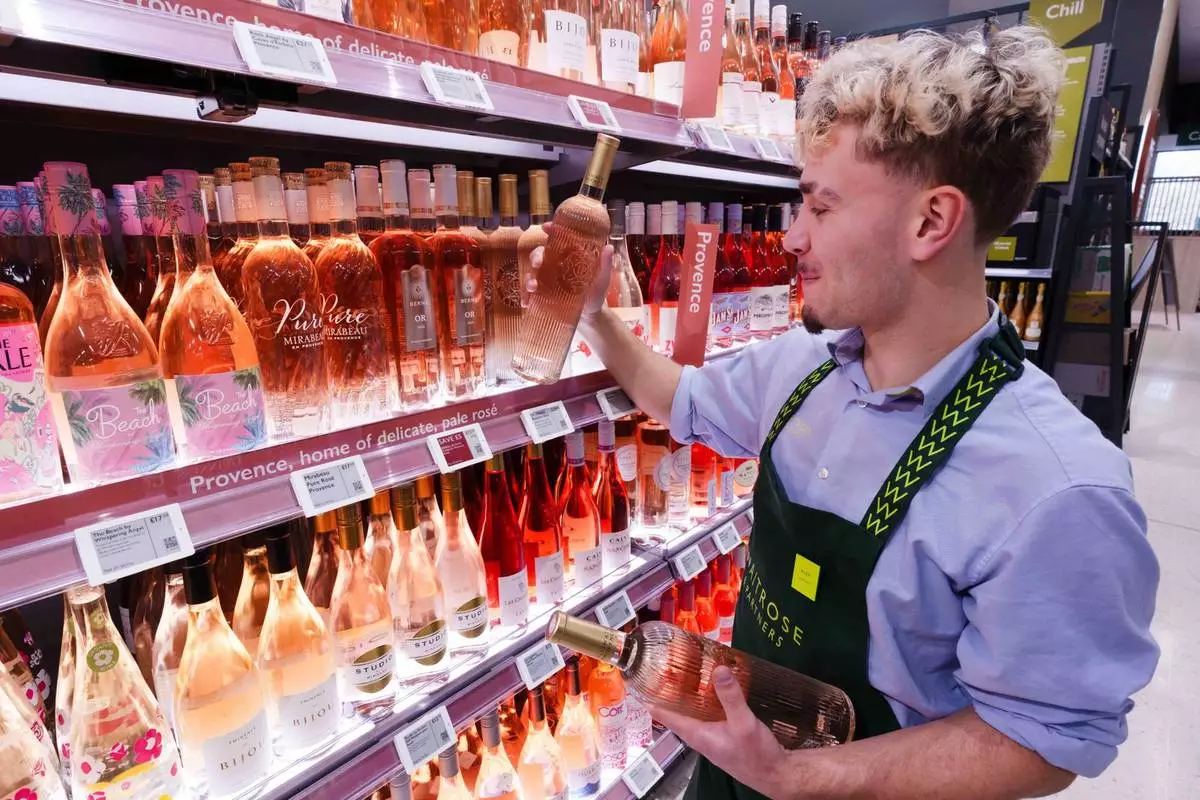
Waitrose Partners With SOLUM to Introduce Electronic Shelf Labels Nationwide
OKLAHOMA CITY (AP) — Shai Gilgeous-Alexander isn't scoring the way he usually does, but the Oklahoma City Thunder are still winning the way they normally do.
Gilgeous-Alexander, the reigning NBA MVP, averaged 31.1 points during the regular season. In the Western Conference semifinals against the Los Angeles Lakers, he is averaging 20 points and taking only 14 shots per game.
Oklahoma City has still won the first two games by an average of 18 points. Gilgeous-Alexander and Chet Holmgren each scored 22 points, and the defending champion Thunder beat the Lakers 125-107 on Thursday night.
Ajay Mitchell, starting in place of injured Jalen Williams, is averaging 19 points on 50% shooting in the series for Oklahoma City.
“I think the coaching staff does a good job at just getting all of us ready,” said Mitchell, a second-year guard. "And we have a lot of competitors. Like, everyone’s a competitor on our team. So every time the lights are bright, everyone’s ready to go.”
Holmgren is the leading scorer for the Thunder in the best-of-seven series with 23 points per game. The 2026 All-Star also is averaging 10.5 rebounds and 2.5 blocks.
Jared McCain, a midseason acquisition from the Philadelphia 76ers, barely played in the first round against Phoenix but has averaged 15 points and made 8 of 10 3-pointers in the series.
“He goes in there, stays in character, stays aggressive," Thunder coach Mark Daigneault said. "He’s going to shoot the next shot. He makes the right plays, plays inside the team. He competes defensively, has had good defensive possessions for us. And he was huge tonight. You need that in a playoff series.”
The Lakers again were without scoring champion Luka Doncic, who is out indefinitely with a strained left hamstring. They also were missing forward Jarred Vanderbilt, the reserve forward who dislocated the pinkie on his right hand during the second quarter of Game 1. The Lakers had three players finish with five fouls, limiting their aggressiveness late in the game.
Los Angeles guard Austin Reaves, who struggled with his shot in Game 1, scored 31 points on 10-for-16 shooting in Game 2. LeBron James, coming off a 27-point effort in Game 1, followed that up with 23.
With the Lakers up 63-61 early in the third quarter, Gilgeous-Alexander got tied up with Reaves and was called for his fourth foul. Upon review, it was upgraded to a flagrant 1 for Gilgeous-Alexander's follow through. Oklahoma City's Alex Caruso was called for a technical foul as the situation was being sorted out.
Gilgeous-Alexander left the game with the Lakers up 65-61, but the Thunder rallied and took control without him. On a fast break, Holmgren found a trailing Jaylin Williams, who hit a 3-pointer and was fouled. His free throw put the Thunder up 85-74.
The Thunder outscored the Lakers 32-15 while Gilgeous-Alexander was out in the third quarter to take a 93-80 lead into the fourth.
“It was amazing," Gilgeous-Alexander said. “They strung together stops, they’re playing the right way offensively and things are going their way. Full confidence in those guys. They know how to win basketball games. And we've proven that. They’ve proven that no matter who’s on the floor, they know how to get the job done. And they just did it again tonight."
The Lakers cut Oklahoma City's lead to five in the fourth quarter before the Thunder pulled away again.
Los Angeles will host Game 3 on Saturday.
“We just stuck with it,” Holmgren said. “It’s the game of basketball. It’s not always going to go your way. It’s about how you respond. And this team has proven many times that we know how to respond. And we did so tonight.”
This story has been corrected to show that Shai Gilgeous-Alexander is averaging 20, not 19, points per game against the Lakers.
AP NBA: https://apnews.com/hub/NBA
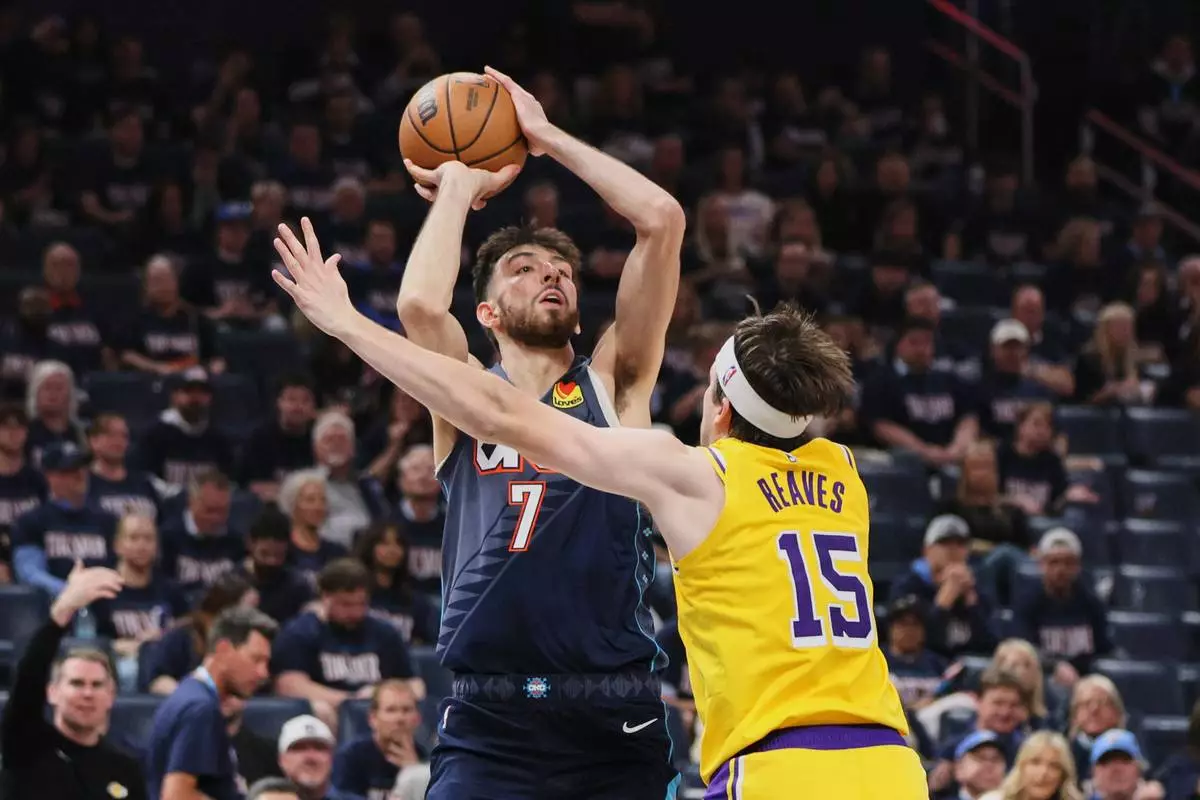
Oklahoma City Thunder's Chet Holmgren (7) shoots over Los Angeles Lakers' Austin Reaves (15) in the second half of Game 2 in a second-round NBA basketball playoffs series Thursday, May 7, 2026, in Oklahoma City. (AP Photo/Nate Billings)
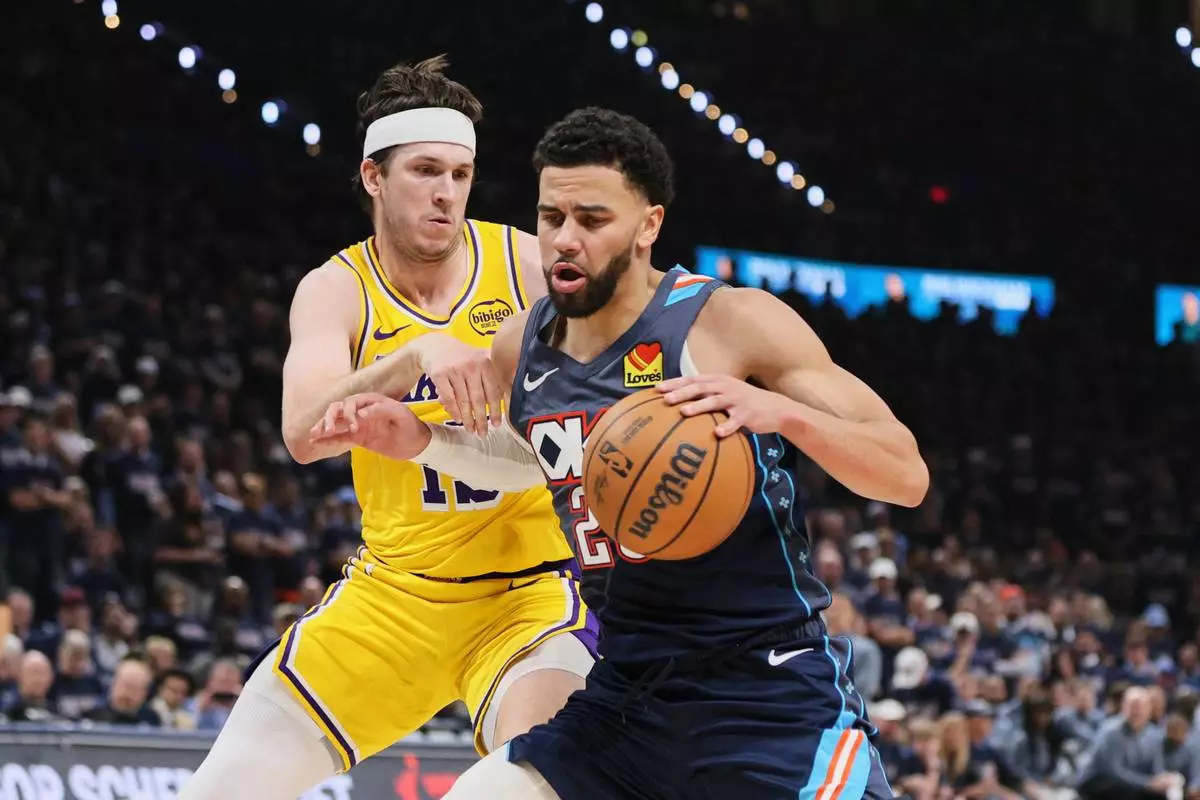
Oklahoma City Thunder guard Ajay Mitchell, front, works for a shot as Los Angeles Lakers' Austin Reaves, rear, defends in the second half of Game 2 in a second-round NBA basketball playoffs series Thursday, May 7, 2026, in Oklahoma City. (AP Photo/Nate Billings)
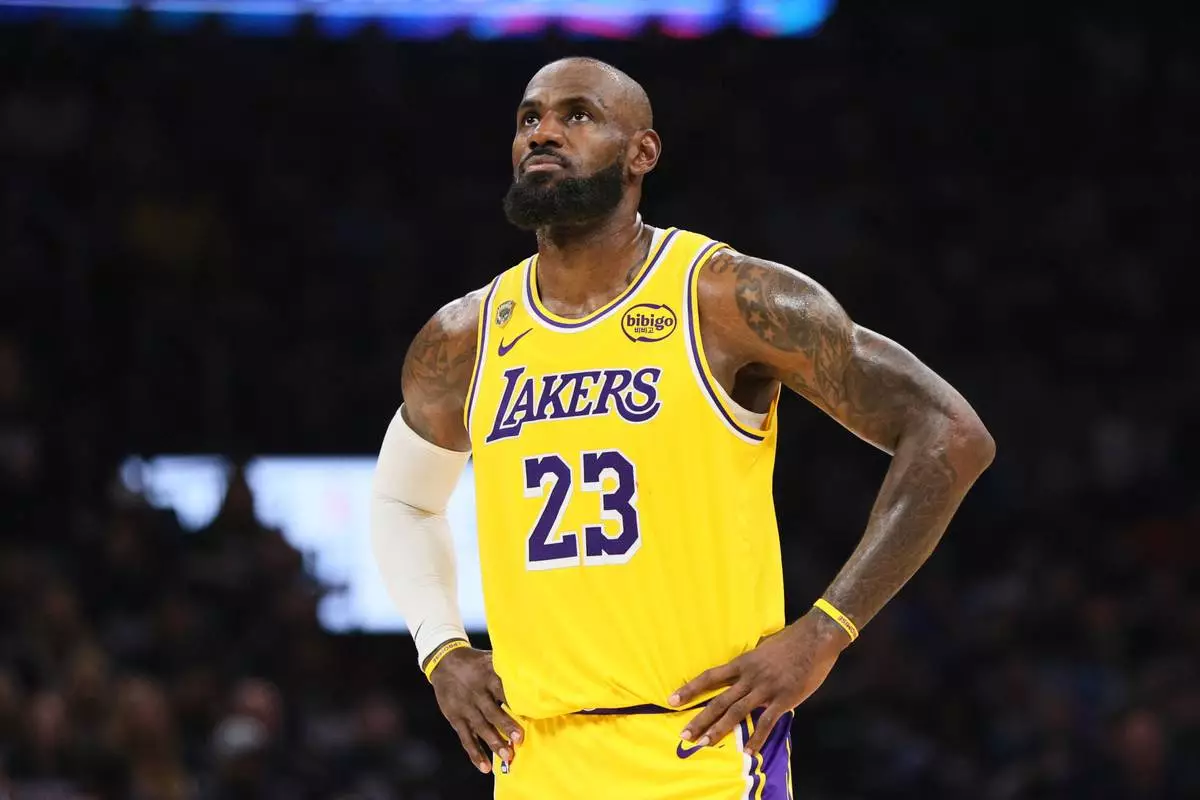
Los Angeles Lakers' LeBron James stands on the court in the second half of Game 2 in a second-round NBA basketball playoffs series against the Oklahoma City Thunder Thursday, May 7, 2026, in Oklahoma City. (AP Photo/Nate Billings)
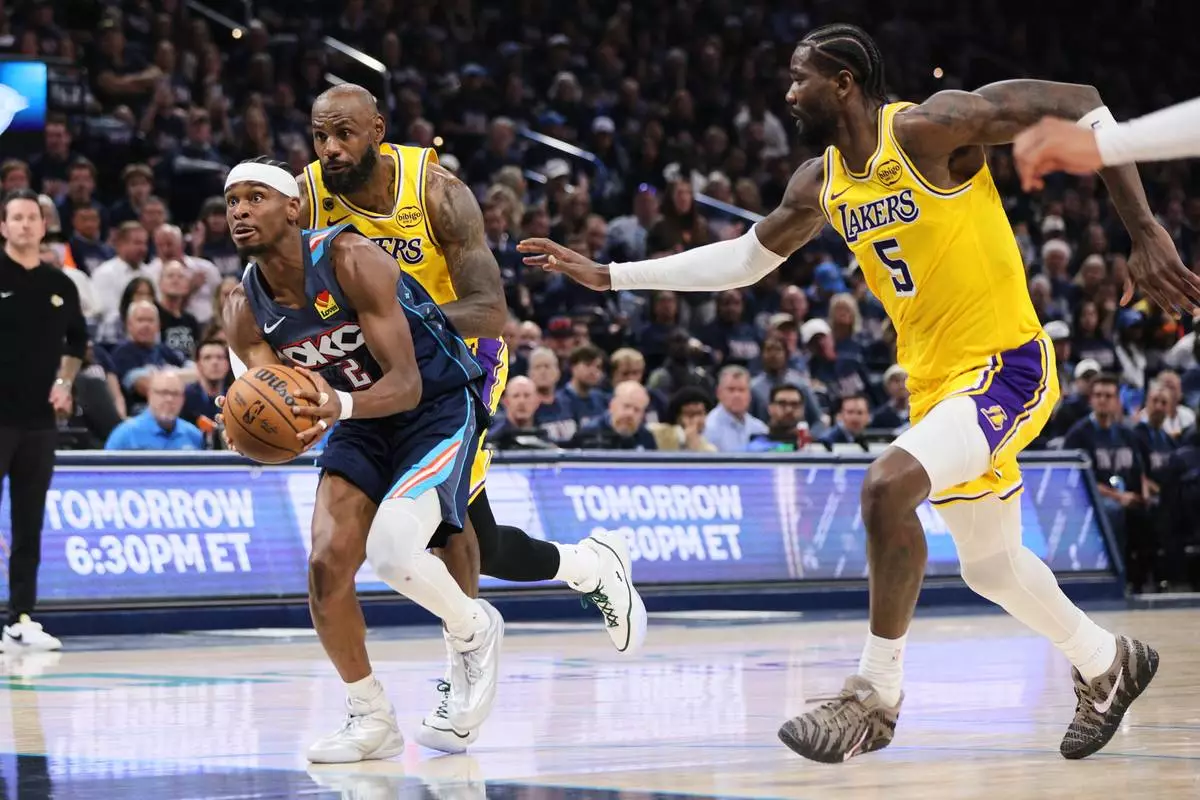
Oklahoma City Thunder guard Shai Gilgeous-Alexander (2) drives to the basket past Los Angeles Lakers' Deandre Ayton (5) and LeBron James, rear, in the second half of Game 2 in a second-round NBA basketball playoffs series Thursday, May 7, 2026, in Oklahoma City. (AP Photo/Nate Billings)
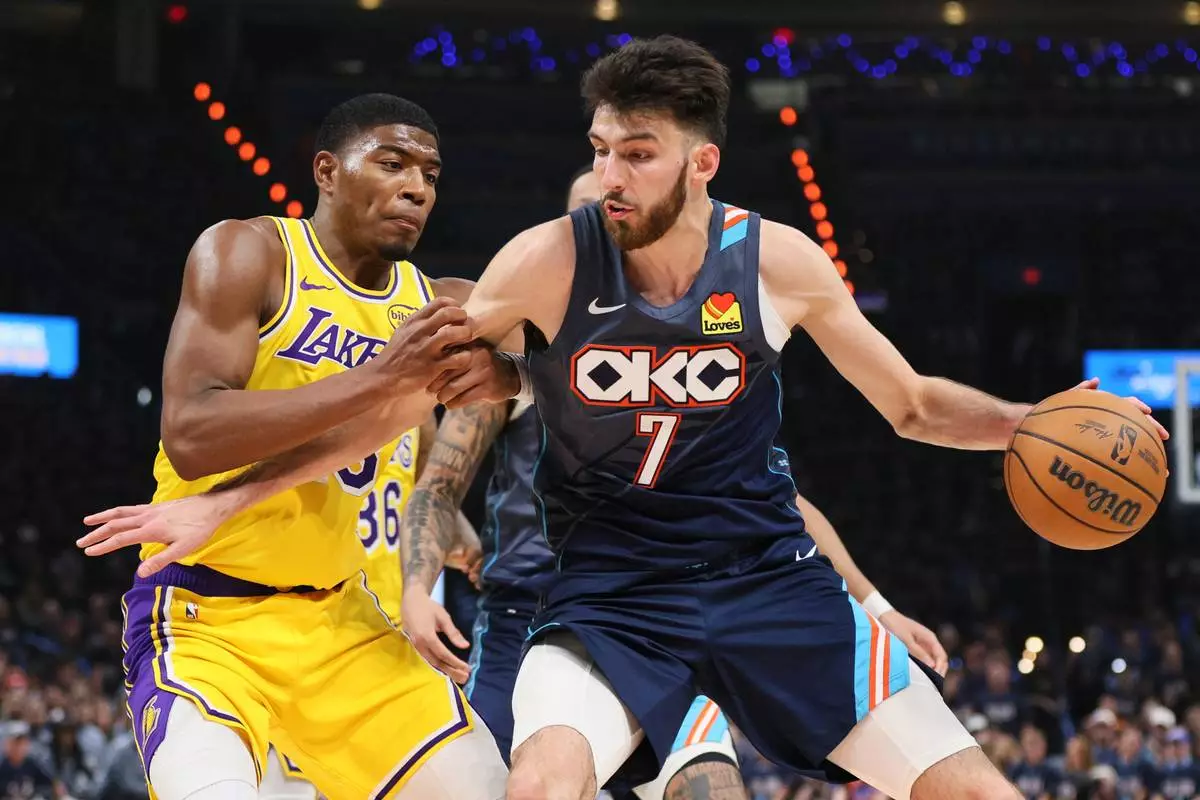
Oklahoma City Thunder center Chet Holmgren (7) works to the basket against Los Angeles Lakers forward Rui Hachimura (28) in the second half of Game 2 in a second-round NBA basketball playoffs series Thursday, May 7, 2026, in Oklahoma City. (AP Photo/Nate Billings)