Skip to Content Facebook Feature Image

Omdia: YouTube TV on Track to Become the Largest US Pay-TV Operator by 2027

Business

Omdia: YouTube TV on Track to Become the Largest US Pay-TV Operator by 2027
Business

Business

Omdia: YouTube TV on Track to Become the Largest US Pay-TV Operator by 2027

2025-12-11 21:27 Last Updated At:12-12 15:14

LONDON--(BUSINESS WIRE)--Dec 11, 2025--

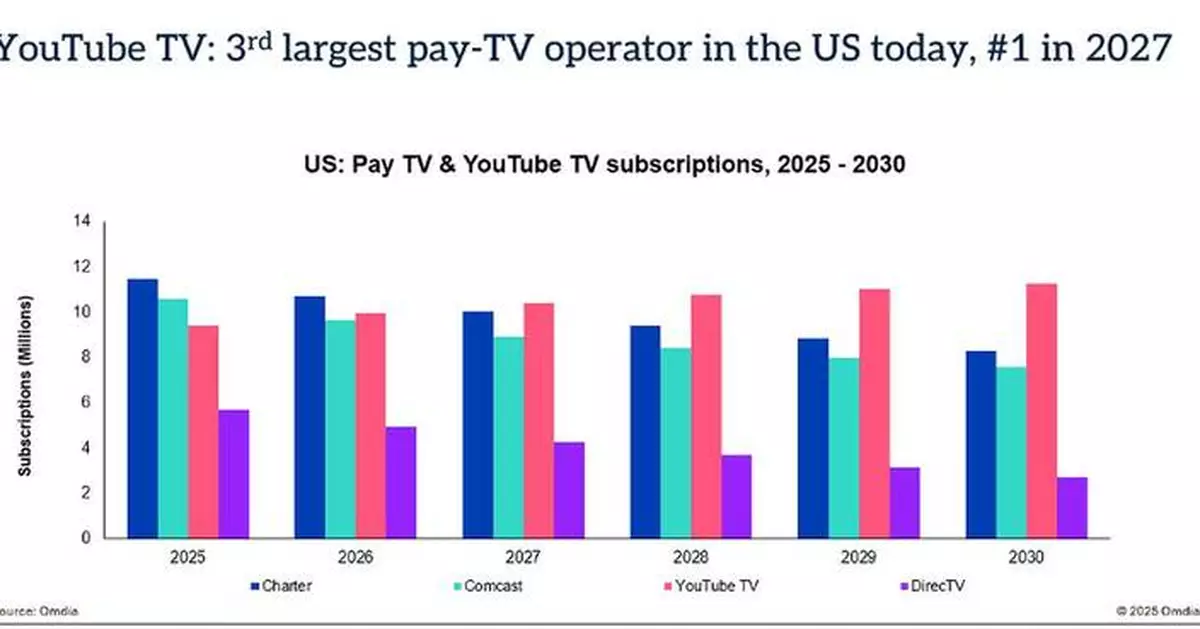
YouTube TV is set to redefine the US television landscape. According to new forecasts from Omdia, YouTube TV will surpass Charter and Comcast to become the largest pay-TV operator in the United States by 2027, marking the first time a virtual pay-TV provider will claim the top position in the market.

This press release features multimedia. View the full release here: https://www.businesswire.com/news/home/20251211953566/en/

Omdia’s latest analysis highlights the rapid growth trajectory of YouTube TV and its continued expansion into traditional pay-TV territory.

US Pay-TV Market Snapshot (End of 2025)

US Pay-TV Market Forecast (2027)

“For the first time in US television history, the largest pay-TV operator will be a virtual provider,” said Maria Rua Aguete, Head of Media and Entertainment at Omdia. “YouTube TV has evolved into a full pay-TV bundle, integrating linear channels, premium networks, and marquee sports properties such as NFL Sunday Ticket. This is not just another streaming service; it is the new face of US pay TV.”

YouTube’s Dual Strength: Global Video Giant and Rising Pay-TV Leader

Rua Aguete notes that YouTube’s influence extends far beyond its pay-TV platform. With nearly 3 billion global users, YouTube remains the largest video ecosystem in the world by a significant margin.

“Netflix may reach 300 million global subscribers, but alongside YouTube’s 3 billion users, it is not a dominant global player,” she said. “YouTube operates at a scale that no subscription service can match.”

This dual position, global video dominance plus rising pay-TV leadership, gives YouTube a unique strategic advantage in the media landscape.

US Streaming Market: Big, Fragmented, and Intensely Competitive

Omdia’s latest subscriber data highlights a highly fragmented US streaming market. Even as the largest single service, Netflix accounts for just 15.7% of total US SVOD subscriptions.

US Streaming Leaders in 2025 (Omdia forecast)

“The idea of Netflix as a dominant streaming service is a misconception,” Rua Aguete noted. “Audience attention and spend are spread across a wide array of platforms.”

Omdia’s research shows a clear shift toward hybrid services that blend linear TV, premium channels, live sports, UGC, and on-demand content. With YouTube TV on course to lead US pay-TV and YouTube already commanding the world’s biggest video audience, the company exemplifies where the industry is heading.

Rua Aguete also addressed consolidation pressures, noting strong interest in Warner assets.

“Paramount and Warner remain two of the most strategically valuable assets in Hollywood,” she said. “Interest from players such as Netflix or Paramount reflects the growing need for scale, premium IP, and global distribution.”

ABOUT OMDIA

Omdia, part of Informa TechTarget, Inc. (Nasdaq: TTGT), is a technology research and advisory group. Our deep knowledge of tech markets combined with our actionable insights empower organizations to make smart growth decisions.
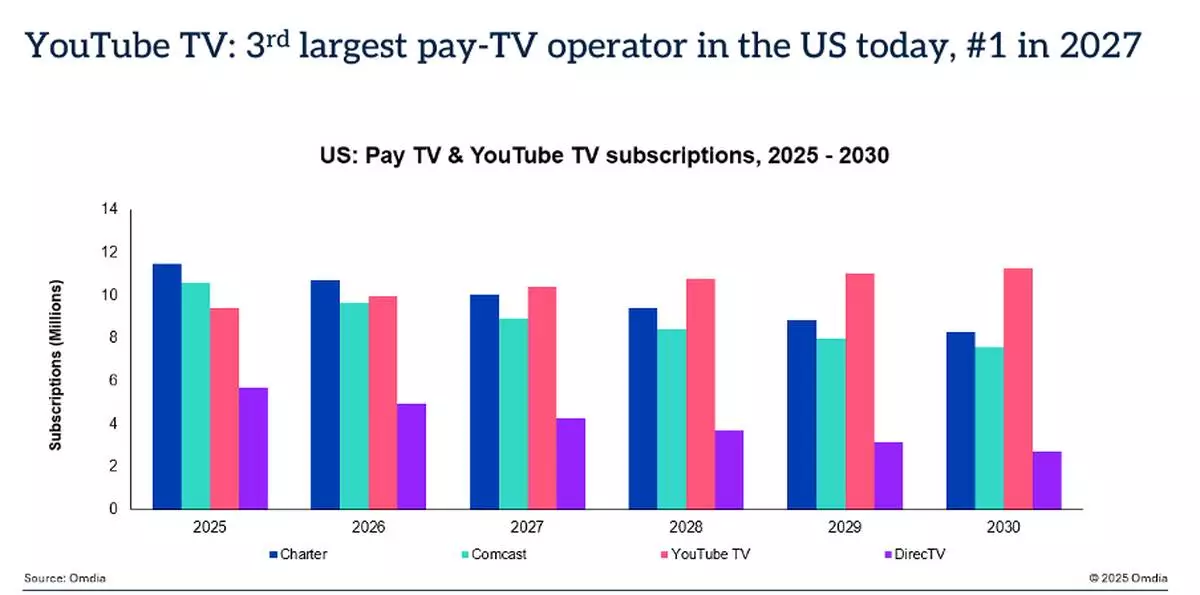
YouTube TV: 3rd largest pay-TV operator in the US today, #1 in 2027

YouTube TV: 3rd largest pay-TV operator in the US today, #1 in 2027

DUBAI, United Arab Emirates (AP) — Iran’s President Masoud Pezeshkian says a new leadership council “has begun its work” after the killing of Supreme Leader Ayatollah Ali Khamenei in U.S. and Israeli strikes.

Pezeshkian made the comment in a prerecorded message aired on Iranian state television Sunday.

Pezeshkian is one of three officials on the council. The other two are Gholam Hossein Mohseni Ejehei, head of the judiciary, and Ayatollah Ali Reza Arafi.

THIS IS A BREAKING NEWS UPDATE. AP’s earlier story follows below.

DUBAI, United Arab Emirates (AP) — An explosion rocked Iran’s capital Sunday as Israel said it would carry out “non-stop strikes” against its leaders and military. Iran meanwhile fired more missiles at Israel and Gulf Arab states in retaliation for the killing of its supreme leader in the surprise U.S. and Israeli attack that launched the widening war.

The blasts in Tehran — whose target was not immediately clear — sent a huge plume of smoke into the sky in an area where there are government buildings. Iranian authorities say more than 200 people have been killed since the U.S. and Israeli bombardment began.

Loud explosions caused by missile impacts or interceptions could be heard in Tel Aviv. Israel’s rescue services said eight people were killed and 28 wounded in a strike in the central town of Beit Shemesh.

The killing of Ayatollah Ali Khamenei, and U.S. President Donald Trump's calls for the overthrow of the decades-old Islamic Republic, marked the start of a stunning new U.S. intervention in the Middle East and potentially a prolonged war.

It is also a startling show of military might for an American president who swept into office on an “America First” platform and vowed to keep out of “forever wars.” It was the second time in eight months that the Trump administration has joined Israel in using military force against Iran.

In a 12-day war in June, Israeli and American strikes greatly weakened Iran’s air defenses, military leadership and nuclear program. But the killing of Khamenei and several top security officials creates a leadership vacuum, increasing the risk of regional instability.

“You have crossed our red line and must pay the price,” Iran’s parliamentary speaker, Mohammad Bagher Qalibaf, said in a televised address Sunday. “We will deliver such devastating blows that you yourselves will be driven to beg.”

Trump warned that any retaliation would only lead to further escalation.

“THEY BETTER NOT DO THAT,” Trump fired back in a social media post. “IF THEY DO, WE WILL HIT THEM WITH A FORCE THAT HAS NEVER BEEN SEEN BEFORE!”

In a sign of how the attack could stoke regional unrest, hundreds of people stormed the U.S. Consulate in Pakistan’s port city of Karachi on Sunday. Police and paramilitary forces used batons and fired tear gas to disperse the crowd, and at least nine people were killed in the clashes, authorities said.

As U.S. and Israeli strikes have pounded Iran, the Islamic Republic has retaliated with missiles and drone attacks on Israel and nearby Arab Gulf countries hosting U.S. forces.

The air war could rattle global markets, particularly if Iran makes the Strait of Hormuz unsafe for commercial traffic. Around 20% of the world's traded oil passes through the vital waterway, and oil prices are already set for swings.

In repeated barrages across Israel, at least nine people were killed and more than 120 injured, according to authorities. Many missiles were intercepted, the military said.

Israel’s Defense Minister Israel Katz said Sunday that Israel will have “a non-stop air train” of strikes against military and leadership targets in Iran.

Flights across the Middle East were disrupted, and air defense fire thudded over Dubai. The United Arab Emirates’ commercial capital has long drawn business and expatriates by billing itself as a safe haven in a volatile region.

Shrapnel from Iranian attacks on the Emirates’ capital of Abu Dhabi killed two people, state media said, and debris from aerial interceptions caused fires at the city’s main port and on the facade of the iconic Burj Al Arab hotel.

Attacks also extended into Oman — Iran’s longtime interlocutor with the West that hadn’t been drawn into the fray previously.

Saudi Arabia condemned Iran’s attacks on its capital, Riyadh, and eastern region, saying it had successfully intercepted them. The kingdom noted that it had not allowed its airspace or territory to be used to target Iran.

Jordan said it “dealt with” 49 drones and ballistic missiles. Kuwait, Bahrain and Qatar also said they had intercepted projectiles Sunday morning.

In Iraq, a militant group claimed responsibility for a drone attack targeting American bases in Irbil, according to the Rudaw media outlet. Smoke could be seen from an area where the U.S. has an air base there, but it was not immediately clear whether it had been hit.

As supreme leader, Khamenei had final say on all major policies during his decades in power. He led Iran’s clerical establishment and the Revolutionary Guard, the two main centers of power in the governing theocracy.

Though Trump called on Saturday for the Iranian people to “take over” their government, there was no sign in Tehran or elsewhere of unrest.

Iran quickly formed a council to govern the country until a new supreme leader is chosen.

An Iranian diplomat told the United Nations Security Council that hundreds of civilians were killed and wounded in the strikes.

In southern Iran, at least 115 people were reported killed when a girls’ school was struck, and dozens more were wounded, the local governor told Iranian state TV.

Lt Col Nadav Shoshani, an Israeli military spokesperson, said he was not aware of any Israeli or American strikes in the area of the school. U.S. Central Command spokesperson Capt. Tim Hawkins said he was aware of those reports and that officials were looking into them.

Iran’s state news agency IRNA said at least 15 people were killed in the southwest, quoting the governor of the Lamerd region, Ali Alizadeh, as saying a sports hall, two residential areas and a hall near a school were hit.

As reports trickled out about Khamenei’s death, eyewitnesses in Tehran told The Associated Press that some residents were rejoicing, cheering from rooftops, blowing whistles and letting out ululations.

Mourners raised a black flag over the Imam Reza shrine in Mashhad and the Iranian government declared 40 days of public mourning and a seven-day nationwide public holiday to commemorate Khamenei’s death.

Citing unidentified sources, the semiofficial Fars news agency reported that several relatives of Khamenei were also killed, including a daughter, son-in-law, daughter-in-law and grandchild.

Tensions have soared in recent weeks as the Trump administration built up the largest force of American warships and aircraft in the Middle East in decades. The president insisted he wanted a deal to constrain Iran’s nuclear program while the country struggled with growing dissent following nationwide protests.

Democrats decried that Trump had taken action without congressional authorization. The White House said it had briefed several Republican and Democratic leaders in Congress in advance.

Though Trump had pronounced the Iranian nuclear program obliterated in strikes last year, the country was rebuilding infrastructure that it had lost, according to a senior U.S. official who spoke to reporters on condition of anonymity to discuss Trump’s decision-making process. The official said intelligence showed that Iran had developed the capability to produce its own high-quality centrifuges, an important step in developing the highly enriched uranium needed for weapons.

Iran has said it has not enriched since June — though it has maintained its right to do so while saying its nuclear program is entirely peaceful. It has also blocked international inspectors from visiting the sites the U.S. bombed. Satellite photos analyzed by AP have shown new activity at two of those sites, suggesting Iran is trying to assess and potentially recover material.

Lidman reported from Tel Aviv, Israel; Boak from West Palm Beach, Florida; and Tucker from Washington. Associated Press writers Joe Federman in Jerusalem, Aamer Madhani and Konstantin Toropin in Washington, Sam Mednick in Tel Aviv, Israel, Farnoush Amiri in New York, David Rising in Bangkok and AP journalists around the world contributed to this report.

Shiite Muslims hold the portraits of Iranian leaders during a rally to condemn the killing of Iranian Supreme Leader Ayatollah Ali Khamenei, in Quetta, Pakistan, Sunday, March 1, 2026. (AP Photo/Arshad Butt)

Shiite Muslims hold the portraits of Iranian leaders during a rally to condemn the killing of Iranian Supreme Leader Ayatollah Ali Khamenei, in Quetta, Pakistan, Sunday, March 1, 2026. (AP Photo/Arshad Butt)

Iraqis hold a portrait of Iranian supreme Leader Ayatollah Ali Khamenei during a protest against U.S. and Israeli attacks on multiple cities across Iran, at a bridge leading to the fortified Green Zone where the U.S. Embassy is located, in Baghdad, Iraq, Sunday, March 1, 2026. (AP Photo/Hadi Mizban)

Iraqis hold a portrait of Iranian supreme Leader Ayatollah Ali Khamenei during a protest against U.S. and Israeli attacks on multiple cities across Iran, at a bridge leading to the fortified Green Zone where the U.S. Embassy is located, in Baghdad, Iraq, Sunday, March 1, 2026. (AP Photo/Hadi Mizban)

Israeli air defense system fires to intercept missiles during an Iranian attack over central Israel, Sunday, March 1, 2026. (AP Photo/Ohad Zwigenberg)

Israeli air defense system fires to intercept missiles during an Iranian attack over central Israel, Sunday, March 1, 2026. (AP Photo/Ohad Zwigenberg)

Israeli air defense system fires to intercept missiles during an Iranian attack over central Israel, Sunday, March 1, 2026. (AP Photo/Ohad Zwigenberg)

Israeli air defense system fires to intercept missiles during an Iranian attack over central Israel, Sunday, March 1, 2026. (AP Photo/Ohad Zwigenberg)

Government supporters chant slogans as they gather in mourning after state TV officially announced the death of Iranian Supreme Leader Ayatollah Ali Khamenei, in Tehran, Iran, Sunday, March 1, 2026. (AP Photo/Vahid Salemi)

Government supporters chant slogans as they gather in mourning after state TV officially announced the death of Iranian Supreme Leader Ayatollah Ali Khamenei, in Tehran, Iran, Sunday, March 1, 2026. (AP Photo/Vahid Salemi)

A plume of smoke rises after a strike in Tehran, Iran, Sunday, March 1, 2026. (AP Photo/Vahid Salemi)

A plume of smoke rises after a strike in Tehran, Iran, Sunday, March 1, 2026. (AP Photo/Vahid Salemi)

Smoke rises up after a strike in Tehran, Iran, Sunday, March 1, 2026. (AP Photo/Vahid Salemi)

Smoke rises up after a strike in Tehran, Iran, Sunday, March 1, 2026. (AP Photo/Vahid Salemi)

Government supporters gather in mourning after state TV officially announced the death of Iranian Supreme Leader Ayatollah Ali Khamenei, in Tehran, Iran, Sunday, March 1, 2026. (AP Photo/Vahid Salemi)

Government supporters gather in mourning after state TV officially announced the death of Iranian Supreme Leader Ayatollah Ali Khamenei, in Tehran, Iran, Sunday, March 1, 2026. (AP Photo/Vahid Salemi)

Government supporters chant slogans as they gather in mourning after state TV officially announced the death of Iranian Supreme Leader Ayatollah Ali Khamenei, shown in the poster, in Tehran, Iran, Sunday, March 1, 2026. (AP Photo/Vahid Salemi)

Government supporters chant slogans as they gather in mourning after state TV officially announced the death of Iranian Supreme Leader Ayatollah Ali Khamenei, shown in the poster, in Tehran, Iran, Sunday, March 1, 2026. (AP Photo/Vahid Salemi)

Government supporters gather in mourning after state TV officially announced the death of Iranian Supreme Leader Ayatollah Ali Khamenei, in Tehran, Iran, Sunday, March 1, 2026. (AP Photo/Vahid Salemi)

Government supporters gather in mourning after state TV officially announced the death of Iranian Supreme Leader Ayatollah Ali Khamenei, in Tehran, Iran, Sunday, March 1, 2026. (AP Photo/Vahid Salemi)

Rescue workers and military personnel survey the scene of a direct hit a day after an Iranian missile struck in Tel Aviv, Israel, Sunday, March 1, 2026. (AP Photo/Oded Balilty)

Rescue workers and military personnel survey the scene of a direct hit a day after an Iranian missile struck in Tel Aviv, Israel, Sunday, March 1, 2026. (AP Photo/Oded Balilty)

A government supporter holds a picture of the Iranian Supreme Leader Ayatollah Ali Khamenei during a gathering after state TV officially announced the death of Khamenei, in Tehran, Iran, Sunday, March 1, 2026. (AP Photo/Vahid Salemi)

A government supporter holds a picture of the Iranian Supreme Leader Ayatollah Ali Khamenei during a gathering after state TV officially announced the death of Khamenei, in Tehran, Iran, Sunday, March 1, 2026. (AP Photo/Vahid Salemi)

Israel's air defense missile fires to intercept missiles from Iran over Israel, Sunday, March 1, 2026. (AP Photo/Ariel Schalit)

Israel's air defense missile fires to intercept missiles from Iran over Israel, Sunday, March 1, 2026. (AP Photo/Ariel Schalit)

Government supporters mourn in a gathering after state TV officially announced the death of Iranian Supreme Leader Ayatollah Ali Khamenei, in Tehran, Iran, Sunday, March 1, 2026. (AP Photo/Vahid Salemi)

Government supporters mourn in a gathering after state TV officially announced the death of Iranian Supreme Leader Ayatollah Ali Khamenei, in Tehran, Iran, Sunday, March 1, 2026. (AP Photo/Vahid Salemi)

Government supporters chant slogans as they gather in mourning after state TV officially announced the death of Iranian Supreme Leader Ayatollah Ali Khamenei, in Tehran, Iran, Sunday, March 1, 2026. (AP Photo/Vahid Salemi)

Government supporters chant slogans as they gather in mourning after state TV officially announced the death of Iranian Supreme Leader Ayatollah Ali Khamenei, in Tehran, Iran, Sunday, March 1, 2026. (AP Photo/Vahid Salemi)

Recommended Articles