Senators for the first time are questioning military leaders over President Donald Trump’s use of the National Guard in American cities, an extraordinary move that has prompted legal challenges as well as questions about states’ rights and the use of the military on U.S. soil.
The hearing Thursday before the Senate Armed Services Committee is featuring tough questioning for Pentagon leaders over the legality of the deployments, which in some places were done over the objections of mayors and governors.
Meanwhile, in the House, lawmakers are questioning Homeland Security Secretary Kristi Noem about the administration's campaign to detain and deport thousands of immigrants.
The Latest:
Thompson repeatedly asked Michael Glasheen, operations director of the national security branch of the FBI, about how the Trump administration came to classify the decentralized antifa movement as a domestic terrorist organization. He asked for details on where the group is headquartered, and how many people are involved.
Trump announced he had made that designation earlier this year, in a crackdown on leftists after the assassination of conservative activist Charlie Kirk.
Glasheen said officials were “building out the infrastructure” to investigate the group but offered no details as Thompson doubled down.
Mike Lindell, the fervent supporter of President Donald Trump known to TV viewers as the “MyPillow Guy,” officially entered the race for Minnesota governor Thursday in hopes of winning the Republican nomination to challenge Democratic Gov. Tim Walz.
“I’ll leave no town unturned in Minnesota,” Lindell told The Associated Press in an interview ahead of a news conference set for Thursday.
He said he has a record of solving problems and personal experiences that will help businesses and fight addiction and homelessness as well as fraud in government programs.
▶ Read more about Lindell’s campaign announcement
The hearing quickly became heated over the tragic shooting of two National Guard members in Washington, D.C.
Thompson had begun questioning Noem over what he called the “unfortunate accident” when the secretary interrupted the ranking Democrat.
“Unfortunate accident?” Noem retorted. She called it a “terrorist attack.”
The interaction devolved from there as Thompson questioned her department’s approval of asylum claim that allowed the suspect to stay in the U.S.
Noem insisted it was the Biden administration’s vetting process that failed to properly screen the man who had worked alongside the U.S. military in Afghanistan.
Democrats on the Senate Armed Services Committee zeroed in Thursday on Trump’s statements that an “invasion within” or an “enemy within” justifies his guard deployments.
Gen. Gregory Guillot, who leads the military’s Northern Command, said “I do not have any indications of an enemy within.”
Charles Young, principal deputy general counsel for the Defense Department, said the Supreme Court has ruled that the president has the exclusive authority to decide whether an emergency exists.
Republican Sen. Tim Sheehy, a former Navy SEAL officer, argued during a Senate hearing that transnational crimes present enough of a risk to national security to justify military action, including on U.S. soil.
Sheehy claimed that there are foreign powers “actively attacking this country, using illegal immigration, using transnational crime, using drugs to do so.”
Air Force Gen. Gregory M. Guillot agreed with Sheehy’s assessment.
An attorney for the Pentagon declined to offer a clear answer when asked if a president could lawfully order the military to shoot protesters.
During a hearing Thursday on National Guard deployments in U.S. cities, Sen. Mazie Hirono, D-Hawaii, noted that former Defense Secretary Mark Esper alleged that Trump inquired about shooting protesters during the George Floyd demonstrations.
Hirono asked Charles L. Young III, principal deputy general counsel at the defense department, whether a presidential order to shoot protesters would be lawful.
Young said he was unaware of Trump’s comments and responded that the answer “would depend on the circumstances.”
“We have a president who doesn’t think the rule of law applies to him,” Hirono said in response.
U.S. District Judge Paula Xinis in Maryland ruled that Immigration and Customs Enforcement must release Abrego Garcia from custody immediately.
“Since Abrego Garcia’s return from wrongful detention in El Salvador, he has been re-detained, again without lawful authority,” the judge wrote. “For this reason, the Court will GRANT Abrego Garcia’s Petition for immediate release from ICE custody.”
The Salvadoran national has an American wife and child and has lived in Maryland for years, but he originally immigrated to the U.S. illegally as a teenager. An immigration judge in 2019 ruled Abrego Garcia could not be deported to El Salvador because he faced danger from a gang that targeted his family. When Abrego Garcia was mistakenly deported there in March, his case became a rallying point for those who oppose Trump’s immigration crackdown.
Sen. Tim Kaine, a Virginia Democrat, raised concerns that National Guard troops deployed to U.S. cities don’t receive training on how to handle situations where someone is having a mental health episode, saying that many police officers frequently encounter such situations and receive extensive training on how to handle them.
Air Force Gen. Gregory M. Guillot, the commander of U.S. troops in North America, said that National Guard troops are trained to de-escalate tense interactions with people, but don’t receive any specific training on mental health episodes.
The secretary also levied broad criticism of the program that brought the man to the United States years before he allegedly shot two National Guard members.
Operation Allies Welcome was created by the Biden administration to safe Afghan supporters from Taliban retribution after the U.S. military pullout from Afghanistan following 20 years of American intervention and billions of dollars of aid.
Spc. Sarah Beckstrom, was killed in the Washington shooting. Noem said Thursday that U.S. Air Force Staff Sgt. Andrew Wolfe, has been showing improvement.
Rahmanullah Lakanwal, a 29-year-old Afghan national who was also shot during the confrontation, has been charged with murder. He pleaded not guilty.
The top Democrat on the Senate Armed Services Committee, Sen. Jack Reed, questioned Air Force Gen. Gregory M. Guillot, the commander of U.S. troops in North America, on how he evaluates the lawfulness of orders.
Guillot said that he consults with military attorneys, raises any questions with the defense secretary and commanding military officers, and executes the order once he’s confident in its lawfulness.
This has become a pressing question under the Trump administration amid National Guard deployments to U.S. cities and a campaign to strike boats allegedly carrying drugs near Venezuela. The president has targeted Democratic lawmakers who released a video urging military and intelligence officers to refuse illegal orders.
“End deportations!” shouts one. “Stop ICE raids!” yells another.
The two people were escorted by Capitol Police out of the Homeland Security Committee hearing room.
Chairman Andrew Garbarino, R-N.Y., gaveled the panel back to order as Noem resumed her opening remarks.
Rep. Bennie Thompson, the ranking Democrat on the Homeland Security Committee, told the secretary she has diverted vast resources to carry out Trump’s “extreme” immigration agenda, and failed to provide basic responses to oversight questions from Congress.
“I call on you to resign,” the Mississippi congressman said. “Do a real service to the country.”
Air Force Gen. Gregory M. Guillot, the commander of U.S. troops in North America, told senators that National Guard troops are instructed not to perform many law enforcement activities like making arrests or searching for evidence of a crime. However, the troops are allowed to detain people if they deem the person to be putting others at risk.
Guillot said that one person was detained as part of Trump’s campaign to deploy National Guard troops to U.S. cities. The person was detained in June outside a federal facility in Los Angeles.
“Stop terrorizing our communities,” one person shouted as the secretary entered.
Noem greeted some others in the audience.
One protester was singing the song from Star Wars that had been used to follow law enforcement officers as the agency conducts mass immigration raids and patrols city streets.
Homeland Security Secretary Kristi Noem is expected to face fierce questioning from Democrats Thursday as the public face of the Republican administration’s hard-line approach to immigration.
Since Noem last appeared in Congress in May, immigration enforcement operations in U.S. cities have become increasingly contentious, with federal agents and activists frequently clashing over her department’s tactics.
Noem is testifying in front of the House Committee on Homeland Security to discuss “Worldwide Threats to the Homeland,” which in years past have focused on issues such as cybersecurity, terrorism, China and border security. Thursday’s appearance is likely to focus heavily on immigration.
This hearing is the highest level of scrutiny to Trump’s use of the National Guard outside of a courtroom since the deployments began and comes a day after the president faced another legal setback over his muscular use of troops in larger federal operations. Trump has justified the use of the military in American cities by saying the National Guard is needed to support federal law enforcement, protect federal facilities and combat crime.
The hearing comes two weeks after two West Virginia National Guard members deployed to Washington were shot just blocks from the White House in what the city’s mayor described as a targeted attack. Spc. Sarah Beckstrom died a day after the Nov. 26 shooting, and her funeral took place Tuesday. Staff Sgt. Andrew Wolfe is still hospitalized in Washington.
Sen. Tammy Duckworth of Illinois said Trump’s deployment of the National Guard into American cities is “deeply unpopular.”
“Most Americans don’t want this,” she said at a the Senate Armed Services Committee hearing, adding that most of the guard members don’t want these assignments, either.
“Our heroes did not sign up for this,” said Duckworth, a combat veteran who served in the Illinois National Guard.
She noted that she had threatened to hold up the annual defense bill if Republican leadership continued to block the hearing, which she said is long overdue. She said she has questions for the military about how Trump’s deployments are affecting readiness, training and costs.
The Republican chairman of the Senate Armed Services Committee is opening a hearing on Trump’s National Guard troop deployment to U.S. cities by asserting that crime is on the rise.
“In recent years, violent crime, rioting, drug trafficking and heinous gang activity have steadily escalated,” said Sen. Roger Wicker, a Mississippi Republican.
He added that the troop deployments are “not only appropriate, but essential.”
Democrats are expected to use the hearing to criticize the deployments as an inappropriate use of military troops.
U.S. jobless claim applications for the week ending Dec. 6 climbed by 44,000 from the previous week’s 192,000, the Labor Department reported Thursday. That’s more than analysts’ forecast of 213,000.
The total number of Americans filing for jobless benefits for the previous week ending Nov. 29 fell by 99,000 to 1.84 million, the government said. That’s the lowest level for continuing claims since mid-April.
Applications for unemployment aid are viewed as a proxy for layoffs and are close to a real-time indicator of the health of the job market. Overall layoffs have been muted despite recent high-profile job cuts. Hiring is also sluggish, which makes finding a job for those out of work challenging. For now, the U.S. job market appears stuck in a “low-hire, low-fire” state.
The U.S. trade deficit fell for the second straight month in September, dropping to the lowest since June 2020 when global commerce was disrupted by the COVID-19 pandemic.
The Commerce Department reported Thursday that the deficit — the gap between what the United States sells other countries and what it buys from them — dropped nearly 11% to $52.8 billion in September. It had fallen more than 23% from July to August.
Still, the U.S. trade deficit is up so far in 2025, coming in at $765.1 billion through September, up 17% from $652.6 billion in January-September 2024. Many companies imported foreign goods early in 2025 to get ahead of Trump’s tariffs.
The outcome of Thursday’s state Senate vote remains uncertain despite months of pressure from Trump to remap Indiana’s House districts in ways that could give the GOP control of all nine seats. Even in the face of one-on-one pressure from the White House and violent threats against state lawmakers, many Indiana Republicans have been reluctant to back a new congressional map that would split the city of Indianapolis into four districts.
Democrats are increasingly liking their odds at flipping control of the U.S. House after the results of recent high-profile elections. Trump is threatening to back primary challengers for any GOP state senator who votes against the Republican remap. “If Republicans will not do what is necessary to save our Country, they will eventually lose everything to the Democrats,” Trump wrote on social media.
▶ Follow developments on Indiana redistricting
Trump’s approval ratings on immigration have declined since March, but border security remains a relatively strong issue for him.
Half of U.S. adults, 50%, approve of how Trump is handling border security, according to a new AP-NORC poll. Just 38% currently approve of how he’s handling the issue of immigration.
Trump’s relative strength on border security is partially driven by Democrats and independents, who are less likely to approve of his immigration approach. Other polls have shown these groups tend to prioritize increasing border security more than deporting immigrants, even those who are living in the country illegally.
Shaniqwa Copeland, a 30-year-old independent and home health aide in St. Augustine, Florida, said she approves of Trump’s overall handling of the presidency, but believes his immigration actions have gone too far.
“Now they’re just picking up anybody,” Copeland told the AP. “They just like, pick up people, grabbing anybody. It’s crazy.”
▶ Read more about the poll’s findings
Prediction markets pegged AI as a leading contender, along with Trump, Pope Leo XIV, Israeli Prime Minister Benjamin Netanyahu and New York Mayor-elect Zohran Mamdani.
Trump was already named the 2024 person of the year by the magazine after his winning his second bid for the White House, succeeding Taylor Swift, who was the 2023 person of the year.
The magazine cited 2025 as the year when the potential of artificial intelligence “roared into view” with no turning back. “For delivering the age of thinking machines, for wowing and worrying humanity, for transforming the present and transcending the possible, the Architects of AI are TIME’s 2025 Person of the Year,” Time said in a social media post Thursday.
President Volodymyr Zelenskyy said Ukraine would give its latest peace proposals to U.S. negotiators ahead of his urgent talks Thursday with a coalition of about 30 countries supporting Kyiv’s effort to end the war with Russia on acceptable terms. The White House did not respond to a request for comment Wednesday on whether that happened.
Negotiations are at “a critical moment,” German Chancellor Friedrich Merz, British Prime Minister Keir Starmer and French President Emmanuel Macron said in a statement.
Washington’s goal of a swift compromise to stop the fighting that followed Russia’s full-scale invasion in 2022 is reducing Kyiv’s room for maneuvering. Zelenskyy is walking a tightrope between defending Ukrainian interests and showing Trump he is willing to compromise, even as Moscow shows no public sign of budging from its demands. Zelenskyy’s allies are backing his effort, seeking a fair settlement that will deters future Russian attacks and defend Europe.
▶ Read more about the latest negotiations to end Russia’s war in Ukraine
The Senate is poised on Thursday to reject legislation to extend Affordable Care Act tax credits for millions of Americans, a potentially unceremonious end to a monthslong Democratic effort to prevent the COVID-era subsidies from expiring on Jan. 1.
Despite a bipartisan desire to continue the credits, Republicans and Democrats have never engaged in meaningful or high-level negotiations. The Senate is expected to vote on two partisan bills and defeat them both — essentially guaranteeing that many who buy their health insurance on the ACA marketplaces see a steep rise in costs at the beginning of the year.
“It’s too complicated and too difficult to get done in the limited time that we have left,” said Sen. Thom Tillis of North Carolina, who has unsuccessfully pushed his Republican colleagues to extend the tax credits for a short time so they can find agreement on the issue next year. Neither side has seemed interested in compromise.
▶ Read more about the congressional stalemate on health care
Senators for the first time are poised to question military leaders over Trump’s use of the National Guard in American cities, an extraordinary move that has prompted legal challenges as well as questions about states’ rights and the use of the military on U.S. soil.
The hearing Thursday before the Senate Armed Services Committee is expected to feature tough questioning for Pentagon leaders over the legality of the deployments, which in some places were done over the objections of mayors and governors.
The hearing will bring the highest level of scrutiny to Trump’s use of the National Guard outside of a courtroom since the deployments began and comes a day after the president faced another legal setback over his muscular use of troops in larger federal operations.
▶ Read more about Senate scrutiny of the Guard deployments
Oil companies offered $300 million for drilling rights in the Gulf of Mexico on Wednesday in the first of 30 sales planned for the region under Republican efforts to ramp up U.S. fossil fuel production.
The sale came after Trump’s administration recently announced plans to allow new drilling off Florida and California for the first time in decades. That’s drawn pushback, including from Republicans worried about impacts to tourism.
Wednesday’s sale was mandated by the sweeping tax-and-spending bill approved by Republicans over the summer. Under that legislation, companies will pay a 12.5% royalty on oil produced from the leases. That’s the lowest royalty level for deep-water drilling since 2007.
Thirty companies submitted bids on parcels covering 1,600 square miles (4,142 square kilometers). Total high bids were down from $382 million offered in the most recent lease sale in the Gulf of Mexico under former President Joe Biden in December 2023.
▶ Read more about the sales
When Trump promised new tariffs while running for president, Gene Stehly worried that trade disputes would jeopardize his international sales of corn, soybeans and wheat.
A little more than a year later, Stehly said his fears have become a reality, and Trump’s latest promise of federal assistance is insufficient to cover farmers’ losses.
Trump announced Monday that his administration would distribute $12 billion in one-time payments to farmers, who have suffered from persistently low commodity prices, rising costs and declining sales after China cut off all agricultural purchases from America during the trade war.
While rural areas remain conservative bastions, farmers’ patience with Washington is wearing thin. Several of them described the government bailout, an echo of similar policies during Trump’s first term, as a welcome stopgap but one that won’t solve the agricultural industry’s problems.
“It’s a bridge. It’s not the ultimate solution we’re looking for,” said Charlie Radman, a fourth-generation farmer. “What we really want to have is a little more certainty and not have to rely on these ad hoc payments.”
▶ Read more about farmers’ concerns
Sweeping taxes on imports have cost the average American household nearly $1,200 since Donald Trump returned to the White House this year, according to calculations by Democrats on Congress’ Joint Economic Committee.
Using Treasury Department numbers on revenue from tariffs and Goldman Sachs estimates of who ends up paying for them, the Democrats’ report Thursday found that American consumers’ share of the bill came to nearly $159 billion — or $1,198 per household — from February through November.
In his second term, Trump has reversed decades of U.S. policy that favored free trade. He’s imposed double-digit tariffs on almost every country on earth. According to Yale University’s Budget Lab, the average U.S. tariff has shot up from 2.4% at the beginning of the year to 16.8%, the highest since 1935.
The president argues that the import taxes will protect U.S. industries from unfair foreign competition, bring factories to the United States and raise money for the Treasury.
▶ Read more about the Democrats’ report
Trump’s approval on the economy and immigration have fallen substantially since March, according to a new AP-NORC poll, the latest indication that two signature issues that got him elected barely a year ago could be turning into liabilities as his party begins to gear up for the 2026 midterms.
Only 31% of U.S. adults now approve of how Trump is handling the economy, the poll from The Associated Press-NORC Center for Public Affairs Research finds. That is down from 40% in March and marks the lowest economic approval he’s registered in an AP-NORC poll in his first or second term. Trump has also struggled to recover from public blowback on other issues, such as his management of the federal government, and has not seen an approval bump even after congressional Democrats effectively capitulated to end a record-long government shutdown last month.
Just a few months ago, 53% of Americans approved of Trump’s handling of crime, but that’s fallen to 43% in the new poll. There’s been a similar decline on immigration, from 49% approval in March to 38% now.
▶ Read more about the poll’s findings

This image from video posted on Attorney General Pam Bondi's X account, and partially redacted by the source, shows an oil tanker being seized by U.S. forces off the coast of Venezuela, Wednesday, Dec. 10, 2025. (U.S. Attorney General's Office/X via AP)

Sitting next to founder and CEO of Dell, Michael Dell, left, President Donald Trump speaks during a roundtable discussion with business leaders in the Roosevelt Room of the White House, Wednesday, Dec. 10, 2025, in Washington. (AP Photo/Evan Vucci)
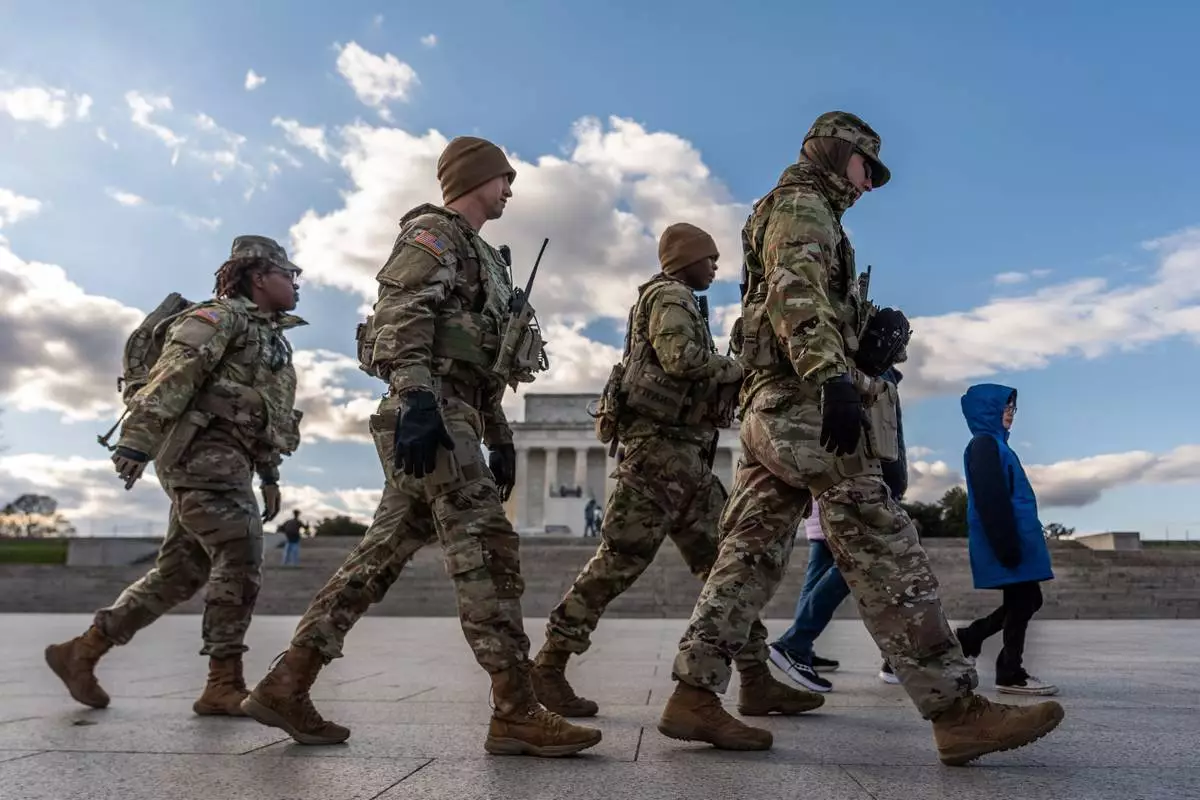
Members of the National Guard patrol in front of the Lincoln Memorial on the National Mall, Friday, Nov. 28, 2025, in Washington. (AP Photo/Julia Demaree Nikhinson)