LITTLE ROCK, Arkansas (AP) — The commission that oversees public television in Arkansas voted Thursday to sever ties with PBS, making it the first state to end its contract with the broadcast giant that provides popular television programs such as “Sesame Street,” “Nova” and “Antiques Roadshow.”
The eight-member Arkansas Educational Television Commission, made up entirely of appointees of the governor, announced in a news release Thursday that it planned to disaffiliate from PBS effective July 1, citing annual membership dues of about $2.5 million it described as “not feasible.” The release also cited the unexpected loss of about that same amount of federal funding from the Corporation for Public Broadcasting, which was targeted for closure earlier this year and defunded by Congress.
PBS Arkansas is rebranding itself as Arkansas TV and will provide more local content, the agency's Executive Director and CEO Carlton Wing said in a statement. Wing, a former Republican state representative, took the helm of the agency in September.
“Public television in Arkansas is not going away,” Wing said. “In fact, we invite you to join our vision for an increased focus on local programming, continuing to safeguard Arkansans in times of emergency and supporting our K-12 educators and students.”
PBS confirmed in an email Thursday that Arkansas is the first state to definitively sever ties with the broadcaster. Alabama considered similar action last month, but opted to continue paying its contract with PBS after public backlash from viewers and donors.
“The commission’s decision to drop PBS membership is a blow to Arkansans who will lose free, over the air access to quality PBS programming they know and love," a PBS spokesperson wrote in an email to The Associated Press.
The demise of the Corporation for Public Broadcasting, is a direct result of President Donald Trump’s targeting of public media, which he has repeatedly said is spreading political and cultural views antithetical to those the United States should be espousing. The closure is expected to have a profound impact on the journalistic and cultural landscape — in particular, public radio and TV stations in small communities nationwide.
Arkansas House Democratic Leader Rep. Andrew Collins called the demise of PBS in Arkansas sad. “It’s certainly a loss for Arkansas families who value the programming of PBS,” he said.
CPB helps fund both PBS and NPR, but most of its funding is distributed to more than 1,500 local public radio and television stations around the country.

FILE - An entrance to the Arizona PBS offices in the Walter Cronkite School of Journalism and Mass Communication in Phoenix is seen, May 2, 2025. (AP Photo/Katie Oyan, File)
PHILIPSBURG, Pa. (AP) — Kilmar Abrego Garcia was freed from immigration detention on a judge's order Thursday while he fights to stay in the U.S., handing a major victory to the immigrant whose wrongful deportation to a notorious prison in El Salvador made him a flashpoint of the Trump administration’s immigration crackdown.
U.S. District Judge Paula Xinis in Maryland ordered Immigration and Customs Enforcement to let Abrego Garcia go immediately, writing that federal authorities had detained him again after his return to the United States without any legal basis.
Abrego Garcia’s attorney’s office confirmed he was released just before 5 p.m., the deadline the judge gave the government for an update on Abrego Garcia’s release. His attorney, Simon Sandoval-Moshenberg, earlier told The Associated Press that Abrego Garcia plans to return to Maryland, where he has an American wife and child and where he has lived for years after originally immigrating to the U.S. illegally as a teenager.
Abrego Garcia had been held at Moshannon Valley Processing Center about 115 miles (185 kilometers) northeast of Pittsburgh.
Sandoval-Moshenberg said he’s not sure what comes next, but he’s prepared to defend his client against further deportation efforts.
“The government still has plenty of tools in their toolbox, plenty of tricks up their sleeve,” Sandoval-Moshenberg said, adding he fully expects the government to again take steps to deport his client. “We’re going to be there to fight to make sure there is a fair trial.”
The Department of Homeland Security sharply criticized the judge's decision and vowed to appeal, calling the ruling “naked judicial activism” by a judge appointed during the Obama administration.
“This order lacks any valid legal basis, and we will continue to fight this tooth and nail in the courts,” said Tricia McLaughlin, the department’s assistant secretary.
Sandoval-Moshenberg, said the judge made it clear that the government can’t detain someone indefinitely without legal authority and that his client “has endured more than anyone should ever have to.”
Abrego Garcia, with an American wife and child, has lived in Maryland for years but entered the U.S. illegally as a teenager. An immigration judge ruled in 2019 that Abrego Garcia, a Salvadoran national, could not be deported to El Salvador because he faced danger from a gang that targeted his family. When he was mistakenly sent there in March, his case became a rallying point for those who oppose President Donald Trump’s immigration enforcement actions.
A court later ordered his return to the United States. Since he cannot be removed to El Salvador, ICE has been seeking to deport him to a series of African countries. His federal suit claims the Trump administration is illegally using the removal process to punish Abrego Garcia for the public embarrassment caused by his deportation.
In her order releasing Abrego Garcia, Xinis wrote that federal authorities “did not just stonewall” the court, “They affirmatively misled the tribunal.” The judge was referencing the successive list of four African countries that officials had sought to remove Abrego Garcia seemingly without commitments from those countries, as well as officials' affirmations that Costa Rica withdrew its offer to accept him, a claim later proven untrue.
“But Costa Rica had never wavered in its commitment to receive Abrego Garcia, just as Abrego Garcia never wavered in his commitment to resettle there,” the judge wrote.
Xinis also rejected the government’s argument that she lacked jurisdiction to intervene on a final removal order for Abrego Garcia, because she found no final order had been filed.
Separately, Abrego Garcia is asking an immigration court to reopen his case so he can seek asylum in the United States.
He is also criminally charged in Tennessee, where he has pleaded not guilty to human smuggling. He has asked the federal court to dismiss the case, arguing the prosecution is vindictive. His defense attorney in Tennessee, Sean Hecker, declined to comment.
Loller reported from Nashville and Seewer reported from Toledo, Ohio. Associated Press reporters Alanna Durkin Richer in Washington and Claudia Lauer in Philadelphia contributed to this report.
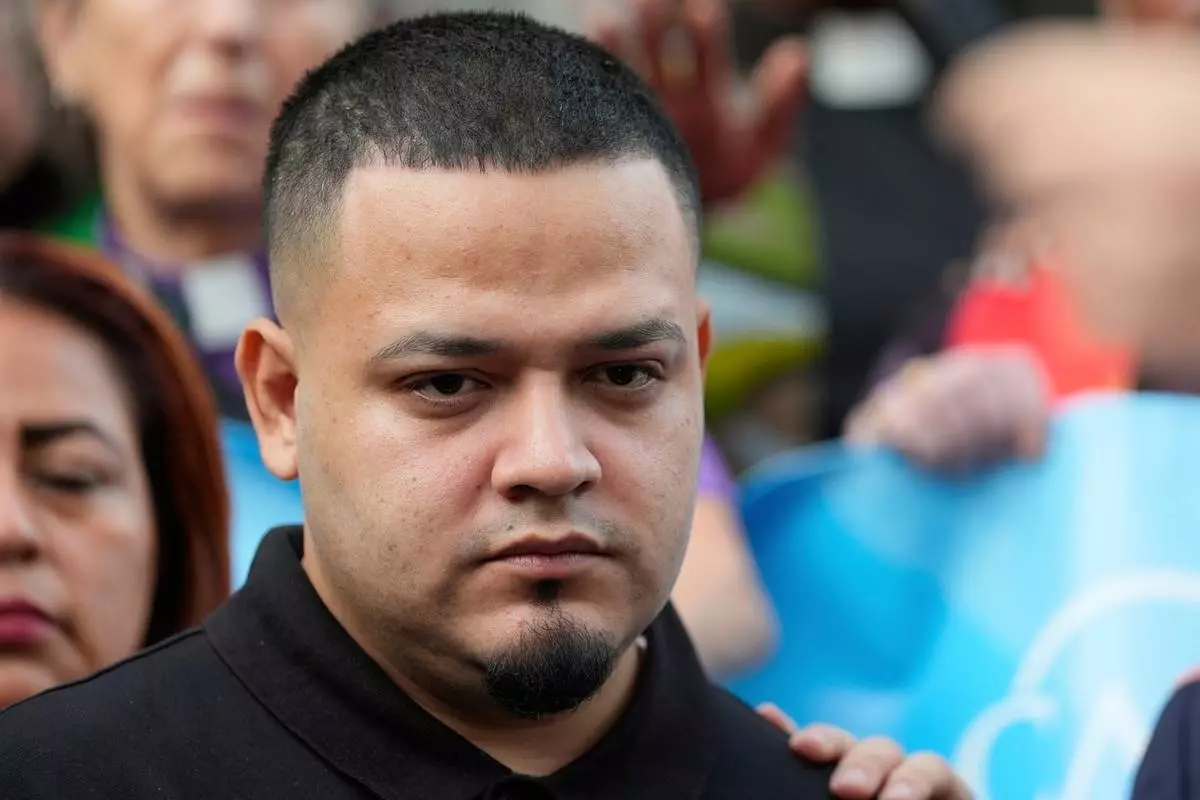
FILE - Kilmar Abrego Garcia joins supporters in a protest rally outside the Immigration and Customs Enforcement field office in Baltimore, Aug. 25, 2025. (AP Photo/Stephanie Scarbrough, File)