DENVER (AP) — The Stanley Cup was in the building Thursday night as part of the pregame celebration to honor the 1995-96 Colorado Avalanche squad.
It could be in the building again later this season, too.
Click to Gallery

Members from the 1996 Stanley Cup Championship team of the Colorado Avalanche gather for a group shot during a ceremony to mark the 30th anniversary of winning the Cup before an NHL hockey game against the Florida Panthers, Thursday, Dec. 11, 2025, in Denver. (AP Photo/David Zalubowski)

Colorado Avalanche general manager Joe Sakic and member of team that won the Stanley Cup in 1996, is introduced during a ceremony to mark the 30th anniversary of the win before an NHL hockey game against the Florida Panthers, Thursday, Dec. 11, 2025, in Denver. (AP Photo/David Zalubowski)

Peter Forsberg waves as he is introduced as one of the members from the Colorado Avalanche's 1996 Stanley Cup Championship team during a ceremony to mark the 30th anniversary of the victory before an NHL hockey game against the Florida Panthers, Thursday, Dec. 11, 2025, in Denver. (AP Photo/David Zalubowski)

Members of the 1996 Stanley Cup Championship team from the Colorado Avalanche are honored to mark the 30th anniversary of winning the Cup before an NHL hockey game against the Florida Panthers Thursday, Dec. 11, 2025, in Denver. (AP Photo/David Zalubowski)
At least, longtime forward Claude Lemieux believes so. He's been on four Stanley Cup-winning teams, including the ‘95-96 Avalanche squad. This team, he surmised after watching a 6-2 win over the two-time defending champion Florida Panthers, has all the necessary ingredients.
“I love watching them play,” said Lemieux, whose squad back then won the Mile High City’s first major professional championship in their first season in town after relocating from Quebec. “They’re fun to watch.”
In a lot of ways, this version is built in the image of that squad. No real surprise there, given the architect of this team is Hall of Famer turned front office executive Joe Sakic.
Back then, Sakic, the captain, and fellow Hall of Famer Peter Forsberg helped provide the scoring punch in a season that ended with a Stanley Cup Final sweep over Florida. Colorado had a blue line that include a rugged defender in Adam Foote and a scoring defenseman in Sandis Ozolinsh. They also had another Hall of Famer in goaltender Patrick Roy.
This team has that same sort of makeup. They have an elite goal scorer (Nathan MacKinnon), leadership (captain Gabriel Landeskog), even more leadership (40-year-old Brent Burns), a scoring defenseman (Cale Makar) and reliable goaltending (Mackenzie Blackwood and Scott Wedgewood).
The current crew watched Thursday night as the players from the '95-96 squad were recognized. They heard the applause. They then went out and put on a show for them.
“This team knows what it takes,” Lemieux said. “They have players, quite a few of them, that were on the ‘22 Cup. I think it could be the ’26 Cup.”
The Avalanche (22-2-7) have a league-leading 51 points so far this season as they became the sixth team in the last 20 years to reach the 50-point plateau in 31 or fewer games. What's more, they still haven't lost a game at home in regulation (12-0-2).
Avalanche coach Jared Bednar thinks it was a valuable experience having the older players back in the building. The current roster briefly got to chat with them Thursday morning, and hear some stories.
“Obviously, they accomplished that two years before I was born,” Makar cracked. “But I've obviously heard a lot about it. It’s pretty cool they bring legends like that back.”
Some of the Avalanche players who made the trip to the rink for the ceremony from the 1995-96 squad included Forsberg, Stephane Yelle, Valeri Kamensky, Lemieux, Ozolinsh, Mike Ricci and, of course, Sakic.
“For them to be able to come back and get together as a group and share their stories with our guys and amongst one another, I’m sure it’s been a great couple days for them,” Bednar said. “We’ve been really happy that they were able to come and visit us.”
It gave the old-timers a chance to stroll down memory lane.
“When it’s happening, when you’re in the middle of it, you don’t quite appreciate it as much as you should,” said Lemieux, who also won Stanley Cup titles with Montreal (1985-86) and two with the New Jersey Devils (1994-5, 1999-00). “So you get to relive it now.”
How has the game has changed?
“We think we’re better — no, we’re just kidding,” Lemieux said. “The game’s change. It’s not as physical as it was, but to counter that physicality they've got so much more skills. So we appreciate the game. We appreciate their skills and everything they bring.”
The get-together provided a chance to remember old teammates, too. The late Chris Simon was represented during the on-ice ceremony by his children. He died in 2024 at 52.
“It’s very difficult, and especially with Chris passing at such a young age,” Lemieux said. “We have to count our blessings — be grateful for the days that we have and enjoy and appreciate those times when we get together."
Lemieux certainly enjoyed being around this new cast of Avalanche.
“We hope we bring them good luck," Lemieux said, "and inspire them to win another Cup.”
AP NHL: https://apnews.com/hub/nhl
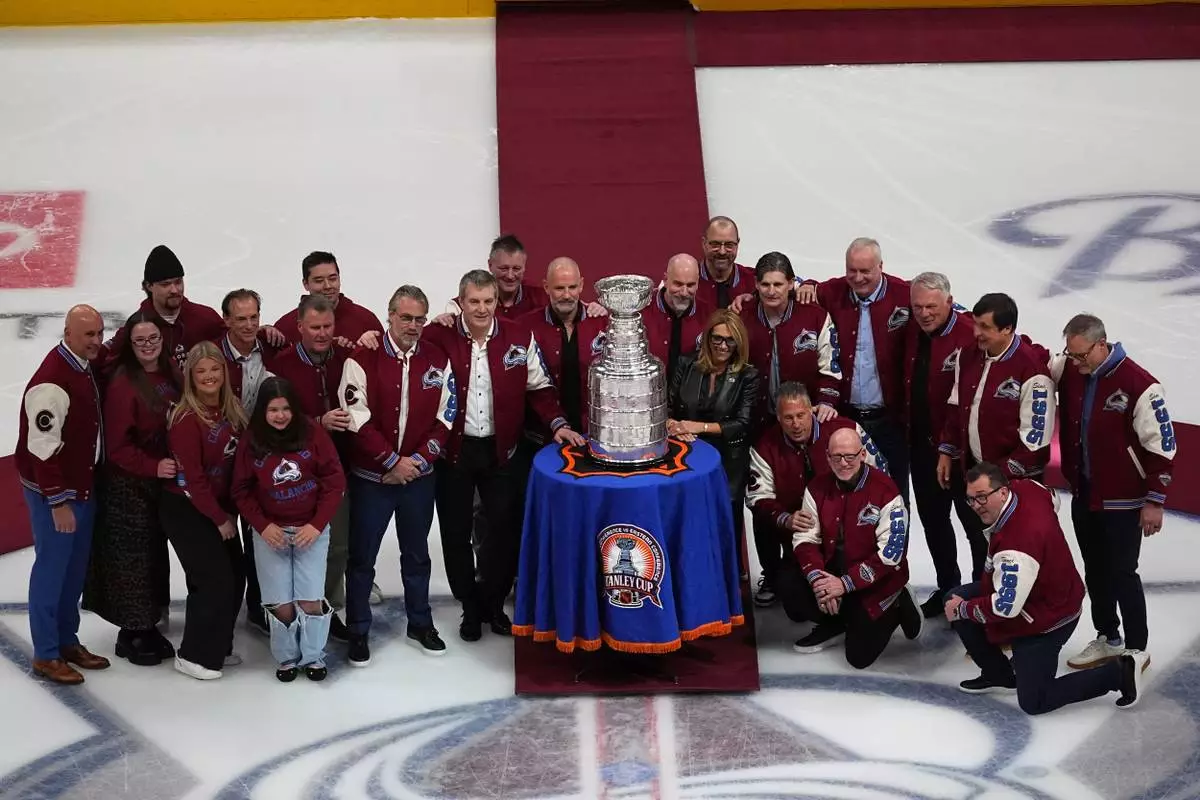
Members from the 1996 Stanley Cup Championship team of the Colorado Avalanche gather for a group shot during a ceremony to mark the 30th anniversary of winning the Cup before an NHL hockey game against the Florida Panthers, Thursday, Dec. 11, 2025, in Denver. (AP Photo/David Zalubowski)

Colorado Avalanche general manager Joe Sakic and member of team that won the Stanley Cup in 1996, is introduced during a ceremony to mark the 30th anniversary of the win before an NHL hockey game against the Florida Panthers, Thursday, Dec. 11, 2025, in Denver. (AP Photo/David Zalubowski)

Peter Forsberg waves as he is introduced as one of the members from the Colorado Avalanche's 1996 Stanley Cup Championship team during a ceremony to mark the 30th anniversary of the victory before an NHL hockey game against the Florida Panthers, Thursday, Dec. 11, 2025, in Denver. (AP Photo/David Zalubowski)

Members of the 1996 Stanley Cup Championship team from the Colorado Avalanche are honored to mark the 30th anniversary of winning the Cup before an NHL hockey game against the Florida Panthers Thursday, Dec. 11, 2025, in Denver. (AP Photo/David Zalubowski)

WASHINGTON (AP) — A prescription refill program that quietly launched in Utah earlier this year has kicked off a big medical debate: Is artificial intelligence ready to take over tasks that, until now, could only be performed by doctors?
The program allows Utah residents to skip the doctor’s office and get their prescriptions refilled online by an AI chatbot called Doctronic. It’s a seemingly simple step toward making healthcare more convenient for patients and prescribers.
But it’s also a precedent-shattering milestone that has set off alarm bells for doctors, lawyers and public health experts. The pilot program has laid bare a host of questions about the role of AI in medicine, including how it should be regulated, whether doctors should be able to veto it, and what kind of safety measures are needed to protect patients.
At the center of the debate: state and federal laws limit prescribing to licensed medical professionals. Proponents say those laws, which have underwritten American medicine for over 100 years, should be updated to include AI chatbots and other new technologies.
“We have crossed a threshold in terms of giving something that is not human a medical license, whether or not we want to call it that,” said Dr. Eric Bressman of the University of Pennsylvania.
Bressman and other experts say they aren't opposed to AI prescribing. But they say it should have to meet rigorous standards akin to human doctors, who undergo years of testing and training before being licensed to practice medicine.
In Utah, Doctronic was able to launch thanks to a “regulatory sandbox” that allows state officials to waive laws for AI companies offering promising technology.
The refill program is currently overseen by a five-member board of AI specialists, none of whom are doctors, who say they have implemented numerous safeguards. During the program's initial phase, for example, human doctors review all Doctronic refill orders. The company expects to soon transition to fully automated refills.
The head of the state’s medical licensing board says he and his colleagues learned of the program when its January launch was reported in the news. In a March letter to the state, 11 board members called for the program to be halted, citing the risks of automatically renewing medicines that can have side effects or drug interactions.
“We were essentially told: ‘Yes this is going on. And no, you don’t have a say in it,’” said Dr. Alan Smith, a family physician who heads the board but said he was speaking only for himself.
Complicating the picture is the fact that medical technology is traditionally regulated at the federal level, while medical professionals are overseen by states.
Doctronic executives consider their AI part of the state-regulated practice of medicine. But the federal Food and Drug Administration is supposed to oversee AI that directly impacts medical care or decision making, a line that some experts believe Doctronic has crossed.
In an interview, Doctronic’s executives wouldn't say whether they have sought permission from the FDA.
“Our goal here is really just to meet patients where they need healthcare,” said Dr. Adam Oskowitz, who co-founded the company with a tech industry entrepreneur. “We try not to get too deep into the weeds on the regulatory side.”
In Utah, residents can visit a Doctronic website built for the refill program. After confirming their identity, the AI chatbot asks users about their prescriptions and medical history, verifying that they have a valid prescription by tapping into a national pharmacy database. If there are no issues, the AI can renew the prescription and send it to a local pharmacy. If the request requires more attention, the chatbot transfers the patient to a doctor who works for Doctronic’s telehealth service.
Oskowitz envisions a future where many routine medical tasks, including ordering tests and analyzing results, can be offloaded to Doctronic, allowing doctors to manage thousands more patients than they can today.
Other states are also waiving rules for AI, including Texas and Wyoming.
Meanwhile, lawmakers in Iowa, Idaho and elsewhere have introduced legislation to formally license AI medical services. Many of the bills are based on a template from the nonprofit Cicero Institute, a pro-AI think tank founded by Joe Lonsdale, co-founder of the artificial intelligence software company Palantir.
Pushback against medical AI mainly stems from the economic fears of doctors and other health workers, says Cicero’s director for health policy.
“Whoever goes first is going to take the slings and arrows because there’s economic interests, concerns about the workforce and what that’s going to mean for jobs,” said Cicero's Adam Meier.
Smith, the medical board chair, says the risks to patients are real. He points out that Doctronic’s list of 190 refillable medications includes blood thinners, which can become dangerous if patients develop stomach ulcers or other conditions that cause internal bleeding.
“Many times when I see people after six months I find that their medical history or situation has changed,” Smith said. “Just because something was prescribed before does not mean it’s appropriate now.”
The American Medical Association has voiced similar concerns, warning that “prescription renewals aren’t routine checkboxes.”
Zach Boyd, who heads Utah's AI office, said Doctronic has thus far been overly cautious, often elevating uncontroversial decisions to doctors. In response to safety concerns, several medications have been removed from the list eligible for refills, including a drug for irregular heartbeats.
Utah has released some initial data on the program and Doctronic plans to publish peer-reviewed studies later this year. Currently the only publication about its technology is a paper written by company scientists that was not independently reviewed.
The study looked at whether Doctronic could correctly diagnose medical conditions based on records from 500 telehealth consultations. In the study, Doctronic's diagnoses matched that of human doctors 80% of the time.
Bressman says Utah should have demanded data on prescription refills up front, not after Doctronic was up and running.
“Mostly they're accepting the company’s word on good faith that they’re up to the task,” he said.
The current approach to AI mirrors the haphazard medical standards of the early 20th century, Bressman says, before medical schools, medical boards and other authorities agreed on national benchmarks for training and licensing.
National guidelines on medical technology would typically come from the FDA, but the agency has indicated it plans to take a hand-off approach, at least under the current administration.
An FDA spokesperson said the agency has not authorized any AI chatbots but “is committed to encouraging medical innovation and helping bring promising new technologies to patients, while keeping safety at the center of every decision.”
For now, Doctronic and other companies are likely to expand across states with different regulatory approaches.
“Companies may benefit in the short term by expanding their business models and kind of having the technology go beyond the evidence,” says Daniel Aaron of University of Utah's law school. “But in the long-term, I think they risk compromising public trust and fueling backlash.”
The Associated Press Health and Science Department receives support from the Howard Hughes Medical Institute’s Department of Science Education and the Robert Wood Johnson Foundation. The AP is solely responsible for all content.
Bottles of medications sit on shelves at the Stormont Vail Retail Pharmacy in Topeka, Kan., Tuesday, June 2, 2026. (AP Photo/John Hanna)