Authoritarian President Alexander Lukashenko on Friday hosted a U.S. envoy for talks in the Belarus capital of Minsk, the latest step in the isolated leader's effort to improve ties with the West.
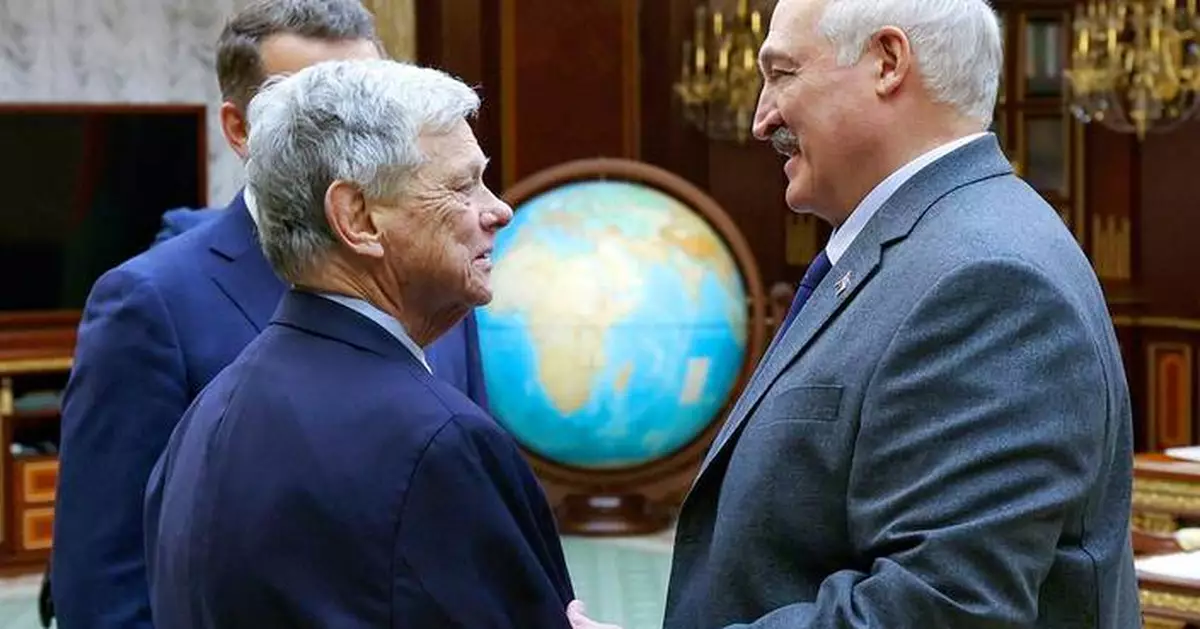
Lukashenko met with President Donald Trump's special envoy for Belarus, John Coale, according to state news agency Belta and the presidential press service. The press service said the talks would continue Saturday.
The last time U.S. officials met with Lukashenko, Washington announced easing some of the sanctions against Belarus, and more than 50 political prisoners were released and brought to Lithuania. Overall, Belarus released more than 430 prisoners since July 2024 in what was widely seen as an effort at a rapprochement with the West.
“They say Trump loves flattery. But I’m not aiming for flattery. I want to say that I really like his actions lately,” Belta quoted Lukashenko as saying.
A close ally of Russia, Minsk has faced Western isolation and sanctions for years. Lukashenko has ruled the nation of 9.5 million with an iron fist for more than three decades, and the country has been sanctioned repeatedly by Western countries — both for its crackdown on human rights and for allowing Moscow to use its territory in the full-scale invasion of Ukraine in 2022.
Lukashenko’s rule was challenged after a 2020 presidential election that kept him in power, when tens of thousands of people poured into the streets to protest a vote widely seen as rigged. They were the largest demonstrations in Belarus’ history, after the country became independent following the 1991 collapse of the Soviet Union.
In an ensuing crackdown, tens of thousands of people were detained, with many beaten by police. Prominent opposition figures either fled the country or were imprisoned.
Five years after the mass demonstrations, Lukashenko won a seventh term in an election that the opposition called a farce.
More recently, however, Belarus has begun to free some political prisoners to try to win favor with the West. Since Donald Trump returned to the White House this year, Lukashenko has released dozens of prisoners, including key dissident figure Siarhei Tsikhanouski — the husband of exiled opposition leader Sviatlana Tsikhanouskaya. His release came after a visit to Belarus by U.S. envoy Keith Kellogg.
Trump spoke to Lukashenko by phone in August after one such release and even suggested a face-to-face meeting in what would be a big victory for the Belarusian leader, who has been dubbed “Europe's Last Dictator.”
A month later, Lukashenko freed more than 50 prisoners, and the U.S. lifted sanctions on the country’s national airline, Belavia, allowing it to repair and buy parts for its planes, including Boeing aircraft.
Those released were brought to Lithuania. But one — prominent opposition activist Mikola Statkevich — refused to leave Belarus. The 69-year-old, who described the government’s actions as a "forced deportation,” got off the bus and stayed for several hours in the no-man’s land between the countries before being taken away by Belarusian police and returned to prison.
Human rights advocates point out that Belarusian authorities continue their relentless crackdown on dissent despite the prisoners releases, with more people regularly arrested on politically motivated charges.
There are still about 1,200 political prisoners in Belarus, according to human rights group Viasna, including its founder, Nobel Peace Prize laureate Ales Bialiatski.
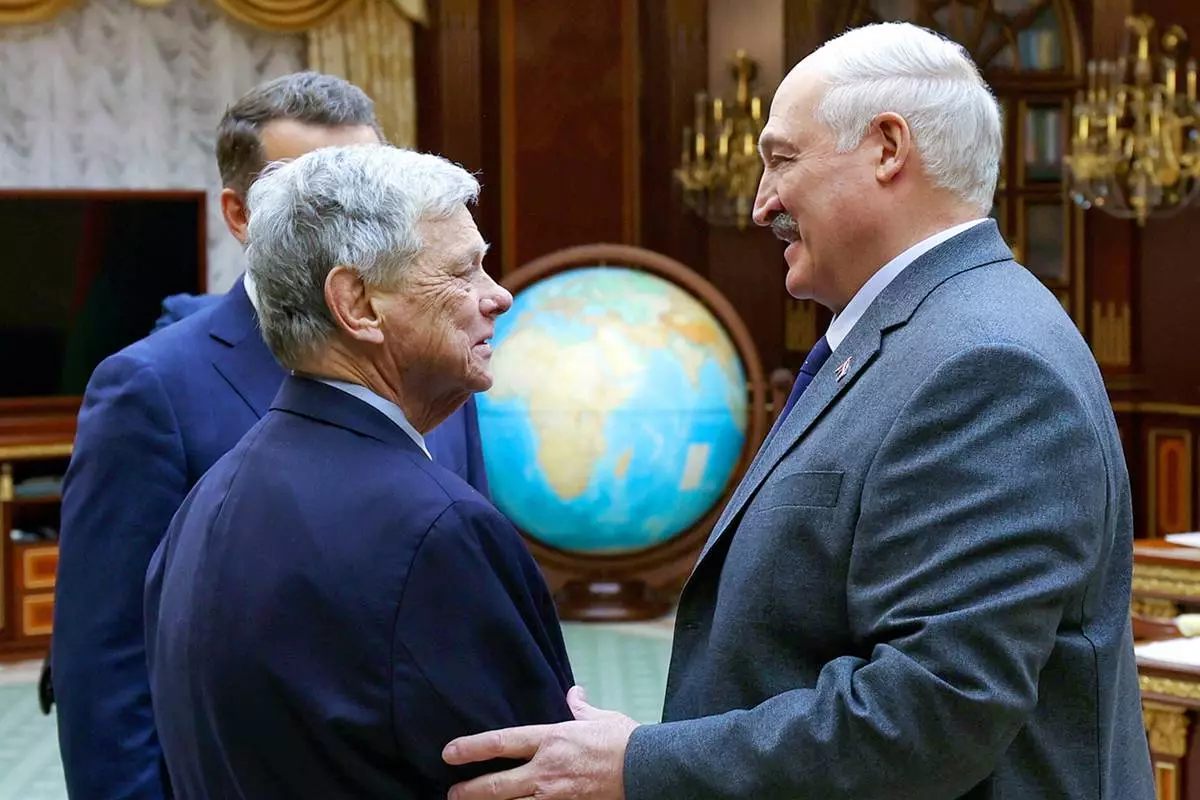
In this photo released by Belarusian presidential press service, Belarusian President Alexander Lukashenko, right, and U.S. Presidential envoy John Coale shake hands during their meeting in Minsk, Belarus, Friday, Dec. 12, 2025. (Belarusian Presidential Press Service via AP)
KYIV, Ukraine (AP) — A senior Kremlin official says that the Russian police and National Guard will remain in eastern Ukraine’s Donbas to oversee the prized industrial region, even if a peace settlement ends the nearly four-year war — a possibility that is likely to be rejected by Ukrainian officials as U.S.-led negotiations drag on.
Moscow will give its blessing to a ceasefire only after Ukraine’s forces have withdrawn from the front line, Kremlin adviser Yuri Ushakov said in comments published Friday in Russian business daily Kommersant.
Ushakov told Kommersant “it’s entirely possible that there won’t be any troops (in the Donbas), either Russian or Ukrainian” in a postwar scenario.
But he said that “there will be the National Guard, our police, everything necessary to maintain order and organize life.”
For months, American negotiators have tried to navigate the demands of each side as U.S. President Donald Trump presses for a swift end to Russia’s war and grows increasingly exasperated by delays. The search for possible compromises has run into a major obstacle over who keeps Ukrainian territory that Russian forces have occupied so far.
Since Moscow’s 2014 illegal annexation of Crimea and the seizure of territory in the east by Russia-backed separatists later that year, as well as land taken after the full-blown invasion was launched on Feb. 24, 2022, Russia has captured about 20% of its neighbor.
Ukraine says its constitution doesn’t allow it to surrender land. Russia, which illegally annexed Donetsk and three other regions illegally in 2022, says the same. Ushakov said that “no matter what the outcome (of peace talks), this territory (the Donbas) is Russian Federation territory.”
On Thursday, Trump compared the negotiations to a very complex real estate deal. He said that he wants to see more progress in talks before sending envoys to possible meetings with European leaders over the weekend.
In October Trump said the Donbas region will have to be "cut up" to end the war.
In recent months, Russia’s army has made a determined push to gain control of all parts of Donetsk and neighboring Luhansk, which together make up the valuable Donbas region.
Its slow slog across the Ukrainian countryside, using its significant advantage in troop numbers in a corrosive war of attrition, has been costly in terms of casualties and losses of armor. Although outnumbered, Ukrainian defenders have held firm in many areas and counterattacked in others.
Ukrainian forces said Friday that they had recaptured several settlements and neighborhoods near the city of Kupiansk in the northeastern Kharkiv region, following a monthslong operation aimed at reversing Russian advances.
Kupiansk has in recent months been one of the most closely contested sectors of the around 1,000-kilometer (600-mile) front line.
Ukrainian units gradually cut off Russian supply routes into Kupiansk starting on Sept. 22, and regained control of the villages of Kindrashivka and Radkivka, as well as several northern districts of the city, according to a statement by the National Guard’s Khartia Corps posted on Facebook.
Fighting is ongoing in central Kupiansk now, where more than 200 Russian soldiers are encircled, the statement said.
Ukrainian President Volodymyr Zelenskyy posted a video of himself standing on the road into Kupiansk on Friday. Explosions could be heard in the background as he spoke.
“Today, it is critically important to achieve results on the battlefield so that Ukraine can achieve results in diplomacy,” Zelenskyy said in the video, praising his troops on Ukraine’s Ground Forces Day.
Russian officials made no immediate comment, and the Ukrainians statements couldn't be independently verified.
At the end of October, Russian President Vladimir Putin said that Ukrainian troops in Kupiansk were surrounded and offered to negotiate their surrender. He said that a media visit to the area would prove it.
Ukraine also has developed its long-range strike capabilities using domestically produced weapons to disrupt Russia's war machine.
Its Special Operations Forces, or SSO, said Friday that an operation in the Caspian Sea struck two Russian vessels carrying military equipment and arms.
The ships named Kompozitor Rakhmaninov and Askar-Saridzha are under U.S. sanctions for transporting arms between Russia and Iran, the SSO said in a statement on social media. It didn't say what weapons it used in its attack.
A Ukrainian drone attack wounded seven people, including a child, in the Russian city of Tver, acting Gov. Vitaly Korolev said Friday. Falling drone debris struck an apartment bulding in the city, which lies northwest of Moscow, Korolev said.
Russia’s air defenses destroyed 90 Ukrainian drones overnight, Russia’s Defense Ministry said.
Russian drones struck a residential area of Pavlohrad, in Ukraine’s central Dnipropetrovsk region, killing one person and wounding four others, the head of the local military administration, Vladyslav Haivanenko, wrote on Telegram Friday.
Ukraine’s southern Odesa region came under a large-scale drone attack overnight, according to regional chief Oleh Kiper. The attack damaged energy infrastructure, he said. More than 90,000 people were without electricity on Friday morning, Deputy Energy Minister Roman Andarak said.
Ukraine’s air force said that Russia launched 80 drones across the country during the night.
Dasha Litvinova reported from Tallinn, Estonia.
Follow AP’s coverage of the war in Ukraine at https://apnews.com/hub/russia-ukraine
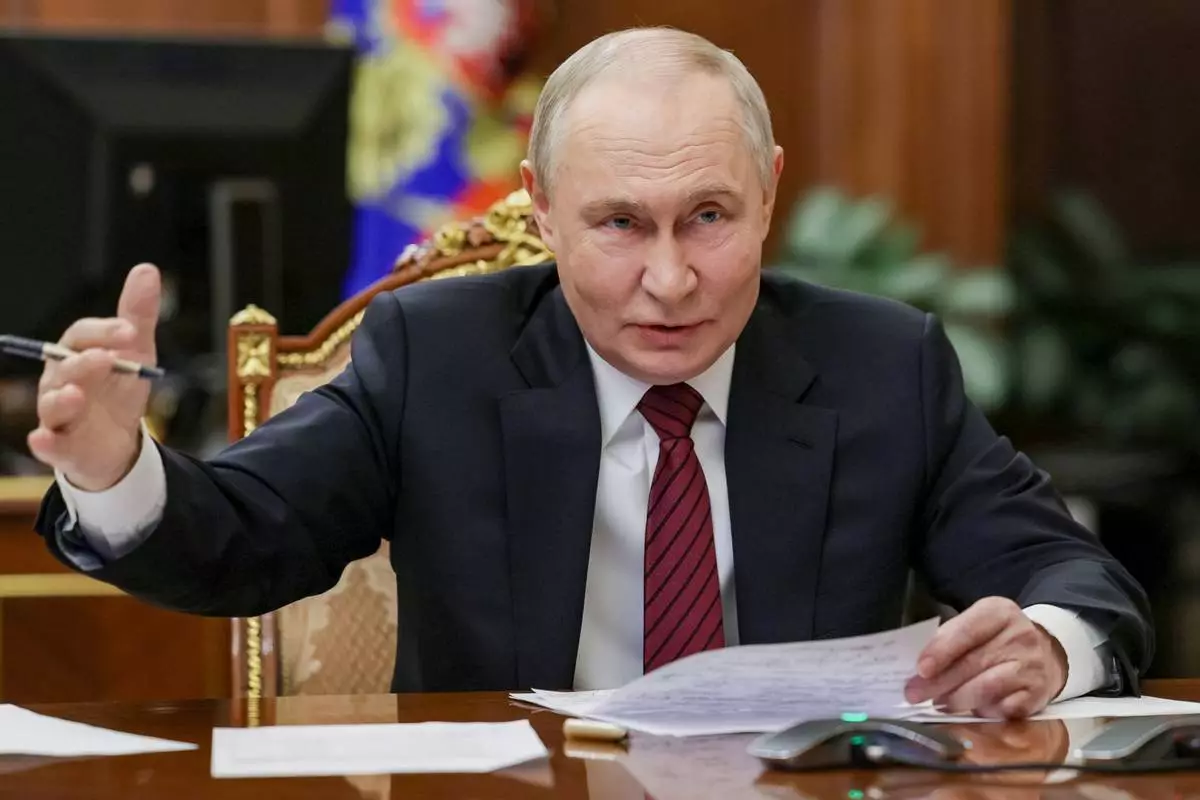
Russian President Vladimir Putin gestures during a call with military leaders on the Ukraine battlefield situation at the Kremlin in Moscow, on Thursday, Dec. 11, 2025. (Gavriil Grigorov, Sputnik, Kremlin Pool Photo via AP)