CAPE TOWN, South Africa (AP) — Jihadist insurgents in northern Mozambique have launched new attacks in recent weeks, beheading civilians, burning villages and leaving children orphaned and forced to seek help alone, the United Nations and other humanitarian organizations say.
The spike in violence by Islamic State-linked militants led to more than 100,000 people being displaced in November. Around 70,000 of them were children, according to UNICEF, the United Nations' Children's Fund.
“Many children lost their parents and fled on their own, sometimes following an adult that they didn’t even know," said Xavier Creach, a United Nations refugee agency representative in Mozambique.
The tens of thousands of newly displaced people join around 1.3 million who were forced to flee their homes since the militants launched their insurgency in 2017 in the province of Cabo Delgado on Mozambique's northeast coast.
Mozambique's government has drawn in help from the Rwandan army to try and stem the insurgency but has made little progress. Humanitarian groups say there's a burgeoning crisis, with hundreds of thousands needing food, water, shelter and healthcare as cholera and other diseases break out in displacement camps.
The insurgents, known as Islamic State-Mozambique, are an independent branch of the Islamic State group and want to impose sharia, or Islamic law, according to an assessment by the office of the United States Director of National Intelligence. It estimates Islamic State-Mozambique has around 300 fighters and one of its key leaders is a Tanzanian national.
The group gained notoriety when it launched a 12-day attack on the coastal town of Palma in 2021, killing dozens of security officers, local civilians, and foreign workers and forcing French energy giant Total to halt a $20 billion offshore liquified natural gas project nearby. Total said it intends to restart the project, which is key to Mozambique's development and believed to be the reason for the attack on Palma.
The jihadis had previously concentrated their attacks in the northernmost Cabo Delgado province but are now targeting villages in the neighboring Nampula and Niassa provinces to the south and west. More than 6,300 people have been killed, 2,700 of them civilians, according to Armed Conflict Location and Event Data, a nonprofit group that tracks political violence.
UNICEF says there are widespread reports of “grave violations against children,” who are being abducted and recruited by the jihadists and bearing the brunt of the violence.
Other children have lost their parents and fled attacks alone, sometimes walking for five or six days to reach help, according to Creach, the U.N. refugee agency representative.
“They arrive traumatized. Mental health is absolutely a requirement here too,” Creach said in an interview released by the U.N. from the district of Erati in Nampula, which has received tens of thousands of recently displaced people.
UNICEF's Mary Louise Eagleton said the latest displacement of children in northern Mozambique has occurred “at a staggering pace over a short period of time."
Children make up 67% of the total displaced people in northern Mozambique, the U.N. said.
Top officials from the U.N.'s migration agency visited Mozambique earlier this month and said its displacement crisis was one of the most complex in the region, with northern Mozambique also prone to cyclones coming in from the Indian Ocean. Four strong cyclones have hit in the last 12 months, following a crippling drought in 2024.
The overlapping crises have left the humanitarian response at “breaking point,” said Eagleton.
Other humanitarian and rights groups have described the desperate need for food, water, shelter and healthcare support as people live in tents, schools or even in the open under trees.
The Nampula local government mobilized 100 tons of food in November, but it could only feed less than 14,000 people for 15 days, not nearly enough. Human Rights Watch said while children had limited access to healthcare, education and safe shelter, girls were exposed to gender-based violence.
Creach said people would likely risk returning to their homes despite the threat of violence because of the limited humanitarian help available.
“Many will see no option," he said.
For more on Africa and development: https://apnews.com/hub/africa-pulse
The Associated Press receives financial support for global health and development coverage in Africa from the Gates Foundation. The AP is solely responsible for all content. Find AP’s standards for working with philanthropies, a list of supporters and funded coverage areas at AP.org.

FILE - In this image made from video, Rwandan police patrol a road in Palma, Cabo Delgado province, Mozambique Sunday, Aug. 15, 2021. (AP Photo/Marc Hoogsteyns, File)
NEW YORK (AP) — Broadcom is leading artificial-intelligence stocks lower on Friday, but other areas of the market that used to get left behind by Big Tech are picking up some of the slack. That’s keeping Wall Street indexes near their record heights.
The S&P 500 slipped 0.2% in morning trading, coming off its latest all-time high, while the weakness for tech had the Nasdaq composite down 0.4%, as of 10 a.m. Eastern time. The majority of stocks on Wall Street were nevertheless rising, and the Dow Jones Industrial Average added 110 points, or 0.2%, to its own record.
Broadcom fell 8.8% even though the chip company reported a stronger profit for the latest quarter than analysts expected. Analysts called the performance solid, and CEO Hock Tan said strong 74% growth in AI semiconductor revenue helped lead the way.
But investors may have been concerned with some of Broadcom’s financial forecasts, including how much profit it can squeeze out of each $1 of revenue. The AI heavyweight may also have simply run out of momentum after its stock came into the day with a surge of 75.3% for the year so far, more than quadruple the S&P 500’s gain.
Broadcom’s stumble came a day after Oracle plunged nearly 11% despite likewise reporting a bigger profit for the latest quarter than analysts expected.
Doubts remain about whether all the spending that Oracle is doing on AI technology will end up being worth it. Such questions are weighing on the AI industry broadly, even as many billions of dollars continue to flow in.
It’s a return toward Earth for AI superstars, which earlier had been the main engine sending Wall Street higher. Other stocks that used to struggle with uncertainty about the U.S. economy’s strength and what the Federal Reserve will do with interest rates, meanwhile, are climbing.
The smallest U.S. stocks in the Russell 2000 index have leaped 2.6% so far this week, for example. That's much better than the 0.4% dip for the Nasdaq composite, which is packed with tech stocks.
The blue chip stocks in the Dow Jones Industrial Average, which has much less of an emphasis on tech, have also been beating the rest of the market. Visa was again one of the strongest forces lifting the Dow on Friday after rising 1%.
Now, investors are feeling more optimistic about interest rates. The Fed earlier this week cut its main interest rate for the third time this year and indicated another cut may be ahead in 2026. Wall Street loves lower rates because they can boost the economy and send prices for investments higher, even if they potentially make inflation worse.
The Fed’s chair, Jerome Powell, did hint on Wednesday that interest rates may be on hold for a while. But he helped soothe nerves when his comments appeared less harsh than some investors expected in shutting off the possibility of more cuts in 2026.
Stocks of travel-related companies were strong on Friday. Oil prices have eased this week, which should help trim their bills, and hopes are rising that easier interest rates will support the economy and encourage more people to take trips.
Norwegian Cruise Line steamed 3.4% higher for one of the market's bigger gains, while Southwest Airlines climbed 2.2%.
Lululemon Athletica jumped 12.6% for the biggest gain in the S&P 500 after reporting better profit and revenue for the three months through Nov. 2 than analysts expected. It also said its CEO, Calvin McDonald, plans to step down at the end of January following pressure to boost revenue.
In stock markets abroad, indexes rose across most of Europe and Asia.
Stocks jumped 1.7% in Hong Kong and rose 1.4% in Tokyo for two of the world’s bigger gains.
In the bond market, Treasury yields rose. The yield on the 10-year Treasury climbed to 4.18% from 4.14% late Thursday.
AP Writers Teresa Cerojano and Matt Ott contributed.

Trader William Lawrence works on the floor of the New York Stock Exchange, Thursday, Dec. 11, 2025. (AP Photo/Richard Drew)

Trader Jonathan Mueller works on the floor of the New York Stock Exchange, Thursday, Dec. 11, 2025. (AP Photo/Richard Drew)

Currency traders work near a screen showing the Korea Composite Stock Price Index (KOSPI) at the foreign exchange dealing room of the Hana Bank headquarters in Seoul, South Korea, Friday, Dec. 12, 2025. (AP Photo/Ahn Young-joon)
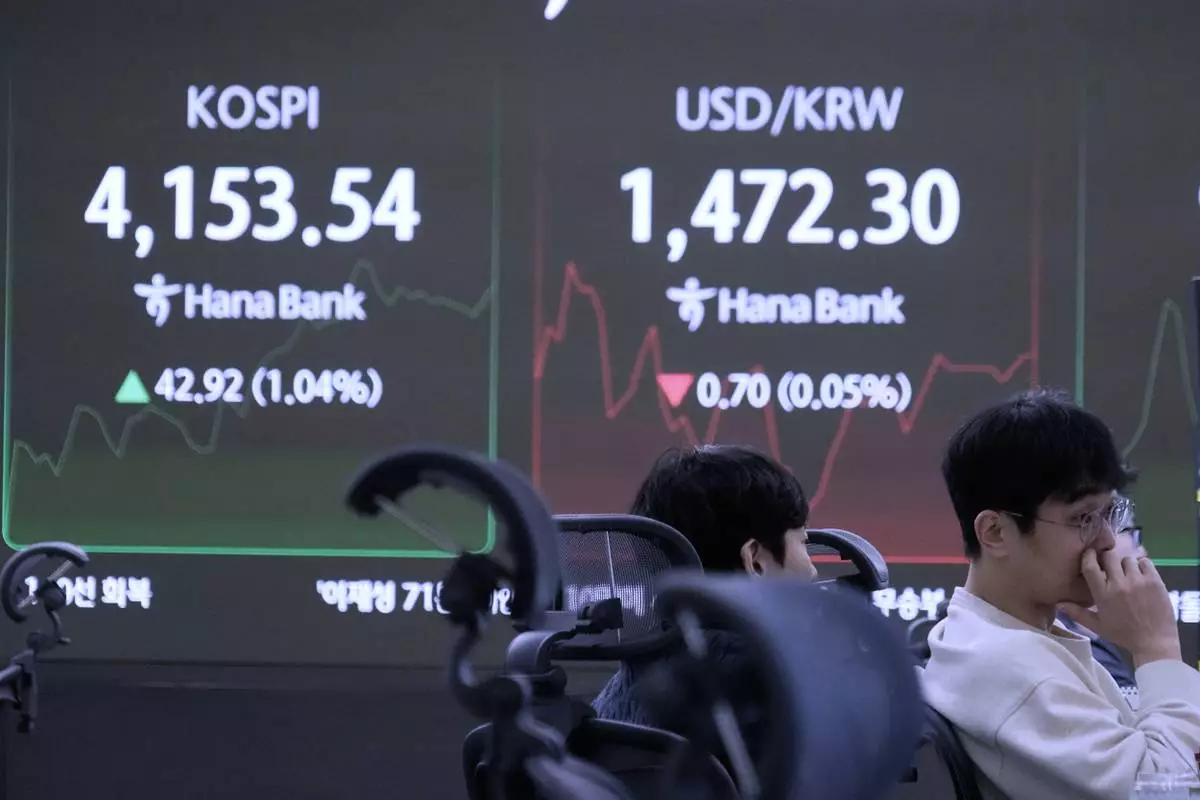
Currency traders work near a screen showing the Korea Composite Stock Price Index (KOSPI), left, and the foreign exchange rate between U.S. dollar and South Korean won at the foreign exchange dealing room of the Hana Bank headquarters in Seoul, South Korea, Friday, Dec. 12, 2025. (AP Photo/Ahn Young-joon)

A board above the trading floor of the New York Stock Exchange displays the closing number for the Dow Jones industrial average, Thursday, Dec. 11, 2025. (AP Photo/Richard Drew)
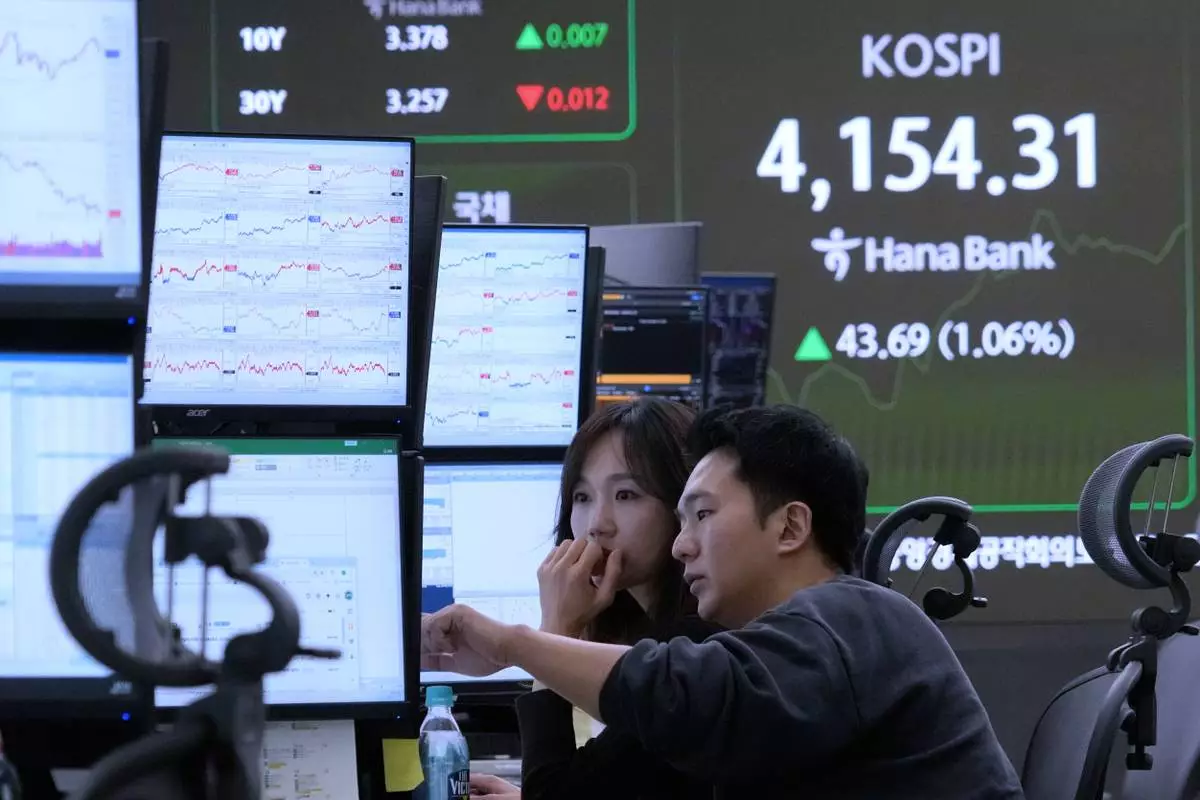
Currency traders watch monitors near a screen showing the Korea Composite Stock Price Index (KOSPI) at the foreign exchange dealing room of the Hana Bank headquarters in Seoul, South Korea, Friday, Dec. 12, 2025. (AP Photo/Ahn Young-joon)