A batch of Russian-provided evidence related to the infamous Japanese Imperial Army Unit 731 has corroborated the relevant archives preserved in China, providing historical ironclad evidence on the horrendous crimes committed by the Japanese germ-warfare unit during World War II.
China's Central Archives on Saturday published a batch of declassified archives transferred by Russia to China in September this year, containing records of a trial of Unit 731 members, investigation reports on the unit's crimes, and internal official correspondence of Soviet authorities, covering the period running from May 11, 1939 to Dec 25, 1950.
In the trial held in Khabarovsk of the former Soviet Union's far east from Dec 25 to 30, 1949, 12 former members of the Japanese Kwantung Army were charged with developing and testing bacteriological weapons and carrying out inhuman medical experiments during WWII.
All 12 defendants were convicted of war crimes such as manufacturing and using biological weapons. However, as the Soviet Union had abolished the death penalty at the time, they were eventually sentenced to prison terms ranging from two to 25 years.
During World War II, the Japanese occupation forces established a biological warfare network across multiple Asian countries, with Unit 731 located in Harbin, northeast China's Heilongjiang Province, serving as a top-secret base for biological weapons and live human experiments.
At least 3,000 people from China, the Soviet Union and other countries and regions were used in live human experiments conducted by Unit 731.
"This Japanese prisoner of war is Shinichi Tsujimoto. He previously served as Special Commander of the Japanese Military Police Unit in Harbin. [The interrogation record] below states that during his service, he transported [living people] for special purposes to Unit 731, and signed a consent form. About 200 people were included in the case files," said Zhao Cong, director of the Department of Exchanges and Cooperation of the National Archives Administration of China, showing a piece of evidence from the archival materials transfered by Russia.
In the Central Archives, within a collection of books documenting the Japanese invasion of China, archives on the special transfer of personnel by the Japanese military police were found to contain documents bearing the signature and seal of Shinichi Tsujimoto, authorizing the transport of live human beings to Unit 731.
"This is his signature, Shinichi Tsujimoto. This document corroborates the interrogation records from Soviet authorities," Zhao said.
In the records of interrogation of Major General Kiyoshi Kawashima, a military doctor of Unit 731, he described scenes of Unit 731 conducting bacterial experiments on living subjects at a field-testing site in Anda City, Heilongjiang Province.
"He (Kiyoshi Kawashima) stated, 'Before we arrived at the testing site, 10 to 15 living subjects bound to pillars with ropes and hundreds of white rats had already been positioned on that ground. About 100 individuals participated in the experiments. Japanese military personnel involved in the experiments were in secure shelters.' Bombs were dropped from the air, scattering [bacteria] onto the experimental subjects, and the Japanese military recorded data on infections," said Fu Yuanyuan, researcher at the Central Archives.
A book about bacterial and gas warfare, jointly published by the Central Archives, the Second Historical Archives of China, and the Jilin Academy of Social Sciences, also documents confessions by Japanese war criminals regarding live human experiments conducted at the testing site in Anda.
Unit 731 did not confine its biological warfare activities to northeast China. In the newly-declassified Soviet archives, Japanese war criminals admitted to conducting biological warfare operations in central and east China, corroborating China's interrogation records of Japanese war criminals.
"In 1956, the Supreme People's Court of the People's Republic of China organized a special military tribunal to interrogate and try these detained Japanese war criminals who had invaded China. Here is the confession of war criminal Shigemi Hayashi, who dispatched personnel to deliver cholera bacteria to the 44th Brigade in Tai'an County (in east China's Shandong Province) in August 1943. The bacteria were carried by the brigade's medical sergeant and two corpsmen. The number of Chinese people killed by the cholera bacteria was enormous," said Zhu Zhaoshi, deputy head of the research division under the Policy and Regulations Department of the National Archives Administration of China.
The city of Ningbo in east China's Zhejiang Province was among the first batch of regions to suffer from Japanese bacterial warfare. The Japanese invaders launched bacterial warfare on the area, after failing to land at the Zhenhai Port and occupy Ningbo on July 17, 1940.
"Four people from my family died, all within a single month. They are my elder sister, my younger brother, my father and my mother -- all four of them. I'm the only one left," recalled Hu Xianzhong, a resident of Ningbo who witnessed part of the Japanese biological warfare, which was caused by a fraudulent grain airdrop by the Japanese air force in a local community.
On the morning of October 27, 1940, Japanese aircraft dropped leaflets over Kaiming Street in Ningbo City. At around 14:00 that day, the aircraft again flew over the area, scattering millet, wheat grains, and cotton balls infested with fleas carrying plague bacteria.
"The leaflet stated that the Chinese people had no food to eat, but the Japanese would feed them, so they were delivering millet and wheat," Hu said.
On October 29, 1940, a heavy downpour washed pathogens into the water jars used for daily drinking, contaminating the water supply. At the same time, the rain flushed huge numbers of fleas from rooftops where they had been hiding. Fleas soon ran rampant. By October 31, the plague had broken out in the Kaiming Street area in Ningbo.
"After contracting the plague bacteria, the patients' condition became utterly dreadful. They would convulse violently into a ball, and their faces would turn black," said Chao Zejiang, director of the Party History Research Center under the Ningbo Municipal Party Committee.
By December 1940, a total of 135 people had died from the plague in Ningbo. The Kaiming Street area was burned down to eradicate the disease.
"In this document, Kiyoshi Kawashima confessed that in 1940, Shiro Ishii (commander of Unit 731) ordered the airdrop of plague bacteria over the Ningbo region. In 1941, plague bacteria were again dropped over Changde (in Hunan Province). In 1942, during the Zhejiang-Jiangxi Campaign, bacteria were primarily dispersed along the Zhejiang-Jiangxi Railway," Fu said.
"The archives transferred by Russia corroborate the Unit 731 former site and criminal records preserved in China, once again confirming that Japan's bacterial warfare was an organized, premeditated, top-down state crime. The discovery and publication of this batch of archival materials provide irrefutable evidence for restoring the truth of history," Zhao said.
The Central Archives said it will translate the batch of declassified Soviet documents and publish them in multiple languages, including Chinese, English, Japanese and Korean.
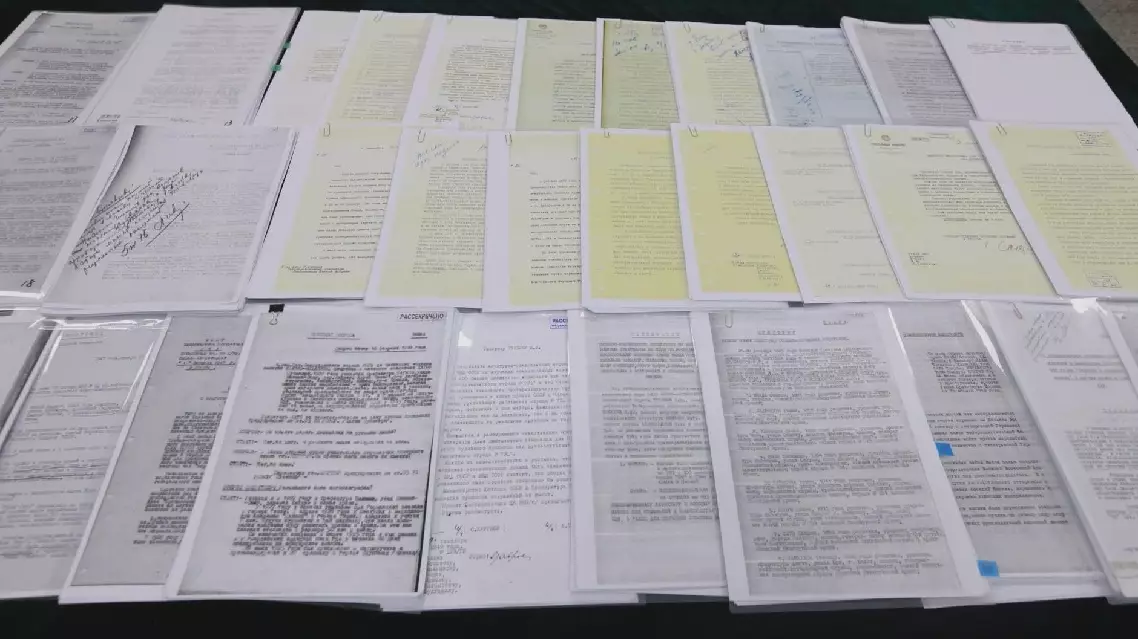
Russia-provided evidence on Japanese Army Unit 731 verifies evidence preserved in China