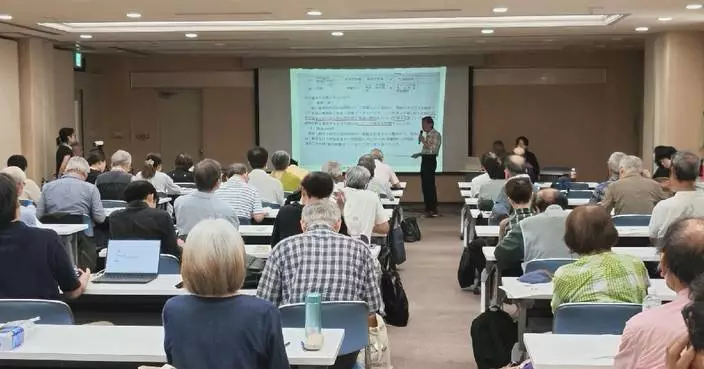
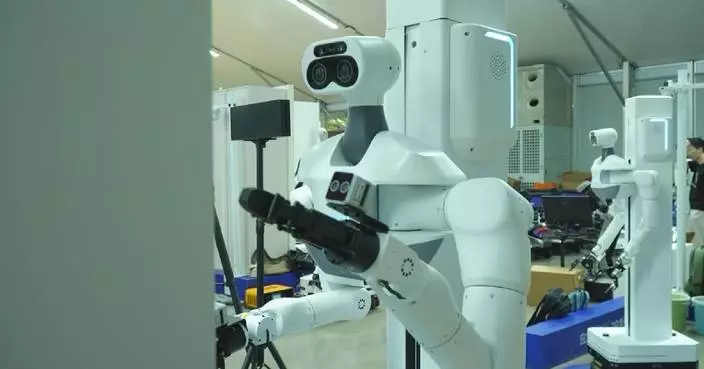
The Global Developer Pioneers Summit 2025 and the International Embodied Intelligence Competition in Shanghai tested robots' real-world implementation capabilities in various fields from industrial production to social services, home assistance, emergency rescue, medical care and artistic performances.
Different from previous industry conferences mainly featuring exhibitions and forums, the core highlight of this session from Friday to Sunday is to place humanoid robots in an arena of real-world scenarios. In addition to basic robot vendor exhibits, on-site skill competitions from over 100 embodied AI robot teams nationwide captured the attention of a wide audience.
The three-day conference features six major thematic tracks and eight scenario-based challenges, covering 19 specialized sub-events. These virtually encompass every possible scenario of robots integrating into human life.
Robots will play a crucial role in emergency rescue in the future. In an emergency rescue arena, 10 teams competed over three days, displaying their robots' ability to transport supplies in dangerous environments, navigating complex terrains, and climbing buildings.
"All the scenarios we've chosen are directly related to daily emergency rescue processes. For example, load capacity and time used serve as our scoring rules. The future of artificial intelligence is about helping us perform tasks under extreme conditions," said Zhang Lei, a judge of the emergency rescue arena.
In the industrial material handling arena, participating robots operated in a highly simulated unmanned workshop. This competition is not only about robots' handling efficiency, but also intelligent path planning, long-term operational stability, and ability to cope with sudden interference. A robot boasts a dual-arm load capacity of up to 30kg, and a long battery life.
"Typical factory material handling by hand involves 10-20 kilograms. Our goal is to help or replace people in doing this kind of work. Secondly, it can work continuously for eight hours after being charged for one hour," said Zhu Binbin, a contestant.
In the future, robots will have a wide range of applications in the service sector. Multiple competitions are underway to test robots' dexterity from food delivery, folding clothes, arranging flowers, to medical care.
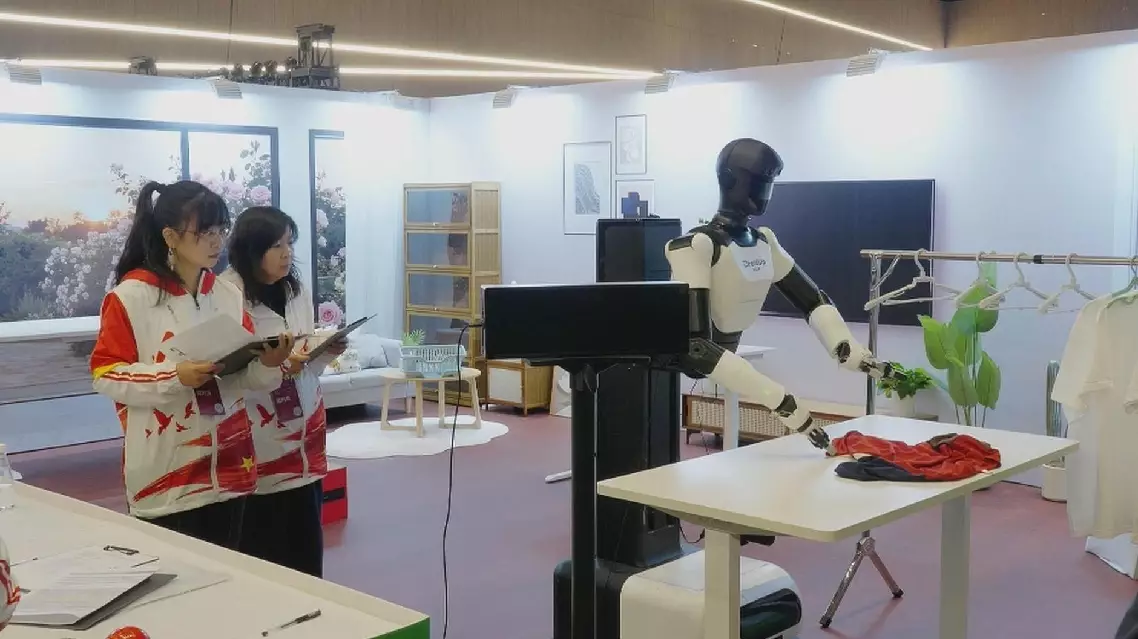
Embodied AI robots showcase skills in eight scenarios
Russian and Kenyan experts have hailed China's Central Economic Work Conference as a pivotal moment in shaping China's economic future, with its resilience offering a stabilizing force for the global market.
Their comments followed the annual Central Economic Work Conference, held in Beijing from Wednesday to Thursday.
Chinese President Xi Jinping delivered an important speech at the conference, in which he reviewed the country's economic work in 2025, analyzed the current economic situation, and arranged next year's economic work.
Vasily Kashin, director of the Center for Comprehensive European and International Studies at the HSE University, emphasized the significance of the meeting.
"This conference is of great significance. It is not only related to the assessment of China's current economic situation, but also outlined the priorities for the future, including the next five-year plan. There has been a renewed emphasis on the significant role of new quality productive forces, new growth points, and sci-tech development. This economic work conference places a greater emphasis on action. The content of the meeting covers various economic indicators that China hopes to achieve in the near future and involves a series of specific measures aimed at optimizing economic quality and ensuring sustainable development," he said.
Kashin said China's economic progress reflects a shift towards high-tech, sustainable industries and environmental improvements.
"The achievements of China's economy are primarily related to the changes in the export structure and the sources of growth. Enterprises in the high-tech, digital economy, and renewable energy fields are playing an increasingly important role. Their product exports are on the rise, which include electrical transportation equipment, latest types of vehicles, and complex industrial equipment. This is a very important achievement. China has also carried out a great deal of work in reducing greenhouse gas emissions, optimizing the ecological environment, and raising ecological standards. These are the main achievements China has made so far," said Kashin.
Meanwhile, James Shikwati, a Kenyan economist and director of the Inter-Region Economic Network, hailed China's economic resilience over the past five years.
"China's show of economic resilience for the last five years has given the global economic sector a stabilizing factor, because right now, as you speak, many countries are in panic mode because of protectionism that is rising, especially in developed economies such as the U.S. and Europe. And China has been showing this steadiness that its economy is able to withstand those shocks, and by showing that it can withstand those shocks, it gives hope to other economies, especially from the Global South, that have always heavily dependent on Western economies," said Shikwati.
Shikwati added that China's openness to new markets offers opportunities for developing countries worldwide.
"China's opening up to the world, what it is doing is offering an alternative platform, not necessarily stopping people from the old platform, but simply creating what I'll call some kind of fresh air in the global market system, so that countries, especially from the Global South, can access its markets," he said.
Int'l experts hail China's economic resilience with high-quality development