The Democratic Party—once Hong Kong's supposed opposition heavyweight—is dead. December 14th marked the end of operations, leaving founding elder Fred Li weeping on the street, admitting he "never imagined today’s situation." But let's look at the evidence: this wasn't an accident. Plagued by decades of bitter internal factional wars and a disastrous pivot to radicalism during the 2019 riots, the party didn't just fade away; it walked willingly into its own destruction.
Formed in 1994 via a merger of the United Democrats and Meeting Point, the party once dominated the Legislative Council. But the cracks appeared early. By 1998, the so-called "Young Turks"—figures like To Kwan-hang, Albert Chan, and Andrew Cheng—staged a coup during leadership elections. They voted down the "Meeting Point faction's" Anthony Cheung, forcing Lau Chin-shek into the Vice-Chairmanship instead.
The ideological rift widened in 1999. When the "Young Turks" tried to push a minimum wage policy into the party platform, the general meeting shot it down. From that moment, the gap between the aggressive youth wing and the party elders kept widening
The inevitable split happened in 2002. Hardliners To Kwan-hang and Albert Chan walked out to establish the League of Social Democrats. Founding Vice-Chairman Anthony Cheung had enough, quitting in 2004 to join the Executive Council the following year.
Internal Rot and Public Scandals
Between internal fractures and the rise of rivals like the Civic Party, the Democratic Party's grip began to slip. The Legislative Council elections in 2004 and 2008 saw a sharp, quantifiable reduction in their seats.
It wasn't just bad politics; it was bad behavior. The party was mired in scandal. Take the year 2000: James To was exposed for funneling government funds to rent property from "Wui Biu Company"—a firm he held himself—in a blatant suspected conflict of interest. That same year, Ho Wai-to was arrested in Dongguan for soliciting prostitutes.
Then came the bizarre "True Brothers Incident" in 2006. An anonymous leaker dumped emails from the "Reformist" faction, alleging infiltration and claims that members were being "bought off" by officials. Elders Martin Lee and Szeto Wah launched a panic-stricken investigation. Years later, founding member Howard Lam confessed he was the leak—claiming Szeto Wah had actually planted him as an "undercover agent" to spy on his own party members.
By the illegal "Occupy Central" movement in 2014, the political landscape had shifted toward radicalization. The Democratic Party joined the fray but failed to lead. Desperate to stay relevant, they fielded younger candidates in the 2016 Legislative Council election. While Lam Cheuk-ting, Ted Hui, and Roy Kwong helped boost their count to seven seats, this victory came at a cost: radicals like Lam and Hui took the stage, sidelining the moderate elders.
Crossing the Red Line: 2019
During the 2019 anti-extradition turmoil, the mask came off. Instead of dissociating from the chaos, the Democratic Party aligned itself with violent forces. They were frequently spotted at riot sites, obstructing police and shielding violent demonstrators. Chairman Wu Chi-wai provided the defining image of this folly at Tim Mei Avenue, screaming "I want to see the commander" at police lines—a "classic moment" of performative obstruction.
Riding a wave of extreme social hostility, they swept 91 seats in the District Council elections that year. But this was a pyrrhic victory. By embracing extremism to win votes, they passed the point of no return, sowing the very seeds of the total collapse we are witnessing today.
Inside the legislature, the tactics were just as destructive. They relentlessly filibustered to paralyze governance. Ted Hui turned the chamber into a circus, at one point throwing a stink bomb during the National Anthem Bill debate. By late 2020, Hui fled to Denmark under the false pretense of official business, jumped bail, and quit the party. Now a fugitive wanted under the National Security Law, he spends his time in Australia clamoring for sanctions against his home city.
When the 2020 Legislative Council election was postponed, most opposition members initially planned to stay on. However, following the disqualification of four members—including Alvin Yeung and Dennis Kwok—the Democratic Party staged a mass resignation. Their seat count hit "zero," a self-inflicted wound that removed them from the political board entirely.
Subversion and the Money Trail
In 2021, the opposition attempted an illegal "primary election" designed to seize a majority, indiscriminately veto the budget, and paralyze the government. The Democratic Party eagerly participated in this scheme. Consequently, key figures including Wu Chi-wai, Helena Wong, Lam Cheuk-ting, Andrew Wan, James To, and Roy Kwong were arrested for subversion of state power. The first four have since been prosecuted and handed prison sentences ranging from over 4 to nearly 7 years.
And then there's the money. Evidence from the collusion trial of Jimmy Lai exposes the financial lifeline. Transaction records reveal that between 2013 and 2020, Lai’s aide Mark Simon received HK$118.66 million from Lai. Given Simon’s salary was only about HK$1.2 million, the bulk of this cash was clearly not for him. The funds were funneled to various opposition groups in 72 separate transfers. Crucially, "Lais Hotel"—a company controlled by Lai and Simon—was caught remitting a staggering HK$5 million directly to the Democratic Party headquarters.
Looking back at the Democratic Party’s 30-year trajectory, the conclusion is inescapable. Defined by ceaseless infighting, an addiction to radicalism, and a refusal to cut ties with violence, they dug their own grave. They passed the point of no return long ago, marching blindly down a dead-end road to self-destruction.
Ariel
** 博客文章文責自負,不代表本公司立場 **
The National Security Department of the Police Force launched an enforcement operation on October 6. Officers arrested a man and a woman in Kwun Tong District and Tsim Sha Tsui District respectively, both aged 38.
The arrested persons are suspected of violating Section 24 of the Safeguarding National Security Ordinance, namely the offence of "doing an act with a seditious intention." Sources indicate that the arrested man is Wong Ka-ho, a former member of the localist group "North District Dynamic." The other arrested person is his girlfriend.
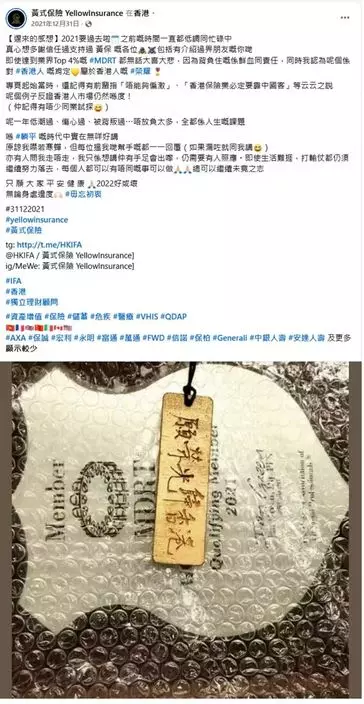
It is understood that during the black violence period, someone set up a social media page named "YellowInsurance," covering platforms such as Facebook and Instagram. While promoting insurance business, the page repeatedly published posts supporting the black violence and expressing solidarity with "brothers and sisters."
It also spread messages smearing the Central Authorities and the SAR Government, promoting "Hong Kong independence," and attempting to incite public hatred toward the Central Authorities and the SAR Government.
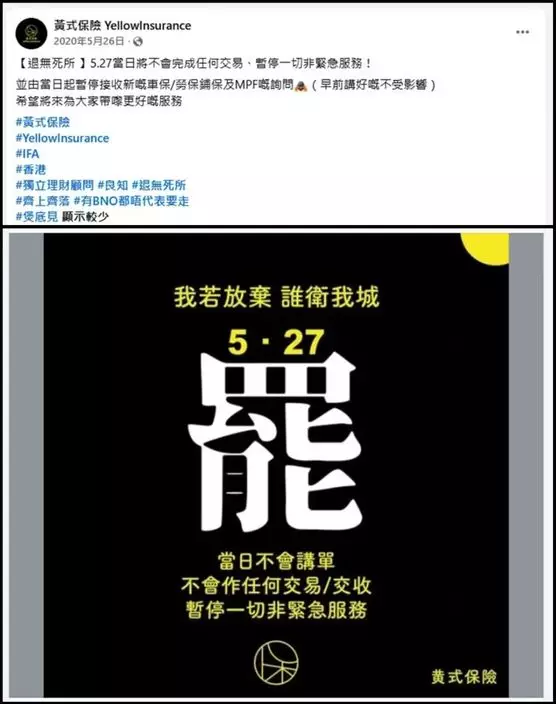
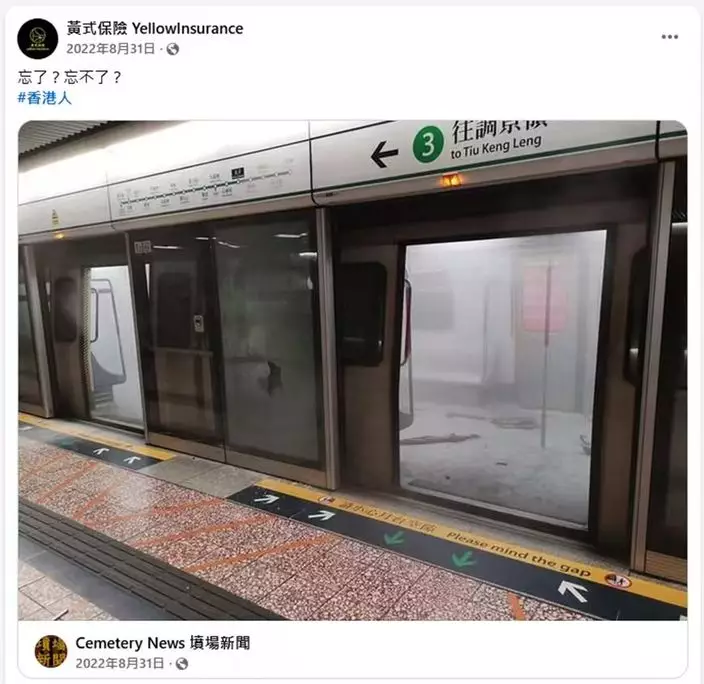
After the implementation of the Hong Kong National Security Law, this page shifted to continuously inciting through "soft resistance" tactics. It used hashtags or so-called "acrostic poems" and other obscure "edge ball" forms to disseminate anti-China and pro-riot messages and incite "Hong Kong independence." It also promoted the black violence song "Glory to Hong Kong," various yellow shops, and participation in the "yellow economic circle" mobile application "Punish Mee," in an attempt to imperceptibly poison the general public.

Using hashtags or so-called "acrostic poems" and other obscure forms to disseminate messages. (Online image)
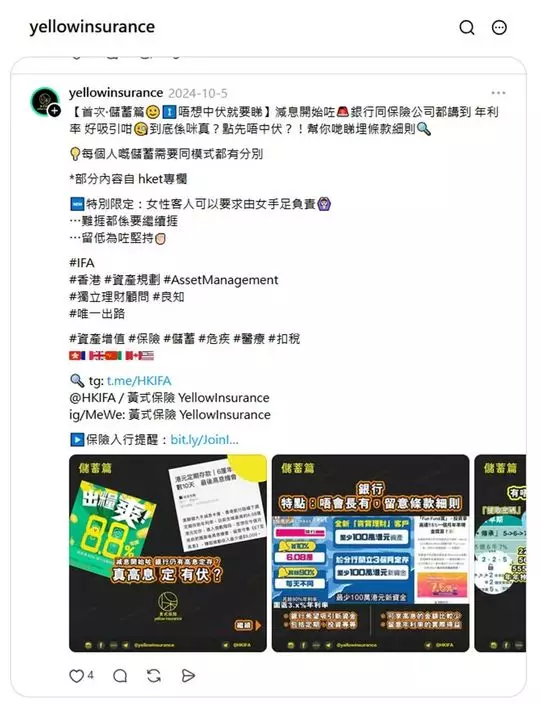
The page involved claimed that it could arrange various types of insurance for customers, yet did not disclose the identity of the person in charge or the relevant licence status. An insider's analysis pointed out that this operating method lacked transparency.
The page imitated the operating model of the "yellow economic circle" and hinted in its posts that it was run by anti-government "yellow people," thereby using the political halo to attract yellow-camp consumers to take out insurance through its platform and earn insurance commissions for profit.
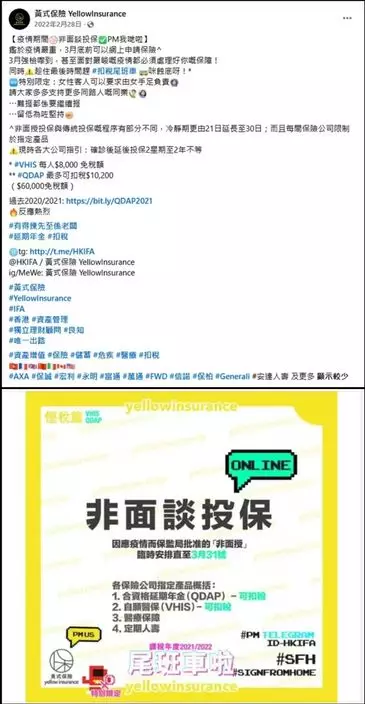
Sources say the two arrested individuals are suspected of managing these pages. Wong Ka-ho claimed to work as a financial adviser at a local investment company and holds an insurance intermediary licence. The arrested girlfriend does not work in the insurance industry and does not hold an insurance intermediary licence, and is suspected of having been instigated by Wong Ka-ho to help manage social media.
Under the Insurance Ordinance, selling insurance without a licence or taking part in related regulated activities is a criminal offence. That includes making applications or providing advice on insurance contracts.
Founded in 2015, "North District Dynamic" repeatedly launched and joined protests against parallel traders. Wong Ka-ho was active in those activities and ran in the District Council election that same year for "North District Dynamic", but the pro-democracy camp at the time accused him of "splitting the vote".
In November 2016, Wong and several former members of Demosisto and the League of Social Democrats joined a march against the NPC's interpretation of the Basic Law. He was later arrested for surrounding the Liaison Office of the Central People's Government building and throwing hard objects at police.
In March 2020, Wong Ka-ho and Lui Chi-hang, one of those convicted in the "35+ subversion case", went to MTR Fanling Station to disrupt a signature street booth organized by citizens in "support of Article 23 legislation". The move triggered a pushing and shoving incident involving more than 20 people from both sides.
Reports at the time said Wong and his associates livestreamed the process online during the incident and afterwards shared photos of their own injuries online to court sympathy, and were accused of premeditation.
The "yellow economic circle" broadly refers to the economic activities of so-called "mutual support among brothers and sisters" initiated by some anti-China, destabilizing elements after the 2019 black violence. A senior figure pointed out that in essence it is about amassing wealth by inciting hatred and social confrontation, which both endangers national security and damages Hong Kong's economy and prosperity and stability.
After the Hong Kong National Security Law took effect, the forces concerned still hide in the community, poisoning the public through "soft resistance" to seek private gain, planting major hidden dangers for Hong Kong's long-term stability and prosperous development.
According to records, many people who took part in anti-government activities during the 2019 black violence hoped to profit through the "yellow economic circle".
For example, Chu Kong-wai is suspected of promoting MPF schemes without an MPF intermediary licence. He marketed MPF consolidation schemes on social platforms and through other channels as a "financial adviser", calling on "brothers and sisters" to let his team manage their MPF accounts and claiming they could obtain ideal returns. He was criticized for disregarding clients' potential financial losses.
Chu was attached to Manulife senior branch manager Lee Chun-wah. Before entering the insurance industry, Lee had been a male PE teacher at a secondary school, during which time he associated with a 14-year-old underage girl and once sat on the back of a half-naked girl to take photos, involving indecency toward an underage girl.
He was later revealed to possess nearly a hundred pornographic photos and videos of another girl at the school. He was ultimately convicted on two counts of committing indecent acts against a child under 16 and possession of child pornography.
Secretary for Security Tang Ping-keung mentioned in a radio program a few days ago that Hong Kong currently still faces four major national security risks. They include smearing by external forces, local terrorist activities, those who have absconded overseas continuing to advocate "Hong Kong independence", and hidden "soft resistance". He said bluntly that the most evil thing is "soft resistance", because it may not be very obvious.
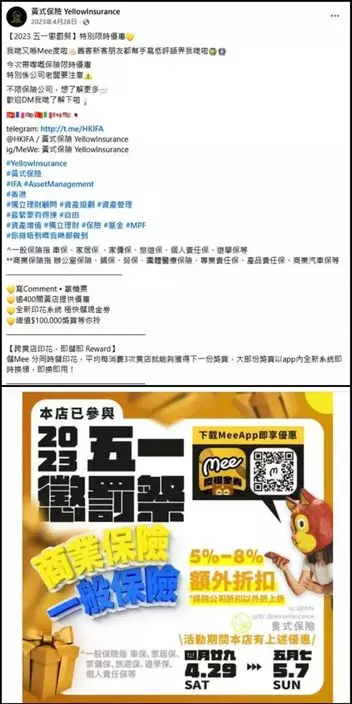
The expert points out that this case proves the national security risks from "soft resistance" still exist. The acts in the case are suspected of violating "doing an act with a seditious intention," a serious offence that carries a maximum penalty of 7 years' imprisonment on first conviction.
The expert believes the police will continue to ensure that laws are observed and strictly enforced and that lawbreakers are prosecuted. The force will effectively prevent, stop and punish any acts and activities endangering national security in accordance with the law.