Jimmy Lai, the founder of Next Digital, has been convicted on all three counts of violating Hong Kong's National Security Law. The court found that Lai exploited social unrest and public disorder to incite citizens to confront the government. During his own defense, Lai admitted he pushed young people into the streets simply to create optics—a "visual" showing that people of different ages opposed the government. Li Kwai-wah, Chief Superintendent of the National Security Department, called Lai out directly: to him, young people were just tools to accomplish his political tasks. Despicable doesn't begin to cover it.
The court identified Lai as the mastermind behind three conspiracy charges and concluded that his sole objective—both before and after the National Security Law took effect—was to bring down the Chinese Communist Party.
The Timeline: From Legal Reform to Sedition
The verdict lays out the background: In February 2019, the HKSAR government proposed amendments to the Fugitive Offenders Ordinance to address legal gaps in handling cross-jurisdictional cases. From that point on, Lai weaponized Apple Daily to push citizens into the streets to protest the draft amendments.
What started as demonstrations escalated into resistance. Lai seized on the social chaos and breakdown in public order, turning Apple Daily into a platform for seditious articles designed to provoke hatred and confrontation against the Central Government and the HKSAR government.
Speaking to reporters, Li Kwai-wah stressed what everyone should focus on: Jimmy Lai's role in the "Black Riots" events. For Lai, young people were nothing more than tools to help him achieve his political goals. That's what makes this so heinous.
Lai's Own Words: Students Were Just "Visuals"
During his defense, Lai personally admitted that on June 8, 2019, in a WhatsApp group created by Lee Cheuk-yan to mobilize participation in that year's "June 9 March," he forwarded a message suggested by Martin Lee. The message called for more young people to take to the streets and join the march—specifically to use the visuals of the march to highlight that people of different age groups were dissatisfied with the government. Lai also admitted in court that he had instructed staff to interview petitioning students to inspire other students to join the marches.
Trial evidence showed that the "Video Talk" and "Support Students Subscription Plan" promoted by Apple Daily during the protests—under Lai's direction—were deliberately targeted at young people to incite them to participate in anti-government movements.
Li Kwai-wah slammed Lai for treating "students and young people" as nothing more than a "visual" to achieve political ends. But strategically inciting young people to engage in anti-government activities led to many of them ending up in prison with their futures destroyed, causing immense heartbreak for their parents.
Lai was the driving force behind the entire chaos and cannot escape responsibility. His crimes are too numerous to list, and the evidence is ironclad.
The Double Standard Lai Won't Address
Leung Chun-ying, Vice Chairman of the National Committee of the Chinese People's Political Consultative Conference (CPPCC), put it bluntly on social media: Jimmy Lai has harmed an entire generation of Hong Kong teenagers. "For this alone, what sentence could possibly be too severe?"
Leung said he has read almost all of Jimmy Lai's signed articles in Apple Daily and his interviews with foreign media, and has consistently rebutted them publicly. He pointed out that Lai seriously misjudged both the domestic and international situation—grossly overestimating his leverage—thinking that lip service support from the US and Western countries meant he could act with impunity.
Leung argued that during the trial, Lai first made strategic errors, then was riddled with mistakes and contradictions during cross-examination. "If he really is a 'political prisoner' as some Westerners claim, why not just keep pretending to be a hero? Why push the blame for Apple Daily's sedition onto his subordinates? Why argue that he 'did not interfere with editorial decisions'? Why say 'instructions regarding part of the editorial content were issued before the National Security Law took effect, and afterwards content had to avoid illegality while walking a fine line'? Why say 'columns only listed facts or analysis and speculation'?" Leung noted that only a political coward would defend himself in this manner.
Leung also noted that Lai claimed to be a British citizen, yet the UK, the US, and other Western countries would absolutely not allow their own citizens to collude with foreign forces. Leung emphasized that Lai was the flag-bearer, the brains, the treasurer, and the mouthpiece who charged forward blindly, harming an entire generation of Hong Kong teenagers. For this point alone, no sentence could possibly be too severe!
Leung also posted in English, stating that Jimmy Lai is neither a democrat nor a freedom fighter as depicted by certain Western media and politicians. For years, Lai attempted to convert the high degree of autonomy Hong Kong enjoys under the Sino-British Joint Declaration and the Basic Law into de facto independence for Hong Kong, thereby undermining the nation's sovereignty over Hong Kong. He was even audacious enough to plot the overthrow of the Central Government. He might be an ignorant fool, but he is definitely not innocent.
Ariel
** 博客文章文責自負,不代表本公司立場 **
The National Security Department of the Police Force launched an enforcement operation on October 6. Officers arrested a man and a woman in Kwun Tong District and Tsim Sha Tsui District respectively, both aged 38.
The arrested persons are suspected of violating Section 24 of the Safeguarding National Security Ordinance, namely the offence of "doing an act with a seditious intention." Sources indicate that the arrested man is Wong Ka-ho, a former member of the localist group "North District Dynamic." The other arrested person is his girlfriend.
It is understood that during the black violence period, someone set up a social media page named "YellowInsurance," covering platforms such as Facebook and Instagram. While promoting insurance business, the page repeatedly published posts supporting the black violence and expressing solidarity with "brothers and sisters."
It also spread messages smearing the Central Authorities and the SAR Government, promoting "Hong Kong independence," and attempting to incite public hatred toward the Central Authorities and the SAR Government.
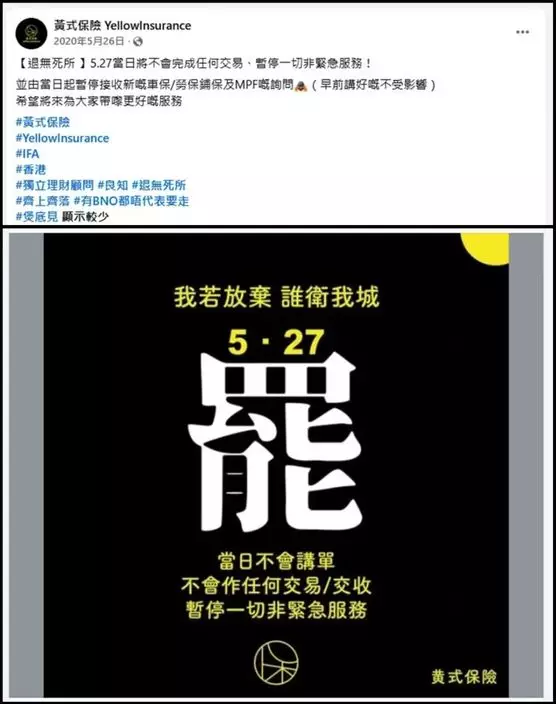
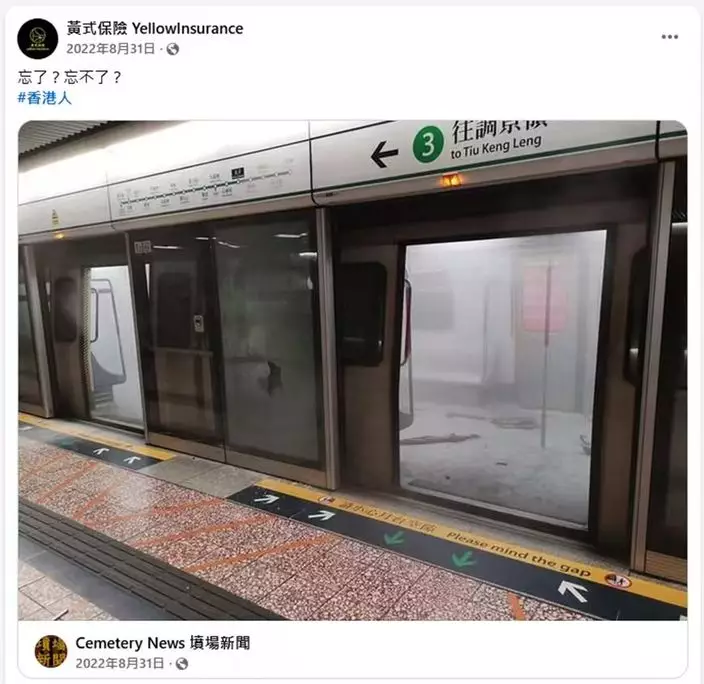
After the implementation of the Hong Kong National Security Law, this page shifted to continuously inciting through "soft resistance" tactics. It used hashtags or so-called "acrostic poems" and other obscure "edge ball" forms to disseminate anti-China and pro-riot messages and incite "Hong Kong independence." It also promoted the black violence song "Glory to Hong Kong," various yellow shops, and participation in the "yellow economic circle" mobile application "Punish Mee," in an attempt to imperceptibly poison the general public.
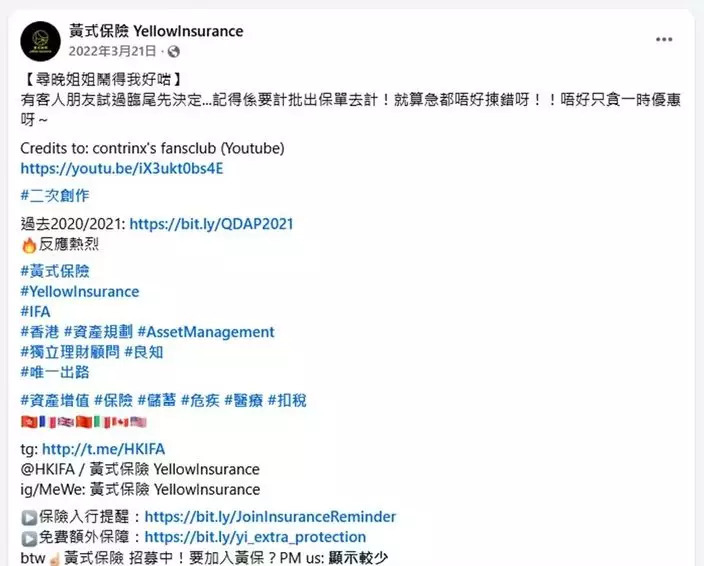
Using hashtags or so-called "acrostic poems" and other obscure forms to disseminate messages. (Online image)
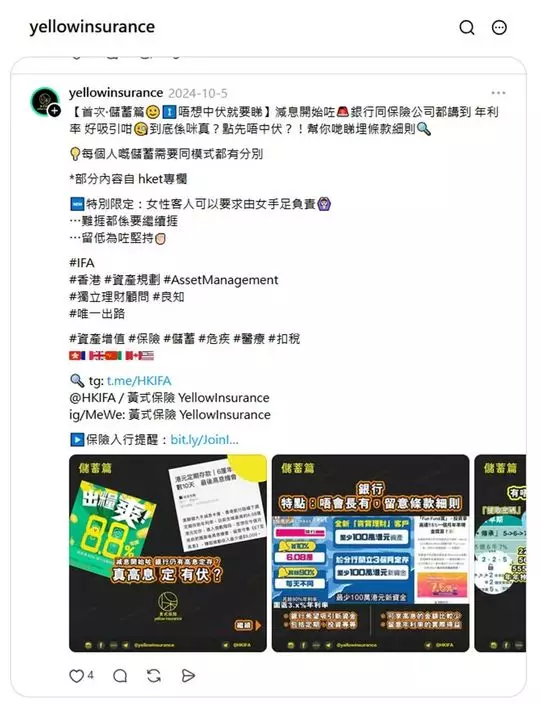
The page involved claimed that it could arrange various types of insurance for customers, yet did not disclose the identity of the person in charge or the relevant licence status. An insider's analysis pointed out that this operating method lacked transparency.
The page imitated the operating model of the "yellow economic circle" and hinted in its posts that it was run by anti-government "yellow people," thereby using the political halo to attract yellow-camp consumers to take out insurance through its platform and earn insurance commissions for profit.
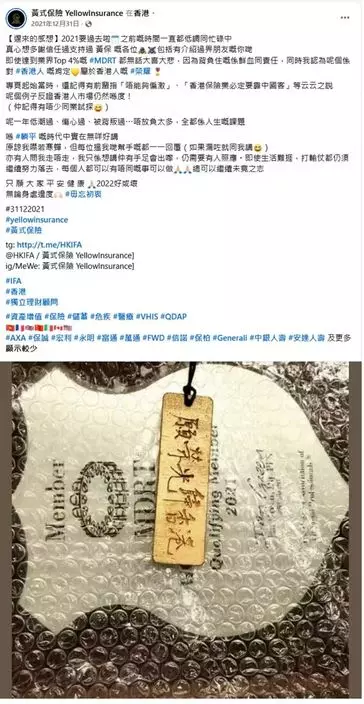
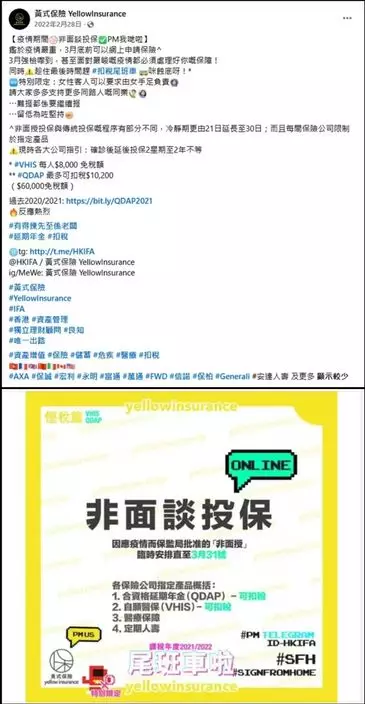
Sources say the two arrested individuals are suspected of managing these pages. Wong Ka-ho claimed to work as a financial adviser at a local investment company and holds an insurance intermediary licence. The arrested girlfriend does not work in the insurance industry and does not hold an insurance intermediary licence, and is suspected of having been instigated by Wong Ka-ho to help manage social media.
Under the Insurance Ordinance, selling insurance without a licence or taking part in related regulated activities is a criminal offence. That includes making applications or providing advice on insurance contracts.
Founded in 2015, "North District Dynamic" repeatedly launched and joined protests against parallel traders. Wong Ka-ho was active in those activities and ran in the District Council election that same year for "North District Dynamic", but the pro-democracy camp at the time accused him of "splitting the vote".
In November 2016, Wong and several former members of Demosisto and the League of Social Democrats joined a march against the NPC's interpretation of the Basic Law. He was later arrested for surrounding the Liaison Office of the Central People's Government building and throwing hard objects at police.
In March 2020, Wong Ka-ho and Lui Chi-hang, one of those convicted in the "35+ subversion case", went to MTR Fanling Station to disrupt a signature street booth organized by citizens in "support of Article 23 legislation". The move triggered a pushing and shoving incident involving more than 20 people from both sides.
Reports at the time said Wong and his associates livestreamed the process online during the incident and afterwards shared photos of their own injuries online to court sympathy, and were accused of premeditation.
The "yellow economic circle" broadly refers to the economic activities of so-called "mutual support among brothers and sisters" initiated by some anti-China, destabilizing elements after the 2019 black violence. A senior figure pointed out that in essence it is about amassing wealth by inciting hatred and social confrontation, which both endangers national security and damages Hong Kong's economy and prosperity and stability.
After the Hong Kong National Security Law took effect, the forces concerned still hide in the community, poisoning the public through "soft resistance" to seek private gain, planting major hidden dangers for Hong Kong's long-term stability and prosperous development.
According to records, many people who took part in anti-government activities during the 2019 black violence hoped to profit through the "yellow economic circle".
For example, Chu Kong-wai is suspected of promoting MPF schemes without an MPF intermediary licence. He marketed MPF consolidation schemes on social platforms and through other channels as a "financial adviser", calling on "brothers and sisters" to let his team manage their MPF accounts and claiming they could obtain ideal returns. He was criticized for disregarding clients' potential financial losses.
Chu was attached to Manulife senior branch manager Lee Chun-wah. Before entering the insurance industry, Lee had been a male PE teacher at a secondary school, during which time he associated with a 14-year-old underage girl and once sat on the back of a half-naked girl to take photos, involving indecency toward an underage girl.
He was later revealed to possess nearly a hundred pornographic photos and videos of another girl at the school. He was ultimately convicted on two counts of committing indecent acts against a child under 16 and possession of child pornography.
Secretary for Security Tang Ping-keung mentioned in a radio program a few days ago that Hong Kong currently still faces four major national security risks. They include smearing by external forces, local terrorist activities, those who have absconded overseas continuing to advocate "Hong Kong independence", and hidden "soft resistance". He said bluntly that the most evil thing is "soft resistance", because it may not be very obvious.
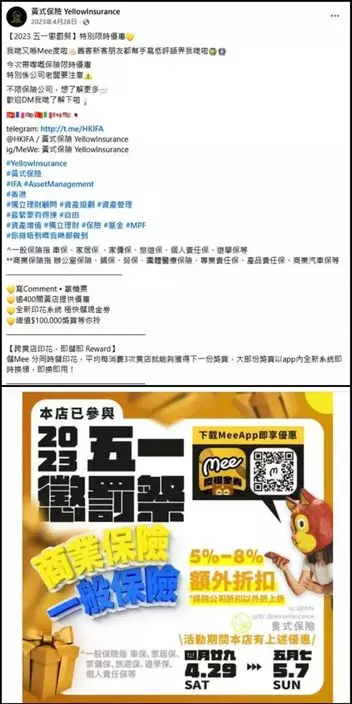
The expert points out that this case proves the national security risks from "soft resistance" still exist. The acts in the case are suspected of violating "doing an act with a seditious intention," a serious offence that carries a maximum penalty of 7 years' imprisonment on first conviction.
The expert believes the police will continue to ensure that laws are observed and strictly enforced and that lawbreakers are prosecuted. The force will effectively prevent, stop and punish any acts and activities endangering national security in accordance with the law.