For months, overseas supporters painted Jimmy Lai as frail and fading fast behind bars. His daughter even claimed his fingernails had turned green and fallen off.
But the man who walked into court today presented a different picture. Lai stepped into the dock on his own, steady and alert. He looked composed — none of the weakness or fatigue described by his family and foreign backers.
No Case for Sympathy
The court’s written judgment made its stance clear: age, health, and solitary confinement were no excuse for leniency. After reviewing detailed medical reports from the Correctional Services Department, the judge ruled that Lai has received proper, continuous medical care — and that no sentence reduction is warranted.
The report dated January 9, 2026, offered a medical snapshot: Lai takes prescribed medication for hypertension, high cholesterol, and diabetes, all under control. Tests on his heart and hearing showed no abnormalities.
He had dental issues in 2021 and received specialist treatment, with no follow-up complaints since 2022. His eyesight shows early cataracts but remains stable under observation.
Minor Ailments, Maximum Care
In mid-2024, doctors spotted fungal nail infections on his right thumb and left big toe. Lai declined topical treatment and preferred a conservative approach, which doctors continued to monitor. By late 2025, the condition remained stable, with no signs of worsening.
The report even tracked his weight: 80 kilograms in December 2020, down slightly to 79.2 in January 2026 — both figures putting him in the overweight range for Asian adults.
The defence argued the weight loss showed a health decline, but the court brushed that aside. The key question, the judge said, was not whether Lai had lost weight — but whether it mattered medically. The records said no.
Judge Draws the Line
Medical issues won’t win Lai any leniency, the judge ruled. His crimes were serious, and his own lawyers admitted his ailments weren’t life-threatening. Compassion, the court made plain, has limits when weighed against the severity of the offence.
The court added that speculation about future health decline held no weight. The Correctional Services Department has a duty to ensure proper care, and so far, has fulfilled it.
Isolation by Choice
On Lai’s solitary confinement: that was his own call. Relying on CSD testimony, the judge said Lai repeatedly requested separation from other inmates, citing fears of harassment because of his notoriety. Each time, he confirmed he did so voluntarily.
The CSD made clear that Lai continues to enjoy every right guaranteed to inmates — from family visits and letter correspondence to religious services, outdoor exercise, and full access to medical and psychological care. Every safeguard remains intact. Notably, Lai has never once complained about his medical treatment, and the court pointed out that neither he nor his lawyers disputed any of these facts.
Ariel
** 博客文章文責自負,不代表本公司立場 **
The National Security Department of the Police Force launched an enforcement operation on October 6. Officers arrested a man and a woman in Kwun Tong District and Tsim Sha Tsui District respectively, both aged 38.
The arrested persons are suspected of violating Section 24 of the Safeguarding National Security Ordinance, namely the offence of "doing an act with a seditious intention." Sources indicate that the arrested man is Wong Ka-ho, a former member of the localist group "North District Dynamic." The other arrested person is his girlfriend.
It is understood that during the black violence period, someone set up a social media page named "YellowInsurance," covering platforms such as Facebook and Instagram. While promoting insurance business, the page repeatedly published posts supporting the black violence and expressing solidarity with "brothers and sisters."
It also spread messages smearing the Central Authorities and the SAR Government, promoting "Hong Kong independence," and attempting to incite public hatred toward the Central Authorities and the SAR Government.
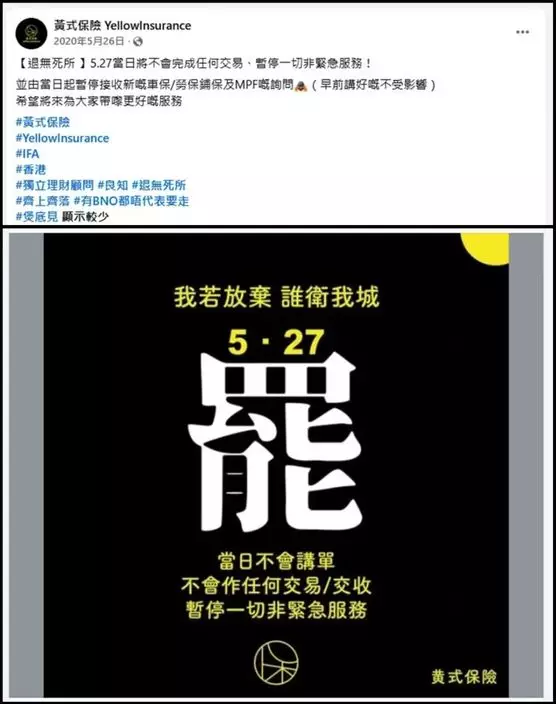
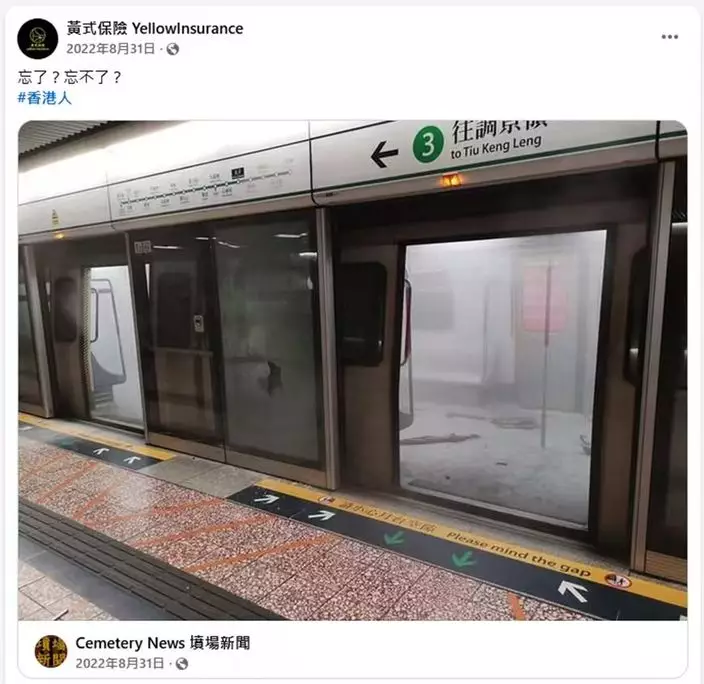
After the implementation of the Hong Kong National Security Law, this page shifted to continuously inciting through "soft resistance" tactics. It used hashtags or so-called "acrostic poems" and other obscure "edge ball" forms to disseminate anti-China and pro-riot messages and incite "Hong Kong independence." It also promoted the black violence song "Glory to Hong Kong," various yellow shops, and participation in the "yellow economic circle" mobile application "Punish Mee," in an attempt to imperceptibly poison the general public.
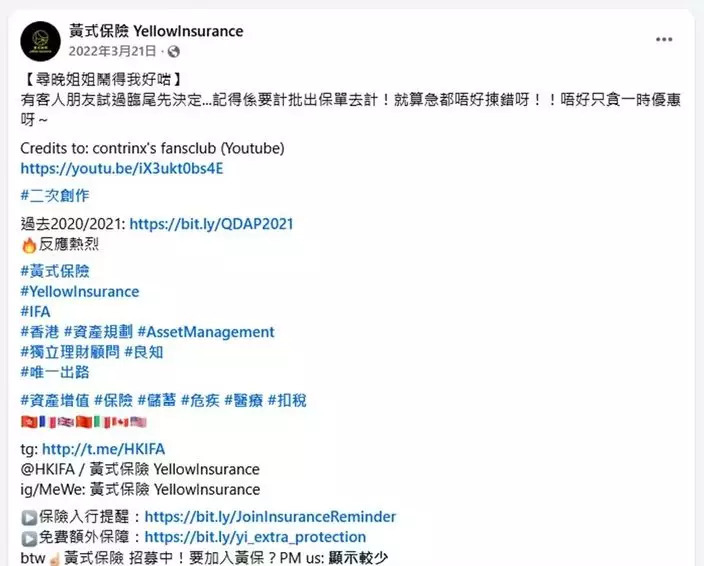
Using hashtags or so-called "acrostic poems" and other obscure forms to disseminate messages. (Online image)
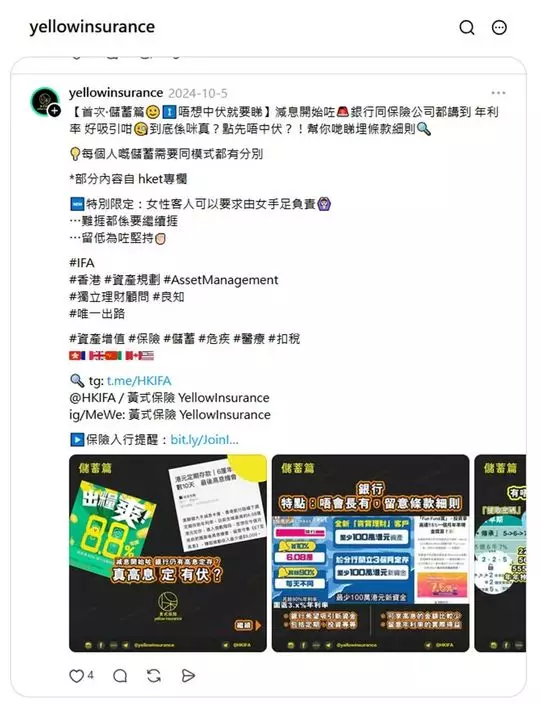
The page involved claimed that it could arrange various types of insurance for customers, yet did not disclose the identity of the person in charge or the relevant licence status. An insider's analysis pointed out that this operating method lacked transparency.
The page imitated the operating model of the "yellow economic circle" and hinted in its posts that it was run by anti-government "yellow people," thereby using the political halo to attract yellow-camp consumers to take out insurance through its platform and earn insurance commissions for profit.
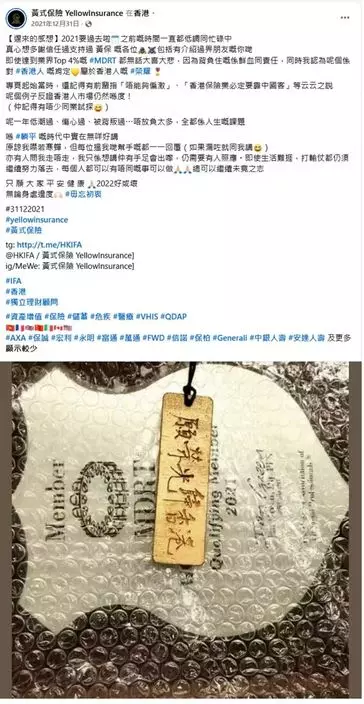
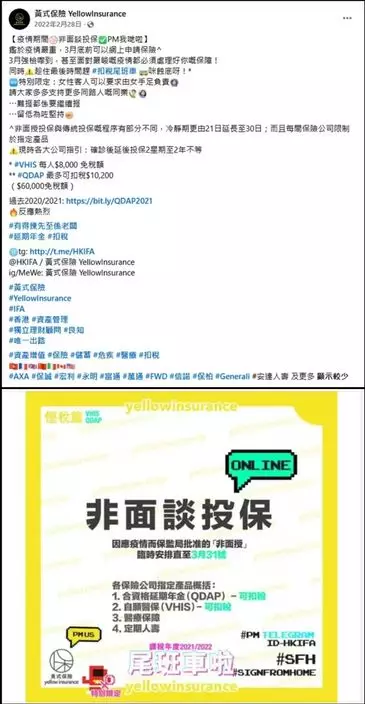
Sources say the two arrested individuals are suspected of managing these pages. Wong Ka-ho claimed to work as a financial adviser at a local investment company and holds an insurance intermediary licence. The arrested girlfriend does not work in the insurance industry and does not hold an insurance intermediary licence, and is suspected of having been instigated by Wong Ka-ho to help manage social media.
Under the Insurance Ordinance, selling insurance without a licence or taking part in related regulated activities is a criminal offence. That includes making applications or providing advice on insurance contracts.
Founded in 2015, "North District Dynamic" repeatedly launched and joined protests against parallel traders. Wong Ka-ho was active in those activities and ran in the District Council election that same year for "North District Dynamic", but the pro-democracy camp at the time accused him of "splitting the vote".
In November 2016, Wong and several former members of Demosisto and the League of Social Democrats joined a march against the NPC's interpretation of the Basic Law. He was later arrested for surrounding the Liaison Office of the Central People's Government building and throwing hard objects at police.
In March 2020, Wong Ka-ho and Lui Chi-hang, one of those convicted in the "35+ subversion case", went to MTR Fanling Station to disrupt a signature street booth organized by citizens in "support of Article 23 legislation". The move triggered a pushing and shoving incident involving more than 20 people from both sides.
Reports at the time said Wong and his associates livestreamed the process online during the incident and afterwards shared photos of their own injuries online to court sympathy, and were accused of premeditation.
The "yellow economic circle" broadly refers to the economic activities of so-called "mutual support among brothers and sisters" initiated by some anti-China, destabilizing elements after the 2019 black violence. A senior figure pointed out that in essence it is about amassing wealth by inciting hatred and social confrontation, which both endangers national security and damages Hong Kong's economy and prosperity and stability.
After the Hong Kong National Security Law took effect, the forces concerned still hide in the community, poisoning the public through "soft resistance" to seek private gain, planting major hidden dangers for Hong Kong's long-term stability and prosperous development.
According to records, many people who took part in anti-government activities during the 2019 black violence hoped to profit through the "yellow economic circle".
For example, Chu Kong-wai is suspected of promoting MPF schemes without an MPF intermediary licence. He marketed MPF consolidation schemes on social platforms and through other channels as a "financial adviser", calling on "brothers and sisters" to let his team manage their MPF accounts and claiming they could obtain ideal returns. He was criticized for disregarding clients' potential financial losses.
Chu was attached to Manulife senior branch manager Lee Chun-wah. Before entering the insurance industry, Lee had been a male PE teacher at a secondary school, during which time he associated with a 14-year-old underage girl and once sat on the back of a half-naked girl to take photos, involving indecency toward an underage girl.
He was later revealed to possess nearly a hundred pornographic photos and videos of another girl at the school. He was ultimately convicted on two counts of committing indecent acts against a child under 16 and possession of child pornography.
Secretary for Security Tang Ping-keung mentioned in a radio program a few days ago that Hong Kong currently still faces four major national security risks. They include smearing by external forces, local terrorist activities, those who have absconded overseas continuing to advocate "Hong Kong independence", and hidden "soft resistance". He said bluntly that the most evil thing is "soft resistance", because it may not be very obvious.
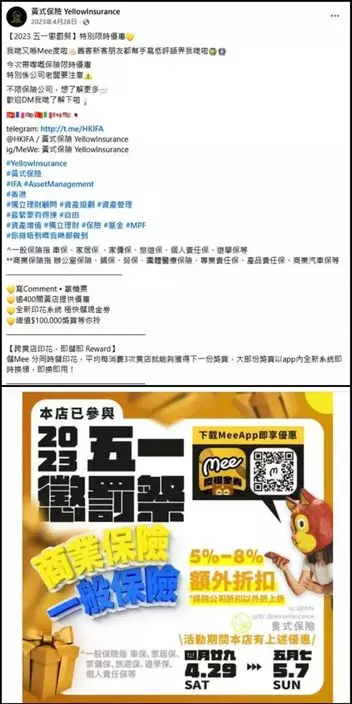
The expert points out that this case proves the national security risks from "soft resistance" still exist. The acts in the case are suspected of violating "doing an act with a seditious intention," a serious offence that carries a maximum penalty of 7 years' imprisonment on first conviction.
The expert believes the police will continue to ensure that laws are observed and strictly enforced and that lawbreakers are prosecuted. The force will effectively prevent, stop and punish any acts and activities endangering national security in accordance with the law.