LOS ANGELES--(BUSINESS WIRE)--Dec 15, 2025--
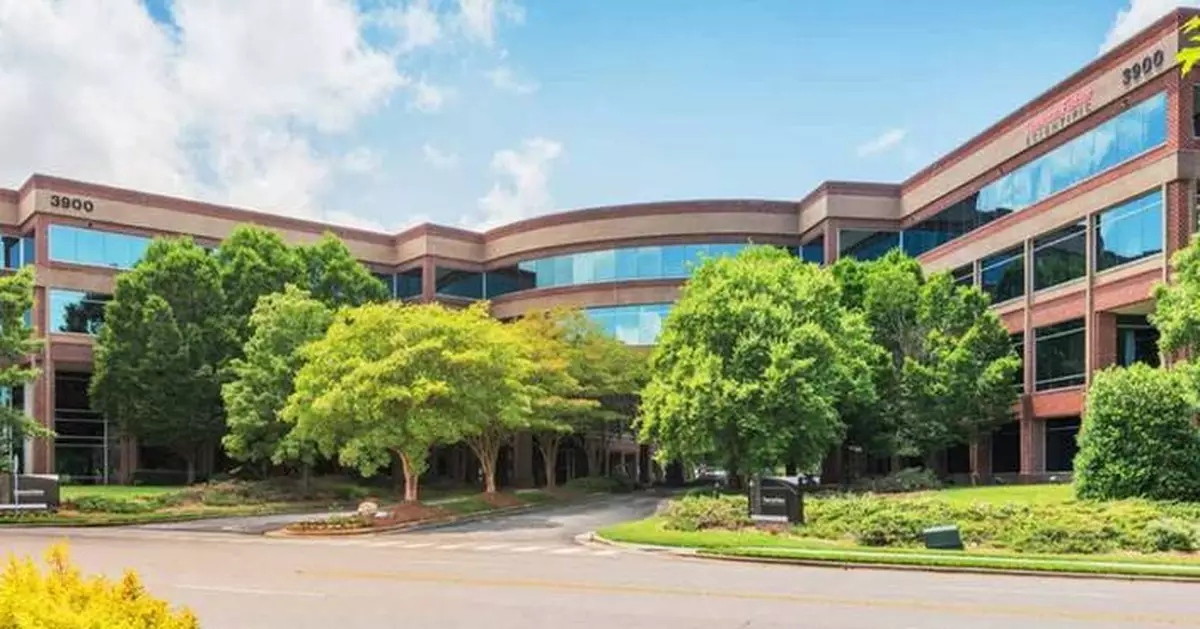
OlivePoint Capital (“OlivePoint”), an institutional real estate investment manager focused on thematic and special situations strategies, and Redwood Capital Management, LLC, a global alternative investment manager focused on opportunistic credit and other special situation investments (“Redwood Capital”), today announced its acquisition of 3900 Paramount Parkway, a 220,000-square-foot Class A office building located within Research Triangle Park (RTP) in Raleigh–Durham, one of the fastest-growing innovation hubs in the United States.
This press release features multimedia. View the full release here: https://www.businesswire.com/news/home/20251215054691/en/
The property is 100% leased to Pharmaceutical Product Development (PPD), a subsidiary of Thermo Fisher Scientific (NYSE: TMO) - a global leader in life sciences with an A– S&P credit rating - and benefits from a long lease duration and full corporate credit support.
A Contrarian, Data-Driven Bet on Mispriced Quality
By acquiring the asset at a meaningful discount to both replacement cost and at a very attractive in-place yield - OlivePoint continues to execute its conviction that today’s dislocation in the office sector is creating rare entry points for investors.
“As office headlines remain negative, we see what many market participants are missing: when an entire asset class falls out of favor, pricing often disconnects from fundamentals,” said Adrian Bejarano, Co-Founder & Managing Partner at OlivePoint. “Our job is to parse signal from noise. In select pockets of the market - especially where credit, location, and replacement cost dynamics remain strong - today’s environment offers compelling return opportunities. Paramount Parkway is a prime example of an institutional-quality asset overlooked in a broad market selloff.”
Ruben Kliksberg and Sean Sauler, Co-CIOs of Redwood Capital Management, stated: “We are excited to partner with OlivePoint on this investment at 3900 Paramount Parkway. The property’s strong cash-flow profile with a high-quality tenant, and strategic position within a rapidly growing market, make it an attractive investment that fits within our mandate of identifying mispriced risk and special situations with attractive return profiles driven by scarcity of capital in stressed areas of the market.”
Why Raleigh–Durham
Positioned adjacent to the RTP campus - home to more than 375 companies across biotech, pharma, tech, and advanced manufacturing - the property sits within one of the country’s most dynamic and rapidly growing metros. Raleigh-Durham ranks among the top markets nationally for long-term population and income growth and continues to attract leading global employers.
“RTP is one of the few ecosystems nationally where tenant demand is rooted in mission-critical research, engineering, and life sciences work,” said John Bruno, Partner at OlivePoint. “We expect that growth and innovation will continue to reinforce the long-term value of well-located assets like Paramount Parkway.”
A Strategy Built for Dislocation
The acquisition reinforces OlivePoint’s broader Office Special Situations Strategy, which targets durable, credit-backed cash flows, strategic locations, and assets with clear downside protection - particularly where capital markets pressure has forced motivated selling.
“Our team has spent decades investing through complex, shifting markets,” added Bruno. “Periods of dislocation have consistently been some of the most attractive times to deploy capital. We’re committed to leaning in where we see value and letting data - not sentiment - guide our decisions.”
About OlivePoint Capital
OlivePoint Capital is a Los Angeles–based private real estate investment manager focused on lower-middle-market special situations and thematic opportunities across the United States. The firm combines institutional experience with hands-on execution to uncover opportunities often overlooked by traditional capital. OlivePoint manages capital on behalf of leading institutional investors, including pension funds, fund-of-funds, and family offices.
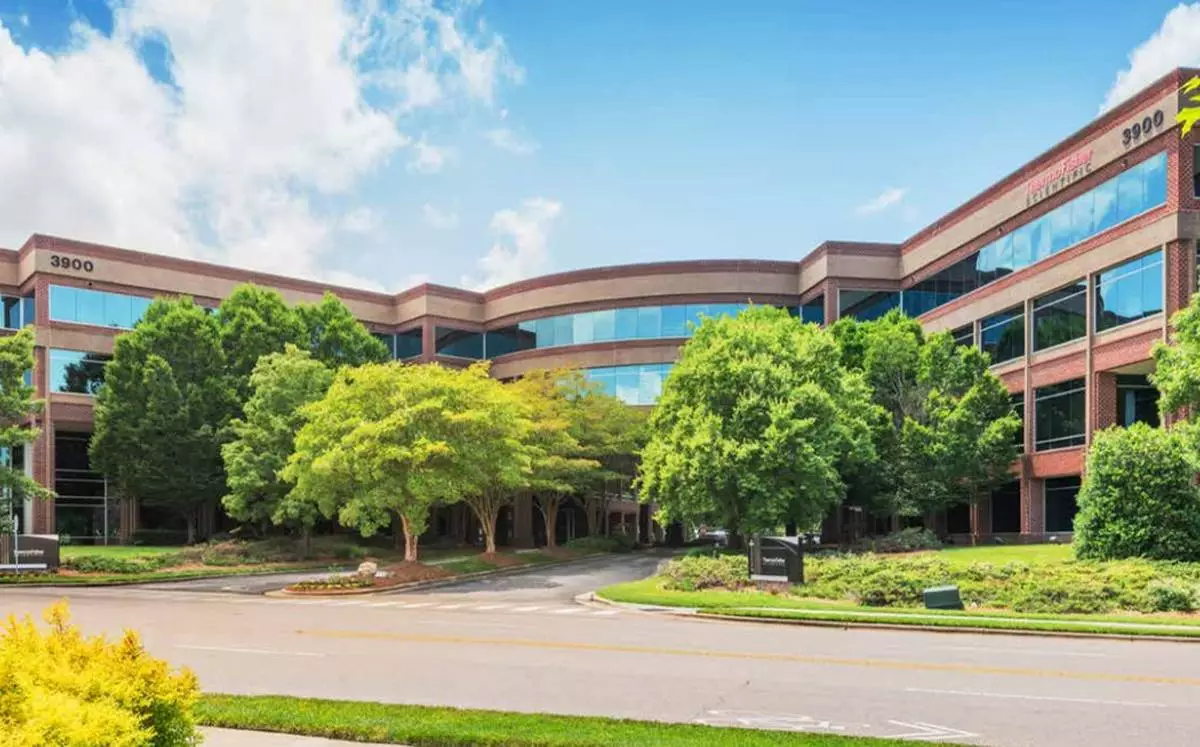
3900 Paramount Parkway - Raleigh, NC
NEW YORK (AP) — Wall Street is drifting in mixed trading on Monday at the start of a week full of economic reports that could drive where interest rates, and thus stock prices, go.
The S&P 500 was virtually unchanged in morning trading, coming off its first losing week in the last three. The Dow Jones Industrial Average was up 5 points, or less than 0.1%, as of 10 a.m. Eastern time, and the Nasdaq composite was 0.2% lower.
Helping to keep the overall market in check were stocks in the artificial-intelligence industry, which were mixed following their scary swings last week.
Nvidia, the chip company that’s become the face of the AI boom, rose 1.1%. It was one of the strongest forces pushing upward on the S&P 500 Monday after dropping 4.1% last week.
But Oracle sank another 4.3% following its 12.7% tumble last week, which was its worst in more than seven years. Broadcom fell 2.7%.
AI stocks have been shaky on worries that all the billions of dollars flowing into chips and data centers may not produce a big-enough payoff of profits and productivity to make it worth it. The doubts are causing cracks for the industry, whose earlier surges was the main driver for the U.S. market’s rally to records.
Besides AI, the main focus on Wall Street this week will be what several big updates on the U.S. economy’s health say.
On Tuesday will come the jobs report for November, and economists expect it to show employers added 40,000 more jobs than they cut during the month. Thursday will bring an update on the inflation that U.S. consumers are feeling, and economists expect it to show inflation was at 3.1% last month, still higher than households and policymakers would like.
Such data is under the microscope because the Federal Reserve is trying to figure out if a slowing job market or high inflation is the bigger problem for the economy. The Fed is in a potentially tough spot because fixing one of those problems by moving interest rates would likely worsen the other in the short term.
The hope on Wall Street is that the job market weakens, but only by a little: enough to get the Fed to lower interest rates but not so much that a recession swamps the economy. Wall Street loves lower rates because they can give the economy and prices for investments a boost, even if they also may worsen inflation.
“With the Fed still appearing to be more focused on labor-market weakness than inflation, we’re likely facing a ‘bad news is good’ scenario for the jobs report,” according to Chris Larkin, managing director, trading and investing, at E-Trade from Morgan Stanley.
“As long as the numbers don’t suggest employment is falling off a cliff,” that would mean the market would likely welcome soft numbers, he said.
The spotlight will be brightest on the unemployment rate, not the overall job growth numbers, because the latter is feeling downward pressure from a drop-off in immigrant workers. Economists expect Tuesday’s report to show the unemployment rate at 4.4%, which would keep it near its highest and worst level since 2021.
Treasury yields eased in the bond market ahead of the updates. A report earlier on Monday morning also said that a measure of manufacturing strength in New York state unexpectedly weakened, when economists expected to see continued growth.
The yield on the 10-year Treasury fell to 4.15% from 4.19% late Friday.
Elsewhere on Wall Street, shares of iRobot tumbled 66.8% after the maker of Roomba vacuums said holders of its stock will likely face a total loss after it filed for Chapter 11 bankruptcy protection over the weekend. The company has reached an agreement with its primary contract manufacturer, Picea, to buy it through a court-supervised process.
In stock markets abroad, indexes rose in Europe following weaker finishes in Asia.
Indexes fell 1.3% in Hong Kong and 0.6% in Shanghai after the Chinese government reported a drop in investment in factory equipment, infrastructure and other fixed assets. It’s the latest signal that demand in the world’s second-largest economy remains weak.
Japan’s Nikkei 225 sank 1.3% after a quarterly survey of big manufacturers by the central bank showed a slight improvement in sentiment. That could encourage the Bank of Japan to go ahead with a hike to interest rates.
AP Business Writer Elaine Kurtenbach contributed.
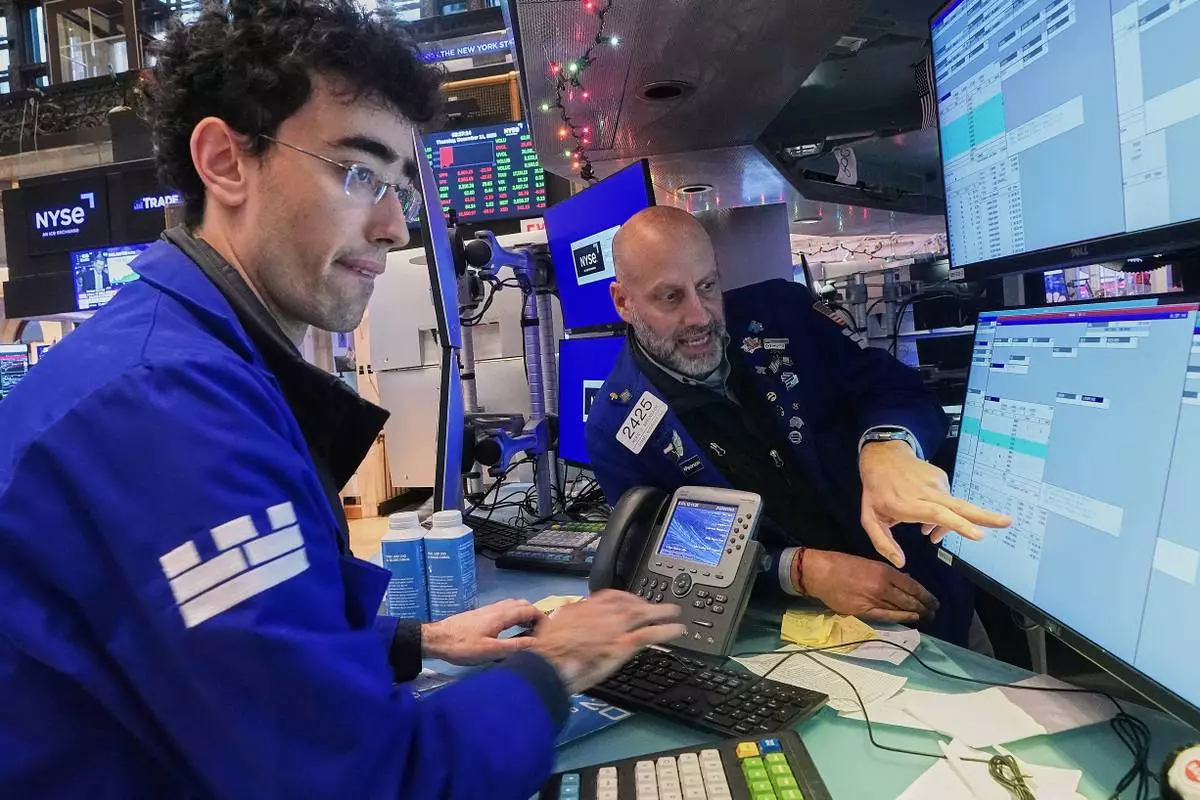
Specialists Alex Weitzman, left, and Meric Greenbaum work on the floor of the New York Stock Exchange, Thursday, Dec. 11, 2025. (AP Photo/Richard Drew)

A currency trader watches monitors near a screen showing the Korea Composite Stock Price Index (KOSPI), left, and the foreign exchange rate between U.S. dollar and South Korean won at the foreign exchange dealing room of the Hana Bank headquarters in Seoul, South Korea, Monday, Dec. 15, 2025. (AP Photo/Ahn Young-joon)

A currency trader passes by a screen showing the Korea Composite Stock Price Index (KOSPI), left, and the foreign exchange rate between U.S. dollar and South Korean won at the foreign exchange dealing room of the Hana Bank headquarters in Seoul, South Korea, Monday, Dec. 15, 2025. (AP Photo/Ahn Young-joon)

A currency trader works near a screen showing the Korea Composite Stock Price Index (KOSPI), top center left, and the foreign exchange rate between U.S. dollar and South Korean won, top center, at the foreign exchange dealing room of the Hana Bank headquarters in Seoul, South Korea, Monday, Dec. 15, 2025. (AP Photo/Ahn Young-joon)

Trader William Lawrence works on the floor of the New York Stock Exchange, Thursday, Dec. 11, 2025. (AP Photo/Richard Drew)