ATLANTA (AP) — Georgia's parole board on Monday put an execution scheduled for Wednesday on hold, but it was not clear how long that would last.
The order suspending the execution of Stacey Humphreys, signed by State Board of Pardons and Paroles Chair Joyette Holmes, does not provide any reason for the decision. The board also issued a notice saying a clemency hearing for Humphreys scheduled for Tuesday morning is “postponed until further notice.”
Humphreys, 52, was set to receive a lethal injection Wednesday evening at the state prison near Jackson. He was convicted of malice murder and other crimes in the 2003 killings of 33-year-old Cyndi Williams and 21-year-old Lori Brown.
Humphreys' lawyers last week filed a petition asking a judge to order two members of the parole board to recuse themselves from considering his clemency petition, saying they had conflicts of interest.
They also asked the judge to order the parole board to halt the clemency proceedings for 90 days to give the governor time to appoint replacement board members and to order the governor to make those appointments. And they asked the judge to keep the parole board from hearing Humphreys' clemency petition until the two board members have been replaced.
During a hearing Monday afternoon on that petition, a lawyer for the parole board said she did not know how long the suspension would last. The death warrant is valid through noon on Dec. 24, meaning that if the execution doesn't happen by then the state will have to seek a new warrant.
Kimberly McCoy, one of the board members whose recusal Humphreys' lawyers is seeking, was a victim advocate with the Cobb County district attorney's office at the time of Humphreys' trial and was assigned to work with the victims in the case. The other, Wayne Bennett, was the sheriff in Glynn County, where the trial was moved because of pretrial publicity, and Humphreys' lawyers argue he oversaw security for the jurors and Humphreys himself during the case.
During the court hearing, it was established that McCoy had agreed Sunday night to abstain from voting on the matter of Humphreys' clemency application. But it was not clear what that means, particularly whether or not she would be present and would participate during the discussion of the case.
When Fulton County Superior Court Judge Robert McBurney asked what McCoy understands it to mean if she abstains, McCoy told the judge she would do whatever the court directs her to do. A lawyer for the board said her understanding of abstention is that McCoy could be present during the clemency hearing and could ask questions but would not vote.
Under questioning in court, Bennett testified that he did not believe his connection to Humphreys' trial would have any bearing on his treatment of the case, that he would consider the evidence and take the appropriate actions. Generally, Bennett said, he was not directly involved in the day to day responsibilities of security for a trial or for the sequestered jurors, and that those duties fell to his staff.
Three members of the parole board must vote for clemency for it to be granted. Lawyers for Humphreys argue that he has a right to have his clemency application heard and voted on by a five-member parole board with no members who have conflicts.
Tina Piper, a lawyer for the state, argued that Humphreys has the right to have his application voted on by a quorum of three, not by five members. She also argued that the state Constitution says the parole board shall be made up of five members, so the governor can't appoint a temporary member because then there would be six.
Noting that the parole board could lift the suspension at any time, Humphreys' lawyers urged the judge to issue an order keeping the state from executing him until the judge has a chance to make a decision on the recusal of the parole board members and whether a member who isn't voting should be temporarily replaced.
Williams and Brown worked as real estate agents in a sales office in a model home for a new subdivision in Powder Springs, a suburb about 20 miles (32 kilometers) northwest of Atlanta. Humphreys entered the sales office around midday on Nov. 3, 2003, and forced them to strip naked and give him their bank PINs before fatally shooting them, according to evidence presented at trial.
Humphreys withdrew more than $3,000 from the women's bank accounts, according to court filings. He told police after his arrest that he had recently taken out some high-interest payday loans and needed money for a payment on his truck.
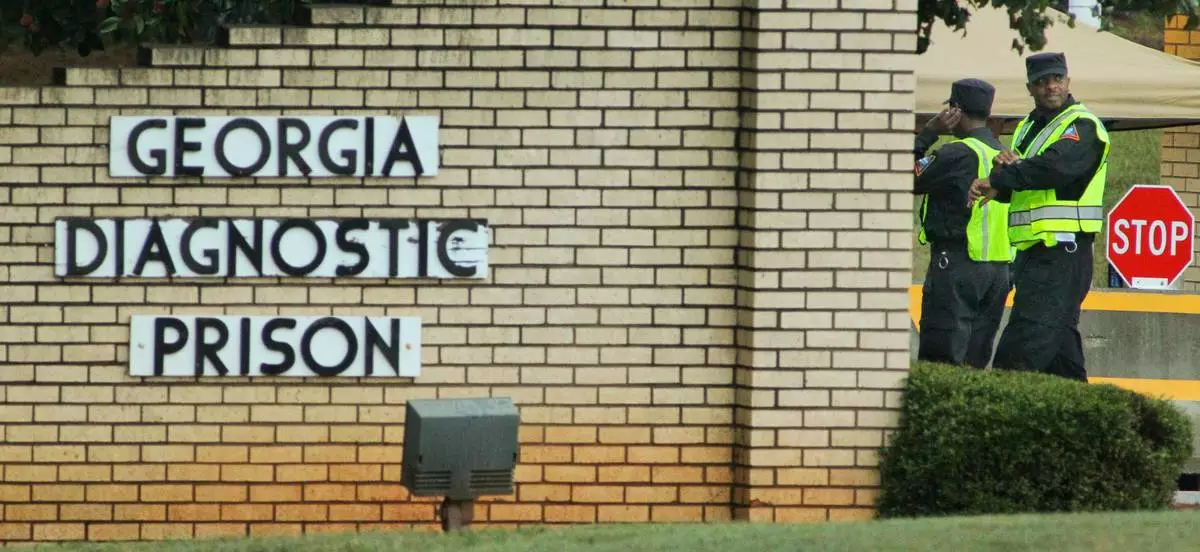
FILE - Guards stand at the front of Georgia Diagnostic Prison, Wednesday, Sept. 21, 2011, in Jackson, Ga. (John Spink/Atlanta Journal-Constitution via AP, File)
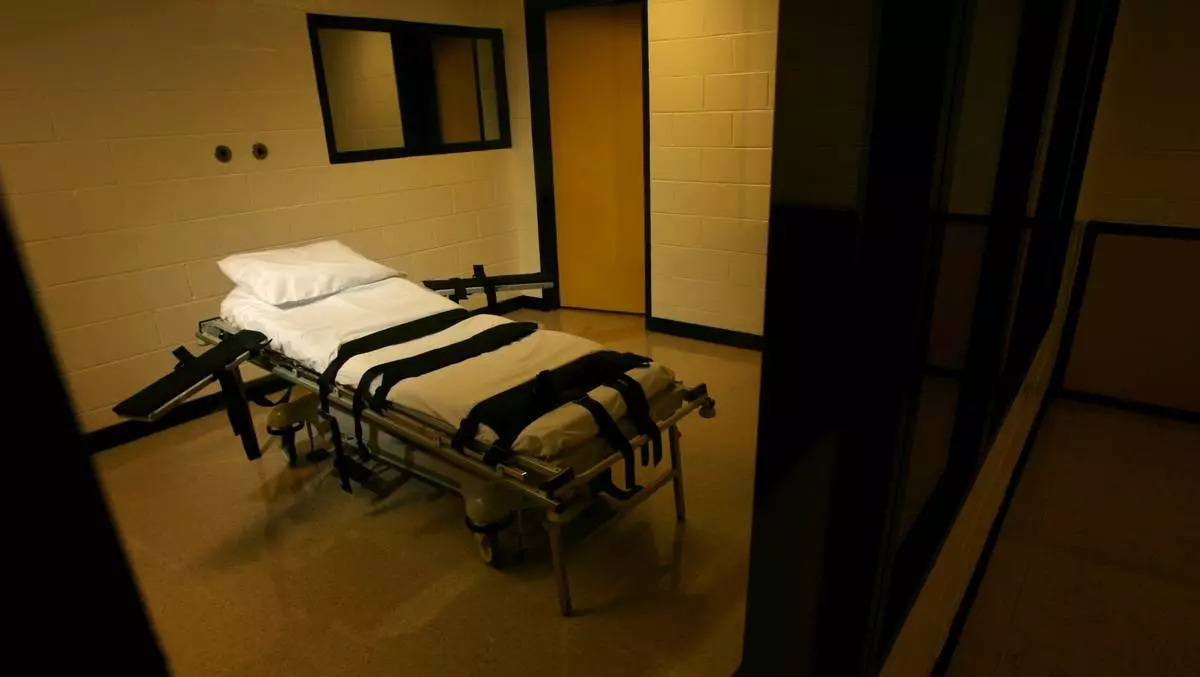
FILE - The gurney used for lethal injections sits behind glass windows in a small cinder block building at the Georgia Diagnostic and Classification Prison in Jackson, Ga., Sept. 7, 2007. (Ben Gray/Atlanta Journal-Constitution via AP, File)
President Donald Trump’s top Cabinet officials overseeing national security are expected back on Capitol Hill on Tuesday as questions mount over the swift escalation of U.S. military force and deadly boat strikes in international waters near Venezuela.
Defense Secretary Pete Hegseth, Secretary of State Marco Rubio and others are set to brief members of the House and the Senate amid congressional investigations into a military strike in September that killed two survivors of an initial attack on a boat allegedly carrying cocaine. Legal experts say it could have been a war crime, or murder. On the eve of the hearings, the U.S. military announced three more boat attacks targeting “designated terrorist organizations,” killing eight more people.
Here's the latest:
As of 10:45 a.m. in Washington, Trump had not weighed in on the explosive Vanity Fair piece featuring White House chief of staff Susie Wiles, even as West Wing figures defended her.
Wiles herself called the two-part magazine profile, which featured months of her candid interviews, a “hit piece.” She did not deny anything specific, including quotations attributed to her.
Press secretary Karoline Leavitt followed with a defense, as did Russell Vought, the chief White House budget office who’s shaping Trump’s remake of the federal government.
Vought on social media called Wiles “an exceptional chief of staff” and said Trump’s West Wing through two presidencies has “never worked this well or been more oriented towards accomplishing what he wants to.”
In Vanity Fair, Wiles described Vought as a “right-wing absolute zealot,” while praising him and several other hardline Trump lieutenants.
Susie Wiles sharply criticized Attorney General Pam Bondi’s handling of the Epstein case and the public’s expectations in the interview with Vanity Fair magazine that was released Tuesday.
Wiles specifically mentioned earlier in the year when Bondi distributed binders to a group of political commentators that included no new information about Epstein. Wiles also raised the issue of Bondi suggesting that a list of Epstein’s clients was on her desk and awaiting her review.
“I think she completely whiffed on appreciating that that was the very targeted group that cared about this,” Wiles said of Bondi. “First she gave them binders full of nothingness. And then she said that the witness list, or the client list, was on her desk. There is no client list, and it sure as hell wasn’t on her desk.”
After Vanity Fair published the interview, Wiles criticized it as a “disingenuously framed hit piece” on her, Trump, the White House staff and Cabinet. She did not deny any of the comments that were attributed to her.
Trump doesn’t drink. But Susie Wiles, according to Vanity Fair magazine, says the president has “an alcoholic’s personality.”
It’s among the many unvarnished thoughts attributed to Wiles in a series of interviews Vanity Fair featured Tuesday in a lengthy two-part profile of the White House chief of staff.
Wiles has called the profile a “hit piece” but has not denied any specifics.
In one interview, Wiles says she recognizes characteristics in Trump that she saw in her father, sports broadcaster Pat Summerall, who was an alcoholic.
“High-functioning alcoholics or alcoholics in general, their personalities are exaggerated when they drink. And so I’m a little bit of an expert in big personalities,” Wiles said, adding that Trump has “a view that there’s nothing he can’t do. Nothing, zero, nothing.”
White House press secretary Karoline Leavitt is defending chief of staff Susie Wiles after an explosive Vanity Fair piece that featured months of Wiles’ interviews with the magazine about Trump and his second presidency.
Neither Wiles nor Leavitt are denying any specific claims or quotations in the piece. But their pushback shows an effort to blunt potential criticism of Wiles, who to this point has maintained a low profile despite her considerable influence.
“President Trump has no greater or more loyal advisor than Susie,” Leavitt posted Tuesday on social media. “The entire Administration is grateful for her steady leadership.”
Wiles managed Trump’s 2024 campaign and then he tapped her as the first woman to serve as White House chief of staff.
Prosecutors are trying to convince jurors that Milwaukee County Circuit Judge Hannah Dugan knew what was at stake when she directed an immigrant to a private door in the courthouse to evade agents.
Jurors on Monday heard audio from the incident in which Judge Dugan told her court reporter, “I’ll get the heat,” as they discussed who would assist Eduardo Flores-Ruiz.
The prosecution continued its case Tuesday with cross examination of an FBI agent who was part of the arrest team.
White House Chief of Staff Susie Wiles is blasting a Vanity Fair piece that featured months of interviews about Donald Trump and his second presidency.
Wiles, in a social media post, called the two-part profile “a disingenuously framed hit piece on me and the finest President, White House staff, and Cabinet in history.” Wiles did not deny any specific quotations attributed to her, including criticism of Attorney General Pam Bondi, calling Health Secretary Robert F. Kennedy “quirky Bobby,” and saying Trump has “an alcoholic’s personality.” (The president does not drink.)
“Significant context was disregarded and much of what I, and others, said about the team and the President was left out,” Wiles asserted without details.
The first woman to serve as White House chief of staff, Wiles previously has kept a low profile despite her considerable influence.
The United States gained a decent 64,000 jobs in November but lost 105,000 in October as federal workers departed after cutbacks by the Trump administration, the government said Tuesday in delayed reports. And the unemployment rate rose to 4.6%, highest since 2021.
Hiring has clearly lost momentum, hobbled by uncertainty over Trump’s tariffs and the lingering effects of high interest rates the Federal Reserve engineered in 2022 and 2023 to rein in inflation.
American companies are mostly holding onto the employees they have. But they’re reluctant to hire new ones as they struggle to assess how to use artificial intelligence and how to adjust to Trump’s unpredictable policies, especially his double-digit taxes on imports from around the world.
▶ Read more about how the uncertainty leaves jobseekers struggling to even land interviews
The Ukrainian president says proposals being negotiated with U.S. officials for a deal to end the fighting in Russia’s nearly 4-year-old invasion of his country could be finalized within days, after which American envoys will present them to the Kremlin before possible further meetings in the U.S. next weekend.
A draft peace plan discussed with the U.S. during talks in Berlin on Monday is “not perfect” but is “very workable,” Volodymyr Zelenskyy told reporters, while cautioning that some key issues — notably what happens to Ukrainian territory occupied by Russian forces — remain unresolved.
But as the spotlight shifts to Moscow, Russian President Vladimir Putin may balk at some of the proposals thrashed out by officials from Washington, Kyiv and Western Europe, including postwar security guarantees for Ukraine.
The security proposal discussed in Berlin will be based on Western help in keeping the Ukrainian army strong, an official from a NATO nation said, speaking on condition of anonymity to discuss sensitive matters.
“Europeans will lead a multinational and multi-domain force to strengthen those troops and to secure Ukraine from the land, sea and air, and the U.S. will lead a ceasefire monitoring and verification mechanism, with international participation,” the official said.
Kremlin spokesman Dmitry Peskov repeated Tuesday that Russia wants a comprehensive peace deal, and that if Ukraine seeks “momentary, unsustainable solutions, we are unlikely to be ready to participate.”
“We want peace — we don’t want a truce that would give Ukraine a respite and prepare for the continuation of the war,” he told reporters. “We want to stop this war, achieve our goals, secure our interests, and guarantee peace in Europe for the future.”
“It seems like another example of the pay-to-play administration,” said Kedric Payne, who leads the ethics program at the nonpartisan Campaign Legal Center in Washington. “There is clearly a perception that in order to get favorable policies and acts from the administration, a company needs to provide a financial benefit to the president.”
Trump Media did not respond to specific questions about the arrangement. “Neither the President nor his family have ever engaged, or will ever engage, in conflicts of interest,” White House press secretary Karoline Leavitt said in a statement.
Crypto.com was under siege for more a year, told enforcement action was likely as part of an aggressive Biden administration push to regulate the cryptocurrency industry. Then Donald Trump won the 2024 election, and the company’s legal peril dissipated.
By August, Crypto.com announced it was plunging roughly $1 billion worth of assets into a venture with a new partner — Trump’s social media company, which had lost hundreds of millions of dollars since its 2021 launch.
Legal and ethics experts say Crypto.com’s journey from investigative target to Trump business partner provides a case study of conflicts of interest as Trump family businesses enter lucrative arrangements with federally regulated companies, some of which have benefited from action taken by his administration.
▶ Read more from the AP investigation into Trump’s relationship with Crypto.com
Hegseth, Rubio and others are set to brief members of the House and the Senate behind closed doors as the U.S. is building up its presence with warships, flying fighter jets near Venezuelan airspace and seizing an oil tanker as part of its campaign against Venezuelan President Nicolás Maduro, who has insisted the real purpose of the U.S. military operations is to force him from office.
Trump’s Republican administration has not sought any authorization from Congress for action against Venezuela. But lawmakers objecting to the military incursions are pushing war powers resolutions toward potential voting this week.
▶ Read more about the briefing
The Trump administration said in a court filing Monday that the president’s White House ballroom construction project must continue for unexplained national security reasons and because a preservationists’ organization that wants it stopped has no standing to sue.
The filing was in response to a lawsuit filed last Friday by the National Trust for Historic Preservation asking a federal judge to halt President Donald Trump’s project until it goes through multiple independent reviews and a public comment period and wins approval from Congress.
The administration’s 36-page filing included a declaration from Matthew C. Quinn, deputy director of the U.S. Secret Service, the agency responsible for the security of the president and other high-ranking officials, that said more work on the site of the former White House East Wing is still needed to meet the agency’s “safety and security requirements.” The filing did not explain the specific national security concerns; the administration has offered to share classified details with the judge in a private, in-person setting without the plaintiffs present.
▶ Read more about the court filing
Here’s a look at key moments in Trump fights with the media in his second term:
The 33-page lawsuit filed in Florida accuses the BBC of broadcasting a “false, defamatory, deceptive, disparaging, inflammatory, and malicious depiction of President Trump,” calling it “ a brazen attempt to interfere in and influence ” the 2024 U.S. presidential election.
It accuses the BBC of “splicing together two entirely separate parts of President Trump’s speech on January 6, 2021” in order to ”intentionally misrepresent the meaning of what President Trump said.” It seeks $5 billion in damages for defamation and $5 billion for unfair trade practices.
The broadcaster apologized last month to Trump over the edit of the speech he gave before his supporters stormed the U.S. Capitol. But the publicly funded BBC rejected claims it had defamed him, after Trump threatened legal action.
BBC chairman Samir Shah had called the edit an “error of judgment,” which triggered the resignations of the BBC’s top executive and its head of news.
▶ Read more about the lawsuit
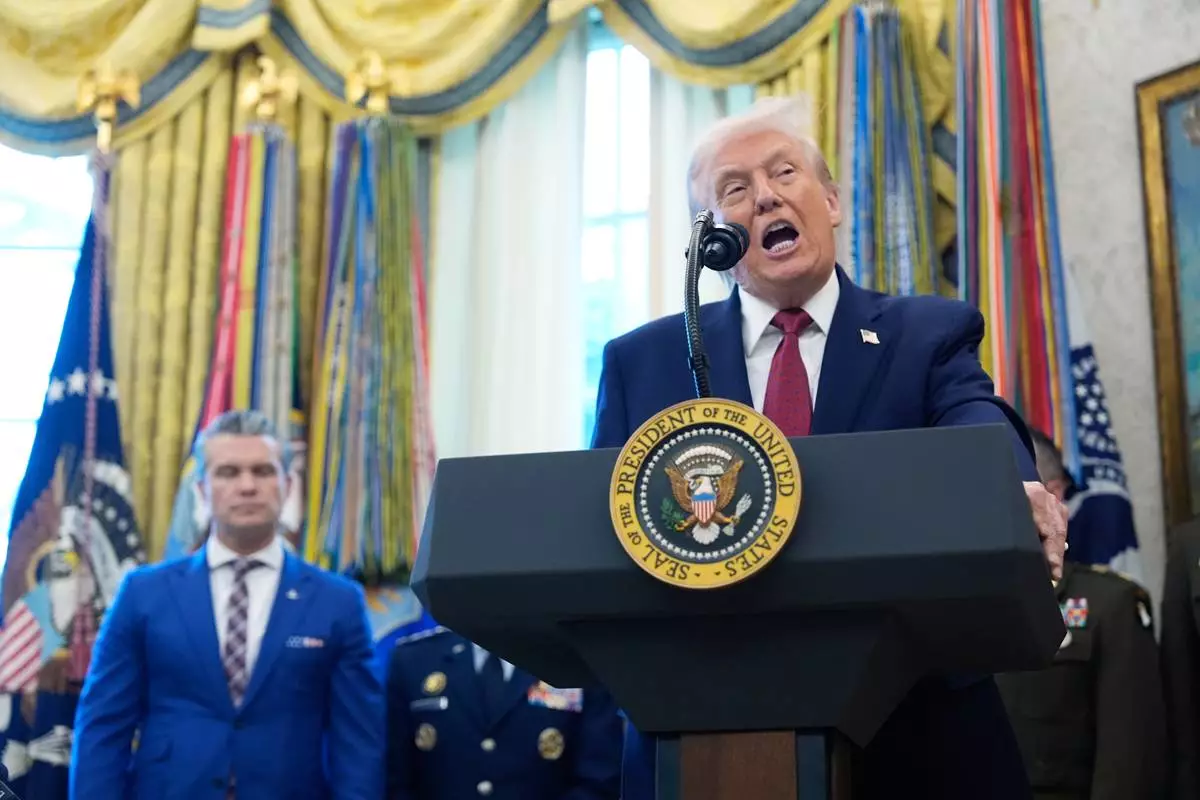
President Donald Trump speaks during a Mexican Border Defense Medal presentation in the Oval Office of the White House, Monday, Dec. 15, 2025, in Washington, as Defense Secretary Pete Hegseth, looks on. (AP Photo/Alex Brandon)