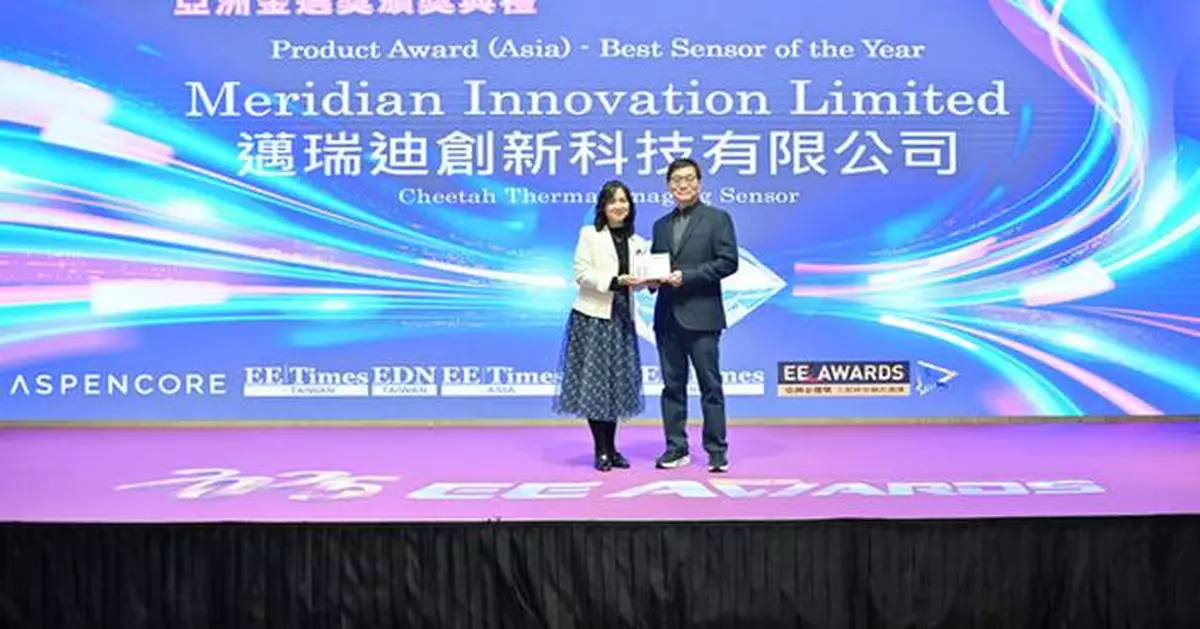
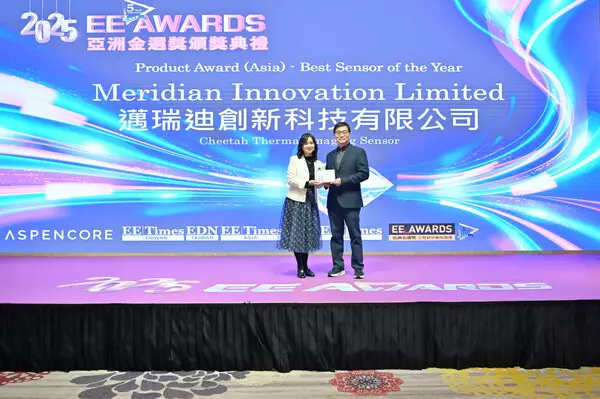
TAIPEI, Dec. 16, 2025 /PRNewswire/ -- Meridian Innovation's Cheetah thermal imaging sensor claimed this year's Best Sensor of the Year award at EE Awards Asia 2025. This follows last year's recognition of the Panther sensor and marks the fourth consecutive year for the company being honored at EE Awards Asia.
For Chief Operating Officer Hasan Gadjali, these awards underscore much more than industry prestige—they affirm a long-term commitment to reshaping thermal imaging for the consumer AI era.
"Basically, it validates our team's consistent innovation," Gadjali says in an interview with EE Times Asia. "Cheetah proves we're solving real needs with cost-effective thermal imaging for AI consumer applications. It strengthens our brand and keeps the team focused on affordable innovation."
This recognition also highlights the strategic progression of Meridian's three CMOS-based thermal imaging solutions—Cheetah, Panther, and Cougar—each developed to meet the performance, price, and scalability requirements of today's rapidly expanding smart home, IoT, and consumer electronics markets.
While last year's award-winning Panther sensor was designed with a 160-by-120 resolution and priced under $40 for health technology and industrial monitoring, Cheetah takes aim at the high-volume consumer IoT segment. Gadjali explains that Cheetah was engineered to strike an optimal balance of image quality, cost, and size—addressing long-standing perceptions that thermal imaging is inherently "expensive and bulky."
By contrast, Cougar, the company's 80-by-62 resolution sensor priced under $20, targets portable and handheld tools such as thermal meters and compact safety devices. Rounding out the lineup, Cheetah offers a 50-by-50 resolution at under $10, making it particularly well suited for wearables, smart-home devices, and dense IoT deployments, where small footprints and aggressive cost targets are essential.
One-size-fits-all
Traditional thermal imaging products have generally fallen into two extremes: high-end, high-cost industrial solutions, or low-cost modules with limited reliability and performance. Meridian aimed to bridge this divide by offering thermal imaging tailored to specific consumer AI applications rather than relying on the industry's historical one-size-fits-all approach.
According to Gadjali, the company's sensors were designed to fill two major gaps. The first is the need for affordable, high-performance thermal imaging to enhance smart homes, personal safety, and wearable devices. The second is the growing demand for accurate, non-contact health monitoring. By enabling tasks such as temperature and sleep tracking, monitoring for overheating appliances, and supporting energy-efficient heating and cooling, Cheetah brings thermal sensing into the fabric of everyday life without depending on visible-light cameras or intrusive surveillance methods.
What makes Cheetah unique
Cheetah's feature set reflects Meridian's focus on mass-market scalability and integration flexibility. The sensor incorporates a compact 50-by-50 CMOS thermal array manufactured using processes optimized for high-volume production. Its factory calibration eliminates the need for mechanical shutters, reducing both cost and mechanical complexity. The device's exceptionally low power consumption aligns with the needs of battery-operated wearables and small IoT nodes, while its availability in both flexible printed circuit (FPC) and TO-CAN module formats allows device manufacturers to choose the configuration best suited for their designs.
Meridian further ensured integration flexibility by supporting both SPI and I²C communication interfaces—a key advantage for developers working across varied microcontroller and AI accelerator ecosystems. This combination of micropackaging, high-volume CMOS manufacturing, and interface versatility allows Cheetah to deliver consistent performance while meeting aggressive cost and size targets.
And as artificial intelligence (AI) increasingly becomes embedded into homes, workplaces, and healthcare systems, the need for private, context-aware sensing modalities is growing—and thermal imaging is emerging as one of the most versatile solutions for this shift.
In smart homes, Cheetah enables a higher level of safety and convenience by identifying overheating appliances, supporting energy-saving HVAC adjustments, and enabling occupancy monitoring without the privacy concerns associated with visible-light cameras. In healthcare settings, its ability to support non-contact temperature checks and continuous, gentle sleep monitoring can reduce workload for caregivers while minimizing infection risks. In industrial and IoT contexts, thermal imaging provides early detection of overheating equipment, improves facility safety, and offers insights into energy usage patterns that can reduce operating costs.
According to Gadjali, these are the kinds of practical, everyday benefits that AI-driven thermal imaging brings to users—from families to facility managers.
The potential applications for Meridian's MI0502 sensor platform extend far beyond smart homes and IoT nodes. In automobiles, particularly electric vehicles, Cheetah-based solutions are being evaluated for cabin monitoring—detecting children or pets left behind and adjusting cabin temperatures to extend battery life.
Elderly care is another major market, where Cheetah's non-intrusive sensing enables activity tracking and can issue alerts when irregular behavior is detected, without compromising privacy. The company is also seeing interest from makers of industrial tools, power monitors, thermal meters, wearable outdoor gear, portable fire detectors, and even specialty equipment such as compact thermal sensors for hobbyist tools and small-scale drones.
Reaching these performance, size, and cost targets required Meridian's engineering team to rethink the fundamentals of thermal sensor architecture. Gadjali notes that the team's collective experience—more than 200 man-years of sensor engineering—was crucial in redefining the product's technical foundation.
The development process involved merging miniaturization with high performance, optimizing low-power logic, and ensuring reliability while maintaining design flexibility. A major advancement was the adoption of low-cost micropackaging that allowed Cheetah to fit into modules as compact as I2C TO-CAN devices. This manufacturing approach not only reduced cost but also enabled the volume scaling needed to meet global consumer demand.
What's next
Looking ahead, Gadjali anticipates that thermal imaging will evolve toward more specialized solutions designed for particular use cases, rather than relying on universal designs. He believes that accessible CMOS-based thermal sensors will accelerate mainstream adoption by removing historical price and production barriers.
Thermal imaging, he says, will increasingly become an integral part of consumer electronics as manufacturing techniques mature and resolutions beyond 160×120 become economical. "It won't be one size fits all," he emphasizes. "We can mass produce in high volumes without production bottlenecks, and thermal imaging will go into more and more consumer devices."
Reflecting on the company's achievements, Gadjali highlights Meridian's broader contributions to health, safety, energy efficiency, and everyday comfort.
"Meridian Innovation has always strived to make thermal imaging accessible to the public—not just professionals," Gadjali says. With its patented CMOS sensor platforms and streamlined production processes, the company has lowered cost thresholds and established three complementary product lines that support mass production of high-quality thermal imaging sensors. Today, Meridian's solutions appear in smart devices, IoT platforms, baby monitors, elderly care systems, industrial instruments, and automotive applications worldwide.
"We are proud to lead this market," he concludes, "and we are proud to make AI-driven thermal imaging part of daily life."
** The press release content is from PR Newswire. Bastille Post is not involved in its creation. **
Meridian Innovation Redefining Low-Cost Thermal Imaging for the AI Era