Skip to Content Facebook Feature Image

December Gravidtrap Indexes Show Low Aedes Albopictus Levels Across Hong Kong, Encouraging Continued Mosquito Control Efforts

HK

December Gravidtrap Indexes Show Low Aedes Albopictus Levels Across Hong Kong, Encouraging Continued Mosquito Control Efforts
HK

HK

December Gravidtrap Indexes Show Low Aedes Albopictus Levels Across Hong Kong, Encouraging Continued Mosquito Control Efforts

2025-12-16 18:00 Last Updated At:18:08

FEHD releases second batch of gravidtrap indexes for Aedes albopictus in December

The Food and Environmental Hygiene Department (FEHD) today (December 16) released the second batch of gravidtrap indexes and density indexes for Aedes albopictus in December, covering 32 survey areas, as follows:
More Images

Source: AI-found images

Source: AI-found images

District

Survey Area

December 2025

First Phase Gravidtrap Index

First Phase Density Index

Central and Western

Central and Admiralty

0.0%

N/A

Sheung Wan and Sai Ying Pun

0.0%

N/A

Southern

Pokfulam

0.0%

N/A

Islands

Cheung Chau North

0.0%

N/A

Tung Chung

0.0%

N/A

Yau Tsim

Tsim Sha Tsui East

0.0%

N/A

Sham Shui Po

Cheung Sha Wan

0.0%

N/A

Lai Chi Kok

0.0%

N/A

Sham Shui Po East

0.0%

N/A

Kowloon City

Kowloon City North

0.0%

N/A

Wong Tai Sin

Wong Tai Sin Central

0.0%

N/A

Wong Tai Sin West

0.0%

N/A

Diamond Hill

0.0%

N/A

Ngau Chi Wan

0.0%

N/A

Kwun Tong

Lam Tin and Sau Mau Ping

0.0%

N/A

Sai Kung

Tseung Kwan O East

0.0%

N/A

Tseung Kwan O North

2.3%

1.0

Sai Kung Town

1.9%

1.0

Ngau Liu and Muk Min Shan

0.0%

N/A

Tai Po

Tai Po West

0.0%

N/A

Yuen Long

Yuen Long Town

0.0%

N/A

Tuen Mun

Tuen Mun North

1.6%

1.0

Tuen Mun West

0.0%

N/A

So Kwun Wat

0.0%

N/A

Tsuen Wan

Sheung Kwai Chung

0.0%

N/A

Kwai Tsing

Kwai Chung

0.0%

N/A

Lai King

0.0%

N/A

District

Survey Area

December 2025

Area Gravidtrap Index

Area Density Index

Wan Chai

Happy Valley

0.9%

1.0

Mong Kok

Mong Kok

0.0%

N/A

Kowloon City

Ho Man Tin

0.0%

N/A

Sai Kung

Tseung Kwan O West

0.0%

N/A

North

Sheung Shui

1.6%

1.0

Among the second batch of First Phase Gravidtrap Indexes covering 27 survey areas and Area Gravidtrap Indexes covering five survey areas in December, all were below 10 per cent.

The FEHD has so far released two batches of gravidtrap indexes for Aedes albopictus in December 2025, covering 48 survey areas. Among these 48 survey areas, 46 recorded a decrease or remained unchanged in the individual gravidtrap index as compared to the Area Gravidtrap Index last month, i.e. November 2025, representing that the areas' mosquito infestation improved or maintained a low level. Two other areas recorded a slight increase, but the indexes were lower than 10 per cent.

The eggs of Aedes albopictus can withstand long periods of desiccation and will hatch when the temperature becomes suitable and water is present. Members of the public should continue to take mosquito control measures during winter to eliminate mosquito eggs.

Public participation is crucial to the effective control of mosquito problems. The FEHD appeals to members of the public to continue to work together in strengthening personal mosquito control measures, including:

  • tidy up their premises and check for any accumulation of water inside their premises;
  • remove all unnecessary water collections and eliminate the sources;
  • check household items (those placed in outdoor and open areas in particular), such as refuse containers, vases, air conditioner drip trays, and laundry racks to prevent stagnant water;
  • change the water in flower vases and clear the water in saucers of potted plants at least once every seven days;
  • properly cover all containers that hold water to prevent mosquitoes from accessing the water;
  • properly dispose of articles that can contain water, such as empty lunch boxes and cans; and
  • scrub drains and surface sewers with alkaline detergent at least once a week to remove any mosquito eggs.
  • Starting in August this year, following the completion of the surveillance of individual survey areas, and once the latest gravidtrap index and the density index are available, the FEHD has been disseminating relevant information through press releases, its website, and social media. It aims to allow members of the public to quickly grasp the mosquito infestation situation and strengthen mosquito control efforts, thereby reducing the risk of chikungunya fever (CF) transmission.

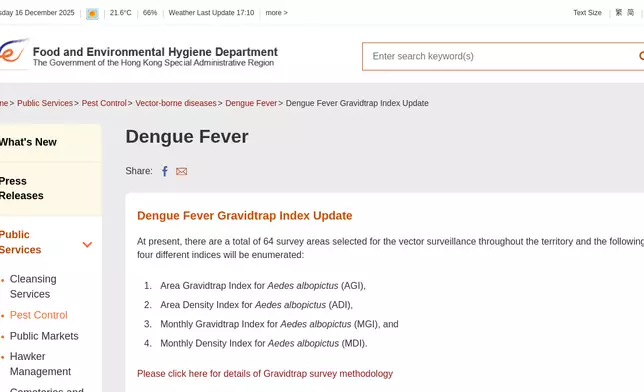
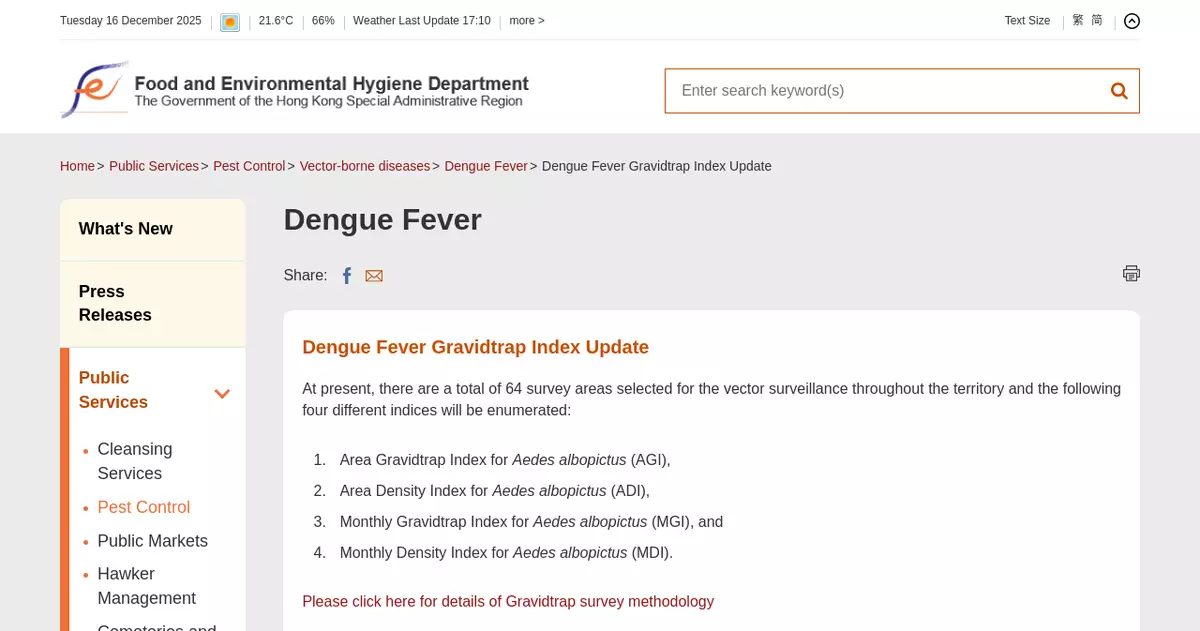
    Following the recommendations from the World Health Organization and taking into account the local situation in Hong Kong, the FEHD sets up gravidtraps in districts where mosquito-borne diseases have been recorded in the past, as well as in densely populated places such as housing estates, hospitals and schools to monitor the breeding and distribution of Aedes albopictus mosquitoes, which can transmit CF and dengue fever. At present, the FEHD has set up gravidtraps in 64 survey areas of the community. During the two weeks of surveillance, the FEHD will collect the gravidtraps once a week. After the first week of surveillance, the FEHD will immediately examine the glue boards inside the retrieved gravidtraps for the presence of adult Aedine mosquitoes to compile the Gravidtrap Index (First Phase) and Density Index (First Phase). At the end of the second week of surveillance, the FEHD will instantly check the glue boards for the presence of adult Aedine mosquitoes. Data from the two weeks of surveillance will be combined to obtain the Area Gravidtrap Index and the Area Density Index. The gravidtrap and density indexes for Aedes albopictus in different survey areas, as well as information on mosquito prevention and control measures, are available on the department's webpage (www.fehd.gov.hk/english/pestcontrol/dengue_fever/Dengue_Fever_Gravidtrap_Index_Update.html#).

    Source: AI-found images

    Source: AI-found images

    Fourth-term Human Resources Planning Commission convenes fourth meeting

    ​The fourth meeting of the fourth-term Human Resources Planning Commission was held today (December 16). At the meeting, the Culture, Sports and Tourism Bureau briefed members on the Government's manpower planning and strategies for the arts, culture and creative industries. It reported that the Government endeavours to nurture local talent through providing professional and continuous training to industry practitioners of different levels. Meanwhile, the Government attracts high-end Mainland and overseas talent and continues to add new impetus to the local arts and culture industries. Members were pleased to learn that the Government is actively developing world-class cultural facilities, and continuously enhancing the ecosystem of the arts, culture and creative industries, thereby providing practitioners with a supportive environment and ample opportunities for creative development. Members supported the Government's continuous efforts to promote the development of the arts, culture and creative industries to attract talent from home and abroad, further consolidating Hong Kong's status as an East-meets-West centre for international cultural exchange.

    Members were also briefed on the further enhancement measures of the Technology Talent Admission Scheme (TechTAS) by the Innovation and Technology Commission (ITC). To expedite the admission of innovation and technology (I&T) talent to undertake research and development work in Hong Kong, the ITC will further enhance TechTAS to (1) streamline application procedures to allow technology companies and eligible talent to submit applications for quotas and visas/entry permits in parallel, (2) lift the requirement of engaging in research and development in 14 designated technology areas to better address the ever-changing I&T development, and (3) launch a new dedicated application channel for the Hong Kong-Shenzhen Innovation and Technology Park to provide one-stop assistance to their tenants and incubatees in application and subsequent follow-up. The ITC and the Immigration Department expect to launch the enhancement measures within this month. Members welcomed the further enhancements to TechTAS, anticipating that these initiatives will contribute to attracting a greater number of I&T talent, with a view to enlarging the I&T talent pool of Hong Kong.

    Recommended Articles