Skip to Content Facebook Feature Image

Hainan FTP to leverage big data, smart technologies to enhance clearance efficiency

China

China

China

Hainan FTP to leverage big data, smart technologies to enhance clearance efficiency

2025-12-16 16:27 Last Updated At:23:57

The Hainan Free Trade Port (FTP) in south China's Hainan Province will leverage big data and smart technologies to accelerate customs clearance of goods following the launch of island-wide special customs operations, effective on Thursday.

Under the special customs operations, Hainan FTP will implement a special supervision model described as "freer access at the first line, regulated access at the second line, and free flows within the island."

The "first line" refers to Hainan's connection with overseas markets. "Freer access at the first line" allows overseas goods to enter the island more conveniently, with most benefiting from zero tariffs and expedited clearance.

The "second line" refers to the customs boundary between Hainan and the mainland, where goods will undergo standard customs oversight to ensure fairness and prevent smuggling.

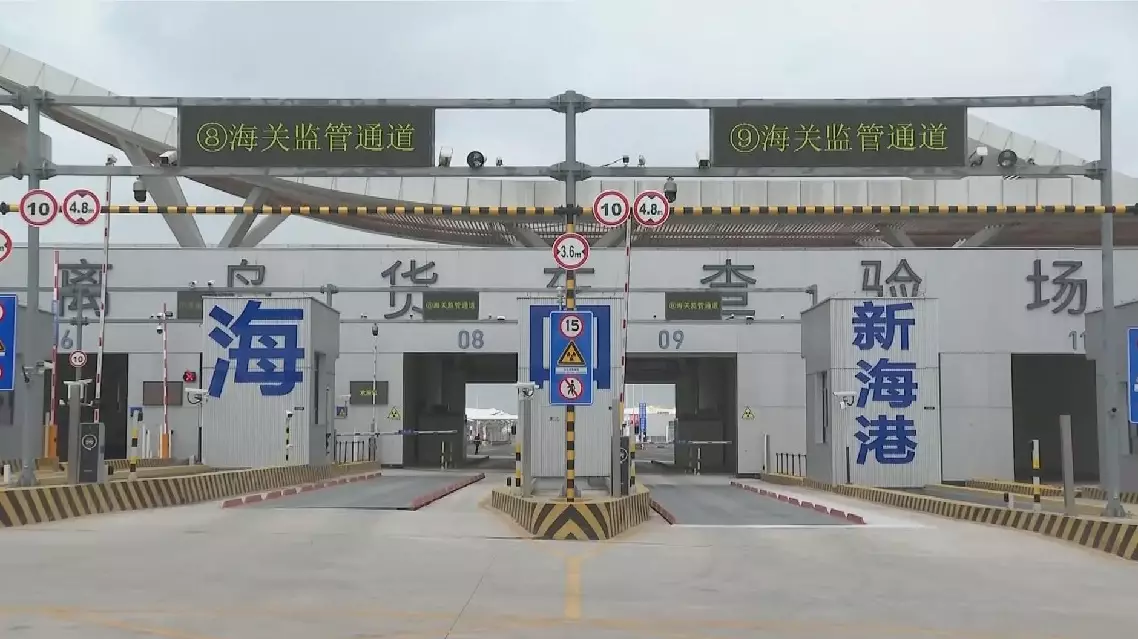
Among the 10 "second-line ports" in Hainan FTP, Xinhai and Nangang ports will be responsible for approximately 80 percent of cargo entering the mainland and are designed to handle an annual passage capacity of 1.72 million trucks.

"After the launch of island-wide special customs operations in Hainan, we have effectively integrated second-line customs supervision into the outbound cargo process, ensuring efficient clearance. When vehicles enter the second-line customs inspection lanes, those not flagged by risk-control instructions are directly released, with the entire passage taking no more than one minute. For flagged vehicles, we prioritize the use of intelligent scanning inspection systems like the H986 to enhance clearance efficiency. Those showing anomalies during machine inspection are directed to manual inspection areas for further handling," sai Liu Quanyan, an expert with the customs authorities of Haikou City, the provincial capital of Hainan.

To ensure both efficiency and security, Haikou Customs has developed a smart supervision platform powered by a database of 3 billion records and over 100 risk-prediction models.

"We focus on major, sensitive, and systemic risks. To this end, we have launched a smart customs supervision platform, built a big data pool containing over 3 billion data records, and developed more than 100 risk-alert models to enable precise risk control. In addition, we've implemented a credit-based clearance system at 'the second-line ports', applying tiered and categorized management to more than 90,000 foreign trade enterprises across Hainan. For highly accredited enterprises and those on the 'white list', inspection frequencies are reduced. Conversely, inspection rates are appropriately increased for high-risk enterprises requiring closer attention. Overall, the risk control and inspection rate at the 'second-line ports' remains at a relatively low level," said the expert.
Hainan FTP to leverage big data, smart technologies to enhance clearance efficiency
Hainan FTP to leverage big data, smart technologies to enhance clearance efficiency
Thai and Cambodian leaders must find a way to resolve their differences through talks and not on the battlefield, according to a former Thai foreign minister, who also believes China could be in a unique position to serve as a mediator given its strong ties with both sides.

Border clashes between the two sides have reignited since Dec 7 -- less than two months after the two sides signed a joint peace declaration -- with both trading the blame for instigating the attacks.

The latest round of fighting has left at least 19 Thai soldiers and 19 Thai civilians dead, with over 270,000 people displaced, Thailand's defense ministry announced on Wednesday.

Meanwhile, on the same day, the Cambodian Defense Ministry said that 17 civilians have been killed and 77 injured as the Thai military forces have continued airstrikes and artillery shelling into Cambodian territory, with over 438,000 individuals fleeing their homes.

With the two sides continuing to point the finger of blame and trade accusations of attacks on civilians, peace talks appear to be a long way off.

Kasit Piromya, who formerly served as Thailand's Minister of Foreign Affairs, urged the two countries' leaders to put people first, set aside their pride and find a resolution.

"The people must be the priority, not the victory or losses or the battlefield. It's detrimental and destructive to all. It is easy to arouse the passion, but [the sign of] great leaders, great statesmen is to be able to overcome the nationalistic sentiment and come back to the sense and sensibility and to start to talk with one another," he said.

China has called for utmost restraint and every possible measure conducive to a ceasefire to ensure de-escalation of tensions as soon as possible, a Chinese foreign ministry spokesman told a daily press briefing on Monday.

China supports direct dialogue and consultation between the two countries, as well as the efforts of ASEAN -- and Malaysia, in particular -- to promote peace talks, and the pursuit of a mutually acceptable solution within the ASEAN framework, according to the spokesman.

Piromya said he believes China could play a constructive role in a peace process between the two sides.

"China has been having, I think, more or less an excellent bilateral relationship respectively with Thailand and Cambodia. So China is in a very unique and great position to bring the two sides, Cambodia and Thailand, together," Piromya said.

Former official urges Thailand, Cambodia to make people priority, end border clashes

Former official urges Thailand, Cambodia to make people priority, end border clashes

Recommended Articles