KAKAMEGA, Kenya (AP) — It’s match day in western Kenya’s Kakamega County, locally known as the home of bullfighting, where two bulls are brought to face off in a dusty arena as thousands cheer.
The derby is a rematch between a relative newcomer bull Shakahola, named after the forest where more than 400 people linked to a cult died in 2023, and another named Promise that has been a longtime favorite, only losing a few matches in over 10 years.
The bullfighting tradition is deeply rooted among the Luhya community in Kenya’s Kakamega County. It started as entertainment and celebrations after harvest season and has now evolved into a sport that attracts thousands of young people, some whom even place bets on social media platforms. During the matches, two bulls face off in under five minutes and after one escapes, the other is declared the winner. The bulls are not deliberately injured.
Sociologist Kathleen Anangwe, a lecturer at the University of Nairobi, attributed the growing interest in bullfighting to the need for socialization and the high rate of unemployment, which is about 9% according to official statistics. At least one workers' rights group estimates unemployment is much higher for youth.
The sport is contributing to the economy, promoting unity and social solidarity, according to Anangwe. Through bullfighting, young people create an avenue to bond and use the matches to sell items such as snacks and bull chasing sticks.
“The youth are interested in identity, ‘who am I?’ and authenticity. Bullfighting gives them that opportunity,” Anangwe said.
Hours before the match, Shakahola the bull is given his daily dose of napier grass, water and a concoction of traditional herbs believed to make him stronger than his peers, according to the young man who has fed him for three years. He gets pampered inside a hidden shelter behind his owner's house, away from prying eyes before being transported by truck to the fighting arena.
His owner Josphat Milimo talks to the bull as part of a traditional ritual, encouraging him to take on his opponent in under five minutes. Elders declare a Shakahola win while pounding the ground with their sticks covered in traditional herbs.
Today’s match is a rematch after Shakahola lost to Promise about two years ago. His owner believes this is his chance to get payback and win the match.
As the bull leaves the shelter to be loaded onto a waiting truck under the warm morning sun, hundreds of people aboard motorcycles escort it as they ululate and wave their chasing sticks that keep the bulls away — part of the spectacle that begins outside the arena even before the match kicks off.
At the fighting arena, some 10 kilometers (6 miles) away, thousands wait anxiously as Shakahola and Promise arrive with pomp, escorted by fans carrying flags bearing their photos. Vendors circulate the stands, selling sticks and refreshments. The bulls are cheered on by their respective stick-waving fans.
Shortly after, the circles open and the bulls face each other head-on. They lock horns and tear up the ground. Dust swirls around them, clouding the view for those closer to the action.
Brenda Milimo, 20, the niece of Shakahola's owner, watches while cheering. She has become an TikTok sensation as a fan of bullfighting, and often travels from Nairobi to Kakamega via bus in a 4.5 hours journey just to attend major matches like this one.
“Bullfighting is in my blood,” she says.
In the past, she has placed bets of up to 1,500 Kenyan shillings ($11) despite being unemployed.
“We do casual betting via social media and through word-of-mouth, but I’m sure soon there will be a website for bullfighting betting because it’s becoming very popular among the youth,” she says.
For other spectators like David Gitau, who came from central Kenya, experiencing the bullfighting tradition is new.
“I’ve enjoyed myself and I’d like to encourage my kinsmen to come and experience this amazing tradition,” he says.
In about three minutes, the match is over as Promise runs out of the arena bearing blood marks on his hide.
It’s a win for Shakahola, and the crowd erupts into song and dance to the traditional drums while carrying his owner on their shoulders.
“I am very happy," Josphat Milimo says. “Last time, I was cheated of victory and this time round I was ready.”

Spectators attend a bullfighting match, in Kakamega, Kenya, Saturday, Nov. 29, 2025. (AP Photo/Brian Inganga)
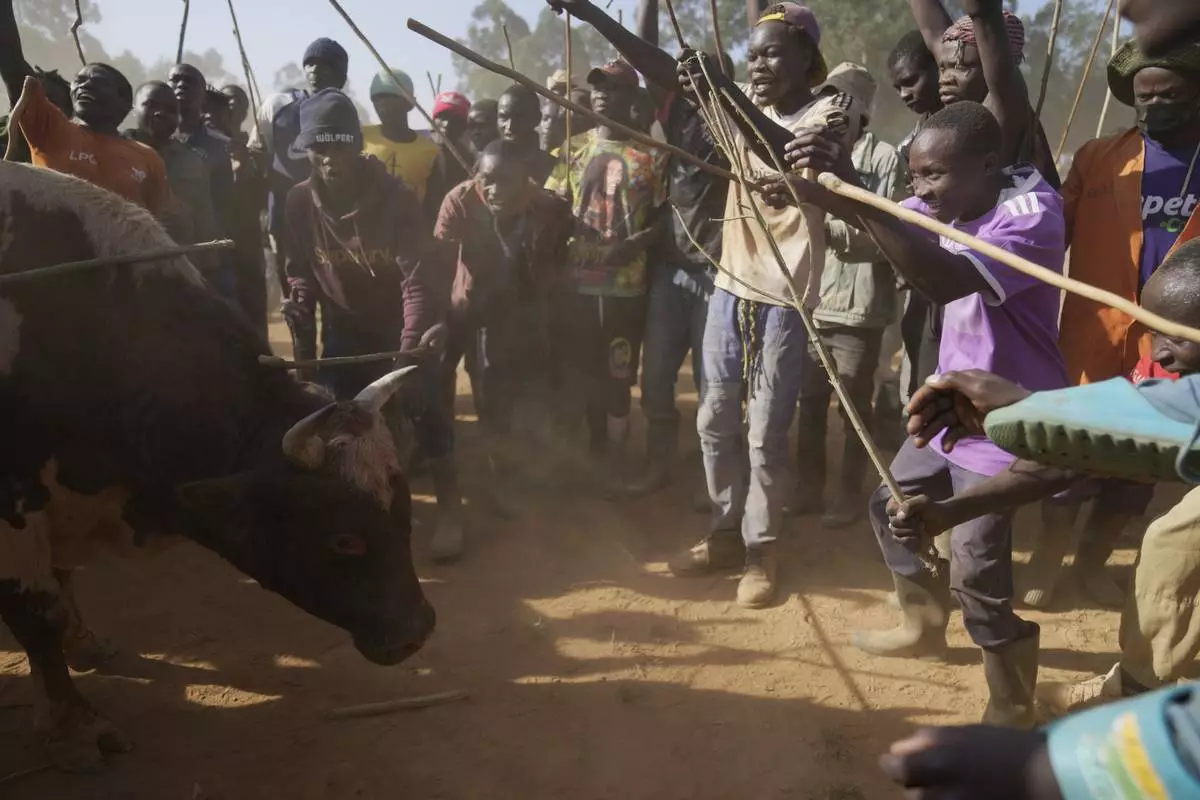
A crowd of spectators encircles a fighting bull during a bullfight in Kakamega, Kenya, Saturday, Nov. 29, 2025. (AP Photo/Brian Inganga)
NEW YORK (AP) — Christine Baranski was in the playground outside St. Matthew’s Church in Bedford, New York, about three years ago when she came across Matthew Guard, artistic director of the Grammy-nominated Skylark Vocal Ensemble.
“I love choral music,” she told him.
An Emmy- and Tony-Award winning actor, Baranski went on to attend some of his concerts.
“I was a fangirl basically,” she recalled. “And I think we just said, `Wouldn’t it be fun to do something together?’”
Baranski agreed to narrate a music-and-spoken word version of Charles Dickens’ “A Christmas Carol” last December at The Morgan Library & Museum in New York, which owns the original manuscript of the 1843 classic. A recording was made last June at the Church of the Redeemer in Chestnut Hill, Massachusetts, and released Dec. 4 on the LSO Live label.
She will perform it again with the group on Thursday night at the Morgan, which is displaying the manuscript through Jan. 11, and again the following night at The Breakers in Newport, Rhode Island, where she will again portray the acerbic Agnes van Rhijn when Season 4 of HBO’s “The Gilded Age” starts filming season four on Feb. 23.
“I have this thing about keeping language alive, keeping beautiful, well-written language,” she said. “Dickens, Stoppard, Shakespeare. We’re getting awfully lazy in our use of the English language.”
She compliments Julian Fellowes, creator of “The Gilded Age” and “Downton Abbey,” for distinguished prose.
“I think he’d play Agnes if he could,” she said. “He gives her the witty stuff.”
Baranski leaned on the skills that earned her an Emmy for “Cybill” and Tonys for “The Real Thing” and “Rumors.”
“You get to bring to life a lot of different characters, none the least of which is Ebenezer,” she said at the library this month. “It’s wonderful for an actor to differentiate in as subtle a way as possible these different characters. As an acting piece, it’s wonderful. And not many women have done it. It’s been done by Alistair Cooke and Patrick Stewart and Patrick Page and all these great actors — but I get to do it with a chorus.”
Guard weaves in underscoring by composer Benedict Sheehan with Baranski’s words and 10 carols that include “Silent Night” and “Deck the Halls” plus “Auld Lang Syne.”
Reciting the entire story would have created a Wagnerian-length evening.
“This manuscript itself is about 30,000 words and we needed about 5,000 to make it a concert length,” Guard said. “I tried to create space in the narrative for obvious musical exclamation points or emotional feelings, almost like arias in an opera.”
Sheehan had worked together with Guard on a 2020 recording “Once Upon a Time” that weaved together the Brothers Grimm’s “Snow White and the Seven Dwarves” and Hans Christian Andersen’s “The Little Mermaid.”
“I said why don’t you commission me to write choral underscoring for the narrative that can kind of stitch together these different choral pieces?” Sheehan said.
Baranski got narration experience in 2023 when she replaced Liev Schreiber with the Orpheus Chamber Orchestra at Carnegie Hall for Beethoven’s “Egmont.”
“I could do this the rest of my career,” she thought at the time. “Just put me in a concert hall surrounded by great musicians.”
After working with dialect coach Howard Samuelsohn, Baranski practiced on Zoom to hone a 19th-century voice and avoid cliché.
“I said this is a good warm up for Aunt Agnes because it’s that kind of speech we were taught at Juilliard,” the 73-year-old Baranski said, recalling lessons from Edith Skinner decades ago.
“Sometimes it’s just a question of modulating your voice, just different rhythms and staccato or legato,” she said. “I want the voice of the Ghost of Christmas past to be disembodied… ethereal.”
She didn’t have an urge to join in on the carols.
“We take from each other,” she said. “When the chorus first heard my version of it, I think it subtly influenced the feeling of it and I take from the mood of the carol and bring it into my interpretation.”
“It’s a really exciting back-and-forth actually,” Guard said. “It’s not really totally clear who’s driving the bus at times.”
Baranski hopes the project has a future.
“We want to film this someday in the Morgan,” she said. “Make this a yearly event at the Morgan, because here’s the manuscript and people. It’s just one of those things like Handel’s `Messiah’ or `The Nutcracker.’”
She’s going to gift the CD to her grandchildren, four boys ranging from ages 2 to 12. Among her previous holiday experiences was portraying Martha May Whovier in the 2000 movie “Dr. Seuss’ How the Grinch Stole Christmas.”
“They’re curiously not interested in my even being Martha May in `The Grinch,’” Baranski explained. “Their friends sometimes say: `That’s your grandmother.’ But I just want to be their grandma — do you know what I mean — and not somebody?”
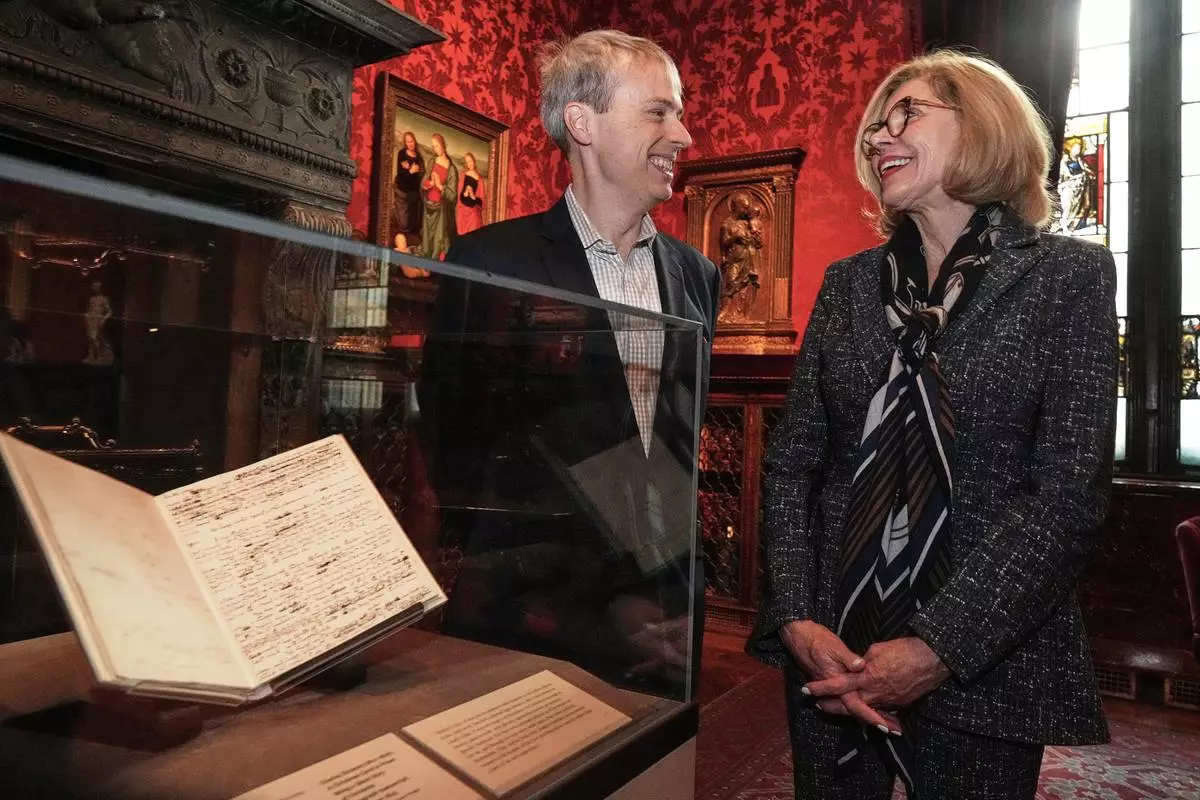
Skylark Artistic Director Matthew Guard and Christine Baranski are interviewed beside "A Christmas Carol In Prose; Being a Ghost Story of Christmas" by Charles Dickens, Dec. 1843," at The Morgan Library & Museum, in New York, Monday, Dec. 1, 2025. (AP Photo/Richard Drew)
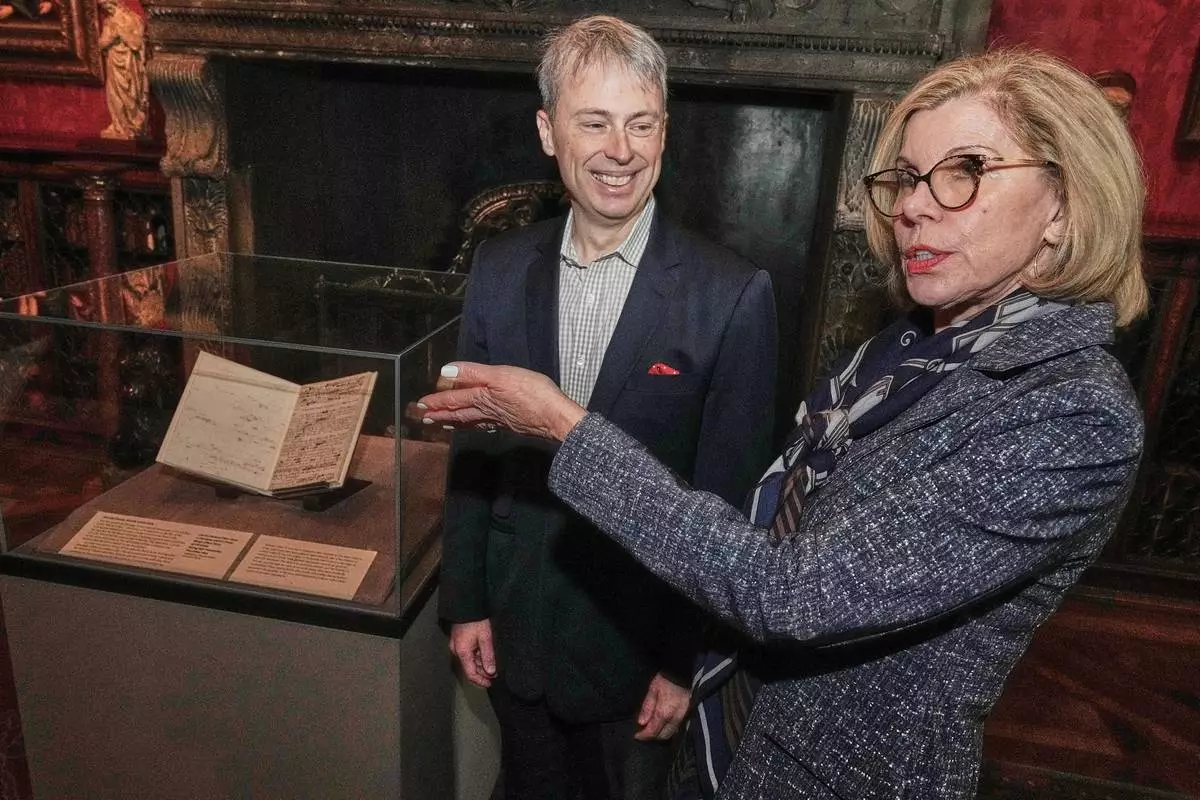
Skylark Artistic Director Matthew Guard and Christine Baranski are interviewed beside "A Christmas Carol In Prose; Being a Ghost Story of Christmas" by Charles Dickens, Dec. 1843," at The Morgan Library & Museum, in New York, Monday, Dec. 1, 2025. (AP Photo/Richard Drew)
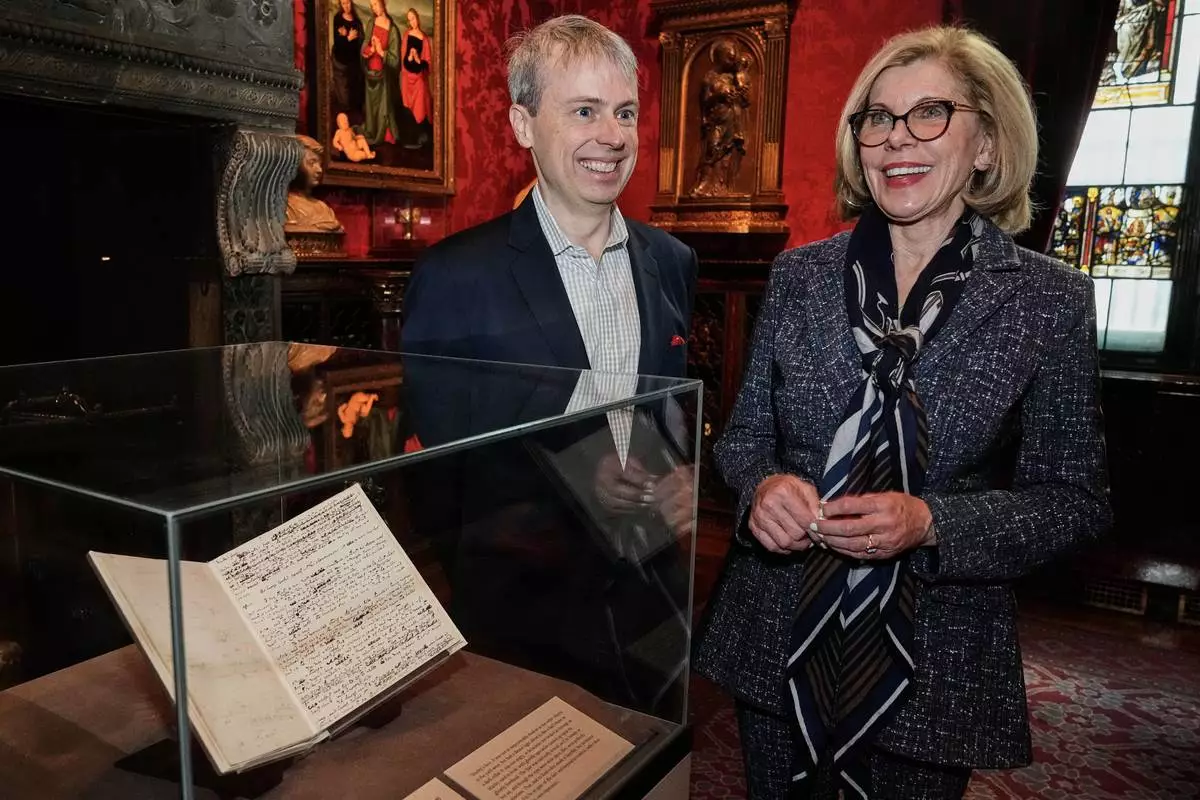
Skylark Artistic Director Matthew Guard and Christine Baranski are interviewed beside "A Christmas Carol In Prose; Being a Ghost Story of Christmas" by Charles Dickens, Dec. 1843," at The Morgan Library & Museum, in New York, Monday, Dec. 1, 2025. (AP Photo/Richard Drew)