Residential Care Services Scheme in Guangdong launches pilot medical subsidy arrangement
The Social Welfare Department (SWD) announced today (December 17) that China Taiping Life Insurance (Hong Kong) Company Limited (Taiping Life (Hong Kong)) has been commissioned to assist the Hong Kong Special Administrative Region (HKSAR) Government in implementing the Residential Care Services Scheme in Guangdong - Pilot Medical Subsidy Arrangement for two years starting from December 22 this year.
Since the commencement date of the pilot arrangement, elderly participants of the Residential Care Services Scheme in Guangdong (the Scheme) can apply for the subsidy concerning their self-paid medical expenses incurred at any designated medical institutions (including clinics, hospitals, and pharmacy stores) within the Guangdong-Hong Kong-Macao Greater Bay Area (GBA) under the coverage of the National Basic Medical Insurance Policy. The annual ceiling is RMB10,000 per person for outpatient expenses and RMB30,000 per person for inpatient expenses.
The Secretary for Labour and Welfare, Mr Chris Sun, attended the launching ceremony of the Pilot Medical Subsidy Arrangement. He said that the HKSAR Government introduces the medical subsidy through policy innovation, providing additional healthcare support for the elderly participants of the Scheme. He was delighted that Taiping Life (Hong Kong) had been selected as the service provider through an open bidding process, and said he looked forward to Taiping Life (Hong Kong)'s promotion of cross-boundary elderly care through professional services.
Under the Pilot Medical Subsidy Arrangement, Taiping Life (Hong Kong) will assist the HKSAR Government in processing applications for reimbursement of medical expenses by elderly persons, including vetting and settling claims of relevant medical expenses and conducting investigation of medical services, etc.
In recent years, the HKSAR Government has been proactively expanding and enhancing the Scheme. To date, 24 residential care homes for the elderly have joined the Scheme, covering eight GBA Mainland cities with over 800 Hong Kong elderly residents. Details of the Pilot Medical Subsidy Arrangement are available on SWD's website: www.swd.gov.hk/storage/asset/section/726/en/The%20Pilot%20Medical%20Subsidy%20Arrangement_EN.pdf.
The Social Welfare Department (SWD), Photo source: reference image of the government
CS concludes visit to Beijing
The Chief Secretary for Administration, Mr Chan Kwok-ki, today (April 2) led the delegation of the Working Group on Planning and Construction of the University Town (WG) under the Committee on Development of the Northern Metropolis to continue their visit to Beijing.
The Director of the Hong Kong and Macao Work Office of the Communist Party of China Central Committee and the Hong Kong and Macao Affairs Office of the State Council, Mr Xia Baolong, met with Mr Chan and other members of the delegation in the morning. Mr Chan thanked Mr Xia for his care and guidance for the Hong Kong Special Administrative Region (HKSAR) Government's work on planning and constructing the Northern Metropolis University Town (NMUT). He also reported that, in the past three days, the delegation of the WG had visited several places, including the Ningbo Higher Education Park, the Xiasha Higher Education Park in Hangzhou, the Zhejiang University International Campus (Haining), the Beijing Municipal Administrative Center, and Xiong'an New Area in Hebei. Through on-site visits to higher education developments in different places, and exchanges with experts and scholars on their successful experiences and development strategies, the delegation gained practical inspiration for the top-level design of the NMUT. This will help advance the deep integration of Hong Kong's academic excellence with industry, promoting industrial development through education. Mr Chan said that the WG will continue to push forward the development of the NMUT with enhanced quality, speed, and efficiency, in proactive alignment with the outline of the National 15th Five-Year Plan, as well as contribute Hong Kong's strengths to the national goal of building China into a leading country in education, and helping Hong Kong better integrate into and serve the overall national development.
The meeting was attended by the Executive Deputy Director of the Hong Kong and Macao Work Office of the Central Committee of the Communist Party of China and the Hong Kong and Macao Affairs Office of the State Council, Mr Xu Qifang. The Secretary for Education of the HKSAR Government, Dr Choi Yuk-lin, also reported on her work. The Director of the Northern Metropolis Co-ordination Office, Miss Linda So, and representatives from the eight University Grants Committee-funded universities attended the meeting together.
Mr Chan and other members of the delegation concluded their visit to Beijing and returned to Hong Kong this afternoon. Dr Choi continued her visit to Beijing this afternoon, and will return to Hong Kong tomorrow (April 3).

CS concludes visit to Beijing Source: HKSAR Government Press Releases
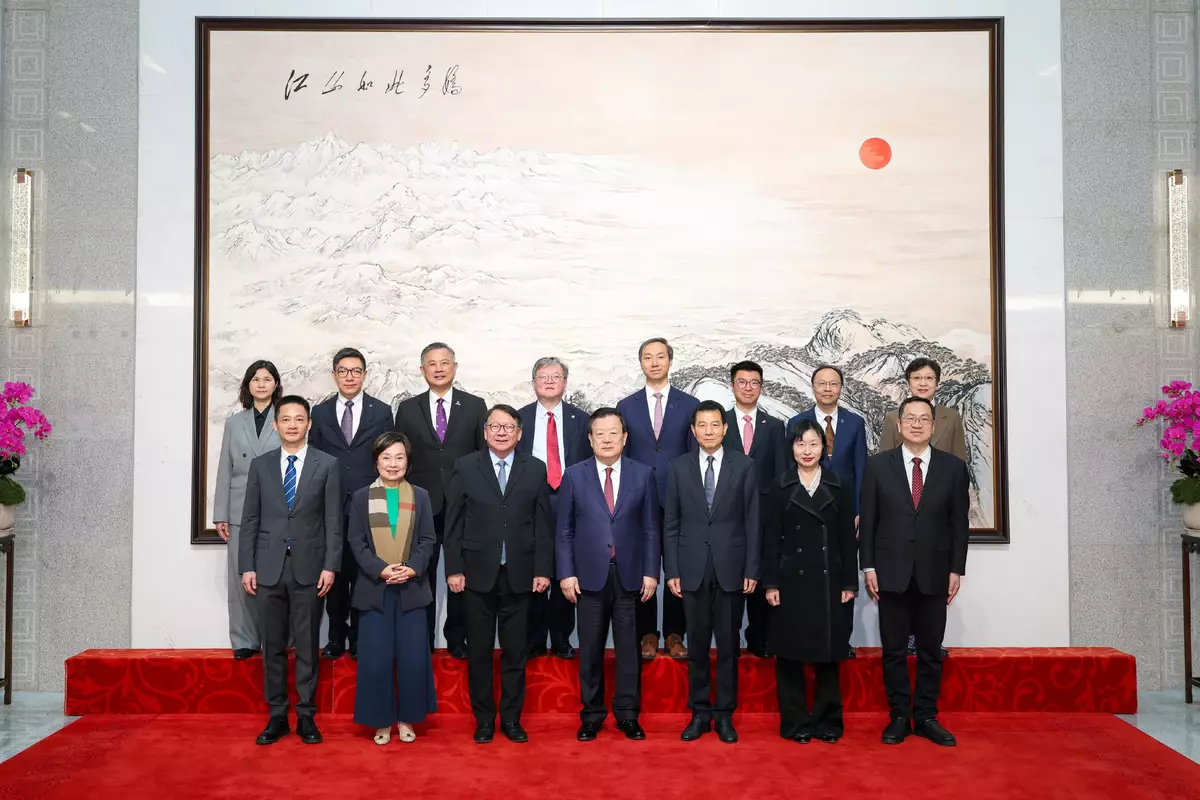
CS concludes visit to Beijing Source: HKSAR Government Press Releases