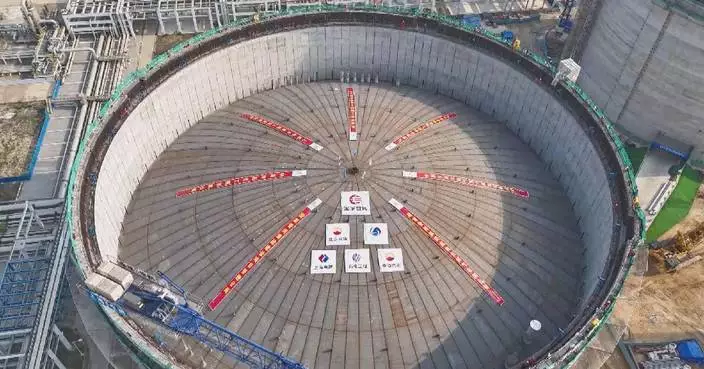
The world's largest ice-and-snow theme park, the 27th edition of the Harbin Ice-Snow World, opens on Wednesday in China's Ice City, the provincial capital of Heilongjiang in the northeast.
The park covers 1.2 million square meters and uses nearly 400,000 cubic meters of ice and snow under this year's theme "Ice and Snow, Fairy Tale World."
It features three main landscape axes, a large-themed parade, an outdoor stage and a newly built 5,000-square-meter air-supported facility. The venue incorporates technological elements like smart lighting and AI interaction.
The 43-meter-high main tower is known as the Inspiring Dreams with Ice Lanterns. With a total consumption of 39,000 cubic meters of ice, the tower is not only the highest and largest single ice-built landscape in the park, but also interprets the important concept of "ice and snow are as valuable as gold and silver" with unique design.
China Media Group (CMG) has built an Ice and Snow Studio in the park's central area. The studio's exterior adopts natural ice harvested from the Songhua River, and it will be used to broadcast the beauty of the ice and snow scenery to the world.
Harbin, often called China's Ice City, has turned its long, cold winters into a major tourist attraction. Last winter, the city received a record 90.36 million visitors, generating 137.22 billion yuan (about 19.37 billion U.S. dollars) in revenue -- a 16.6-percent increase year on year.
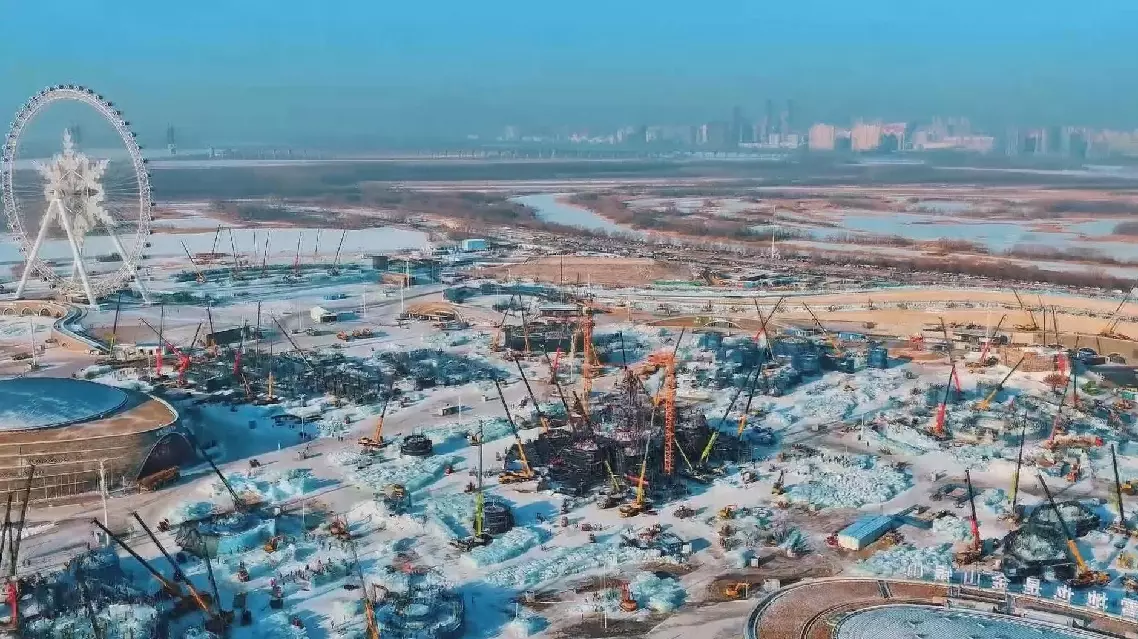
World's largest ice-snow theme park opens in Harbin
China's service industry maintained steady growth in the first 11 months of the year, with the services production index up 5.6 percent year on year, official data showed.
As investors pile into high-tech services and the potential of service consumption continues to be unleashed, the tertiary sector is playing an increasing role in supporting the national economic growth, according to the authorities.
The business activity indices for rail transport, monetary financial services and other industries were all above 55 percent in the expansion range in November.
Investment in high-tech services industries rose by 4.1 percent in the first 11 months, which is 0.6 percentage points higher than the growth rate of the same period last year.
Particularly, investment in information services industries surged by 29.6 percent in the period.
From January to November, the retail sales of services grew faster than the retail sales of goods, seeing a year-on-year increase of 5.4 percent and a growth rate recovery for three consecutive months.
The retail sales of cultural, sports and recreational services, and communication and information services both recorded double-digit year-on-year growths in the period.
"The structural upgrading of industries, especially the continuous growth of new industrial drivers, has effectively driven the expansion of modern producer services. In the meantime, the sustained release of service consumption demand has also driven the overall upgrading of modern consumer services. Currently, the added value of China's service sector accounts for about 60 percent of GDP and contributes also about 60 percent to national economic growth, providing strong support for the stable operation of the entire national economy," said Zou Yunhan, deputy director of the Macroeconomic Research Office of the State Information Center under the National Development and Reform Commission.
China’s service industry maintains steady growth in Jan-Nov