The latest archaeological findings over the past two years have extended the duration of the Hongshan culture, a Neolithic civilization that emerged 6,500 years ago in north China, by at least 200 years.
The findings also reveal the integration of its ritual system into the Chinese civilization.
The new discoveries are among the major archaeological achievements from 2023 to 2025 listed by the Chinese Academy of Social Sciences, the National Cultural Heritage Administration and other institutions at the 6th Shanghai Archaeology Forum on Tuesday.
They offer new insights into the migration and cultural spread of the Hongshan culture, which didn't vanish as previously believed 5,000 years ago, but instead expanded westward and southward to become one of the earliest origins of the Chinese civilization.
In the past two years, archaeologists have found seven additional burnt pits at the Niuheliang site in northeast China's Liaoning Province.
First discovered in 1981, the Niuheliang site consists of a goddess temple, altars, and stone mounds, forming a sacrificial site group found only in capitals. The pits, arranged in a pattern resembling the Big Dipper constellation, have prompted preliminary theories linking them to celestial worship or seasonal rituals.
"We are not sure for now that is the Big Dipper, but the shape does look alike. I think it can be considered as a kind of symbol of a cosmological view," said Jia Xiaobing, a research fellow at the Institute of Archaeology of the Chinese Academy of Social Sciences.
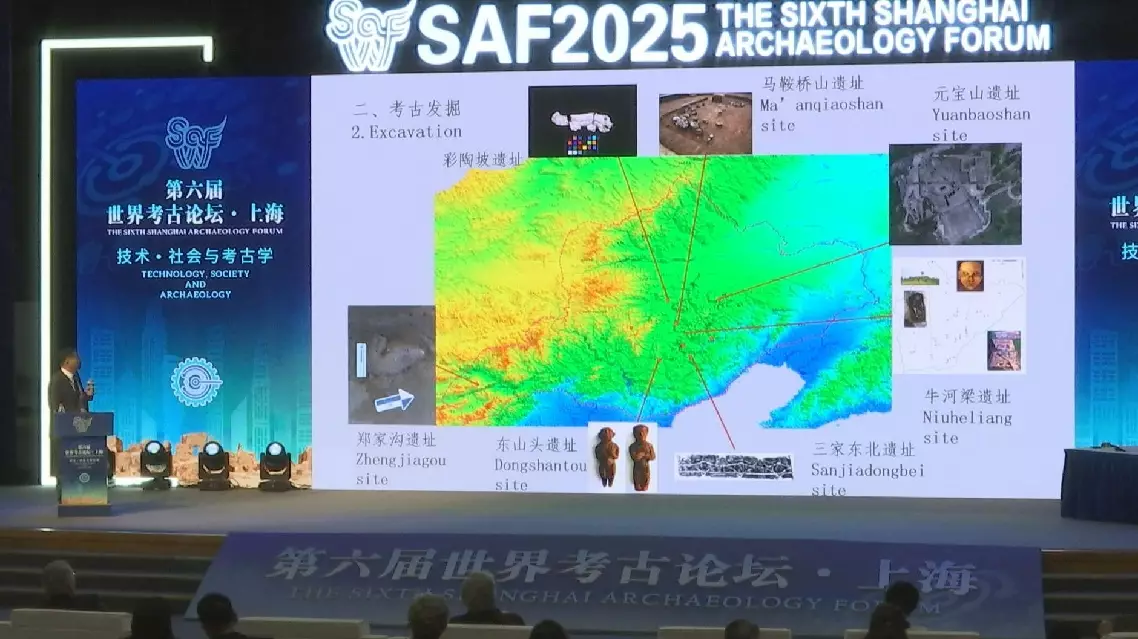
Over the past two years, archeologists have identified new Hongshan culture remains at the Dongshantou site in Hebei Province, the Sanjia Dongbei Ruins in Liaoning, and the Yuanbaoshan site in Inner Mongolia Autonomous Region.
Specifically, pottery figurines have been unearthed from tombs for the first time at the Dongshantou site, offering new clues for understanding the function of such objects.
"They should be pottery figurines of a male and a female, both in clear clothes. They wear boots, and even with boot straps still there. Such figurines must be related to their beliefs and ritual activities," Jia said.
Previously, the prevailing academic views held that the Hongshan culture was distributed in the basins of Xar Moron River, Laoha River, and Daling and Xiaoling rivers north of the Yanshan Mountains, and dated from 6,500 to 5,000 years back. It could be divided into three stages, with the prehistoric society entering its prime in the West Liaohe River basin at the third stage, when a jade-based ritual system was established to constitute an important origin of the Chinese civilization.
However, the relics unearthed from the Zhengjiagou site in Zhangjiakou, Hebei Province over the past two years are with typical features of Hongshan culture, and they have been placed between 5,300 and 4,800 years ago by radiocarbon dating.
"Previously it was believed that the Hongshan culture declined 5,000 years ago. Now, we see it lasted for at least 200 more years until 4,800 years ago. And instead of declining, it moved westward and southward, bringing its sacrificial and ritual system into the origins of the Chinese civilization," Jia said.
New findings extend duration of China's Hongshan culture