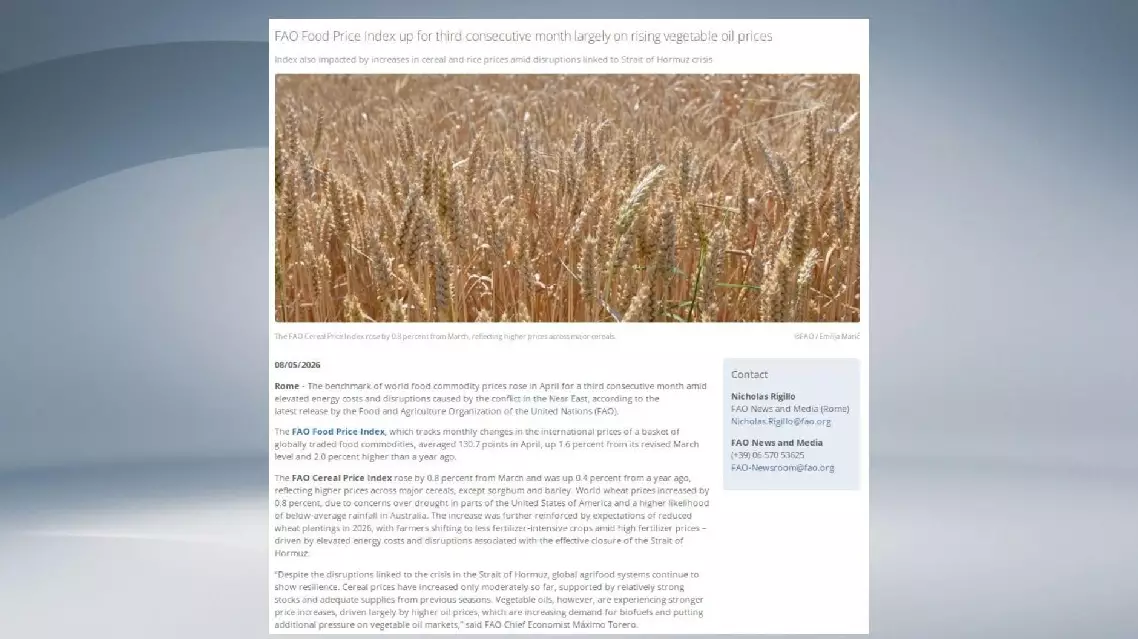
The benchmark of world food commodity prices rose in April for a third consecutive month as the ongoing conflict in the Middle East pushes up energy costs, the Food and Agriculture Organization of the United Nations (FAO) said on Friday.
The conflict escalated in late February, when Israel and the United States carried out joint strikes on Tehran and other Iranian cities, prompting Iran to retaliate with waves of missile and drone attacks on Israel and U.S. interests across the region. Iran also tightened its grip on the Strait of Hormuz, a vital waterway for global trade and energy supplies, while the U.S. imposed a prolonged naval blockade as a lower-risk strategy to pressure Iran.
The FAO Food Price Index, which tracks monthly changes in the international prices of a basket of globally traded food commodities, averaged 130.7 points in April, up 1.6 percent from its revised March level and 2.0 percent year on year.
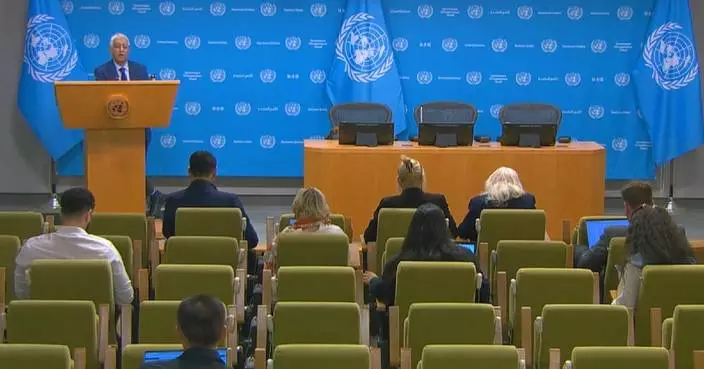
"For the third consecutive month, the FAO Food Price Index has increased. The increase this month of April is 1.6 percent with respect to March, and 2 percent more with respect to the same month a year ago. Now what this means. It means that prices of the inputs costs are starting to be transmitted to the commodity prices, but at a very low pace. The major increase is happening on vegetable oils, which is linked to biofuels, which is a 5.9 percent increase with respect to the previous month and a very slight increase in the wheat price and also in the corn price, corn has increased 0.7 percent," said Maximo Torero, chief economist of FAO.
However, despite the disruptions linked to the crisis in the Strait of Hormuz, global agrifood systems continue to show resilience, Torero said.
Cereal prices have increased only moderately so far, supported by relatively strong stocks and adequate supplies from previous seasons. Vegetable oils, however, are experiencing stronger price increases, driven largely by higher oil prices, which are increasing demand for biofuels and putting additional pressure on vegetable oil markets, he said.
World food prices rise for third consecutive month