Skip to Content Facebook Feature Image

House rejects resolutions to limit Trump's campaign against Venezuela and drug cartels

News

House rejects resolutions to limit Trump's campaign against Venezuela and drug cartels
News

News

House rejects resolutions to limit Trump's campaign against Venezuela and drug cartels

2025-12-18 09:37 Last Updated At:09:40

WASHINGTON (AP) — House Republicans rejected a pair of Democratic-backed resolutions Wednesday that would have put a check on President Donald Trump’s power to use military force against drug cartels and the nation of Venezuela.

Democrats forced the votes using war powers resolutions as Trump has stepped up his threats against the South American nation and Congress has questioned how the U.S. military is conducting a campaign that has destroyed 26 vessels allegedly carrying drugs and killed at least 99 people, including an attack Wednesday. The legislation would have forced the Trump administration to seek authorization from Congress before continuing attacks against cartels that it deems to be terrorist organizations in the Western Hemisphere or launching an attack on Venezuela itself.

Rep. Gregory Meeks, the top Democrat on the House Foreign Affairs Committee, argued that Trump's aggressions in the region were really because “the president is coveting Venezuelan oil.”

They were the first votes in the House on Trump's military campaign in Central and South America. A majority of Republicans in the Senate had previously voted against similar resolutions, and Trump would almost certainly veto them if they were to pass Congress. But Democrats forced the votes as a way to bring up a debate about the military campaign and force Republicans to go on the record about supporting it.

Republican leaders have increasingly expressed support for Trump's campaign, even as it potentially escalates into a direct confrontation with Venezuelan President Nicolás Maduro.

Senate Majority Leader John Thune said earlier Wednesday that he didn't know whether the Trump administration had “publicly stated” that they wanted regime change, but “I would certainly not have a problem if that was their position.”

“Maduro is a cancer on that continent,” added Thune, R-S.D.

Still, the Trump administration has not sought congressional authorization for its recent actions in the Caribbean, arguing instead that it can destroy drug-carrying boats just as it would handle terrorist threats against the U.S. That rationale, however, has led to deep scrutiny of the strikes, especially after it was revealed that a Sept. 2 operation killed two people who had survived an initial attack.

Secretary of State Marco Rubio, Defense Secretary Pete Hegseth and other top national security officials briefed members of Congress on Tuesday. They defended the campaign as a successful counter-narcotic effort that has cut into the drug supply entering the U.S., but did not clue in Congress about its ultimate goals when it comes to Venezuela.

The Navy admiral who ordered the strike on Sept. 2 that killed two survivors was also back on Capitol Hill Wednesday for classified briefings with the House and Senate Armed Services Committees.

After viewing the video of the strike in question, lawmakers emerged with contrasting responses. Republicans mostly backed the decision-making that led up to the strike, saying it was based on exact intelligence and careful decision-making. Democrats said the sight of a missile strike on two people clinging to the wreckage of a boat was shocking and should be made public.

“I think there are serious questions about criminal culpability here, and there is certainly a need for more intensive federal investigation,” said Sen. Richard Blumenthal, a Connecticut Democrat.

Rep. Seth Moulton, a Massachusetts Democrat and former Marine who served in Iraq, said Wednesday’s briefing confirmed his concerns and led him to determine that the two survivors who were killed were “helpless” and that there was “significant evidence that they were not continuing their mission.”

GOP lawmakers, however, appeared ready to move on from investigations that had been opened under the Republican-controlled committees. Rep. Mike Rogers, the GOP chair of the House Armed Services Committee, said his panel’s investigation into the Sept. 2 boat strike is over.

He also said the video of the follow-up strike, which killed two survivors of the initial attack, should not be released to the public unless it’s “declassified to the level that we don’t compromise tactics, techniques and procedures.”

Meanwhile, Sen. Roger Wicker, the Republican who leads the Senate Armed Services Committee, told reporters, “I think we know all we’re going to know as a matter of oversight.”

The resolutions Wednesday were brought under the War Powers Act of 1973, which was intended to reassert congressional power over the declaration of war. And the debate in Congress showed there is still some hesitancy among Republicans to fully endorse an ongoing conflict.

Rep. Don Bacon, a Nebraska Republican who retired from the Air Force with a rank of brigadier general, said that while he believes the boat strike was lawful, the Trump administration should seek authorizations from Congress.

“I think the mission was right," he said after the briefing with Bradley. "But continued hostility does require congressional approval.”

Democrats also repeatedly challenged whether Trump's goals are in fact about halting drug trafficking and preventing overdose deaths. They stridently criticized the president for pardoning former Honduras President Juan Orlando Hernández after he was sentenced last year to 45 years in prison for his role in a drug trafficking operation that moved hundreds of tons of cocaine to the U.S.

A few GOP lawmakers have joined them, noting the escalation of hostilities against Venezuela has failed to keep Trump's campaign promises to disengage from military commitments overseas.

“If it were about drugs, we'd bomb Mexico or China or Colombia,” said Rep. Thomas Massie, a Kentucky Republican, as he pointed out that those countries were actually where illegal drugs originate.

“This is about oil and regime change,” he added.

Defense Secretary Pete Hegseth walks to the auditorium to brief members of Congress on military strikes near Venezuela at the Capitol, Tuesday, Dec. 16, 2025, in Washington. (AP Photo/Jose Luis Magana)
Defense Secretary Pete Hegseth walks to the auditorium to brief members of Congress on military strikes near Venezuela at the Capitol, Tuesday, Dec. 16, 2025, in Washington. (AP Photo/Jose Luis Magana)

One U.S. service member was rescued and at least one was missing after two U.S. military planes went down in separate incidents including the first shoot-down since the war began nearly five weeks ago.

It was the first time U.S. aircraft have been downed in the conflict and came just two days after President Donald Trump said in a national address that the U.S. has “beaten and completely decimated Iran.”

One fighter jet was shot down in Iran, officials said. A U.S. crew member from that plane was rescued, but a second was missing, and a U.S. military search-and-rescue operation was underway.

Separately, Iranian state media said a U.S. A-10 attack aircraft crashed in the Persian Gulf after being struck by Iranian defense forces. A U.S. official, speaking on condition of anonymity to discuss a sensitive military situation, said it was not clear if the aircraft crashed or was shot down.

The war now entering its sixth week is destabilizing economies around the world as Iran responds to the U.S. and Israeli attacks by targeting the Gulf region's energy infrastructure and tightening its grip on oil and natural gas shipments through the Strait of Hormuz.

Here is the latest:

U.S. and Israeli warplanes continued to pound Iran Saturday, hitting several targets including a petrochemical facility, Iranian media reported.

Iran's official English-language newspaper Tehran Times reported that an airstrike hit a facility belonging to Iran’s Agriculture Ministry in the western city of Mehran.

The newspaper said another air raid struck Mahshahr Special Petrochemical Zone in the southwestern Khuzestan province.

The semiofficial Fars news agency reported several explosions heard late Saturday morning in the facility.

Mehr, another semiofficial news agency, reported that the strikes hit four companies within the zone.

Mohammad Bagher Qalibaf made the veiled threat in a social media post late Friday, asking about how busy oil tanker and container ship traffic is through the strait.

The 20-mile (32-kilometer) strait links the Red Sea with the Gulf of Aden and the Indian Ocean and is one of the busiest chokepoints in global trade, with more than a tenth of seaborne global oil and a quarter of container ships passing through it.

Iran has already greatly disrupted the flow of oil through the Strait of Hormuz, sending fuel prices skyrocketing and jolting the world economy.

Disrupting transit through the Bab el-Madeb would force shipping firms to route their vessels around the Cape of Good Hope at the southern tip of Africa, further hitting prices.

Israel’s rescue services said Saturday the man sustained glass shrapnel wounds after an Iranian missile hit the central city of Bnei Brak.

It wasn't clear if the glass shrapnel was caused by a direct strike or falling debris from an intercepted missile.

Israel’s Magen David Adom rescue services said it was taking the man to the hospital.

The Iranian judiciary's Mizan news agency said Saturday that the two men who were hanged belonged to the Iranian exile group Mujahedeen-e-Khalq.

The agency said Abul-Hassan Montazer and Vahid Bani-Amirian were convicted of “being members of a terrorist group.”

This brings to six the total number of MEK members executed since the start of the war.

Activists and rights groups say Iran routinely holds closed-door trials in which defendants are unable to challenge the accusations they face.

The Israeli military said on Saturday that its air force struck ballistic and and anti-aircraft missile storage sites in Tehran.

It said the strikes a day earlier included weapons manufacture sites as well as military research and development facilities in the Iranian capital.

It said the strikes are part of an ongoing phase to increase damage to Iran's “core systems and foundations.”

Authorities in Dubai said the facades of two buildings were damaged by debris from intercepted drones, including one belonging to U.S. tech firm Oracle. No injuries were reported.

Iran’s Revolutionary Guard has threatened to attack Oracle and 17 other U.S. companies after accusing them of being involved in “terrorist espionage” operations in Iran.

Previous Iranian drone strikes caused damage to three Amazon Web Services facilities in the United Arab Emirates and Bahrain.

As of Friday, 247 of the wounded were Army soldiers, 63 were Navy sailors, 19 were Marines and 36 were Air Force airmen, according to Pentagon data available online.

It is unclear if the data includes any of the service members involved in the downing of two combat aircraft reported Friday.

Most of the wounded — 200 — were also mid to senior enlisted troops, 85 were officers and 80 were junior enlisted service members.

The current death toll remains at 13 service members killed in combat.

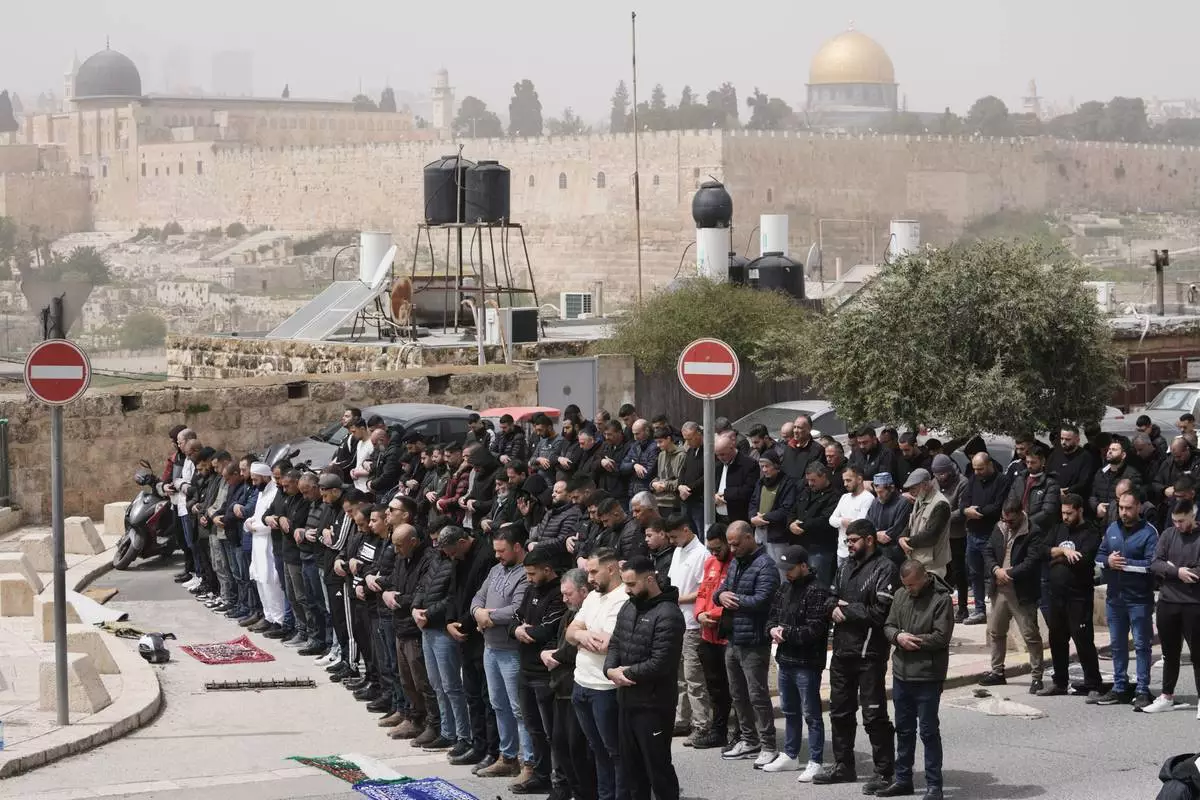
Palestinian Muslims attend Friday prayers outside Jerusalem's Old City due to restrictions linked to the Iran war, April 3, 2026. (AP Photo/Mahmoud Illean)

Palestinian Muslims attend Friday prayers outside Jerusalem's Old City due to restrictions linked to the Iran war, April 3, 2026. (AP Photo/Mahmoud Illean)

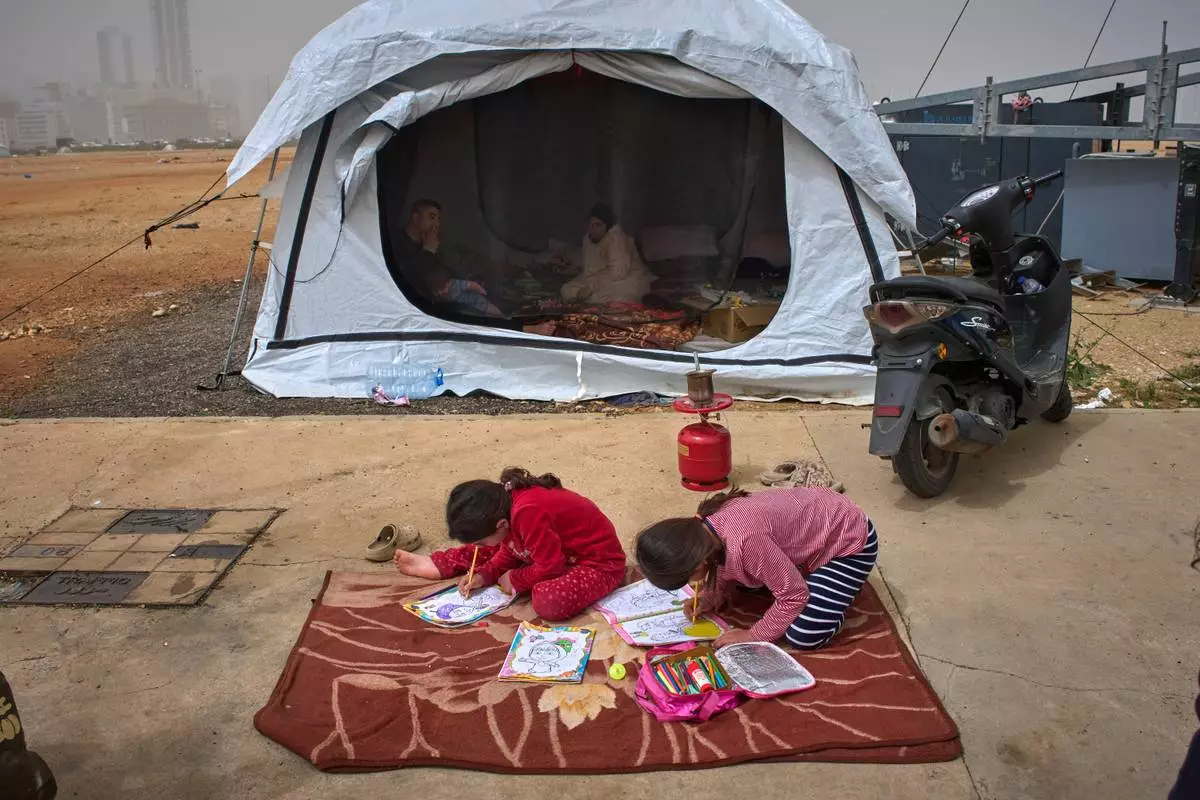
Tamara and her sister Amal color pictures on the floor as their parents, Sara and Ahmed, who fled their village of Khiyam in southern Lebanon due to Israeli bombardment, sit inside a tent used as a shelter in Beirut, Lebanon, Friday, April 3, 2026. (AP Photo/Emilio Morenatti)

Tamara and her sister Amal color pictures on the floor as their parents, Sara and Ahmed, who fled their village of Khiyam in southern Lebanon due to Israeli bombardment, sit inside a tent used as a shelter in Beirut, Lebanon, Friday, April 3, 2026. (AP Photo/Emilio Morenatti)

Mohammad Qubaisi, 53, with burn wounds from an Israeli airstrike on southern Lebanon undergoes surgery by Dr. Mohammed Ziara, left, and his team, at the Sidon Government Hospital in Sidon, Lebanon, Thursday, April 2, 2026. (AP Photo/Emilio Morenatti)

Mohammad Qubaisi, 53, with burn wounds from an Israeli airstrike on southern Lebanon undergoes surgery by Dr. Mohammed Ziara, left, and his team, at the Sidon Government Hospital in Sidon, Lebanon, Thursday, April 2, 2026. (AP Photo/Emilio Morenatti)

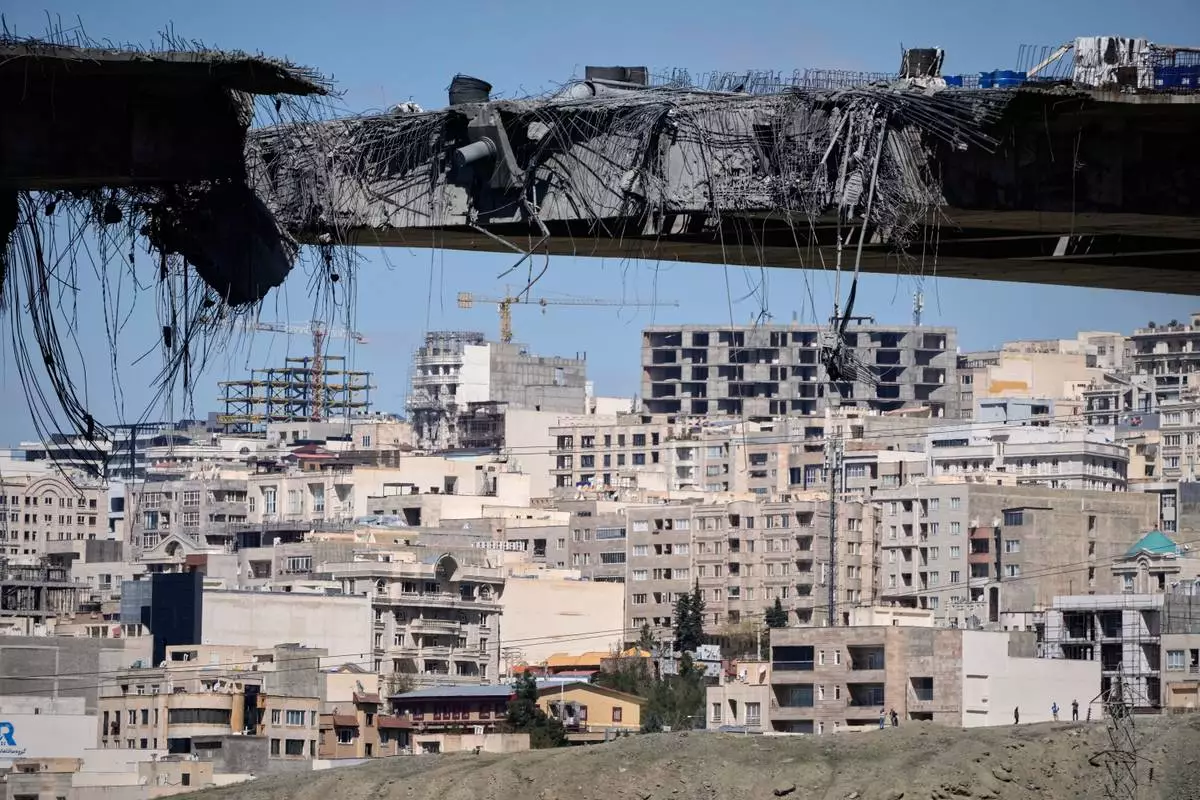
A bridge struck by U.S. airstrikes on Thursday is seen in the town of Karaj, west of Tehran, Iran, Friday, April 3, 2026. (AP Photo/Vahid Salemi)

A bridge struck by U.S. airstrikes on Thursday is seen in the town of Karaj, west of Tehran, Iran, Friday, April 3, 2026. (AP Photo/Vahid Salemi)

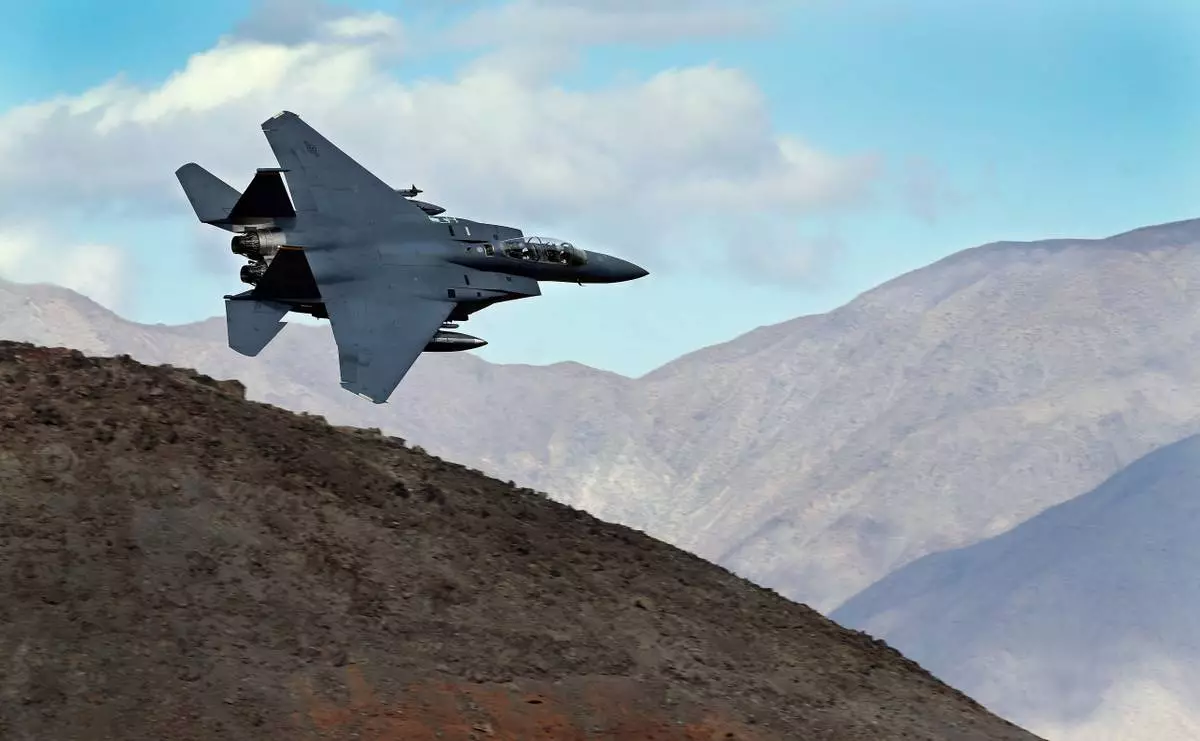
FILE - An F-15E Strike Eagle turns toward the Panamint range over Death Valley National Park, Calif., on Feb. 27, 2017. (AP Photo/Ben Margot, File)

FILE - An F-15E Strike Eagle turns toward the Panamint range over Death Valley National Park, Calif., on Feb. 27, 2017. (AP Photo/Ben Margot, File)

Recommended Articles