|
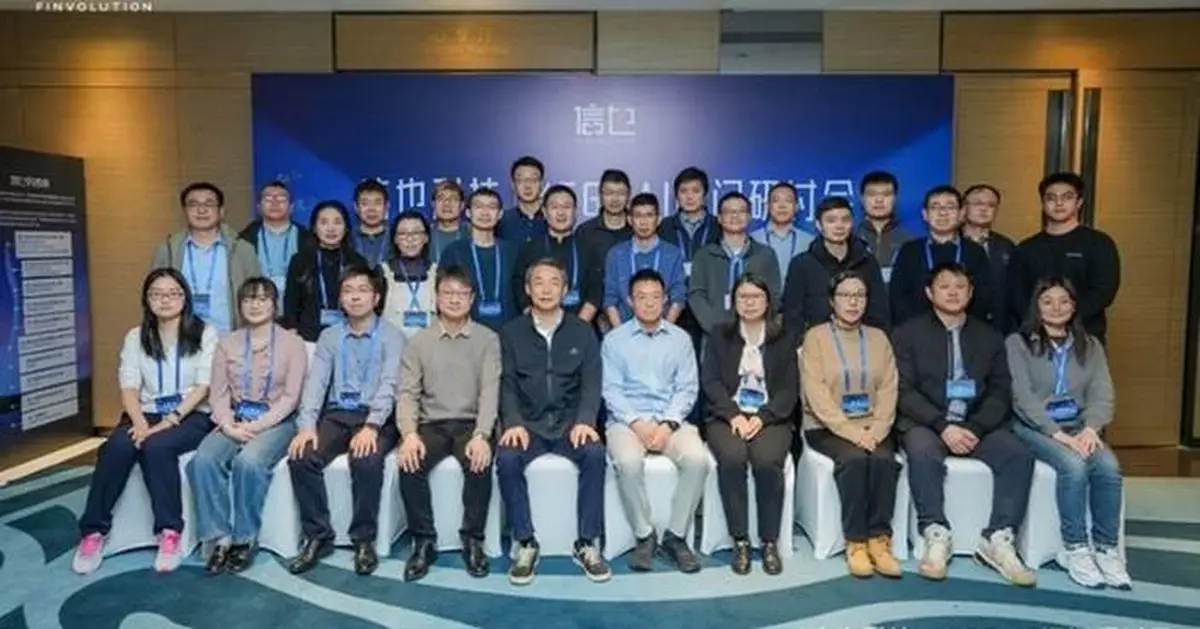
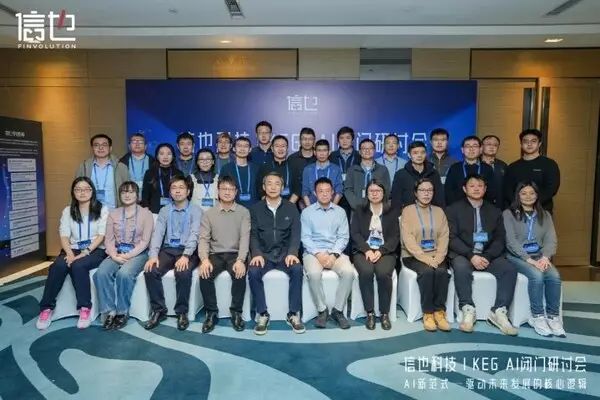
SHANGHAI, Dec. 18, 2025 /PRNewswire/ -- FinVolution Group, a leading credit technology company, recently hosted a closed-door technology forum themed "New AI Paradigms: The Core Logic Driving Future Development," bringing together more than 20 leading scholars from the artificial intelligence field for in-depth dialogue. The discussion focused on how AI technologies are evolving from standalone tools into systemic capabilities and fundamentally reshaping fintech business models.
Scholars from top universities including Tsinghua University, Fudan University, Beijing Jiaotong University, and Beijing Normal University shared insights on the application of large models across different industries and research domains. Discussions centered on industry–academia collaboration and interdisciplinary innovation, covering cutting-edge topics such as AI detection, data mining, and knowledge graphs.
Professor Jie Tang of Tsinghua University offered a forward-looking perspective grounded in both frontier research and the historical evolution of technology, outlining potential development paths and key trends that may define the future of artificial intelligence from a macro-level viewpoint.
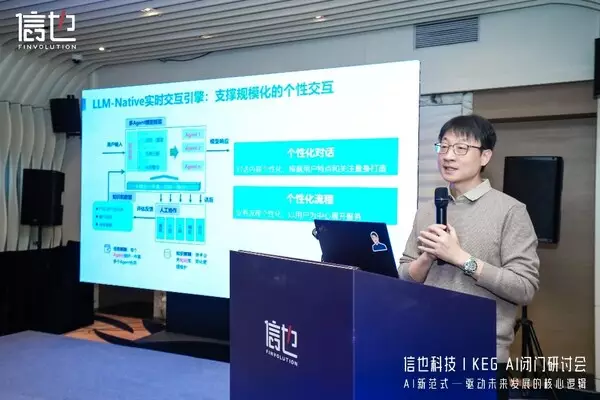
At the forum, Yuxiang Wang, Chief Operating Officer and Chief Technology Officer of FinVolution, shared the company's latest AI practices. He noted that the essence of the new AI paradigm lies in technology's deep integration with core business logic, which requires a systematic reconstruction of underlying architectures rather than the simple addition of model capabilities.
Based on this understanding, Wang introduced FinVolution's AI development framework. Built on top of its hardware infrastructure, the company has established a centralized model layer, resource layer, and application layer. By integrating commercial large models with proprietary models, FinVolution has developed a business-oriented agent platform that enables AI to directly participate in key functions such as risk management, customer service, and operations. FinVolution's multilingual intelligent assistant, Blu, is now deployed across nine countries, handling more than five million interactions per day, demonstrating how AI can systematically empower business at scale.
"In an era where large AI models are transforming every industry, fintech companies should not view AI merely as an efficiency tool," Wang said. "Instead, AI applications need to evolve from discriminative to generative, and from isolated decision-making to end-to-end perception and decision systems."
During the forum, FinVolution also announced the official launch of the research and compilation of its upcoming white paper, "Intelligent Leadership Goes Global: The Evolution of AI in Fintech." Centered on FinVolution's international expansion experience, the white paper will systematically summarize practical approaches to embedding AI into core business operations across diverse markets and regulatory environments. It will place particular emphasis on the application of multimodal large models in cross-border customer acquisition, risk identification, and operational decision-making.
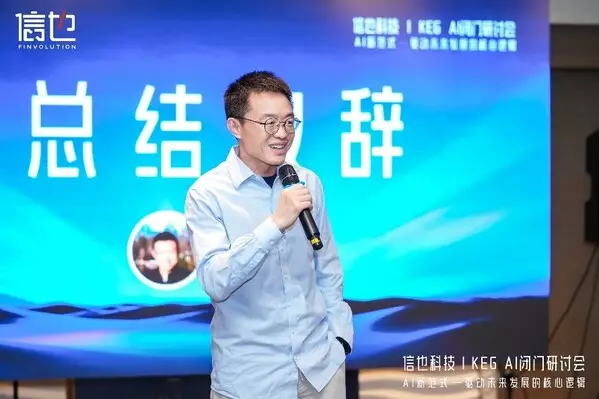
Lei Chen, Vice President of FinVolution, said the white paper represents a consolidation of the company's global, real-world experience as well as a set of practical and replicable technical methodologies. "By grounding our analysis in real international business scenarios, we aim to clarify how AI can be applied, how far it can go, and where its boundaries lie, providing the industry with a reference that balances innovation and compliance," he said.
SHANGHAI, Dec. 18, 2025 /PRNewswire/ -- FinVolution Group, a leading credit technology company, recently hosted a closed-door technology forum themed "New AI Paradigms: The Core Logic Driving Future Development," bringing together more than 20 leading scholars from the artificial intelligence field for in-depth dialogue. The discussion focused on how AI technologies are evolving from standalone tools into systemic capabilities and fundamentally reshaping fintech business models.
Scholars from top universities including Tsinghua University, Fudan University, Beijing Jiaotong University, and Beijing Normal University shared insights on the application of large models across different industries and research domains. Discussions centered on industry–academia collaboration and interdisciplinary innovation, covering cutting-edge topics such as AI detection, data mining, and knowledge graphs.
Professor Jie Tang of Tsinghua University offered a forward-looking perspective grounded in both frontier research and the historical evolution of technology, outlining potential development paths and key trends that may define the future of artificial intelligence from a macro-level viewpoint.
At the forum, Yuxiang Wang, Chief Operating Officer and Chief Technology Officer of FinVolution, shared the company's latest AI practices. He noted that the essence of the new AI paradigm lies in technology's deep integration with core business logic, which requires a systematic reconstruction of underlying architectures rather than the simple addition of model capabilities.
Based on this understanding, Wang introduced FinVolution's AI development framework. Built on top of its hardware infrastructure, the company has established a centralized model layer, resource layer, and application layer. By integrating commercial large models with proprietary models, FinVolution has developed a business-oriented agent platform that enables AI to directly participate in key functions such as risk management, customer service, and operations. FinVolution's multilingual intelligent assistant, Blu, is now deployed across nine countries, handling more than five million interactions per day, demonstrating how AI can systematically empower business at scale.
"In an era where large AI models are transforming every industry, fintech companies should not view AI merely as an efficiency tool," Wang said. "Instead, AI applications need to evolve from discriminative to generative, and from isolated decision-making to end-to-end perception and decision systems."
During the forum, FinVolution also announced the official launch of the research and compilation of its upcoming white paper, "Intelligent Leadership Goes Global: The Evolution of AI in Fintech." Centered on FinVolution's international expansion experience, the white paper will systematically summarize practical approaches to embedding AI into core business operations across diverse markets and regulatory environments. It will place particular emphasis on the application of multimodal large models in cross-border customer acquisition, risk identification, and operational decision-making.
Lei Chen, Vice President of FinVolution, said the white paper represents a consolidation of the company's global, real-world experience as well as a set of practical and replicable technical methodologies. "By grounding our analysis in real international business scenarios, we aim to clarify how AI can be applied, how far it can go, and where its boundaries lie, providing the industry with a reference that balances innovation and compliance," he said.
** The press release content is from PR Newswire. Bastille Post is not involved in its creation. **
FinVolution Hosts Closed-Door Forum with Leading Academics to Explore New AI Paradigms
FinVolution Hosts Closed-Door Forum with Leading Academics to Explore New AI Paradigms
FinVolution Hosts Closed-Door Forum with Leading Academics to Explore New AI Paradigms
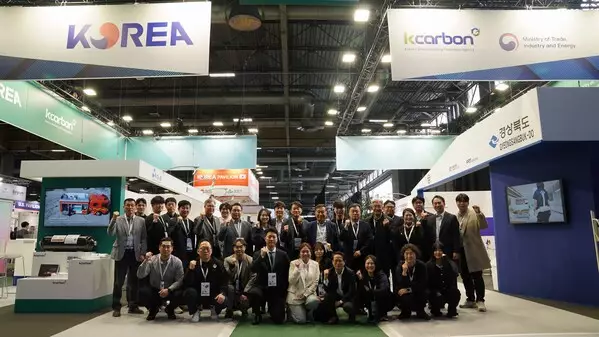
PARIS, April 2, 2026 /PRNewswire/ -- The Korea Carbon Industry Promotion Agency (Kcarbon), in collaboration with Gyeongsangbuk-do, successfully concluded its participation in JEC World 2026, the world's largest composites exhibition, held from March 10 to 12 in Paris, France. Through the operation of the Korea Pavilion, the agency strengthened the global presence of Korea's carbon materials and advanced application technologies.
The Korea Pavilion featured 12 leading small and medium-sized enterprises specializing in carbon materials and components. The exhibition showcased a wide range of high-value materials, including carbon fiber composites, recycled carbon fiber, carbon nanotubes, and graphene, as well as their applications in thermal management products, electric aircraft batteries, wind turbine blade components, and water treatment systems.
Participating companies—Neomond, Daesung Metal, Daeshin Techgen, VSPACE, Shinsung Materials, CTCM, FRT Robotics, O2NB, Il Sung Composites, Cartech H, and Taerim Industry—demonstrated capabilities spanning from raw materials to finished products for aerospace, medical devices, and environmental systems. Leveraging differentiated manufacturing technologies and stable production capabilities, the companies engaged in extensive business discussions with buyers from Europe, the Americas, and the Middle East, achieving tangible outcomes.
Notably, Daeshin Techgen and O2NB secured export contracts totaling $450,000 with international buyers. Daeshin Techgen signed supply agreements with U.S.-based PBS International and N-Water, valued at $200,000 for electromagnetic shielding composites and $100,000 for CNT nanofilters. O2NB concluded a $150,000 contract with Kayo Partners in Gabon for water purification systems, marking a new entry into the African market.
Other participating companies also leveraged the exhibition to explore global opportunities. VSPACE presented solutions for urban air mobility (UAM), FRT Robotics showcased robotic exoskeleton technologies, and Cartech H introduced innovations in recycled carbon fiber technologies, all aiming to expand partnerships in European and global markets.
During the exhibition, the agency operated a dedicated B2B meeting zone in cooperation with the Korea Carbon and Nano Industry Association
(KCANIA) and the World Federation of Overseas Korean Economic And Trade Associations(OKTA). The initiative provided buyer matching, interpretation support for technical discussions, and on-site assistance for exhibitors, contributing to meaningful business outcomes.
Park Gyu-soon, Acting President of the Korea Carbon Industry Promotion Agency, stated, "JEC World 2026 provided an excellent opportunity to present the innovative technologies of Korean carbon companies to the global market. We will continue to identify global partnership opportunities and support companies in strengthening their export competitiveness."
The successful conclusion of the Korea Pavilion at JEC World 2026 underscores Korea's growing competitiveness in advanced carbon materials and its commitment to expanding its footprint in the global composites market.
** This press release is distributed by PR Newswire through automated distribution system, for which the client assumes full responsibility. **
THE KOREA INDUSTRY DAILY: Korea Pavilion Concludes Successful Showcase at JEC World 2026, Secures $450,000 in Export Deals and Expands Global Partnerships