FEHD raids unlicensed cold store in Yuen Long District
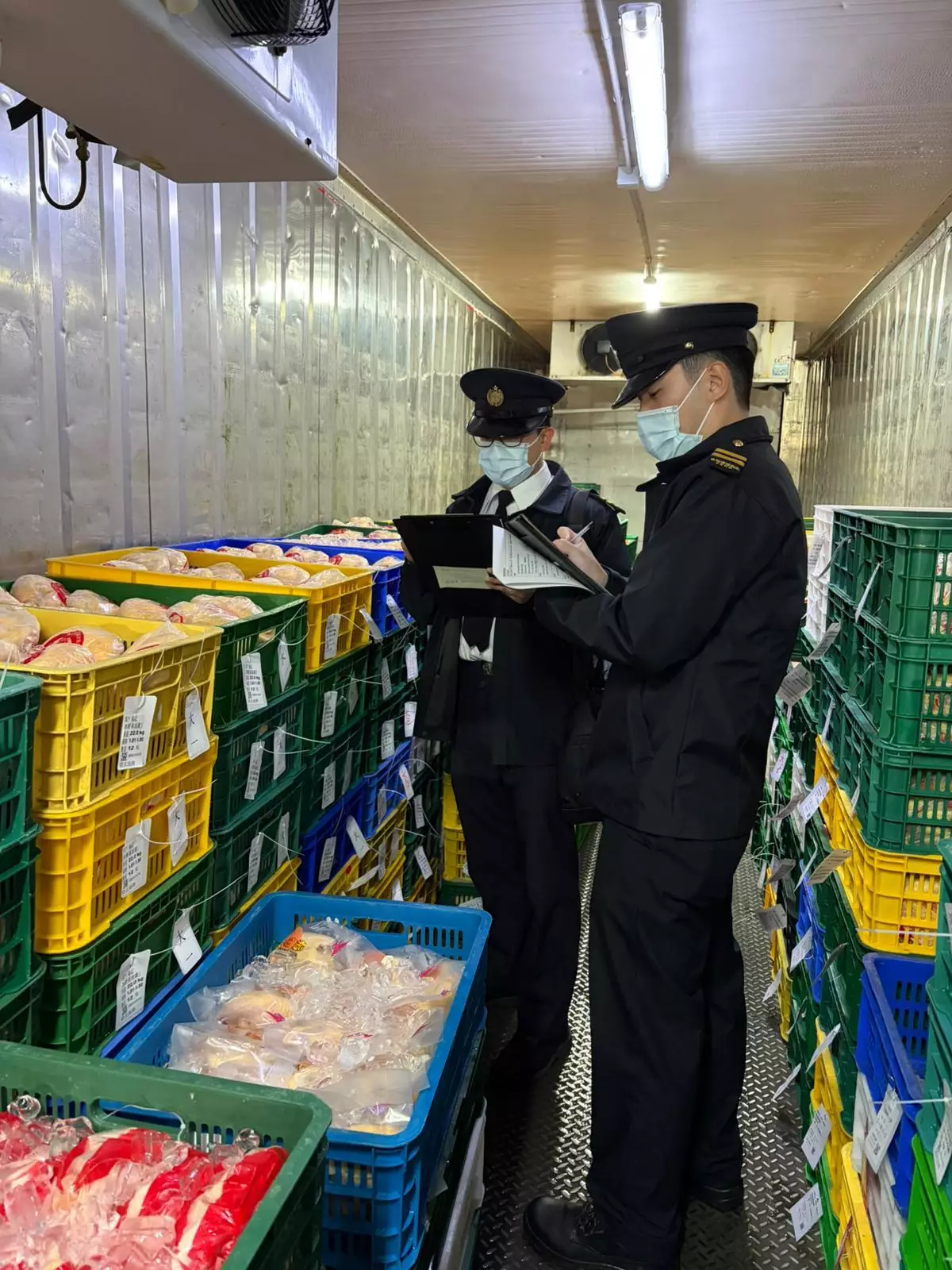
The Food and Environmental Hygiene Department (FEHD) raided an unlicensed cold store last night (December 17) in Pat Heung, Yuen Long.
During the operation, the FEHD arrested one person and initiated procedures on prosecution for the suspected operation of an unlicensed cold store. Over 10 tonnes of chilled poultry and frozen pork were found on the premises, about 272 kilograms of chilled poultry among them were rendered unfit for human consumption due to improper storage, and was seized for disposal.
Under the Food Business Regulation, the maximum penalty for operating an unlicensed cold store is a fine of $50,000 and six months' imprisonment upon conviction.
The FEHD has proactively leveraged innovation and technology to boost the efficacy of environmental hygiene work. The officers of the FEHD made use of drones to facilitate collection of intelligence in the course of the investigation for the present operation, and this substantially stepped up the geographical coverage of the investigation and enhanced the efficacy of surveillance.
"We will continue our stringent enforcement actions against unlicensed food businesses to safeguard food safety and public health," a spokesman for the FEHD said.
Members of the public can report any suspected illegal food business activities by calling the FEHD hotline at 2868 0000.
FEHD raids unlicensed cold store in Yuen Long District Source: HKSAR Government Press Releases

Government implements Southbound Travel for Guangdong Vehicles steadily and provides convenience upon entry into urban area under vehicle and road safety (with photo/video)
The Transport Department (TD) today (December 18) said that the Hong Kong Special Administrative Region (HKSAR) Government has been pressing ahead with the Southbound Travel for Guangdong Vehicles (STGV) in a steady manner under the strategies of ensuring safety, effective diversion, well-equipped supporting facilities, and streamlined application processes. Various measures are ready to receive Guangdong vehicles entering Hong Kong's urban areas from December 23.
Positive response in applications
The STGV (Entry into Urban Area) has been open for application from eligible Guangdong private cars since December 9. After the TD's vetting, applicants gradually completed procedures such as vehicle inspection, verification of e-contact means and obtaining insurance, and then submitted documents via the application system. The TD will issue electronic permits and approval letters to the successful applicants accordingly. The TD has arranged vehicle inspection centres to install the HKeToll vehicle tags for vehicles during inspection, and applicants are required to set up auto-payment means or top up their HKeToll accounts for toll payments. Starting from 0.00am on December 23, approved Guangdong vehicles with confirmed travel bookings may enter Hong Kong's urban areas via the Hong Kong-Zhuhai-Macao Bridge (HZMB) for up to three days per visit.
Vehicle and road safety
The Government attaches great importance to vehicle and road safety. All Guangdong vehicles entering Hong Kong's urban areas are required to undergo and pass a vehicle examination in accordance with Hong Kong requirements at the TD's designated vehicle inspection centres on the Mainland. According to the TD's guidelines, inspection centres are required to carry out 15 inspection items, which include verification of the vehicle identification number and engine number; inspection of tyres and steering, suspension and braking systems; and examination of body structure, markings, safety equipment and whether any vehicle modifications have been made. Managed by Hong Kong service providers, the inspection centres must ensure that Guangdong vehicles are in compliance with Hong Kong standards and are safe for use on Hong Kong roads. The TD has provided training to inspection personnel to ensure consistency in inspection standards.
On road safety, Hong Kong adopts the "left-hand traffic" rule for road design, under which traffic keeps to the left-hand side of the roads, which is different from that on the Mainland. The style of some traffic signs and road markings is also different. Guangdong drivers must heighten their vigilance, particularly when overtaking, making right turns at junctions, using roundabouts, merging onto expressways or seeing signs like "Pedestrian crossing ahead", "Give way" or "Stop", where extra caution is warranted. Motorists are reminded that failing to comply with relevant requirements under traffic laws is liable on conviction to fines or imprisonment.
The TD has released videos on driving in Hong Kong at inspection centres and on social media to introduce Hong Kong's traffic rules, traffic signs and road markings, and points to note while driving. Publicity leaflets have also been distributed to remind Guangdong drivers of the differences between Mainland and Hong Kong road designs, traffic rules and facilities. Guangdong drivers may also refer to the Road Users' Code published by the TD for more details.
Enhanced supporting facilities for diversion
After entering the urban areas, Guangdong drivers may download the TD's HKeMobility mobile app for the latest traffic news and details of parking and charging facilities in various districts to plan their journeys. The HKeMobility launched the STGV dedicated page (sbt.hkemobility.gov.hk) with new functions today to display, via a map-based interface, carparks with enhanced facilities supporting charging for Mainland electric vehicles and Mainland payment means. It also facilitates searches for carparks near tourist hotspots. The TD has liaised with operators of common navigation apps used by Mainland drivers and noted that they will update their Hong Kong maps with reference to HKeMobility and the transport and traffic data from the Government's Open Data Portal to provide the latest information on parking and charging facilities. These measures help ensure road safety and effective diversion.
The TD will release information on carparks to provide convenience for Guangdong drivers in locating public and private carparks with enhanced supporting facilities across districts. Guangdong drivers may use the Octopus App or physical Octopus cards for payment at most carparks. Furthermore, the TD has commissioned an operator to set up the Lantau Charging Stationcum STGVInformation Centre, providing convenient charging services for Guangdong electric vehicles entering the urban areas via the HZMB Hong Kong Port or before returning to Guangdong, along with the latest information on the STGV. The Charging Station has been equipped with ultra fastchargers suitable for both local and Guangdong vehicles.
Guangdong drivers may refer to the Tourist Parking Guides to plan their journeys by self-driving and matching public transport to explore Hong Kong's diverse appeals in culture, sports, exhibitions, shopping and theme parks, thereby diverting Guangdong vehicles to different districts and benefitting various trades and sectors under the inflow of additional tourists.
Since November, the TD has been in collaboration with the Hong Kong Economic and Trade Office in Guangdong and the Guangdong-Hong Kong-Macao Greater Bay Area Development Office in a series of thematic posts on Mainland social media. Details of different parts of the STGV (Entry into Urban Area) are also provided on the thematic webpage, the application and driving information kit, publicity leaflets and tutorial videos. The HKSAR Government will implement the STGV in an orderly manner so that it will be well received by users, reassuring to the public, and beneficial to the community at large.
Government implements Southbound Travel for Guangdong Vehicles steadily and provides convenience upon entry into urban area under vehicle and road safety (with photo/video) Source: HKSAR Government Press Releases