|
KUALA LUMPUR, Malaysia, Dec. 18, 2025 /PRNewswire/ -- GIBO Holdings Ltd. (NASDAQ: GIBO) today announced a strategic collaboration with Japan Benling Zhushi Clubs Limited, marking a major step in the advancement of next-generation manned electric vertical takeoff and landing (eVTOL) aircraft enhanced with GIBO's advanced artificial intelligence technologies. The partnership focuses on developing an intelligent aviation platform capable of supporting disaster investigation, search-and-rescue missions in difficult-to-access terrain, geological and mining exploration, and critical operations in remote or hazardous environments.
Central to the collaboration is the co-development and training of sophisticated AI compute models designed specifically for manned eVTOL systems. These AI models will power high-precision autonomous assistance, complex environmental perception, structural hazard interpretation, geospatial mapping, and real-time situational analysis. By combining GIBO's AI computation engine and autonomous sensing algorithms with Japan Benling Zhushi Clubs Limited's engineering expertise in lightweight aviation structures, electric propulsion technology, and compact aircraft system design, both companies aim to create a new class of intelligent eVTOL aircraft optimized for high-risk, mission-critical operations.
The manned eVTOL platform is being engineered to operate in conditions where conventional vehicles, drones, and helicopters often struggle. This includes navigating collapsed or unstable disaster zones, reaching mountainous or forested regions, entering areas adjacent to underground geological formations, and conducting detailed aerial surveys for mining exploration and resource assessment. The aircraft's AI-driven capabilities will enable real-time 3D environmental reconstruction, thermal and motion sensing, survivor or target identification, advanced terrain analysis, and autonomous flight-path optimization even in low-visibility or adverse environmental situations.
The global eVTOL industry is expanding rapidly, fueled by improvements in battery energy density, breakthroughs in autonomous flight systems, and increasing demand for rapid-response aerial mobility. Industry projections estimate that the global eVTOL market will grow from approximately USD 1.2 billion in 2023 to more than USD 23–25 billion by 2030, representing a compound annual growth rate of over 40 percent. Within this expansion, the specialized segment dedicated to public safety, disaster response, critical infrastructure inspection, and geological or mining exploration is expected to reach USD 6–7 billion by 2030. The collaboration between GIBO and Japan Benling Zhushi Clubs Limited positions both organizations at the forefront of this strategically important and fast-growing aviation frontier.
GIBO's AI system will serve as the core intelligence layer of the aircraft, enabling autonomous navigation, obstacle detection, terrain reasoning, precision landing, and continuous environmental mapping. Its multimodal AI architecture will support mission-level decision-making, including structural damage assessment, geological pattern interpretation, hazard detection, and optimal route planning for complex rescue, investigation, or exploration operations. This intelligence-driven framework is designed to increase mission success rates, reduce operational risk, and significantly improve the effectiveness of rapid-response aviation.
Both companies plan to expand co-development activities across Japan, Southeast Asia, and additional international markets, working closely with agencies and industry partners involved in emergency response, geological and mining assessment, fire and rescue operations, utility and infrastructure monitoring, environmental protection, and security. As the collaboration matures, GIBO and Japan Benling Zhushi Clubs Limited also intend to explore further applications in urban air mobility, autonomous aerial logistics, cross-border operational coordination, and AI-enhanced aviation robotics.
This partnership represents an important milestone in the evolution of manned autonomous aviation. GIBO believes that integrating advanced AI compute capabilities with next-generation eVTOL platforms will redefine national disaster-response capabilities, transform geological exploration workflows, and unlock safe access to remote or previously unreachable environments—ultimately strengthening the resilience and intelligence of future aviation systems.
KUALA LUMPUR, Malaysia, Dec. 18, 2025 /PRNewswire/ -- GIBO Holdings Ltd. (NASDAQ: GIBO) today announced a strategic collaboration with Japan Benling Zhushi Clubs Limited, marking a major step in the advancement of next-generation manned electric vertical takeoff and landing (eVTOL) aircraft enhanced with GIBO's advanced artificial intelligence technologies. The partnership focuses on developing an intelligent aviation platform capable of supporting disaster investigation, search-and-rescue missions in difficult-to-access terrain, geological and mining exploration, and critical operations in remote or hazardous environments.
Central to the collaboration is the co-development and training of sophisticated AI compute models designed specifically for manned eVTOL systems. These AI models will power high-precision autonomous assistance, complex environmental perception, structural hazard interpretation, geospatial mapping, and real-time situational analysis. By combining GIBO's AI computation engine and autonomous sensing algorithms with Japan Benling Zhushi Clubs Limited's engineering expertise in lightweight aviation structures, electric propulsion technology, and compact aircraft system design, both companies aim to create a new class of intelligent eVTOL aircraft optimized for high-risk, mission-critical operations.
The manned eVTOL platform is being engineered to operate in conditions where conventional vehicles, drones, and helicopters often struggle. This includes navigating collapsed or unstable disaster zones, reaching mountainous or forested regions, entering areas adjacent to underground geological formations, and conducting detailed aerial surveys for mining exploration and resource assessment. The aircraft's AI-driven capabilities will enable real-time 3D environmental reconstruction, thermal and motion sensing, survivor or target identification, advanced terrain analysis, and autonomous flight-path optimization even in low-visibility or adverse environmental situations.
The global eVTOL industry is expanding rapidly, fueled by improvements in battery energy density, breakthroughs in autonomous flight systems, and increasing demand for rapid-response aerial mobility. Industry projections estimate that the global eVTOL market will grow from approximately USD 1.2 billion in 2023 to more than USD 23–25 billion by 2030, representing a compound annual growth rate of over 40 percent. Within this expansion, the specialized segment dedicated to public safety, disaster response, critical infrastructure inspection, and geological or mining exploration is expected to reach USD 6–7 billion by 2030. The collaboration between GIBO and Japan Benling Zhushi Clubs Limited positions both organizations at the forefront of this strategically important and fast-growing aviation frontier.
GIBO's AI system will serve as the core intelligence layer of the aircraft, enabling autonomous navigation, obstacle detection, terrain reasoning, precision landing, and continuous environmental mapping. Its multimodal AI architecture will support mission-level decision-making, including structural damage assessment, geological pattern interpretation, hazard detection, and optimal route planning for complex rescue, investigation, or exploration operations. This intelligence-driven framework is designed to increase mission success rates, reduce operational risk, and significantly improve the effectiveness of rapid-response aviation.
Both companies plan to expand co-development activities across Japan, Southeast Asia, and additional international markets, working closely with agencies and industry partners involved in emergency response, geological and mining assessment, fire and rescue operations, utility and infrastructure monitoring, environmental protection, and security. As the collaboration matures, GIBO and Japan Benling Zhushi Clubs Limited also intend to explore further applications in urban air mobility, autonomous aerial logistics, cross-border operational coordination, and AI-enhanced aviation robotics.
This partnership represents an important milestone in the evolution of manned autonomous aviation. GIBO believes that integrating advanced AI compute capabilities with next-generation eVTOL platforms will redefine national disaster-response capabilities, transform geological exploration workflows, and unlock safe access to remote or previously unreachable environments—ultimately strengthening the resilience and intelligence of future aviation systems.
** The press release content is from PR Newswire. Bastille Post is not involved in its creation. **

GIBO Announces Strategic Collaboration with Japan Benling Zhushi Clubs Limited to Develop AI-Powered Manned eVTOL Aircraft for Disaster Response and Geological Exploration
SHENZHEN, China, April 2, 2026 /PRNewswire/ -- X Square Robot, an emerging leader in embodied AI and humanoid robotics, announced the successful conclusion of the world's first Embodied AI Developers Conference (EAIDC 2026), the first global gathering dedicated specifically to developers building embodied AI systems.
EAIDC 2026 marks one of the first large-scale industry gatherings dedicated to embodied AI, bringing together leading researchers, developers, and technology companies to accelerate the transition of intelligent systems from laboratory research to real-world applications. The event features live robotic demonstrations, a national-level hackathon, and discussions between academia and industry focused on deployment, commercialization, and ecosystem development.
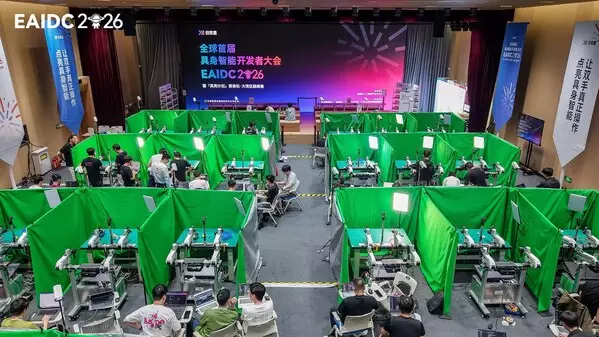
EAIDC 2026, the world's first embodied intelligence developer competition, is designed to accelerate real-world innovation through hands-on collaboration and deployment-focused challenges.
X Square Robot hosted EAIDC as part of a broader effort to contribute to the global embodied AI ecosystem and expand its role in shaping the future of intelligent systems. The competition also introduced a set of "three firsts" designed to bring embodied AI development closer to real-world conditions, including real-robot task execution, continuous system evaluation, and full end-to-end deployment workflows. Task design focused on four core capability areas — grasping and placement, language understanding, fine manipulation, and long-horizon decision-making — with participants completing challenges such as ring placement, instruction-based fruit sorting, cable plugging, and word spelling. A full-variable evaluation approach required teams to operate without preset parameters, using randomized real-world environments to test true adaptability and model robustness.
The company is operating at a time of growing global momentum around humanoid robotics, as advances in physical AI and vision-language-action (VLA) models begin to unlock more complex, real-world capabilities. The company has raised approximately $280 million to date, with backing from investors including Alibaba, ByteDance, Meituan, HongShan (formerly Sequoia China), and other leading technology and venture firms.
X Square Robot is focused on developing general-purpose humanoid systems capable of operating in dynamic, unstructured environments. Its technology centers on embodied foundation models designed to enable robots to perceive, adapt, and perform tasks across a range of real-world scenarios.
The company has begun generating early revenue from deployments across sectors including education, hospitality, and elder care, and is exploring broader applications in household services through collaborations such as its partnership with 58.com. The company has also been active in advancing technical research and industry engagement, including participation in global AI forums and academic communities such as CVPR, reflecting its commitment to contributing to both the development and commercialization of embodied intelligence.
These efforts reflect a broader industry shift toward applying AI-driven robotics to address labor shortages and operational challenges in both consumer and commercial environments.
By hosting EAIDC 2026, X Square Robot is engaging with a growing global ecosystem of developers and industry stakeholders working to define the next generation of intelligent systems. The company views this as part of a broader strategy to expand its international presence and establish itself as a global innovator in embodied AI.
For more information, visit https://x2robot.com/.
About X Square Robot
X Square Robot is a global innovator in embodied artificial intelligence, robotics, and autonomous systems. The company develops integrated software and hardware platforms that enable robots to perceive, reason, and act safely in complex environments. Partnering with leading universities and technology institutions, X Square Robot delivers scalable AI infrastructure and establishes open benchmarks to drive worldwide progress in intelligent robotics.
** This press release is distributed by PR Newswire through automated distribution system, for which the client assumes full responsibility. **
X Square Robot Hosts Inaugural EAIDC 2026, Advancing Real-World Deployment of Embodied AI