Skip to Content Facebook Feature Image

AV Delivers JLTV-Mounted LOCUST Laser Weapon Systems to U.S. Army

Business

AV Delivers JLTV-Mounted LOCUST Laser Weapon Systems to U.S. Army
Business

Business

AV Delivers JLTV-Mounted LOCUST Laser Weapon Systems to U.S. Army

2025-12-18 22:10 Last Updated At:12-22 13:26

ARLINGTON, Va.--(BUSINESS WIRE)--Dec 18, 2025--

AeroVironment, Inc. (“AV”) (NASDAQ: AVAV), a leading provider of counter-unmanned aircraft system (C-UAS) technologies, today announced the successful delivery of two Joint Light Tactical Vehicle (JLTV)-mounted mobile C-UAS Laser Weapon Systems (LWS) to the U.S. Army as part of the second increment of the Army Multi-Purpose High Energy Laser (AMP-HEL) prototyping effort. These systems were delivered to the Army’s Rapid Capabilities and Critical Technologies Office (RCCTO), now integrated into the Portfolio Acquisition Executive Fires, reflecting the Army’s ongoing transformation and acquisition reform efforts.

This press release features multimedia. View the full release here: https://www.businesswire.com/news/home/20251218237438/en/

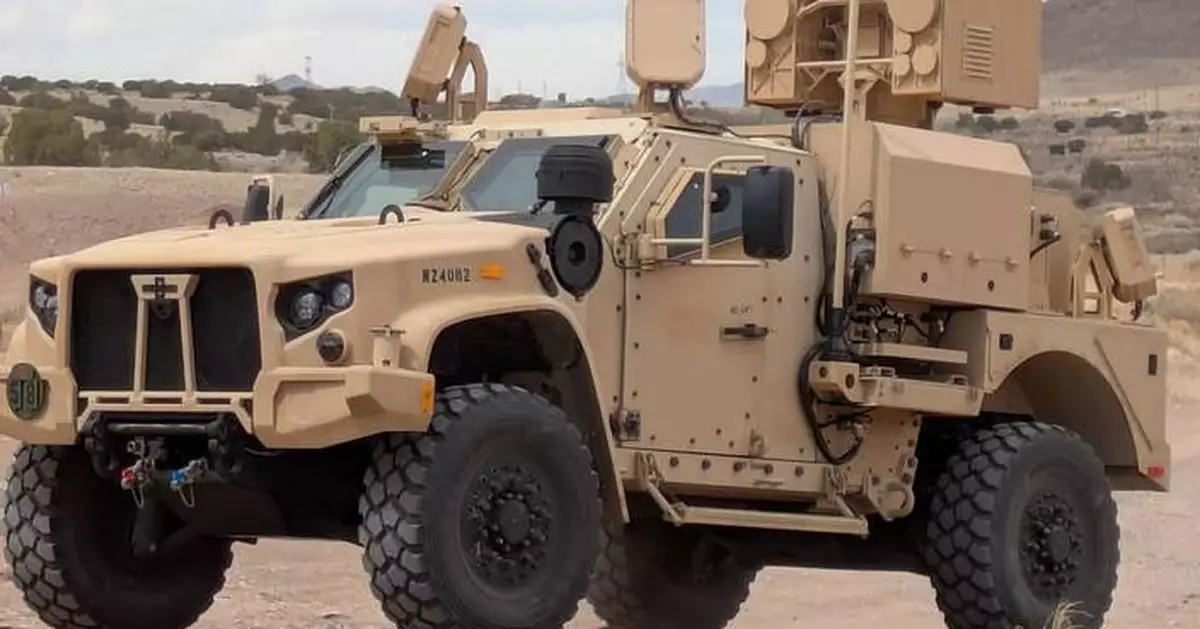
In September, AV announced delivery of the first increment of AMP-HEL prototype systems–two LOCUST LWS integrated on the General Motors Defense Infantry Squad Vehicle (ISV) platform. This second-increment system on the Oshkosh JLTV platform features the same 20kW-class LOCUST LWS with a larger aperture beam director, improving lethality performance.

“AV continues to deliver proven, efficient, modular laser weapon systems that perform and protect in real-world threat environments,” said Mary Clum, President, Space, Cyber & Directed Energy for AV. “Integrated as part of these AMP-HEL systems, LOCUST is a cost-effective, rugged, precise, and scalable solution that is addressing the ever-evolving UAS threats our warfighters are facing on frontlines today. With the technology proven, we remain focused on advancing capabilities while scaling manufacturing to meet the growing demand.”

AV delivered its first LOCUST LWS to RCCTO as part of the Palletized-High Energy Laser (P-HEL) program in 2022. With more than three years of operational deployment outside the United States, these state-of-the-art LWS have demonstrated exceedingly high operational availability rates for prototype systems after first generation lessons learned informed necessary improvements now supporting current technology development efforts. During these deployments, the LOCUST-equipped P-HEL systems, now integrated on AMP-HEL, have performed their designed mission against UAS threats in real world combat.

“Directed energy is no longer a future concept—it is a proven force-protection capability,” said John Garrity, Vice President of AV’s Directed Energy business unit. “Since deployed, LOCUST-equipped P-HEL systems have actively protected warfighters, allies, and critical infrastructure against aerial threats. With LOCUST’s target acquisition, tracking and precision beam control, warfighters have an easy-to-use, reliable, trusted, and proven solution against the very real and evolving threats of modern warfare.”

Designed to be platform-agnostic and rapidly deployable, AV’s directed-energy systems integrate seamlessly with Army command-and-control architectures, providing a critical C-UAS capability that protects Soldiers and assets across a wide range of missions and environments. These systems have been successfully integrated in fixed-site base defense systems and on maneuverable platforms, including the ISV and JLTV, and mounted on the Light Medium Tactical Vehicle for increased mobility.

About AV

AV (NASDAQ: AVAV) is a defense technology leader delivering integrated capabilities across air, land, sea, space, and cyber. The Company develops and deploys autonomous systems, loitering munitions, counter-UAS technologies, space-based platforms, directed energy systems, and cyber and electronic warfare capabilities—built to meet the mission needs of today’s warfighter and tomorrow’s conflicts. At the core of these technologies lies AV_Halo, a modular, mission-ready suite of AI-powered software tools that empowers warfighters and enables full-battlefield dominance: detect, decide, deliver. With a national manufacturing footprint and a deep innovation pipeline, AV delivers proven systems and future-defining capabilities at speed, scale, and operational relevance. For more information, visit www.avinc.com.

Safe Harbor Statement

Certain statements in this press release may constitute "forward-looking statements" as defined in the Private Securities Litigation Reform Act of 1995. These statements are based on current expectations, forecasts, and assumptions that involve risks and uncertainties, which could cause actual results to differ materially. Factors that may cause such differences include, but are not limited to, our ability to perform under existing contracts and obtain new ones; regulatory changes; competitor activities; market growth; product development challenges; and general economic conditions. For a more detailed discussion of these risks, please refer to AeroVironment’s filings with the Securities and Exchange Commission. We undertake no obligation to update forward-looking statements as a result of new information or future events.

U.S. Soldiers, assigned to Joint Task Force Southern Border, prepare to sling load AV’s LOCUST Laser Weapon System integrated on an Infantry Squad Vehicle to a CH-47 Chinook at Fort Bliss, Texas, July 16, 2025. JTF-SB executes full scale, agile, and all-domain operations in support of U.S. Customs and Border Protection to protect the territorial integrity of the United States and achieve 100% operational control of the southern border. [Credit: U.S. Army photo by Staff Sgt. Rynishia Lewis]

U.S. Soldiers, assigned to Joint Task Force Southern Border, prepare to sling load AV’s LOCUST Laser Weapon System integrated on an Infantry Squad Vehicle to a CH-47 Chinook at Fort Bliss, Texas, July 16, 2025. JTF-SB executes full scale, agile, and all-domain operations in support of U.S. Customs and Border Protection to protect the territorial integrity of the United States and achieve 100% operational control of the southern border. [Credit: U.S. Army photo by Staff Sgt. Rynishia Lewis]

The LOCUST Laser Weapon System (LWS) integrated on an Oshkosh Joint Light Tactical Vehicle (JLTV) was delivered to the U.S. Army Rapid Capabilities and Critical Technologies Office (RCCTO) as part of the second increment of the Army Multi-Purpose High Energy Laser (AMP-HEL) prototyping effort. [Credit: AV]

The LOCUST Laser Weapon System (LWS) integrated on an Oshkosh Joint Light Tactical Vehicle (JLTV) was delivered to the U.S. Army Rapid Capabilities and Critical Technologies Office (RCCTO) as part of the second increment of the Army Multi-Purpose High Energy Laser (AMP-HEL) prototyping effort. [Credit: AV]

VATICAN CITY (AP) — Pope Leo XIV made a historic apology on Monday for the Holy See's role in legitimizing slavery and for having failed to condemn it for centuries, calling the Vatican’s record a “wound in Christian memory.”

Past popes have apologized for Christians’ involvement in the trans-Atlantic slave trade. But no pope had ever publicly acknowledged, much less apologized for, the role that past popes played in giving European sovereigns explicit authority to subjugate and enslave “infidels.”

History’s first U.S.-born pope, whose family history includes both enslaved people and slave owners, delivered the apology in his first encyclical, “Magnifica Humanitas,” (Magnificent Humanity), which was released Monday.

The sweeping manifesto is about safeguarding humanity in an era of increasing reliance on artificial intelligence. Leo raised the slave trade in relation to what he called the new forms of slavery and colonialism that the digital revolution is fueling.

Black American Catholics, activists and scholars have long called for the Holy See to atone for its role in the colonial-era trade in human beings, beyond generic apologies for the involvement of individual Christians.

“It is impossible not to feel deep sorrow when contemplating the immense suffering and humiliation endured by so many in stark contrast to their immeasurable dignity as persons infinitely loved by the Lord,” Leo wrote. “For this, in the name of the church, I sincerely ask for pardon.”

Shannen Dee Williams, historian at the University of Dayton and author of the 2022 history of American Black Catholic nuns, “Subversive Habits,” welcomed the apology as a "monumental step toward the kind of essential truth-telling and reparation that many Catholics have prayed and worked to witness.”

“The Catholic Church has never been an innocent bystander in the history of white supremacy," said Williams. “Black Catholics have waited a long time to hear the Vatican speak honestly about the church’s leading roles in the trans-Atlantic slave trade and chattel slavery--and thus by extension the enduring systems of anti-Black racism in the world today.”

The Vatican has insisted that it always upheld the dignity of all human beings as children of God. But a series of 15th-century directives from the Vatican authorized Portuguese sovereigns to conquer Africa and the Americas and enslave non-Christians.

In 1452, for example, Pope Nicholas V issued the papal bull Dum Diversas, which gave the Portuguese king and his successors the right “to invade, conquer, fight and subjugate” and take all possessions — including land — of “Saracens, and pagans, and other infidels, and enemies of the name of Christ” anywhere.

The bull also gave the Portuguese permission “to reduce their persons to perpetual slavery.”

That bull and another issued three years later, Romanus Pontifex, formed the basis of the Doctrine of Discovery, the theory that legitimized the colonial-era seizure of land in Africa and the Americas.

Nicholas V’s permissions to the Portuguese were confirmed or renewed by Pope Callixtus III in 1456, Pope Sixtus IV in 1481 and Pope Leo X in 1514, according to the Rev. Christopher J. Kellerman, a Jesuit priest and author of “All Oppression Shall Cease: A History of Slavery, Abolitionism, and the Catholic Church.”

Spanish kings received the rights for the Americas.

In 2023, the Vatican formally repudiated the Doctrine of Discovery, but it never formally rescinded, abrogated or rejected the bulls themselves. The Vatican insists that a later bull, Sublimis Deus in 1537, reaffirmed that Indigenous peoples shouldn’t be deprived of their liberty or the possession of their property, and weren't to be enslaved.

In his encyclical, Leo recalled that his namesake, Pope Leo XIII, was the first pope to explicitly condemn slavery in 1888, long after many countries had abolished it. Before that, in antiquity and the Middle Ages, church institutions and even popes — Gregory the Great — had slaves, Kellerman said.

In acknowledging the 15th century papal bulls, Leo wrote in his encyclical: “Already in the early modern period, the Apostolic See of Rome, responding to the requests of sovereigns, intervened several times in order to regulate and legitimize forms of subjugation, and, in certain cases, including the enslavement of ‘infidels.’”

Leo said it wasn't possible to judge the morality of the decisions with today’s standards.

“Yet neither can we deny or diminish the delay with which both society and the church came to denounce the scourge of slavery,” he said.

The pope said that the church has long affirmed the dignity of every human being as the basis of its doctrine, “even if it took eighteen centuries for its full incompatibility with slavery to be explicitly recognized.”

“This constitutes a wound in Christian memory, one from which we cannot consider ourselves detached,” he said.

Leo said that the church must firmly condemn all forms of trafficking related to the digital technological revolution “if we want to avoid the need to ask for pardon again in the future for having failed to respect the treasure of human dignity that is required by our faith.”

Anthea Butler, senior fellow at the Koch History Center, Oxford University, said Leo needed to acknowledge and atone for the church's complicity in historic slavery if he wanted to credibly “speak to the current issues of technological enslavement.”

“For descendants of enslaved persons, this is once again a much needed apology from the pope,” said Butler, who is Black.

Kellerman, the scholar, welcomed Leo’s apology but said more needs to be done to further acknowledge how the Catholic Church legitimized and expanded slavery.

“Pope Leo has strengthened the moral credibility of the church with this admission and apology today,” he told The Associated Press. “Hopefully a future document will explain in more detail the church’s involvement with slaveholding. As a scholar I have some quibbles with the wording, but this is a truly remarkable moment.”

During a 1985 visit to Cameroon, St. John Paul II asked forgiveness of Africans for the slave trade on behalf of Christians who participated in it, but not the popes. In a 1992 visit to Goree Island, Senegal, which was the largest slave-trading center in West Africa, he denounced the injustice of slavery and called it a “tragedy of a civilization that called itself Christian.”

According to genealogical research published by Henry Louis Gates Jr., 17 of Leo’s American ancestors were Black, listed in census records as mulatto, Black, Creole or a free person of color. His family tree includes slaveholders and enslaved people, Gates wrote in The New York Times.

During a visit to Angola last month, Leo prayed at a Catholic shrine at the site of an important hub of the African slave trade during Portugal’s colonial rule. While at the Sanctuary of Mama Muxima, Leo recalled the “sorrow and great suffering” Angolans endured for centuries, but he didn’t refer specifically to slavery.

Winfield reported from Middletown, Connecticut.

Associated Press religion coverage receives support through the AP’s collaboration with The Conversation US, with funding from Lilly Endowment Inc. The AP is solely responsible for this content.

Pope Leo XIV speaks during the presentation of his first encyclical, "Magnifica humanitas: On Safeguarding the Human Person in the Time of Artificial Intelligence," at the Vatican, Monday, May 25, 2026. (AP Photo/Alessandra Tarantino)

Pope Leo XIV speaks during the presentation of his first encyclical, "Magnifica humanitas: On Safeguarding the Human Person in the Time of Artificial Intelligence," at the Vatican, Monday, May 25, 2026. (AP Photo/Alessandra Tarantino)

Pope Leo XIV listens to Cardinal Víctor Manuel Fernández, prefect of the Dicastery for the Doctrine of the Faith, right, during the presentation of Pope Leo XIV's first encyclical, "Magnifica humanitas: On Safeguarding the Human Person in the Time of Artificial Intelligence," at the Vatican, Monday, May 25, 2026. (AP Photo/Alessandra Tarantino)

Pope Leo XIV listens to Cardinal Víctor Manuel Fernández, prefect of the Dicastery for the Doctrine of the Faith, right, during the presentation of Pope Leo XIV's first encyclical, "Magnifica humanitas: On Safeguarding the Human Person in the Time of Artificial Intelligence," at the Vatican, Monday, May 25, 2026. (AP Photo/Alessandra Tarantino)

Pope Leo XIV, left, attends the presentation of his first encyclical, "Magnifica humanitas: On Safeguarding the Human Person in the Time of Artificial Intelligence," at the Vatican, Monday, May 25, 2026. (AP Photo/Alessandra Tarantino)

Pope Leo XIV, left, attends the presentation of his first encyclical, "Magnifica humanitas: On Safeguarding the Human Person in the Time of Artificial Intelligence," at the Vatican, Monday, May 25, 2026. (AP Photo/Alessandra Tarantino)

Pope Leo XIV, left, arrives with Vatican Secretary of State Cardinal Pietro Parolin for the presentation of his first encyclical, "Magnifica humanitas: On Safeguarding the Human Person in the Time of Artificial Intelligence," at the Vatican, Monday, May 25, 2026. (AP Photo/Alessandra Tarantino)

Pope Leo XIV, left, arrives with Vatican Secretary of State Cardinal Pietro Parolin for the presentation of his first encyclical, "Magnifica humanitas: On Safeguarding the Human Person in the Time of Artificial Intelligence," at the Vatican, Monday, May 25, 2026. (AP Photo/Alessandra Tarantino)

Vatican Secretary of State Cardinal Pietro Parolin, right, talks to theologian Leocadie Lushombo during the presentation of his first encyclical, "Magnifica humanitas: On Safeguarding the Human Person in the Time of Artificial Intelligence," at the Vatican, Monday, May 25, 2026. (AP Photo/Alessandra Tarantino)

Vatican Secretary of State Cardinal Pietro Parolin, right, talks to theologian Leocadie Lushombo during the presentation of his first encyclical, "Magnifica humanitas: On Safeguarding the Human Person in the Time of Artificial Intelligence," at the Vatican, Monday, May 25, 2026. (AP Photo/Alessandra Tarantino)

Pope Leo XIV holds the pastoral staff as he celebrates the Pentecost Mass in St. Peter's Basilica, at the Vatican, Sunday, May 24, 2026. (AP Photo/Gregorio Borgia)

Pope Leo XIV holds the pastoral staff as he celebrates the Pentecost Mass in St. Peter's Basilica, at the Vatican, Sunday, May 24, 2026. (AP Photo/Gregorio Borgia)

Recommended Articles