MEXICO CITY (AP) — A blunt critique of Mexican bread by a British baker sparked a cascade of social media outrage, ultimately leading to a public apology.
In an interview for a food-themed podcast that resurfaced online, Richard Hart, the co-founder of Green Rhino bakery in Mexico City and a well-known figure in international baking circles, said Mexicans “don’t really have much of a bread culture,” adding that “They make sandwiches on these white, ugly rolls that are pretty cheap and industrially made.”
His comments quickly rippled across Instagram, TikTok and X, with many Mexicans accusing him of being dismissive and insulting of Mexico's traditional breads.
What began as a dispute over bread soon ignited a national debate over food identity — not only over who defines Mexican culinary traditions, but also over the growing influence of foreigners in a capital already tense from a surge of U.S. expatriates and tourists.
“He offended the community of bakers in Mexico and all the people in Mexico who like bread, which is almost everyone," said Daniela Delgado, a university student in Mexico City.
Social media was soon flooded with memes, reaction videos, and passionate defenses of Mexican bread. Users took to social media to praise everyday staples — from the crusty bolillos used for tortas to the iconic conchas found in neighborhood bakeries. In many cases, these simple street foods act as a uniting factor across social groups and classes, and often cut to the core of the country's cultural identity.
While wheat bread was introduced to Mexico during the colonial period, the classic food staple evolved into a distinct national tradition, blending European techniques with local tastes and ingredients. Today, small neighborhood bakeries remain central to daily life in cities and towns, serving as social hubs as well as food sources.
The incident prompted many to question why a foreign entrepreneur would publicly disparage a staple so deeply embedded in Mexican life. For many, Hart's remarks echoed long-standing frustrations over foreign chefs and restaurateurs receiving disproportionate prestige, as well as concerns over gentrification in the capital.
“Don't mess with the bolillo,” warned one viral post on X.
As criticism mounted, Hart issued a public apology on Instagram, saying his comments were poorly phrased and did not show respect for Mexico and its people. He acknowledged the emotional response and said he didn't behave as a “guest."
“I made a mistake,” Hart said in his statement. “I regret it deeply.”
The Associated Press reached out to Green Rhino, but representatives of the bakery declined to comment.
Hart previously worked at high-profile bakeries in the United States and Europe and has been part of Mexico City’s growing artisanal bread scene. That market caters largely to middle and upper-class customers, many of them foreigners, seeking sourdough loaves and European-style pastries, often at prices far above those of neighborhood bakeries.
The apology did little to immediately quiet the debate. While some users accepted it, others said it failed to address deeper concerns about cultural authority and who gets to critique Mexican traditions.
“If you want to be part of Mexican culture by owning a restaurant or bakery, you have to educate yourself,” Delgado said.
Others, like Josué Martínez, a chef at the Mexican Culinary School, said he was happy that the debate was happening because it opened the door for a more robust and nuanced discussion.
Mexican bread has long been criticized domestically for its industrialization and reliance on white flour and sugar. But many like Martínez say those conversations are different and more nuanced when led by Mexicans themselves rather than by a foreign entrepreneur.
“It’s an opportunity to learn about the culture of Mexican breadmaking and pastry, to take pride in it, to highlight the richness of our ingredients, and to stop thinking that the so-called first world represents the ultimate standard," Martínez said.
Follow AP’s coverage of Latin America and the Caribbean at https://apnews.com/hub/latin-america

A vendor prepares a bolillo, a traditional Mexican bread, for consumption at a street stand in Mexico City, Thursday, Dec. 18, 2025. (AP Photo/Marco Ugarte)

People buy pastries at a bakery in Mexico City, Thursday, Dec. 18, 2025. (AP Photo/Marco Ugarte)

Bolillos, a traditional Mexican bread, sit for sale at a street stand in Mexico City, Thursday, Dec. 18, 2025. (AP Photo/Marco Ugarte)
LONDON (AP) — U.S. President Donald Trump and his Defense Secretary Pete Hegseth have been damning of the U.K.'s naval capabilities. Their jibes may have stung in a country with a long and proud maritime history, but they do carry some substance.
The U.K. has been at the forefront of Trump’s ire since the onset of the Iran war on Feb. 28, when British Prime Minister Keir Starmer refused to grant the U.S. military access to British bases.
Though that decision has been partly reversed with the decision to permit the U.S. to use the bases, including that of Diego Garcia in the Indian Ocean, for so-called defensive purposes, Trump is adamant he was let down. He has repeatedly lashed out at Starmer and branded the Royal Navy’s two aircraft carriers as “toys.”
“You don’t even have a navy,” he told Britain's Daily Telegraph in comments published Wednesday. "You’re too old and had aircraft carriers that didn’t work.”
Hegseth, meanwhile, said sarcastically that the “big, bad Royal Navy” should get involved in making the Strait of Hormuz safe for commercial shipping.
For numerous reasons, the Royal Navy is not as big and bad as it used it to be when Britannia ruled the waves. But it's not as feeble as Trump and Hegseth imply and is largely similar with the French navy, which it is often compared with.
“On the negative side, there is a grain of truth, with the Royal Navy being smaller than it has been in hundreds of years,” said professor Kevin Rowlands, editor of the Royal United Services Institute Journal. “On the positive side, the Royal Navy would say that it’s entering its first period of growth since World War II, with more ships set to be built than in decades.”
It’s not that long ago that Britain could muster a task force of 127 ships, including two aircraft carriers, to sail to the south Atlantic after Argentina’s invasion of the Falkland Islands. That 1982 campaign, which then-U.S. President Ronald Reagan was lukewarm about, marked the final hurrah of Britain’s naval pedigree.
Nothing on that scale, or even remotely, could be accomplished now. Since World War II, Britain’s combat-ready fleet has declined substantially, much of it linked to changing military and technological advances and the end of empire. But not all.
The number of vessels in the Royal Navy fleet, including aircraft carriers, destroyers frigates and submarines has fallen from 166 in 1975 to 66 in 2025, according to The Associated Press' analysis of figures from the Ministry of Defense and the House of Commons Library.
Though the Royal Navy has two aircraft carriers at its command, there was a seven-year period in the 2010s when it had none. And the number of destroyers has halved to six while the frigate fleet has been slashed from 60 to just 11.
The Royal Navy faced criticism for the time it took to send the HMS Dragon destroyer to the Middle East after the war with Iran broke out. Though naval officials worked night and day to get it shipshape for a different mission than the one it was readying for, to many it symbolized the extent to which Britain’s military has been gutted since the fall of the Berlin Wall in 1989.
For much of the Cold War, Britain was spending between 4% and 8% of its annual national income on its military. After the Cold War, that proportion steadily dropped to a low of 1.9% of GDP in 2018, fuel to Trump's fire.
Like other countries, Britain, largely under the Labour governments of Tony Blair and Gordon Brown, sought to use the so-called “peace dividend” following the collapse of the Soviet Union to divert money earmarked for defense to other priorities, such as health and education.
And the austerity measures imposed by the Conservative-led government in the wake of the global financial crisis of 2008-9 prevented any pickup in defense spending despite the clear signs of a resurgent Russia, especially after its annexation of Crimea and parts of eastern Ukraine.
In the wake of Russia's full-blown invasion of Ukraine in 2022, and with another Middle East war underway, there's a growing understanding across the political divide that the cuts have gone too far.
Following the Ukraine invasion, the Conservatives started to turn the military spending tide around. Since the Labour Party returned to power in 2024, Starmer is seeking to ramp up British defense spending, partly at the cost of cutting the country's long-vaunted aid spending.
Starmer has promised to raise U.K. defense spending to 2.5% of gross domestic product by 2027, and the updated goal is now for it to rise to 3.5% of GDP by 2035, as part of a NATO agreement pushed by Trump. That, in plain terms, will mean tens of billions pounds more being spent — a lot more kit for the armed forces.
The pressure is on for the government to speed that schedule up. But with the public finances further imperilled by the economic consequences of the Iran war, it's not clear where any additional money will come.
The jibes will likely keep coming even though the critiques are unfair and far from the truth, said RUSI's Rowlands, who was a captain in the Royal Navy.
“We are dealing with an administration that doesn’t do nuance," he said.
This story has been corrected to show there were 166 vessels in 1975, not 466.

An artillery piece from the 1982 Falklands War between Argentina and Britain lies on Mount Longdon on the Falkland Islands, also known as Islas Malvinas, Monday, March 16, 2026. (AP Photo/Ricardo Mazalan)
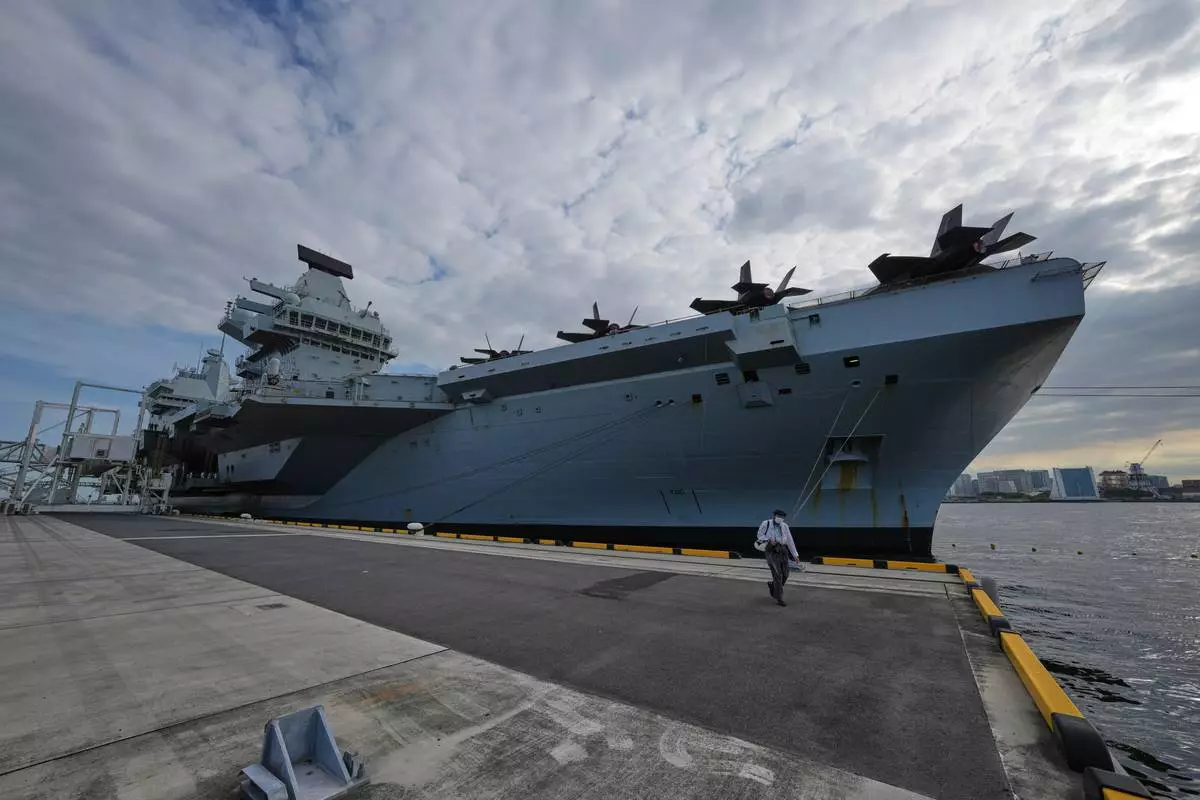
FILE - The Royal Navy aircraft carrier HMS Prince of Wales is pictured before its port call in Tokyo, Thursday, Aug. 28, 2025. (AP Photo/Eugene Hoshiko, File)

FILE - Britain's Prime Minister Keir Starmer speaks to Royal Marines onboard the HMS ST Albans in Oslo, during his visit to Norway on Friday, May 9, 2025.(AP Photo/Alastair Grant, Pool, File)
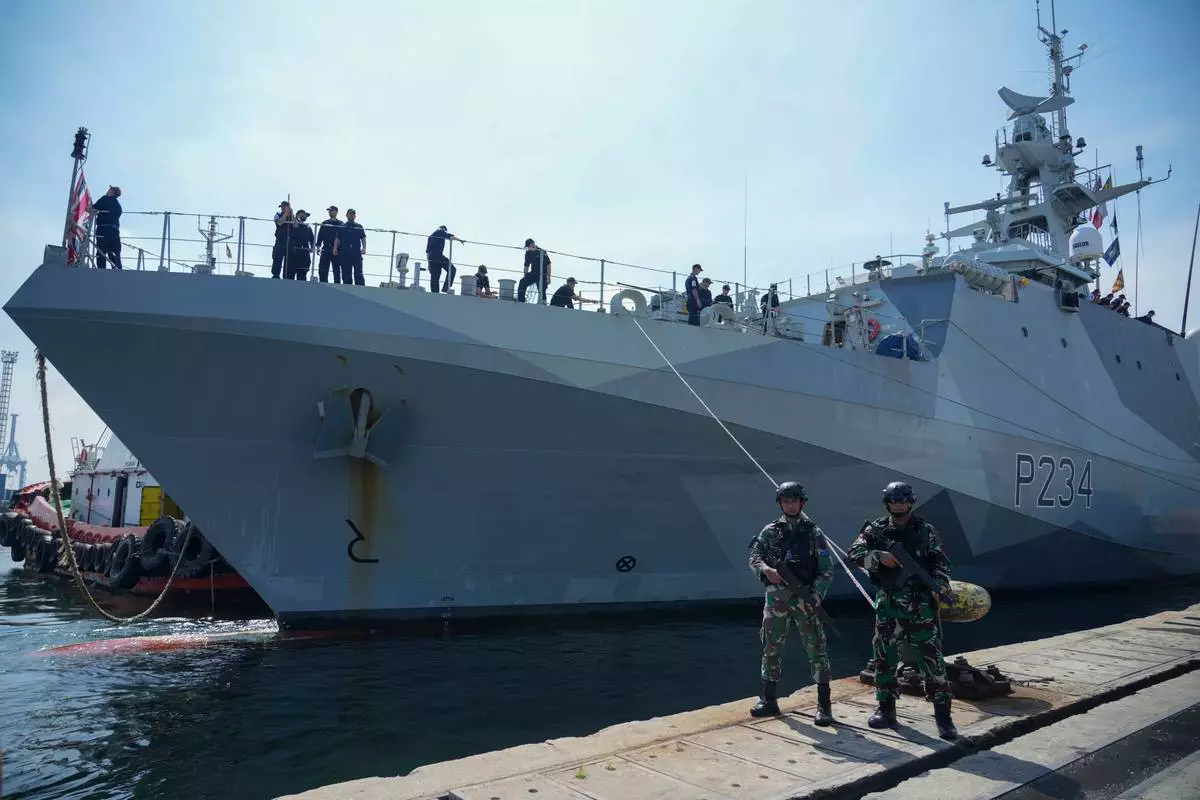
FILE - Indonesian soldiers stand guard as Royal Navy offshore patrol vessel HMS Spey is docked at Tanjung Priok Port during a port visit in Jakarta, Indonesia, Wednesday, Jan. 15, 2025. (AP Photo/Tatan Syuflana, File)
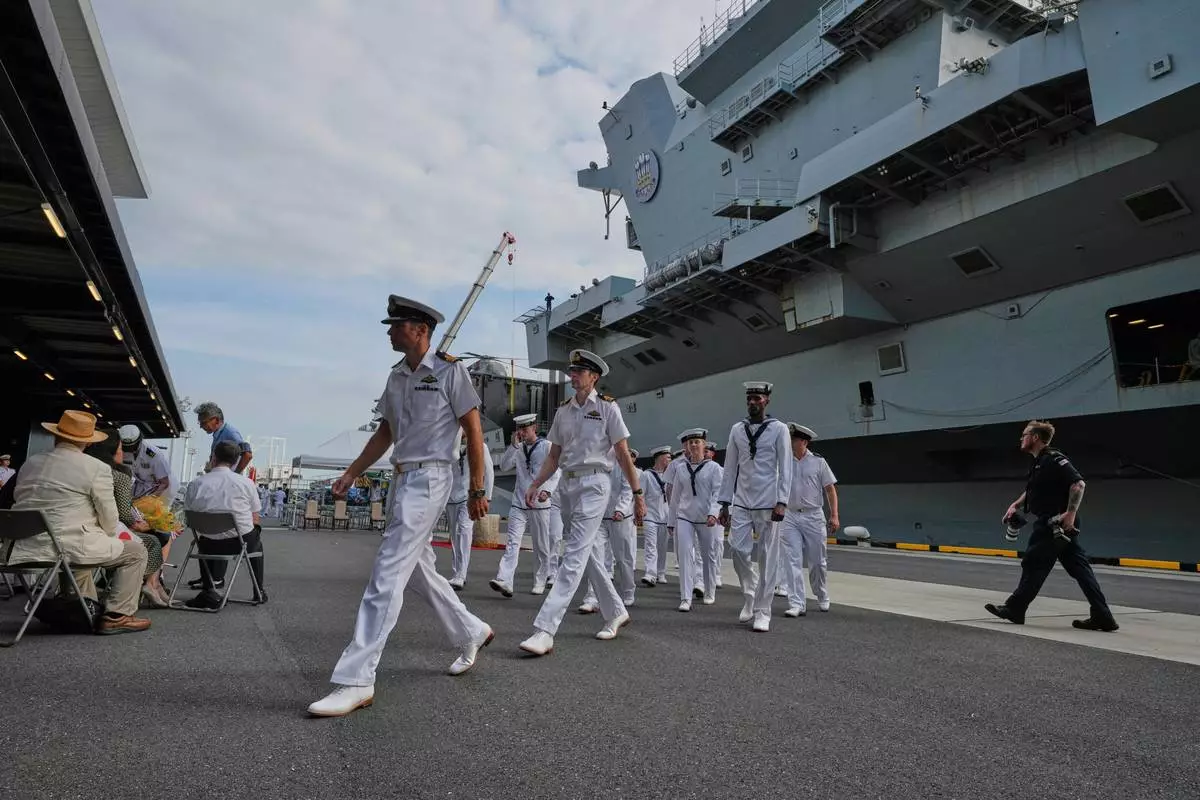
FILE - Crews walk near the Royal Navy aircraft carrier HMS Prince of Wales before its port call in Tokyo Thursday, Aug. 28, 2025. (AP Photo/Eugene Hoshiko, File)