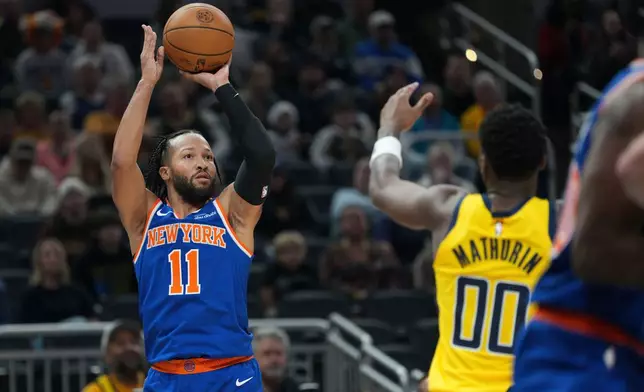
INDIANAPOLIS (AP) — Jalen Brunson made a go-ahead 3-pointer with 4.4 seconds left and scored 25 points, OG Anunoby stole the ensuing inbounds pass and the New York Knicks rallied for a 114-113 victory over the Indiana Pacers on Thursday night.
Brunson also had seven rebounds and seven assists as the Knicks extended their winning streak to seven games. Mikal Bridges added 22 points and eight rebounds and Tyler Kolek had 16 points and 11 assists, both career highs, on a night the NBA Cup champions were short-handed and fell into an early 16-point hole.
Click to Gallery
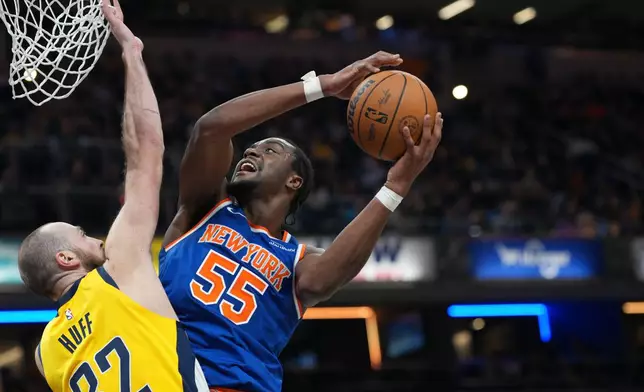
New York Knicks center Ariel Hukporti (55) shoots over Indiana Pacers center Jay Huff (32) during the first half of an NBA basketball game in Indianapolis, Thursday, Dec. 18, 2025. (AP Photo/AJ Mast)
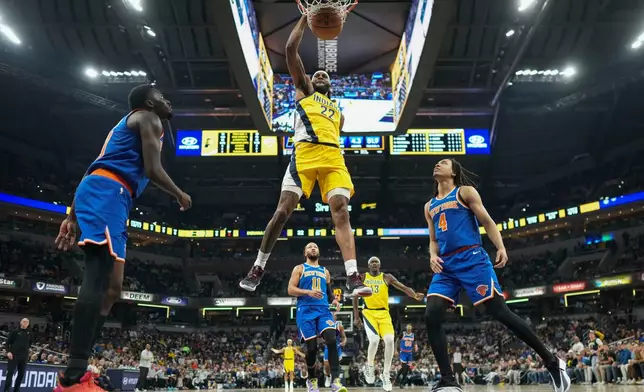
Indiana Pacers forward Isaiah Jackson (22) dunks in front of New York Knicks forward Pacome Dadiet (4) during the first half of an NBA basketball game in Indianapolis, Thursday, Dec. 18, 2025. (AP Photo/AJ Mast)
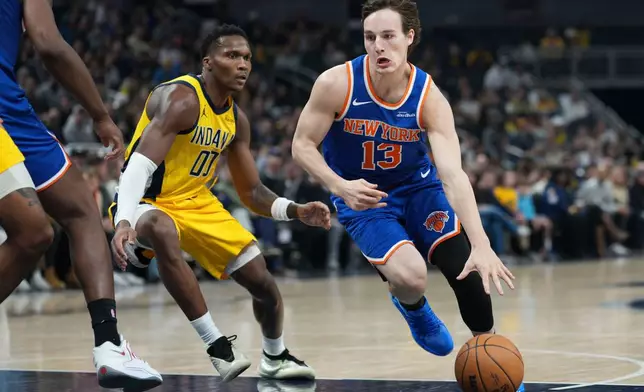
New York Knicks guard Tyler Kolek (13) goes around Indiana Pacers guard Bennedict Mathurin (00) during the first half of an NBA basketball game in Indianapolis, Thursday, Dec. 18, 2025. (AP Photo/AJ Mast)
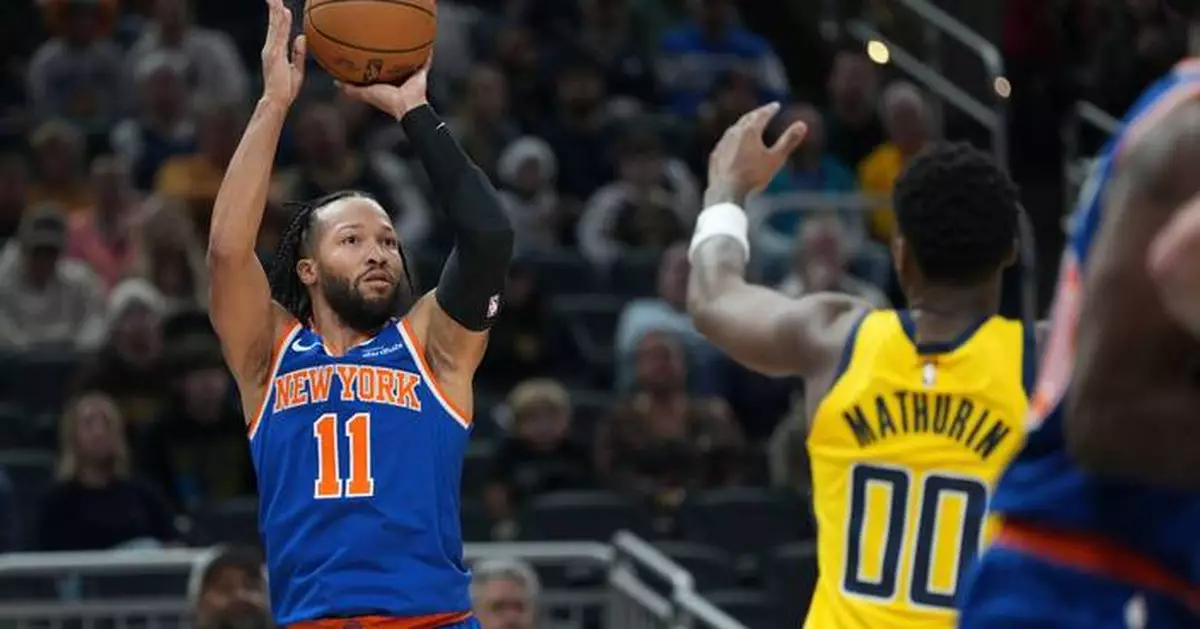
New York Knicks guard Jalen Brunson (11) shoots in front of Indiana Pacers guard Bennedict Mathurin (00) during the first half of an NBA basketball game in Indianapolis, Thursday, Dec. 18, 2025. (AP Photo/AJ Mast)
Andrew Nembhard finished with 31 points on 12-of-19 shooting. He was also 4 of 5 on 3-pointers. Pascal Siakam had 26 points, six rebounds and five assists, and Bennedict Mathurin finished with 16 points and eight rebounds.
The defending Eastern Conference champions lost their third straight since coach Rick Carlisle won his 999th game. He needs one more to become the 11th member of the exclusive 1,000-win club and the first since then-Philadelphia coach Doc Rivers in November 2021.
In this season's first matchup between last season's two Eastern Conference finalists, both teams were missing multiple key players.
The Knicks played without centers Karl-Anthony Towns and Mitchell Robinson, along with guards Josh Hart, Deuce McBride and Landry Shamet. Indiana still has four injured players out: guards Tyrese Haliburton and Ben Sheppard, and forwards Aaron Nesmith and Obi Toppin.
And New York spent most of the night playing catch-up after falling into an early 28-12 deficit.
Down 28-12, the Knicks closed to 62-59 at the half only to fall behind 83-68 late in the third quarter. They fought back again to take a 95-94 lead on Kolek's 17-footer with 8:41 to go.
Indiana broke away from a 99-all tie with a 10-3 run, but the Knicks tied it at 111 on Anunoby's 3-pointer with 1:51 to play.
Knicks: Hosts Philadelphia on Friday.
Pacers: Begins a two-game road trip Monday in Boston.
AP NBA: https://apnews.com/hub/nba
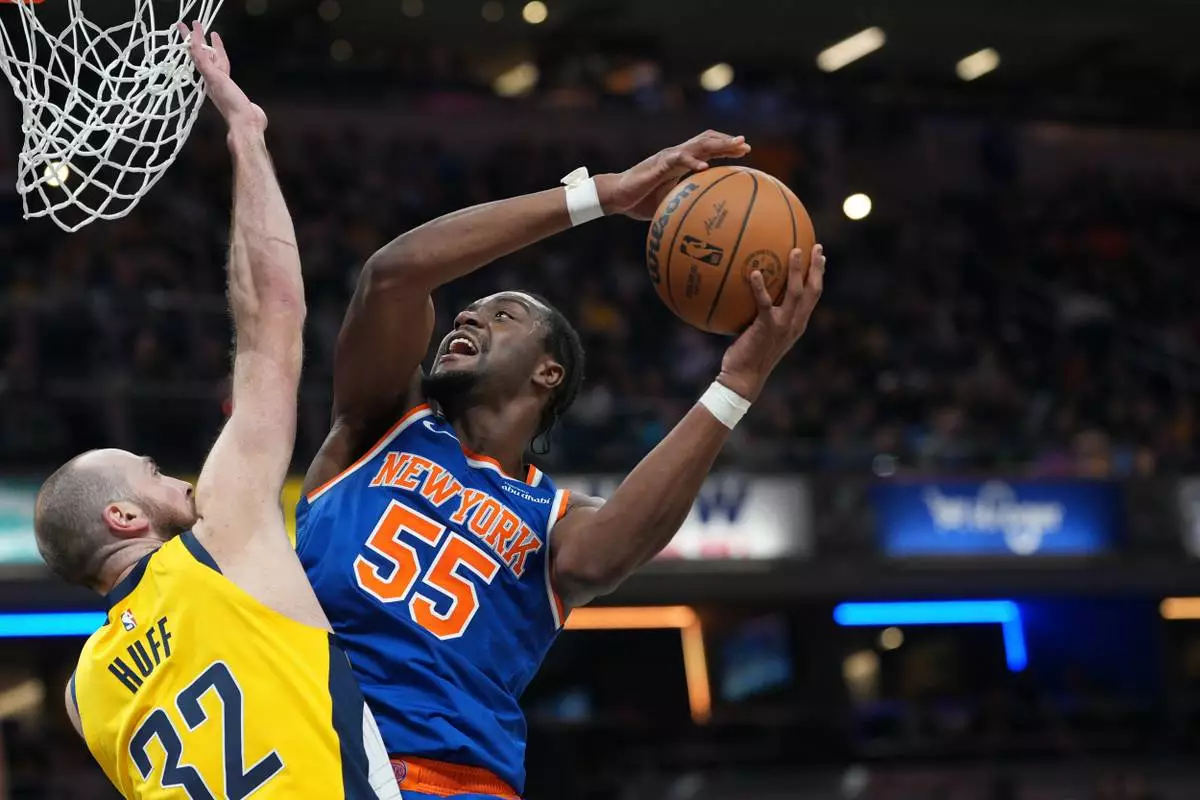
New York Knicks center Ariel Hukporti (55) shoots over Indiana Pacers center Jay Huff (32) during the first half of an NBA basketball game in Indianapolis, Thursday, Dec. 18, 2025. (AP Photo/AJ Mast)
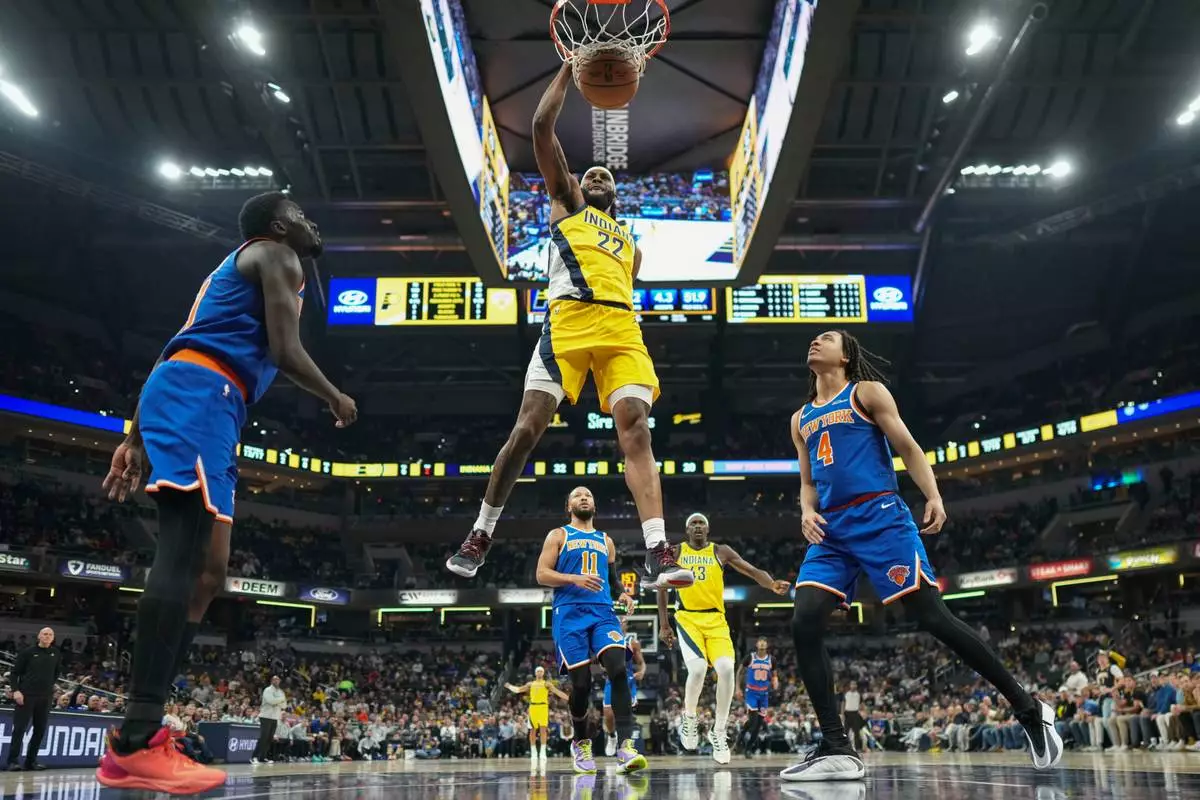
Indiana Pacers forward Isaiah Jackson (22) dunks in front of New York Knicks forward Pacome Dadiet (4) during the first half of an NBA basketball game in Indianapolis, Thursday, Dec. 18, 2025. (AP Photo/AJ Mast)
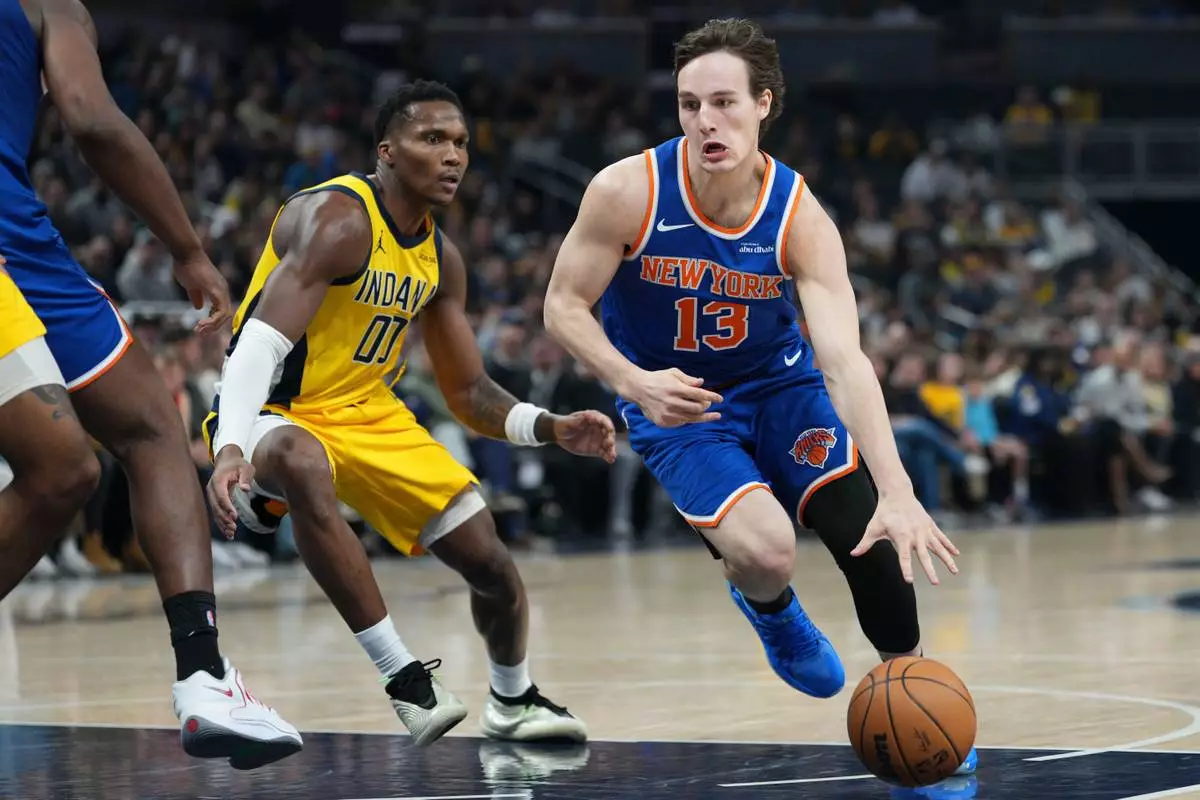
New York Knicks guard Tyler Kolek (13) goes around Indiana Pacers guard Bennedict Mathurin (00) during the first half of an NBA basketball game in Indianapolis, Thursday, Dec. 18, 2025. (AP Photo/AJ Mast)
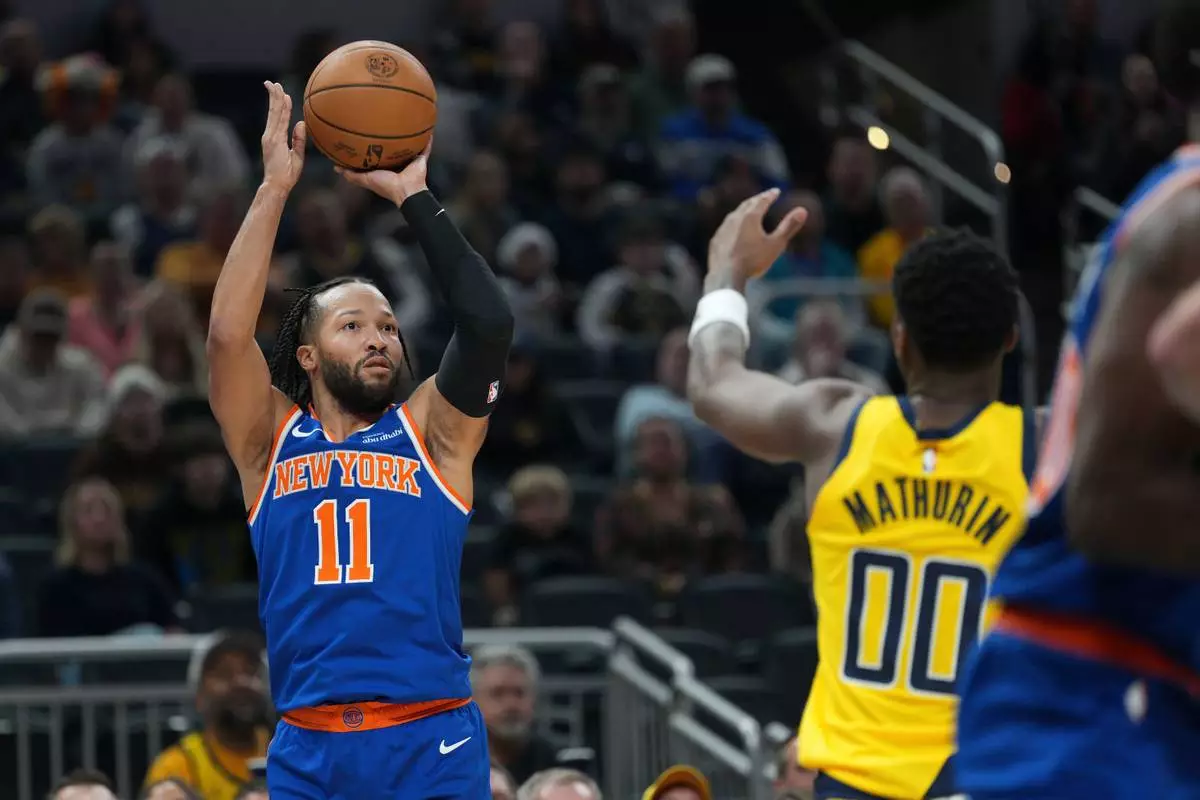
New York Knicks guard Jalen Brunson (11) shoots in front of Indiana Pacers guard Bennedict Mathurin (00) during the first half of an NBA basketball game in Indianapolis, Thursday, Dec. 18, 2025. (AP Photo/AJ Mast)
WASHINGTON (AP) — President Donald Trump’s “blockade” of sanctioned oil tankers off Venezuela’s coast is raising new questions about the legality of his military campaign in Latin America, while fueling concerns that the U.S. could be edging closer to war.
The Trump administration says its blockade is narrowly tailored and not targeting civilians, which would be an illegal act of war. But some experts say seizing sanctioned oil tied to leader Nicolás Maduro could provoke a military response from Venezuela, engaging American forces in a new level of conflict that goes beyond their attacks on alleged drug boats.
“My biggest fear is this is exactly how wars start and how conflicts escalate out of control,” said Rep. Jason Crow, a Colorado Democrat who fought in Iraq and Afghanistan. “And there are no adults in the room with this administration, nor is there consultation with Congress. So I’m very worried.”
Claire Finkelstein, a professor of national security law at the University of Pennsylvania, said the use of such an aggressive tactic without congressional authority stretches the bounds of international law and increasingly looks like a veiled attempt to trigger a Venezuelan response.
“The concern is that we are bootstrapping our way into armed conflict,” Finkelstein said. “We’re upping the ante in order to try to get them to engage in an act of aggression that would then justify an act of self-defense on our part.”
Trump has used the word “blockade” to describe his latest tactic in an escalating pressure campaign against Maduro, who has been charged with narcoterrorism in the U.S. and now has been accused of using oil profits to fund drug trafficking. While Trump said it only applies to vessels facing U.S. economic penalties, the move has sparked outrage among Democrats and mostly shrugs, if not cheers, from Republicans.
Rep. Michael McCaul, R-Texas, said Trump going after sanctioned oil tankers linked to Venezuela is no different from targeting Iranian oil.
“Just like with the Iranian shadow tankers, I have no problem with that,” McCaul said. “They’re circumventing sanctions.”
The president has declared the U.S. is in “armed conflict” with drug cartels in an effort to reduce the flow of drugs to American communities. U.S. forces have attacked 28 alleged drug-smuggling boats and killed at least 104 people since early September. Trump has repeatedly promised that land strikes are next, while linking Maduro to the cartels.
The campaign has drawn scrutiny in Congress, particularly after it was revealed that U.S. forces killed two survivors of a boat attack with a follow-up strike. But Republicans so far have repeatedly declined to require congressional authorization for further military action in the region, blocking Democrats' war powers resolutions.
Sen. Roger Wicker, Republican chairman of the Senate Armed Service Committee, has essentially ended his panel’s investigation into the Sept. 2 strike, saying Thursday that the entire campaign is being conducted “on sound legal advice.”
Trump announced the blockade Tuesday, about a week after U.S. forces seized a sanctioned oil tanker off Venezuela’s coast. The South American country has the world’s largest proven oil reserves and relies heavily on the revenue to support its economy.
The U.S. has been imposing sanctions on Venezuela since 2005 over concerns about corruption as well as criminal and anti-democratic activities. The first Trump administration expanded the penalties to oil, prompting Maduro’s government to rely on a shadow fleet of falsely flagged tankers to smuggle crude into global supply chains.
The state-owned oil company Petróleos de Venezuela S.A., or PDVSA, has been largely locked out of global oil markets by U.S. sanctions. It sells most of its exports at a steep discount on the black market in China.
Nicolás Maduro Guerra, Maduro's son and a lawmaker, on Thursday decried Trump’s latest tactic and vowed to work with the private sector to limit any impact on the country’s oil-dependent economy. He acknowledged that it won’t be an easy task.
“We value peace and dialogue, but the reality right now is that we are being threatened by the most powerful army in the world, and that’s not something to be taken lightly,” Maduro Guerra said.
It wasn’t immediately clear how the U.S. planned to enact Trump's order. But the Navy has 11 ships in the region and a wide complement of aircraft that can monitor marine traffic coming in and out of Venezuela.
Trump may be using the term “blockade,” but the Pentagon says officials prefer “quarantine."
A defense official, who spoke on condition of anonymity to outline internal reasoning about the policy, said a blockade, under international law, constitutes an act of war requiring formal declaration and enforcement against all incoming and outgoing traffic. A quarantine, however, is a selective, preventive security measure that targets specific, illegal activity.
Rep. Adam Smith, the ranking Democrat on the House Armed Services Committee, said he was unsure of the legality of Trump's blockade.
“They’re blockading apparently the oil industry, not the entire country,” said Smith, who represents parts of western Washington state. “How does that change things? I got to talk to some lawyers, but in general, a blockade is an act of war.”
The U.S. has a long history of leveraging naval sieges to pressure lesser powers, especially in the 19th century era of “gunboat diplomacy,” sometimes provoking them into taking action that triggers an even greater American response.
But in recent decades, as the architecture of international law has developed, successive U.S. administrations have been careful not to use such maritime shows of force because they are seen as punishing civilians — an illegal act of aggression outside of wartime.
During the 1962 Cuban missile crisis, President John F. Kennedy famously called his naval cordon to counter a real threat — weapons shipments from the Soviet Union — a “quarantine” not a blockade.
Mark Nevitt, an Emory University law professor and former Navy judge advocate general, said there is a legal basis for the U.S. to board and seize an already-sanctioned ship that is deemed to be stateless or is claiming two states.
But a blockade, he said, is a “wartime naval operation and maneuver” designed to block the access of vessels and aircraft of an enemy state.
“I think the blockade is predicated on a false legal pretense that we are at war with narcoterrorists,” he said.
Nevitt added: “This seems to be almost like a junior varsity blockade, where they’re trying to assert a wartime legal tool, a blockade, but only doing it selectively.”
Geoffrey Corn, a Texas Tech law professor who previously served as the Army’s senior adviser for law-of-war issues and has been critical of the Trump administration’s boat strikes, said he was not convinced the blockade was intended to ratchet up the conflict with Venezuela.
Instead, he suggested it could be aimed at escalating the pressure on Maduro to give up power or encouraging his supporters to back away from him.
“You can look at it through the lens of, is this an administration trying to create a pretext for a broader conflict?” Corn said. “Or you can look at it as part of an overall campaign of pressuring the Maduro regime to step aside.”
Goodman reported from Miami. Associated Press reporters Stephen Groves and Konstantin Toropin in Washington and Regina Garcia Cano in Caracas, Venezuela, contributed to this report.
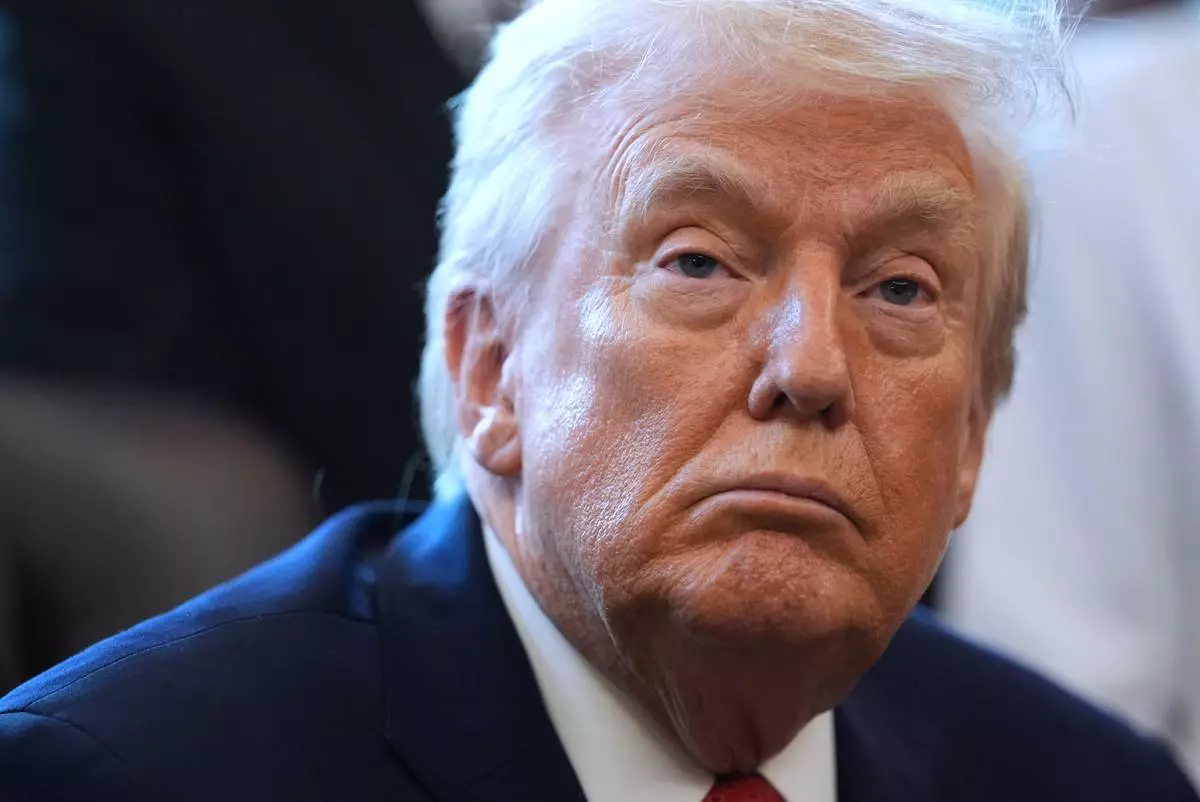
President Donald Trump listens before he signs an executive order reclassifying marijuana as a less dangerous drug in the Oval Office of the White House, Thursday, Dec. 18, 2025, in Washington. (AP Photo/Evan Vucci)